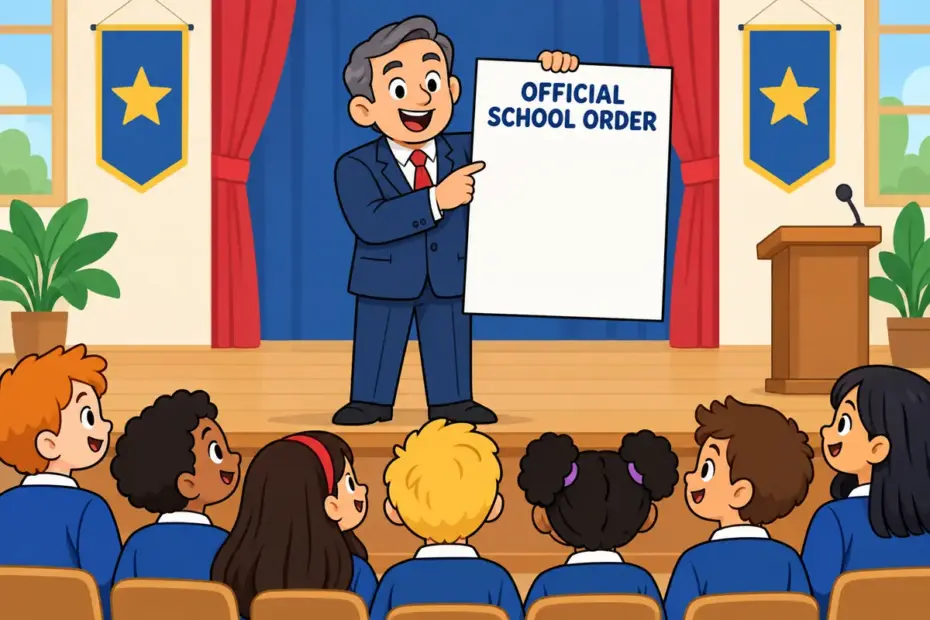
Edict is a noun meaning an official order issued by a person or body with authority. To use edict in a sentence, name the authority and the command it imposes: “The king issued an edict banning the sale of horses.” The word carries a formal, almost royal tone that the plain word order does not.
Edict at a glance
- Edict is a countable noun; its plural is edicts.
- The dominant pattern is issue + an edict, with the authority as the subject.
- It belongs to formal, historical and political writing rather than conversation.
- Common collocations are issue, sign, royal, government and defy.
- The commonest error is treating edict as a verb, as in he edicted a rule.
What does edict mean?
Edict is a noun for an official command issued by a ruling authority, and it covers a ruler’s order, a court’s pronouncement and a government’s public directive. The Cambridge entry for edict records the sense of an official order, and the examples below show how little the meaning shifts from one setting to another.
| Sense | Plain meaning | Example sentence |
|---|---|---|
| Ruler’s order | A command issued by a monarch or governor | The emperor issued an edict that closed the port. |
| Authoritative pronouncement | A firm statement treated as a ruling | The referee enforced his ruling as if it were an edict. |
| Historic ordinance | A published order with the force of law | The Edict of Milan granted religious tolerance. |
One limitation is worth stating plainly. Edict implies public authority, so it is the wrong choice for a private request. A parent does not issue an edict about bedtime, and a friend does not issue an edict about arriving late; instruction, rule or command fits those cases better.
How do you use edict in a sentence?
Put the authority first and the command second: a ruler or body issues an edict, and the edict does something to other people. Five patterns cover almost every real sentence, and the by edict pattern is the one that stresses rule without consent.
| Pattern | Example | What it signals |
|---|---|---|
| issue + an edict | The governor issued an edict on water use. | Names the authority who commands. |
| an edict + banning / ordering | An edict banning night fishing followed. | A participle shows what the order does. |
| by edict | The city was rebuilt by edict. | Rule by command rather than consent. |
| royal / government edict | A government edict froze fuel prices. | Labels the source of the authority. |
| defy / obey an edict | Few merchants dared to defy the edict. | Shows how people answer a command. |
Writers who want a judicial ring often choose a decree from the bench, because an edict sounds political while a decree sounds legal. The rule of thumb is simple: if the command comes from a person who rules, edict fits; if it comes from a process with rules of its own, reach for a different word.
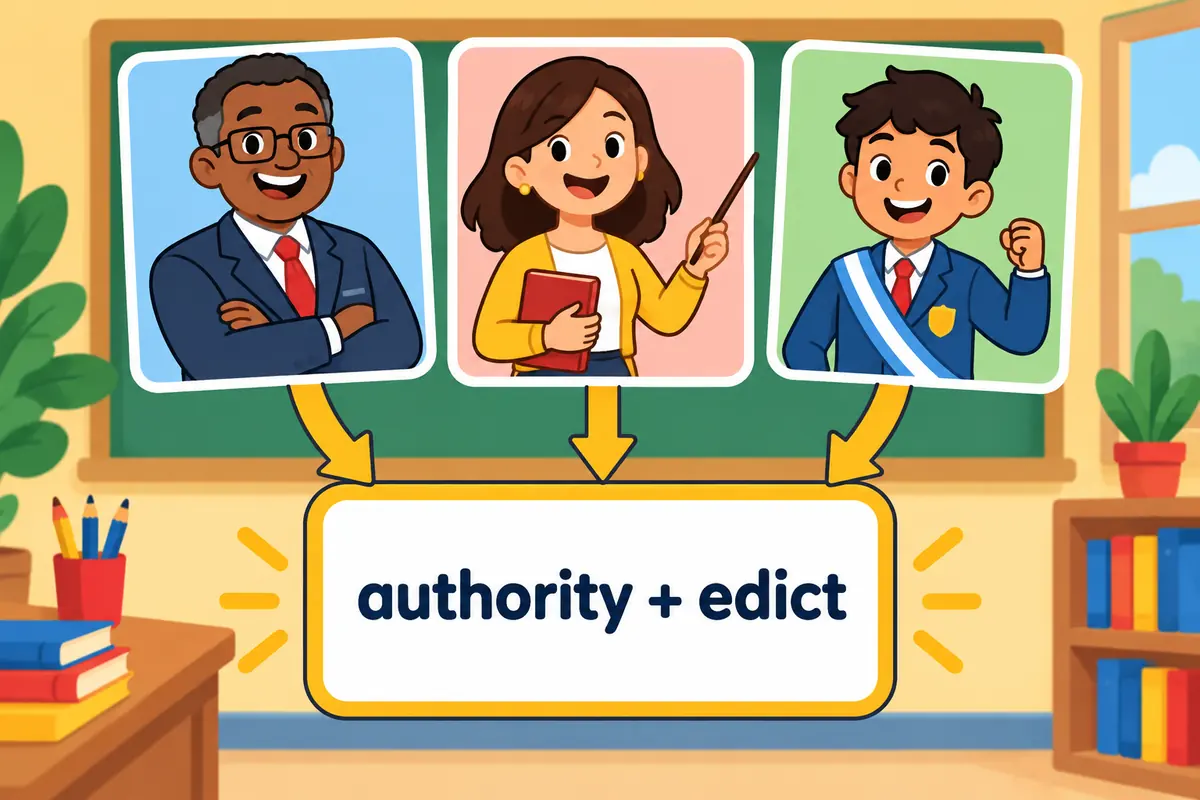
Edict in a sentence: examples across contexts
Edict keeps the same meaning but shifts in tone from one setting to the next. The eight sentences below move from a classroom to a history essay, and each one names the authority that made the order stick.
| Context | Example sentence | Why this works |
|---|---|---|
| Classroom | The head teacher’s edict on phones applied from Monday. | A school authority issues a rule, which the noun fits. |
| Workplace email | The board’s edict leaves branch managers little room to negotiate. | Names a collective authority and its firm command. |
| News report | A presidential edict raised import duties overnight. | Compresses a political decision into one noun. |
| Legal history | The edict of 1685 revoked the earlier protection. | Uses a date to mark a formal, published order. |
| Conversation | He treated the timetable like an edict from the head office. | The simile widens a small rule into something grander. |
| Academic essay | Successive edicts gradually stripped the guilds of their rights. | The plural suggests a long series of official orders. |
| Local government | A council edict restricted market stalls to the square. | Shows a modern authority borrowing the old word. |
| Sports report | The captain obeyed the referee’s edict without a word. | Transfers the word to an unquestioned ruling. |
Notice how often the edict arrives from above. That vertical direction, from authority to subject, is the clearest signal of where this noun lives.
Edict vs decree, mandate and proclamation
Edict overlaps with three official words and is interchangeable with none of them. A proclamation announces, a mandate authorises, and a decree decides; an edict commands.
| Attribute | edict | decree | mandate |
|---|---|---|---|
| Core job | Issue an official command | Deliver a binding ruling | Grant authority to act |
| Typical source | A ruler, governor or court | A court, monarch or government | Voters, a constitution or a superior |
| Usual verb | issue, ban, order | issue, sign, annul | receive, hold, give |
| Register | Formal and often historical | Formal and legal | Formal and political |
| Tone | Commanding, sometimes autocratic | Judicial and binding | Authorising, less personal |
Verdict: choose decree when a court or government hands down a binding decision, mandate when somebody is authorised to act, and edict when a single authority imposes a command.
Word forms and grammar of edict
Edict is almost always a noun, and that fact explains its commonest error. The table lists the forms that exist and the verb that learners wrongly reach for.
| Form | Part of speech | Example |
|---|---|---|
| edict | noun, singular | The edict took effect at dawn. |
| edicts | noun, plural | Three edicts followed in one year. |
| edictal | adjective, rare | Edictal language filled the old charter. |
| dictate | verb, different word | A leader may dictate terms but issues an edict. |
Keep dictate separate: it is the verb for giving orders or speaking words aloud, while edict is the noun for the order itself. There is no standard verb edict, so a sentence like he edicted a rule has no place in careful writing.
Common mistakes with edict
- Incorrect:
The mayor edicted a curfew.Correct: The mayor issued an edict imposing a curfew. Rule: Edict is a noun, so pair it with issue, sign or impose rather than inflecting it as a verb. - Incorrect:
She gave her brother an edict to tidy his room.Correct: She gave her brother a firm instruction to tidy his room. Rule: An edict comes from public authority, not from one family member to another. - Incorrect:
The mural edicts a famous battle.Correct: The mural depicts a famous battle. Rule: Depict is the verb meaning to portray; edict is the noun meaning an order. - Incorrect:
The edict were read aloud in every square.Correct: The edict was read aloud in every square. Rule: Edict is singular; use the plural edicts with a plural verb.
Practice using edict
Work through the six items, then read the reasoning rather than only the answer.
- Fill the gap: The queen ______ an edict forbidding duels.
- Choose the better word: After the trial the court handed down a (decree / edict) that bound both parties.
- Correct the error: The principal edicted that hats were banned.
- Build a sentence: use issue an edict about a fictional city closing its gates.
- Spot the register: which belongs in a history essay — the emperor issued an edict, or the emperor made a rule about it?
- Rewrite with the plural: A single edict changed the tax. Use edicts and adjust the verb.
Answers
- issued — edict is a noun, so it needs a verb such as issue.
- decree — a court hands down a binding decree, while an edict sounds like a ruler’s command.
- The principal issued an edict that banned hats — edict cannot be a verb.
- Model answer: The council issued an edict closing the city gates at sunset.
- The emperor issued an edict — a history essay keeps the formal noun and avoids the flat made a rule.
- Edicts changed the tax one after another — the plural takes a plural verb.
The bottom line
Use edict in a sentence when a recognised authority imposes an official command, and name that authority as the subject. The two details that decide most sentences are these: edict is a noun, never a verb, and it points to public power rather than a private wish. Where the command comes from a court process, a command from an officer or a formal ruling will often be the more precise word.
Frequently asked questions about edict
Is edict still used today?
Edict survives in formal and historical writing, in news reports about authoritarian decisions, and in occasional legal commentary. Modern governments usually issue rules, regulations or executive orders instead. The word reappears when a writer wants to stress that a single authority imposed a command without consulting anyone.
What is the plural of edict?
The plural is edicts, formed by adding s. An edict carries a slightly grander tone than an ordinary order, so a history essay might describe many edicts issued by one emperor, while a modern report would more likely say rulings or directives.
Does an edict have the force of law?
Historically, an edict could carry the full force of law when issued by a ruler or a body with that power. Today the word is mostly descriptive: a modern government edict may be a decree, a regulation or simply a firm public instruction, and its weight depends on who issued it.
How is edict different from dictate?
Edict is a noun naming an official command, while dictate is a verb meaning to give orders or to control. A ruler dictates terms and issues edicts. Dictate can also mean to speak words for someone to write down, a sense that edict never carries.
Have you ever come across the term “edict” and wondered what it means? An edict is a formal proclamation or decree issued by a person of authority, typically a ruler or government, that carries the force of law.
Edicts have been used throughout history to announce important decisions, enforce regulations, or convey instructions to the general populace. These announcements are binding and are often used to establish laws or guidelines that must be followed by the individuals or groups to whom they are directed.
7 Examples Of Edict Used In a Sentence For Kids
- The edict told us to always be kind to our friends.
- The king’s edict said that everyone should be respectful to their elders.
- We must follow the edict and always listen to our teachers.
- The wise man’s edict reminded us to always share our toys with others.
- The royal edict instructed us to keep our classroom clean and tidy.
- The emperor’s edict said that we should always be truthful and honest.
- Let’s all remember the edict and treat each other with kindness and respect.
14 Sentences with Edict Examples
- Edict from the administration stated that all students must wear their ID cards on campus at all times.
- The professor issued an edict declaring that late submissions of assignments would not be accepted.
- The university issued an edict on maintaining cleanliness in the common areas of the campus.
- The academic edict mandated that students must attend a minimum of 75% of classes to be eligible for exams.
- The library edict strictly prohibited eating or drinking inside the premises.
- The student council passed an edict announcing a ban on ragging and bullying on campus.
- The department head issued a new edict regarding the format for submitting research papers.
- The disciplinary committee’s edict outlined the consequences of plagiarism in academic work.
- The sports department released an edict on the dress code for participating in inter-college competitions.
- The career guidance cell issued an edict requesting students to register for upcoming placement drives.
- The edict from the examination controller specified the schedule for mid-term examinations.
- The university senate’s edict announced a revision in the syllabus for the upcoming academic year.
- The hostel warden’s edict restricted the use of electrical appliances in the rooms for safety reasons.
- The student council’s edict encouraged participation in extracurricular activities for personal growth and development.
How To Use Edict in Sentences?
To use the word Edict in a sentence, follow these simple steps:
-
Understand the meaning of Edict: An Edict is an official order or proclamation issued by a person of authority.
-
Choose your context: Think of a situation where a formal command or decree is being made or announced.
-
Integrate Edict into your sentence: Start your sentence with the word Edict followed by the specific order or decree. For example, “The king issued an Edict declaring a new holiday for the kingdom.”
-
Provide additional information: To make your sentence clearer, you can include details about who is issuing the Edict, what the command is about, and any relevant background information.
-
Check for accuracy: Make sure your sentence effectively conveys the meaning of an Edict as an official proclamation or order.
Example of a sentence using Edict: “The mayor’s Edict banning single-use plastics in the city has led to a significant reduction in environmental pollution.”
By following these steps, you can effectively incorporate Edict into your writing and communication to convey authoritative commands or proclamations.
Conclusion
In conclusion, an edict is a formal proclamation or command issued by an authority like a government, ruler, or leader. It carries the force of law and must be obeyed by those under its jurisdiction. Edicts can cover a wide range of topics, from new regulations and policies to decrees on religious matters or social behavior. For example, “The king’s edict required all citizens to pay their taxes by the end of the month” or “The edict from the council mandated that all businesses must adhere to new safety standards.”
Understanding an edict’s significance and implications is crucial for ensuring compliance and avoiding penalties or consequences. By recognizing the authority behind an edict and following its directives, individuals and communities can uphold order and stability within society. It is important to acknowledge edicts as binding legal commands that shape the rules and expectations of a given jurisdiction.


