
Elusive describes something difficult to find, catch, achieve or recall, whether it is a shy animal or a clear answer. To use elusive in a sentence, place it before a noun or after a linking verb: “The evidence remained elusive.” It is an adjective, so it never takes an object of its own.
Elusive at a glance
- Elusive is an adjective; its related forms are elude (verb), elusively (adverb) and elusiveness (noun).
- The dominant pattern is elusive before a noun, as in an elusive goal, or after a linking verb, as in it remained elusive.
- It describes things that are hard to find, catch, achieve, describe or remember.
- Elusive is neutral in tone and common in reports, reviews and academic prose.
- The commonest error is confusing elusive with evasive, which means deliberately avoiding a direct answer.
What does elusive mean?
Elusive is an adjective meaning difficult to find, catch, achieve or describe, because the thing keeps slipping away or is never quite present. The Cambridge entry for elusive records both the physical sense and the sense of a goal that is hard to reach. The word carries no blame: an elusive animal is simply hard to catch, while an evasive answer is one a speaker is dodging on purpose.
| Sense | Plain meaning | Example sentence |
|---|---|---|
| Hard to find or catch | Difficult to locate, hold or observe | The otters proved elusive in the reed beds. |
| Hard to achieve | Difficult to reach or obtain | A lasting peace remained elusive. |
| Hard to describe or recall | Difficult to pin down in words or memory | The name was elusive, just out of reach. |
Elusive is also the wrong word when nothing is actually being chased. A rare bird is elusive because finding it is hard; a discontinued model is merely hard to find. If the difficulty comes only from supply, then rare, scarce or out of print says it more precisely.
How do you use elusive in a sentence?
Put elusive where an adjective belongs: directly before the noun it describes, or after a linking verb such as be, seem, remain or prove. The five patterns below cover almost every real sentence.
| Pattern | Example | What it signals |
|---|---|---|
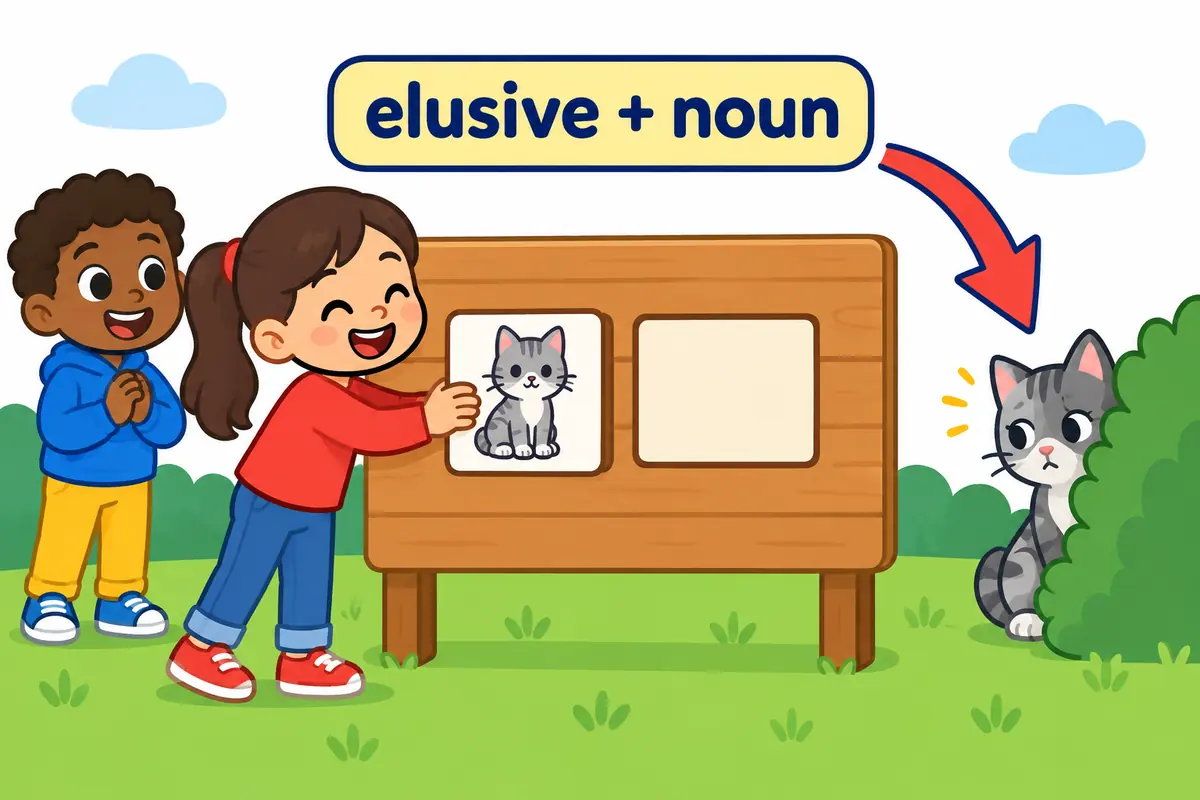
| elusive + noun | The elusive snow leopard was filmed at last. | The quality is attached directly to the noun. |
| linking verb + elusive | The answer stayed elusive all morning. | A state is described rather than an action. |
| prove or remain + elusive | A cure proved elusive for decades. | Difficulty is framed as continuing. |
| too elusive to + verb | The melody was too elusive to hum. | States the exact limit of the difficulty. |
| an elusive + noun | She chased an elusive dream of fame. | Suggests one of many hard-to-reach things. |
Its verb elude carries the same idea but takes an object, so a suspect eludes the police rather than being elusive to them.
Elusive in a sentence: examples across contexts
Elusive keeps the same meaning while its neighbours change. The nine sentences below move from a classroom to a detective story, and each one names what is hard to reach.
| Context | Example sentence | Why this works |
|---|---|---|
| Classroom | The answer to the riddle stayed elusive until the last clue. | Uses a linking verb to show a state, not an action. |
| Workplace email | A permanent fix for the printing fault has proved elusive. | Reports a continuing problem in a formal register. |
| News report | The suspect remained elusive despite a week of searches. | Pairs a person with the effort to find them. |
| Nature writing | The elusive otter left only a trail in the mud. | Attaches the adjective to a shy, hard-to-see animal. |
| Sports report | A first away win proved elusive again. | Frames a missing result as long sought. |
| Academic prose | A single cause of the decline has been elusive. | States that the evidence is hard to pin down. |
| Music review | The melody is deliberately elusive, never quite resolving. | Describes an artistic effect a listener feels. |
| Conversation | Sleep was elusive last night. | Short, idiomatic and natural in speech. |
| Detective story | The clue was elusive, gone before anyone could read it. | Builds suspense around something hard to catch. |
Do not confuse elusive with fleeting, which means lasting only briefly: a fleeting glimpse may be easy to get but gone quickly, while an elusive one is hard to get at all.
Elusive vs evasive
Elusive and evasive look similar and answer different questions. evasive describes a person who avoids giving a straight answer.
| Attribute | elusive | evasive |
|---|---|---|
| Core meaning | Hard to find, catch or achieve | Avoiding a direct answer or commitment |
| What is hard to pin down | A thing, goal or quality | A person, reply or manner |
| Cause of the difficulty | The nature of the thing itself | A deliberate choice to dodge |
| Typical subjects | Animals, goals, evidence, memories | Speakers, witnesses, politicians |
| Extra implication | No fault, just difficulty | A hint of suspicion or guilt |
Verdict: choose evasive when a person is dodging a question, and elusive when the thing itself keeps slipping away.
Word forms and grammar of elusive
Elusive belongs to a small family built on the verb elude, and learners often reach for the noun when the adjective is what the sentence needs.
| Form | Part of speech | Example |
|---|---|---|
| elude | verb, base form | The thief eluded the guard. |
| eludes | verb, third person | The point eludes most readers. |
| eluded | verb, past and participle | The win eluded them again. |
| eluding | verb, present participle | The cat kept eluding capture. |
| elusive | adjective | The win proved elusive. |
| elusively | adverb | The tune drifts elusively through the film. |
| elusiveness | noun | The elusiveness of the answer frustrated everyone. |
The noun elusiveness names the quality itself and is common in reviews and analysis, where a writer wants to discuss the difficulty as a subject.
Common mistakes with elusive
- Incorrect:
The witness was elusive and refused to answer.Correct: The witness was evasive and refused to answer. Rule: Evasive means dodging on purpose; elusive means hard to find or pin down. - Incorrect:
The team elusive the trophy for years.Correct: The trophy eluded the team for years. Rule: Elusive is an adjective; the verb is elude, and it takes an object. - Incorrect:
She was elusively a good candidate.Correct: She was an elusive candidate to assess. Rule: The adverb elusively describes a manner, not a degree of goodness. - Incorrect:
The secret remained very elusive to find.Correct: The secret remained elusive, or proved hard to find. Rule: Elusive already means hard to find, so to find repeats it. - Incorrect:
Elusive means impossible.Correct: Elusive means difficult to find or achieve, not impossible. Rule: The word leaves room for success, which is why it is less final than impossible.
Practice using elusive
Work through the six items, then check the reason beside each answer.
- Fill the gap: After three attempts, the cat remained ______ and slipped out of reach.
- Choose the better word: Asked about the budget, the minister was (elusive / evasive).
- Correct the error: The perfect answer elusion us all week.
- Build a sentence: use prove elusive about a missing puzzle piece.
- Spot the register: which suits a news report — the suspect remained elusive, or the suspect kept giving us the slip?
- Rewrite with the verb: The meaning was elusive to us. Use elude instead.
Answers
- elusive — the cat is hard to catch, so the adjective describes it.
- evasive — the minister is dodging the question, not hard to find.
- Elusion is not a standard word; write The perfect answer eluded us all week, using the verb with its object.
- Model answer: The last puzzle piece proved elusive until it fell behind the sofa.
- The suspect remained elusive — a news report keeps the formal adjective and drops the idiom.
- The meaning eluded us — the verb elude takes the thing that is hard to grasp as its object.
The bottom line
Use elusive in a sentence when something is genuinely hard to find, catch, achieve or recall, and keep it in adjective position. The two points that decide most sentences are that elusive describes a thing rather than a person who is dodging, and that it stops short of impossible. Choose ambiguous when a message has two possible readings rather than when a thing is hard to reach.
Frequently asked questions about elusive
Is elusive a negative word?
No, elusive is neutral. It reports difficulty rather than failure or blame, so an elusive answer or an elusive goal is simply hard to reach. Only evasive carries a hint of criticism, because it suggests a person is dodging on purpose.
Can elusive describe a person?
It can, but it describes how hard the person is to find or reach, not their character. A reclusive author who rarely gives interviews may be called elusive. For a person who avoids answering questions, evasive is the precise word.
What is the noun form of elusive?
The noun is elusiveness, and the related verb is elude. A writer can discuss the elusiveness of the answer, or say that the answer eludes us, but the phrase the answer is elusion is not standard English and should be avoided.
Does elusive mean impossible?
No. Elusive means difficult to find, catch or achieve and still leaves room for success. A cure can be elusive for years and then finally be found, while impossible rules out success from the very start with no room to move.
Have you ever struggled to find the right words to express your thoughts or feelings? This common issue can be described as “elusive,” meaning something that is difficult to grasp or achieve.
When a concept, idea, or even a word feels elusive, it evades easy understanding or articulation. People often experience this when trying to capture a complex emotion or describe a fleeting moment. The elusive nature of certain things can add depth and intrigue to our language and communication.
7 Examples Of Elusive Used In a Sentence For Kids
- The butterfly was very elusive, flying away whenever we tried to catch it.
- The squirrel was elusive, quickly running up the tree and out of sight.
- The rainbow was elusive, disappearing once the rain stopped.
- The firefly was elusive, flashing its light and then disappearing in the dark.
- The fish was elusive, swimming quickly away whenever we tried to catch it.
- The cat was elusive, slipping out of our grasp when we tried to pet it.
- The shooting star was elusive, vanishing before we could make a wish.
14 Sentences with Elusive Examples
- Elusive dreams of getting into a top engineering college can be achieved with determination and hard work.
- Students often find the right internship opportunities to be elusive due to high competition in the job market.
- Balancing academics and extracurricular activities can be an elusive task for college students.
- Some students find it elusive to secure scholarships for higher education despite their excellent academic record.
- Effective time management skills are essential for overcoming the elusive challenge of meeting assignment deadlines.
- For many students, maintaining a healthy social life while focusing on academics can be an elusive task.
- Finding affordable housing near college campuses can be an elusive quest for many students.
- Understanding complex mathematical concepts can be elusive for some students without proper guidance from professors.
- Achieving a perfect work-life balance can seem elusive to college students juggling part-time jobs and studies.
- Some students may find the answer to a particularly challenging exam question to be elusive despite studying extensively.
- Mastering a new language can be an elusive goal for students without consistent practice and immersion.
- Developing strong networking skills can help students overcome the elusive barrier of landing a desired job after graduation.
- Overcoming procrastination can be an elusive battle for many college students struggling to stay focused on their studies.
- Many students find that striking a balance between physical fitness and academic responsibilities can be elusive.
How To Use Elusive in Sentences?
To use the word Elusive in a sentence, consider the following example:
- The solution to the math problem remained elusive to the students even after hours of studying.
In this sentence, the word Elusive is used to describe something that is difficult to grasp, find, understand, or achieve. It implies that the solution to the math problem was challenging or hard to figure out.
When incorporating the word Elusive into a sentence, it’s essential to ensure that it is used correctly within the context of the sentence. It should describe something that is hard to capture or understand, adding depth and complexity to the statement.
To make your sentence more compelling, you could consider using synonyms or related words such as “evasive,” “hard to pin down,” or “difficult to obtain,” but always keep in mind the context in which you are using the word.
Remember, using Elusive in a sentence can enhance your writing by adding nuance and sophistication to your ideas. Practice incorporating it in different contexts to gain a better understanding of how to wield this word effectively.
Conclusion
In summary, sentences with the keyword “elusive” were effectively utilized to convey the idea of something difficult to capture, define, or achieve. The diverse examples highlighted how this term can be employed in various contexts to describe concepts, experiences, or goals that prove challenging to comprehend or attain.
Whether referencing elusive dreams, success, or solutions, the use of this word in sentences effectively captured the essence of an intangible or elusive quality that evades easy definition or grasp. Through these sentences, the reader was able to grasp the nuanced meanings and subtle nuances associated with the term “elusive,” while gaining a clear understanding of its applications in different scenarios.


