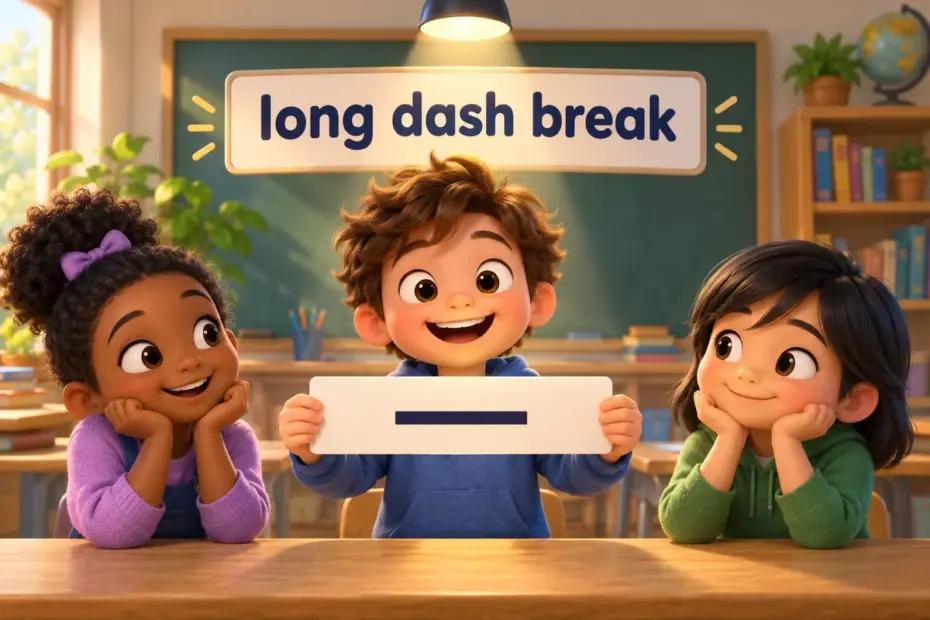
Em dash in English rules and examples centre on one long dash that marks a strong break in a sentence. An em dash can replace a colon, a pair of commas or brackets, and it takes no spaces in most styles. “She arrived late—again” shows the dash adding emphasis.
em dash in english rules and examples at a glance
- An em dash is the longest dash, and it marks a strong break in a sentence.
- It can replace a colon, a pair of commas or a pair of brackets.
- Most publishing styles set the em dash with no space on either side.
- A matching pair of dashes wraps an interrupting aside.
- The commonest error is using a hyphen where an em dash belongs.
What is an em dash?
An em dash is the longest of the three dashes, and it signals a sharp break, an aside or a burst of emphasis inside a sentence. Where a comma merely pauses, an em dash interrupts, which is why it suits dramatic or explanatory moments. A related set of comma rules shows the lighter punctuation it often replaces.
| Use | Example | Effect |
|---|---|---|
| Replace a colon | One thing mattered—the truth. | introduces a sharp explanation |
| Set off an aside | The plan—my own—failed. | adds a parenthetical comment |
| Show a break | I was going to say—never mind. | marks an interruption |
| Add emphasis | It was the best day—of my life. | a dramatic pause that lands |
The single dash introduces or explains, while a pair of dashes wraps material that could be lifted out, so the shape of the punctuation shows its job.
What are the main em dash rules?
The rules are few and firm, and they turn on spacing, pairing and restraint.
| Rule | Example | Note |
|---|---|---|
| No spaces around the dash | Rain—heavy rain—fell. | the usual publishing style |
| Use a pair for an aside | The route—long and steep—tired us. | the two dashes act like brackets |
| Replace a colon for emphasis | Only one choice remained—leave. | when the break should feel sudden |
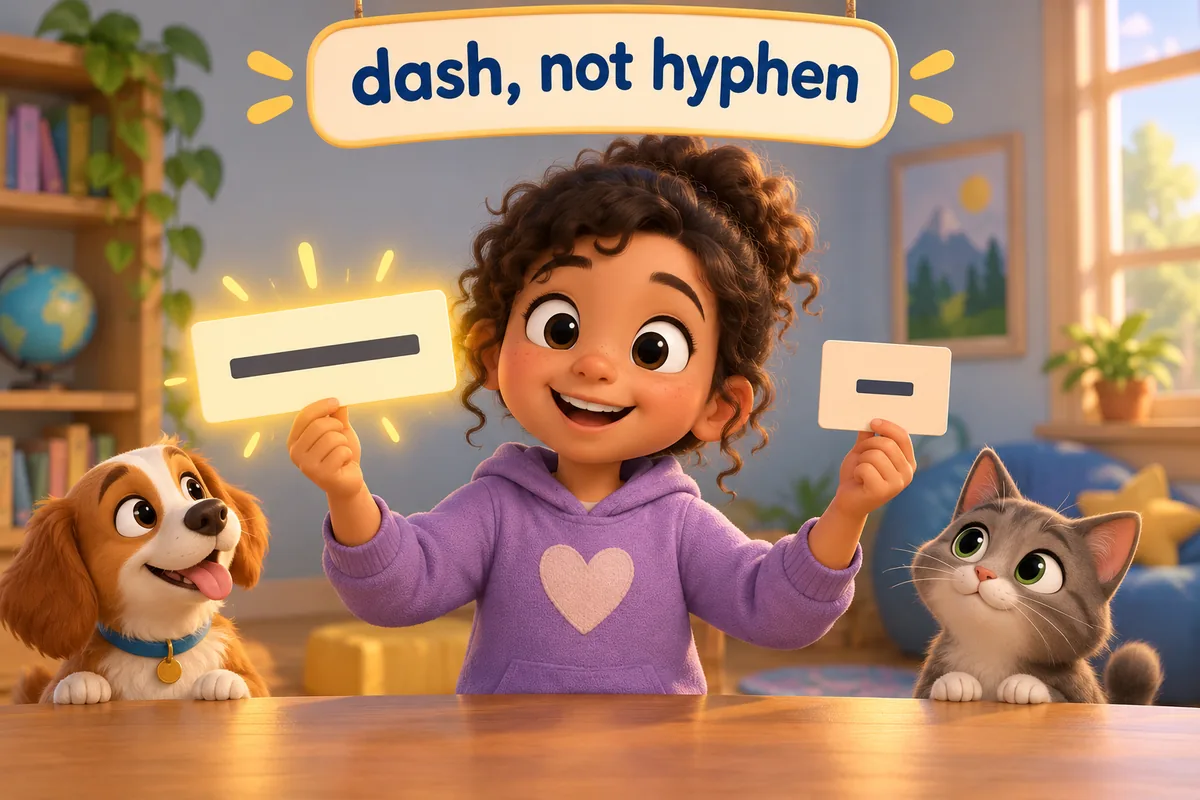
| Do not substitute a hyphen | late—again, not late-again | a hyphen is shorter and joins words |
| Limit the count | one dash per sentence | overuse drains the effect |
Keeping to one dash per sentence preserves the surprise; a page of dashes soon reads as breathless rather than emphatic.
em dash in english rules and examples across contexts
The em dash appears in every register, though formal writing uses it more sparingly than fiction or journalism. Short, punchy uses of the mark gather among dash sentence examples.
| Context | Example sentence | Why this works |
|---|---|---|
| Classroom | The answer—and I checked twice—is four. | a confident aside |
| News report | The vote—close but decisive—ended the debate. | a compact qualifier |
| Academic writing | The result—surprising at first—held up. | careful hedging |
| Workplace email | One item needs attention—the budget. | a pointed explanation |
| Narrative | She turned—and there he was. | a sudden reveal |
| Science writing | The sample—now dry—was weighed. | a stage in a process |
| Travel writing | The path—narrow and wet—climbed sharply. | vivid description |
| Review | The cake—rich, dense, perfect—vanished. | emphatic praise |
| Sports report | The shot—inches wide—missed the post. | a tense detail |
| Conversation | I will come—if I can. | a qualifier after a pause |
When should you use an em dash?
Reach for the em dash when a comma is too weak, a colon too formal and brackets too quiet.
| Situation | Use | Example |
|---|---|---|
| A sudden explanation | em dash | The reason was simple—fear. |
| An interrupting aside | paired em dashes | The car—old and loud—started. |
| A dramatic pause | em dash | I said yes—eventually. |
| A quiet clarification | brackets | The car (an old one) started. |
| A formal list | colon | Three items remained: rope, torch, map. |
| A light pause | comma | The car, an old one, started. |
If the aside is essential to the meaning, keep it without dashes; if it could be cut, a dash or a comma pair will both work.
Em dash and related punctuation forms
The three dashes differ by length and job, and a glance at how a shorter mark dashes off in a phrase shows why the long mark stands apart. The choice is the same one set out in the rules for a, an and the, where a small mark carries a clear signal.
| Form | Symbol | Example |
|---|---|---|
| Hyphen | – | a well-known author |
| En dash | – | pages 10–20 |
| Em dash | — | late—again |
| Paired em dashes | — … — | the route—long—tired us |
| Colon | : | one choice: leave |
| Brackets | ( ) | the car (old) started |
Length and function move together, so the shortest dash joins, the middle dash spans and the longest dash breaks.
Common mistakes with the em dash
Mistake 1: a hyphen for a break. Incorrect: She arrived late – again. Correct: She arrived late—again. Rule: a break takes an em dash, not a hyphen.
Mistake 2: spaces around the dash. Incorrect: She arrived late — again. Correct: She arrived late—again. Rule: most styles close the dash up.
Mistake 3: one dash for a pair. Incorrect: The route — long and steep, tired us. Correct: The route—long and steep—tired us. Rule: an interrupting aside needs a matching pair.
Mistake 4: too many dashes. Incorrect: He ran—fast—and—fell. Correct: He ran fast and fell. Rule: use a dash only for a genuine break.
Mistake 5: a dash before a plain list. Incorrect: Bring three things—rope, torch and map. Correct: Bring three things: rope, torch and map. Rule: a colon introduces a list.
Practice using the em dash in english rules and examples
- Fill in the blank: The answer was simple___forty-two.
- Choose the better mark: The plan (a pair of commas / a pair of em dashes) held.
- Correct the error: The trip was long – but fun.
- Build a sentence: add an interrupting aside about a noisy engine.
- Spot the register: which suits a news report, (a) The vote—close but decisive—ended the debate, or (b) The vote, um, kind of ended the debate?
- Fill in the blank: Three items remained___rope, torch and map.
Answers
- an em dash, because it introduces a sharp explanation after a break.
- a pair of em dashes, because the aside interrupts and needs a matching pair.
- The trip was long—but fun; the break takes an em dash, not a hyphen.
- The engine—old and loud—started on the third try.
- Example (a), because the paired em dashes keep the aside crisp.
- a colon, because it introduces the list.
The bottom line
Em dash in English rules and examples come down to one long mark that breaks a sentence more sharply than a comma. Use it to explain, to interrupt or to emphasise, wrap a true aside in a matching pair, and leave no spaces in most styles. Keep the count low, and the dash stays a signal rather than a habit.
Frequently asked questions about the em dash
What is the difference between an em dash and an en dash?
The em dash is the longest and marks a break or an aside, while the en dash is shorter and usually shows a range or a link, as in pages 10–20. The em dash interrupts a sentence; the en dash joins two things, so the two are not interchangeable.
Should I put spaces around an em dash?
Most publishing styles set the em dash with no spaces, as in late—again. Some newspapers and online styles add a space on each side for readability. Choose one convention and apply it throughout, because mixing the two looks inconsistent.
Can I type two hyphens instead of an em dash?
Two hyphens were once a common way to imitate the em dash in plain text. In finished writing, use the real em dash character so the mark renders correctly. Software often converts a double hyphen automatically, which shows the substitute is acceptable only as a typing shortcut.
How many em dashes are too many?
More than one dash in a sentence usually splits the reader’s attention, so keep to a single dash unless you need a matched pair for an aside. A whole paragraph of dashes reads as breathless. When in doubt, use a comma or a full stop instead.