What Does Equality Mean?
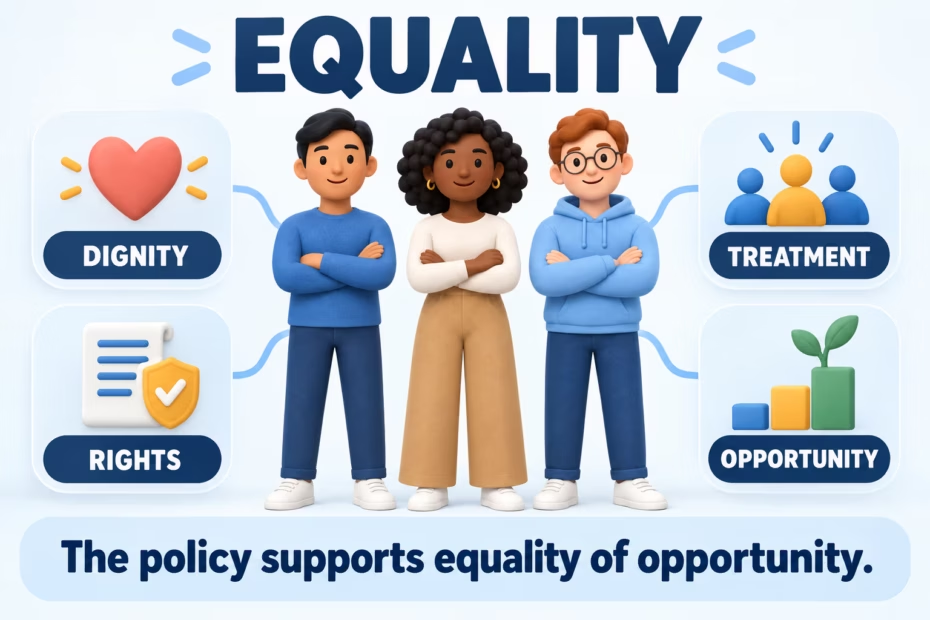
Equality is a noun that describes a state in which people or groups have equal rights, status, treatment, or opportunities. The Cambridge Dictionary uses it for the right of different groups to have a similar social position and receive the same treatment. The word can also describe sameness in a particular measure or relationship, as in “The chart shows equality between the two totals.” Name the area being compared so the reader knows what kind of equality you mean.
In a sentence about human rights, equality is an abstract idea rather than a claim that people are identical. Article 1 of the Universal Declaration of Human Rights states that people are born free and equal in dignity and rights. A writer can therefore discuss equality in law, equality of opportunity, or equality between groups without implying that everyone has the same abilities, needs, or life experiences.
Common Sentence Patterns with Equality
Because equality is a noun, it often follows a verb such as support or promote, or appears in a phrase that names the area being discussed. These patterns make the relationship clear.
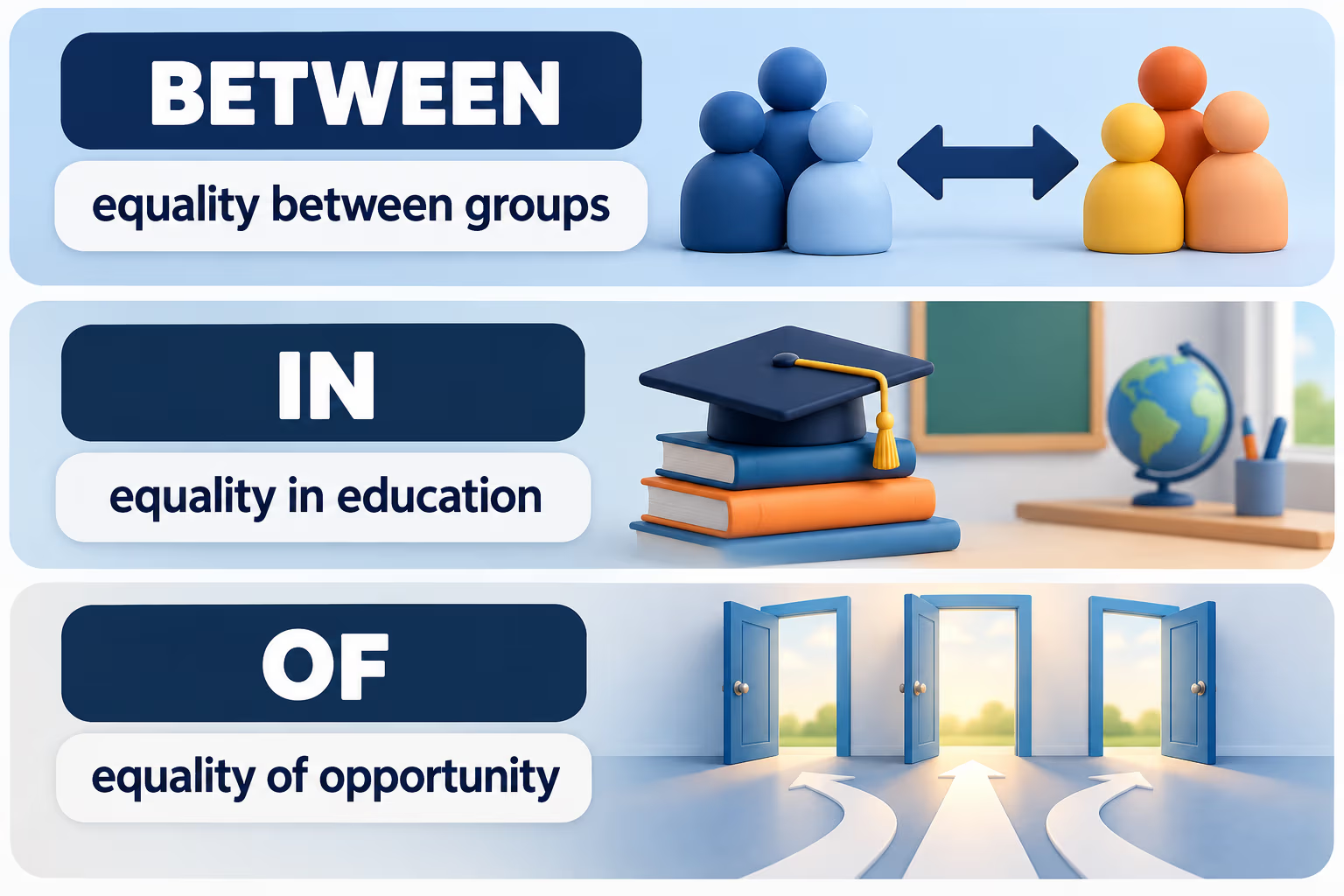
Equality between people or groups
Use equality between when naming the people, groups, or sides being compared.
- “The club’s new rules aim to support equality between its junior and senior members.”
- “The report compares equality between the two teams in access to practice space.”
Equality in an area
Use equality in to identify a setting or field, such as law, education, or employment.
- “The workshop introduced students to equality in the workplace.”
- “The essay examines equality in access to public services.”
Equality of something
Use equality of before the right, resource, or condition that should be shared on equal terms.
- “The school reviewed its policy on equality of opportunity.”
- “The team discussed equality of access to its online materials.”
Equality, Equal, and Equally
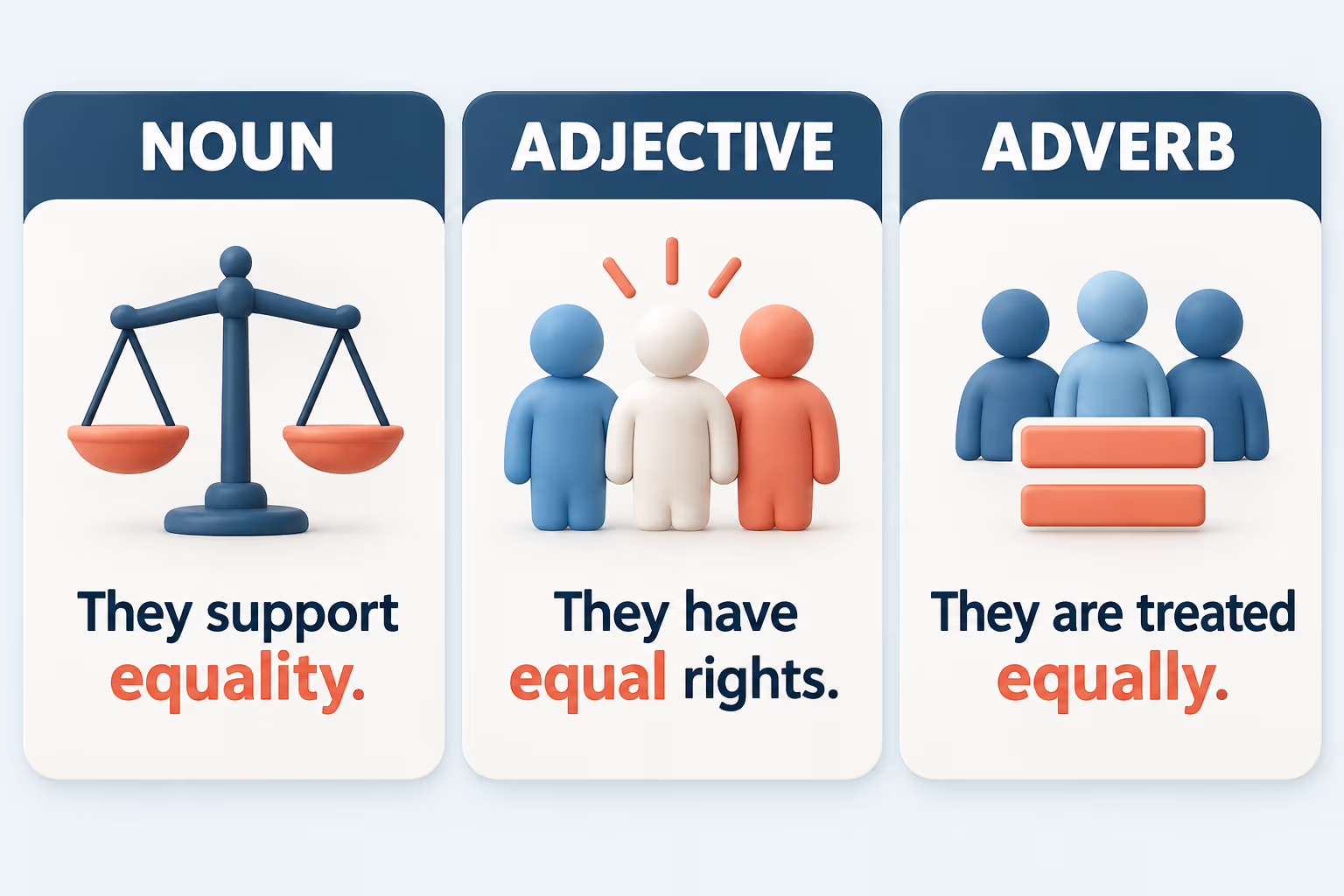
Equality is a noun, equal is usually an adjective, and equally is an adverb. They can appear in the same idea but fill different jobs in a sentence:
- Noun: “The team values equality in access to equipment.”
- Adjective: “Every team member has equal access to equipment.”
- Adverb: “The coach divided the practice time equally.”
Choose the form that fits the grammar around it. Write equal rights, not equality rights; write treat people equally, not treat people equality. If you want to name the principle itself, use the noun: “They discussed equality.”
Equality and equity are related but are not always interchangeable. Cambridge’s discussion of inclusive language describes equality in terms of equal rights and treatment, while equity is often discussed in terms of fair support in light of different circumstances. The exact distinction can depend on the field and the writer’s meaning. If that distinction matters, explain what is being made equal or what support is being allocated rather than relying on either word alone.
Original Sentences with Equality
These examples show equality in school, work, community, and comparison contexts. They identify the particular right, treatment, opportunity, or measure being discussed.
- The class discussed why equality matters when everyone takes a turn speaking.
- The library’s new sign explains its commitment to equality of access.
- Our group compared the equality of the two measurements on the chart.
- The club revised its membership form to support equality between applicants.
- Her presentation connected equality in education with access to learning materials.
- The council invited residents to share ideas about equality in public spaces.
- Equality before the law is a principle named in many human-rights discussions.
- The coach divided the court time equally, giving every player a chance to practice.
- The school asked whether its rules offered equality of opportunity to every student.
- Both versions of the worksheet use the same font size, showing equality in text size.
- The committee discussed equality between remote and in-person participants.
- Equality does not mean that two people must have identical interests or experiences.
Common Questions about Using Equality
Is equality a noun?
Yes. Equality is a noun. It names a condition or principle; equal usually describes a person, right, amount, or relationship, and equally describes how an action is done.
Should I say “equality between” or “equality of”?
Use between to name the people, groups, or things being compared: “equality between the teams.” Use of to name the right or condition: “equality of opportunity.” The phrase equality in names a setting or field, as in “equality in education.”
Is equality countable?
It is commonly used as an uncountable noun when it means equal treatment or rights: “They support equality.” Cambridge labels the noun both uncountable and countable; a countable use may refer to a particular kind or instance. In everyday learner writing, the uncountable form is the usual choice.
Does equality mean everyone receives exactly the same thing?
Not in every context. The sentence should say what is equal, such as rights, treatment, opportunity, or a measured amount. Equal treatment and fair support can involve different decisions in different situations, so explain the context instead of assuming that equality means identical outcomes.
Sources: Cambridge Dictionary: equality; United Nations: Universal Declaration of Human Rights, Article 1; Cambridge University Press & Assessment: the language of inclusion.

Do you know what the term “equality” entails? In its essence, equality refers to the state of being equal in rights, status, and opportunities among all individuals, regardless of their differences.
It is vital in promoting fairness and justice within a society, ensuring that everyone is treated with equal respect and given the same opportunities to succeed. This concept plays a crucial role in various aspects of life, from education and employment to social interactions and political representation.
7 Examples Of Equality Used In a Sentence For Kids
- Equality means treating everyone fairly.
- We should all have equality in our hearts.
- We can achieve equality by helping each other.
- Let’s work together to make sure there is equality for everyone.
- Equality is when everyone has the same opportunities.
- We should always remember to show equality to our friends.
- Let’s spread love and equality to everyone around us.
14 Sentences with Equality Examples
- Equality should be promoted in college admissions to ensure a fair chance for all students.
- It is important for professors to treat all students with equality in order to create a positive learning environment.
- Student organizations play a key role in advocating for equality on campus.
- The college should offer scholarships based on merit to maintain equality among students.
- Assigning group projects can be a good way to promote equality and collaboration among students.
- All students should have access to the same resources to ensure equality in education.
- Equality in opportunity is essential for the success of students from diverse backgrounds.
- College administrations should work towards achieving gender equality in campus policies and programs.
- Lecturers should promote equality in classroom discussions by giving all students a chance to participate.
- It is important for college authorities to address issues related to caste-based equality on campus.
- Student leaders have a responsibility to advocate for equality in all aspects of college life.
- In order to create an inclusive campus, students should actively support initiatives that promote equality.
- The college should provide training on unconscious bias to foster a culture of equality among students and staff.
- It is the responsibility of every student to actively contribute to creating a campus environment that values equality for all.
How To Use Equality in Sentences?
To use Equality in a sentence, first identify a situation where you want to convey the concept of fairness and equal treatment. For example, you can say, “In our classroom, everyone is treated with equality regardless of their background.”
Next, place Equality in a position where it serves as the subject or object of the sentence. This helps to clearly show that the sentence is focused on the idea of equality. For instance, “The principle of equality is fundamental to creating a just society.”
You can also use Equality to compare two things or groups that are equal in value or status. For example, “Both students showed an impressive level of skill, demonstrating equality in their abilities.”
Consider using Equality in conjunction with other words to provide more context or add depth to your sentence. This can help to clarify the meaning and make your point more effectively. For instance, “The company’s policy on pay raises reflects their commitment to gender equality.”
Remember to always check your sentence for clarity and accuracy after incorporating Equality. Make sure it fits naturally within the context you are discussing and accurately conveys the intended meaning. With practice, you will become more comfortable using Equality in various sentences to communicate the idea of fairness and equal treatment.
Conclusion
In conclusion, the importance of promoting equality through sentences is evident in fostering inclusivity, fairness, and respect for all individuals. By using sentences that reflect equality, we can create a more equitable society where everyone is valued and treated with dignity. These sentences serve as powerful tools to challenge biases, encourage empathy, and advocate for justice in our communities.
By incorporating equality into our language and communication, we contribute to shaping a culture that celebrates diversity and embraces differences. It is essential to be mindful of the words we use and to strive for equality in our sentences, as they have the potential to shape perceptions, influence attitudes, and promote a more just and compassionate world for all.


