
How to Use “Essential” in a Sentence
Quick answer: Essential means completely necessary or extremely important for a particular purpose or activity. It can also describe a basic quality that defines something. Choose the pattern that matches your sentence:
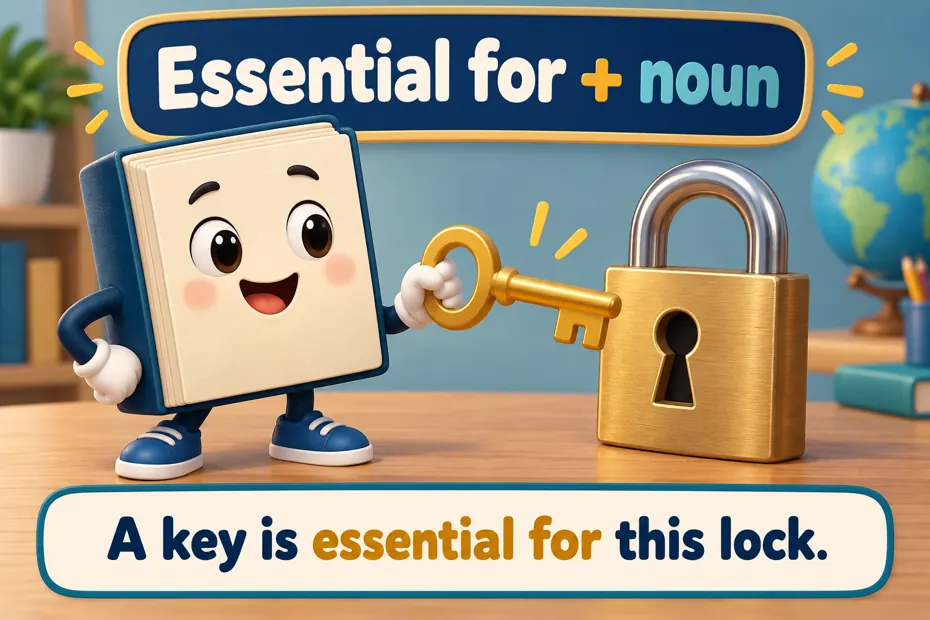
- Essential for + noun or -ing form: Clear labels are essential for safe food storage. Patience is essential for listening carefully.
- Essential to + noun or -ing form: Trust is essential to a strong partnership. Regular practice is essential to improving your timing.
- Essential to + verb: It is essential to save a copy of the application.
- It is essential that + clause: It is essential that every visitor follows the safety instructions.

Essential can describe something basic
The word can also mean central to the nature or character of a person or thing: Curiosity is an essential part of scientific work. In this sense, the sentence emphasizes a defining feature.

“Essential” as a noun
Essential can also be a noun, often used in the plural essentials, for basic things that are needed: She packed the essentials for a weekend trip.
Important can mean valuable or significant without always meaning strictly necessary. Vital is a close alternative to essential and can sound more urgent. Use essential when the sentence means that something is needed for a purpose, activity, or defining quality.
Patterns with examples
| Pattern | Example | What follows essential |
|---|---|---|
| essential + noun | Please bring the essential documents. | The item being described |
| essential for + noun | A key is essential for this lock. | A purpose or requirement |
| essential to + verb | It is essential to save a copy. | An action |
| essential that + clause | It is essential that everyone arrive on time. | A complete requirement |
Do you mean necessary or simply helpful?
Specify the purpose so the reader can judge the claim. “An internet connection is essential for this online examination” names a requirement of that examination. “An internet connection is essential for studying” makes a much broader claim that overlooks offline books and other study methods. The grammar may be correct in both sentences, but the second needs a more carefully limited meaning.
The older examples below illustrate sentence construction; statements that a study group, career fair, or particular device is essential should not be treated as universal requirements. If an activity is beneficial but optional, choose helpful, useful, or valuable. Reserve stronger wording for the circumstances that make the item necessary.
A practical revision adds the missing condition: “A laptop is essential for the course because all assessed tasks use its required software.” That gives the reader a reason, rather than relying on the adjective alone. You can also separate a minimum requirement from a preference: “Access to a computer is essential; owning a laptop is convenient.”
Try the same distinction in a planning note: “A signed form is essential for entry, but a printed map is optional.” This sentence identifies a requirement and a convenience separately, so the reader can act on the wording without guessing which items are mandatory.
Frequently asked questions
Should I use essential to or essential for? Both can introduce a noun or an -ing form, depending on the sentence. “Planning is essential for completing the project” and “Planning is essential to completing the project” are possible. For the separate infinitive pattern, write “It is essential to plan,” with the base verb after to.
Is “It is essential that she arrive” correct? Yes. The base form arrive is a mandative subjunctive used to state a requirement, especially in formal American English. Other accepted constructions include “It is essential that she should arrive” and, in appropriate varieties and contexts, “It is essential that she arrives.” Do not mark every alternative as a mistake.
Is essential an adjective or a noun? It is an adjective in “essential equipment,” where it modifies a noun. It is a noun in “We packed the essentials,” referring to the necessary things themselves. The plural noun needs context: essentials for a school day differ from essentials for a camping trip.
What is the difference between essential and essentially? Essential describes a thing or requirement: “The repair is essential.” Essentially is an adverb often meaning basically or in the most important respects: “The two plans are essentially the same.” Adding the adverb does not automatically mean that something is necessary.
Sources: Cambridge Dictionary: essential and Cambridge Dictionary: essential for/to and Oxford Learner’s Dictionaries: essential.
Essential in the English language refers to something necessary, crucial, or fundamental. When a word or concept is labeled as essential, it indicates that it is indispensable and cannot be overlooked in a particular context.
In linguistics, essential words play a vital role in constructing meaningful sentences and conveying clear messages. They provide the necessary structure, context, and clarity needed for effective communication. Understanding the significance of essential elements in language is key to mastering and utilizing its power in various forms of expression.
7 Examples Of Essential Used In a Sentence For Kids
- Essential vitamins help us stay healthy.
- Eating fruits and vegetables is essential for our bodies.
- Sleep is essential for our bodies to rest and grow.
- Water is essential for our bodies to stay hydrated.
- Exercise is essential to keep our bodies strong.
- Listening carefully in class is essential for learning.
- Being kind to others is essential for making friends.
14 Sentences with Essential Examples
- Essential items to pack for your college trip include toiletries, medications, and extra clothes.
- Keeping your phone charged is essential to stay connected with your classmates for group projects.
- It is essential to manage your time effectively to balance academics and extracurricular activities.
- A good laptop is essential for completing assignments and attending online classes.
- A clear understanding of the syllabus is essential to plan your study schedule efficiently.
- Having a reliable internet connection is essential for submitting assignments and taking online exams.
- Creating a budget for your expenses is essential to avoid overspending during your college years.
- Prioritizing self-care is essential to manage stress and maintain good mental health.
- Joining a study group is essential for getting help with difficult subjects and preparing for exams.
- Regular exercise is essential for staying healthy and maintaining focus during long study sessions.
- Setting academic goals is essential to stay motivated and track your progress throughout the semester.
- Developing good communication skills is essential for networking and building connections with peers and professors.
- Keeping track of important deadlines is essential to avoid missing assignments and exams.
- Attending career fairs and workshops is essential for exploring job opportunities and planning for your future.
How To Use Essential in Sentences?
To use the word “essential” in a sentence, start by identifying something that is absolutely necessary or crucial to the situation you are describing. An essential item is something that you cannot do without. For example, “Water is essential for human survival.”
Next, choose a subject for your sentence, which is the person or thing that you are talking about. This could be a specific noun like “students,” “plants,” or “computers.”
Then, construct your sentence by placing the word “essential” in a position that clearly communicates the importance of the subject in relation to the essential item. For instance, “Sunlight is essential for plants to photosynthesize and grow.”
Remember to pay attention to the context of the sentence to ensure that you are using the word “essential” correctly. You may also consider using adverbs like “absolutely,” “vitally,” or “crucially” to emphasize the significance of the subject in a sentence.
Practice using the word “essential” in different sentences to become more comfortable with its usage. With time and practice, you will gain confidence in incorporating this important word into your writing and communication effectively.
Conclusion
In this article, we explored various sentences showcasing the use of the keyword “essential.” These examples demonstrated the importance or necessity of certain elements or actions within a given context. From highlighting crucial skills needed for a job to emphasizing indispensable items in a survival kit, the word “essential” serves to underline the critical nature of whatever it is describing.
By repeatedly seeing “essential” used in different scenarios, we can better understand its versatile application and appreciate the significance of what it denotes. It reminds us of the vital components that underpin various aspects of our lives, whether it be in terms of basic needs, fundamental principles, or indispensable requirements. This word prompts us to prioritize what is truly necessary and crucial, ultimately guiding us in making informed decisions and choices.


