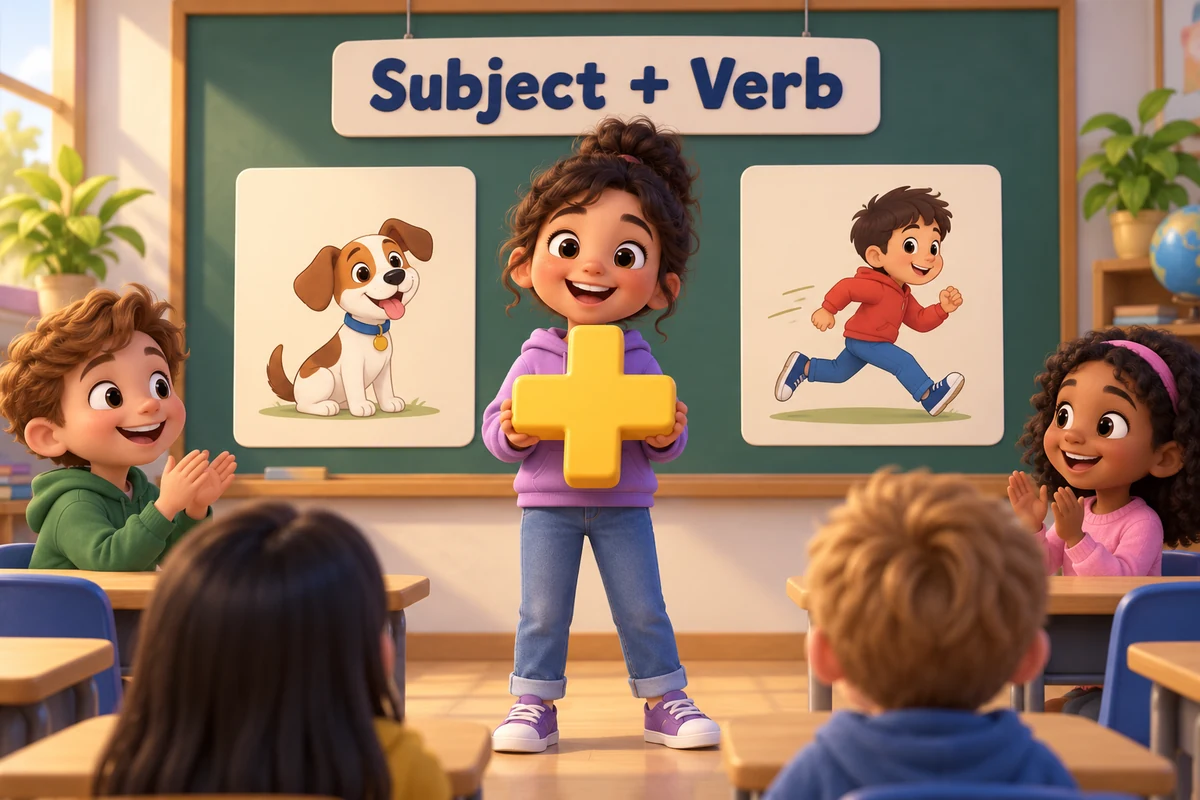
Example sentences of simple sentences carry one subject and one verb, so each line does a single job. The frame is easy to spot: name the actor, then give the action, as in “The dog barks” or “Water boils.” Learning the shape helps writers keep their prose clear.
Example sentences of simple sentences at a glance
- A simple sentence holds one independent clause: a subject and a verb.
- The subject names who or what; the verb shows the action or state.
- Extra words such as objects and adverbs hang off that core pair.
- A simple sentence can still be long if it keeps a single clause.
- The commonest error is joining two clauses with only a comma.
What is a simple sentence?
A simple sentence is a group of words with one independent clause: a subject and a verb expressing one complete idea. The subject names who or what, and the verb says what happens. Every other word in the sentence hangs off that pair, as the table shows.
| Element | Job | Example |
|---|---|---|
| Subject | names who or what | The dog |
| Verb | shows the action or state | barks. |
| Object | receives the action | The dog chased the ball. |
| Adverbial | tells when, where, or how | The dog barks loudly. |
| Adjective | describes the subject | The dog is happy. |
Not every short group of words is a sentence. A phrase such as “in the red coat” has no verb, so it cannot stand alone; add a subject and a verb and the clause is complete. That single test separates a full sentence from a fragment.
How do you build a simple sentence?
Building a simple sentence starts with choosing the subject and then the verb that fits it. Five patterns cover almost every short sentence a learner needs, and each one signals the relationship between the parts. Once the core is steady, a single adjective can sharpen it, and the guide to how to use adjectives in sentences and phrases shows where that word sits.
| Pattern | Example | What it signals |
|---|---|---|
| Subject + verb | Birds sing. | an action with no object |
| Subject + verb + object | She reads novels. | an action on a thing |
| Subject + verb + adjective | The soup tastes salty. | a state or quality |
| Subject + verb + adverbial | He walks to school. | how, when, or where |
| Subject + verb + two objects | She gave me a pen. | one action with a receiver |
Example sentences of simple sentences across contexts
The same one-clause shape appears in every register, from a laboratory note to a bedtime story. What changes is the content, not the structure, so the pattern transfers easily. Ten examples follow, each with the reason it works.
| Context | Example sentence | Why this works |
|---|---|---|
| Classroom | The teacher opened the window. | one subject, one verb, one object |
| Workplace email | The invoice is attached. | a short state sentence |
| News report | The storm damaged three houses. | a plain report of an event |
| Story opening | Rain fell all night. | a short verb sets a mood |
| Cooking | The onions sizzled in the pan. | one clear action |
| Travel | The train leaves at six. | a single fact with a time |
| Sports | The keeper saved the shot. | subject, verb, object |
| Science | Water boils at 100 degrees. | a fact with no object |
| Letter | I miss you. | a state sentence in casual writing |
| Instructions | Press the green button. | a command with the subject left out |
Simple, compound, or complex: which should you use?
Register and rhythm decide whether one clause is enough, and the answer depends on how much information a sentence must carry. A simple sentence suits a clear fact, while a longer idea may need adjective clauses in complex sentences to add detail. Keep the subject-verb core intact even when you sharpen it; a quick second look at using adjectives in a sentence shows how one word can lift a plain line.
| Feature | Simple | Compound | Complex |
|---|---|---|---|
| Clauses | one | two joined by and, but, or so | one main plus a dependent clause |
| Length | short | medium | variable |
| Conjunction | none needed | and, but, so | when, because, although |
| Example | The dog barks. | The dog barks, and the cat runs. | The dog barks when the post arrives. |
| Best for | stating one clear fact | balancing two equal ideas | showing cause, time, or contrast |
Use a simple sentence for a clear fact, a compound one for two equal ideas, and a complex one when one idea depends on another. Read the choice as a question of how many clauses carry a subject and a verb.
Word forms and grammar of simple sentences
A simple sentence keeps its shape while the verb changes tense, mood, and polarity. The table shows the same frame in five forms, so the core subject and verb stay visible throughout.
| Form | Example | Note |
|---|---|---|
| Simple present | She works in a bank. | adds -s on the third person verb |
| Simple past | They moved last year. | one finished action |
| Simple future | I will call you. | will plus a bare verb |
| Negative | He does not drive. | do-support carries the not |
| Question | Does she sing? | the auxiliary moves first |
Questions and negatives change the auxiliary rather than the clause count, so “Does she sing?” and “He does not drive” are still simple sentences. The form shifts while the single subject-verb core stays intact, which is why the sentence never becomes compound.
Common mistakes with simple sentences
Five slips break the one-clause rule, and each has a clear repair. Seeing the broken version beside the fixed one makes the rule memorable.
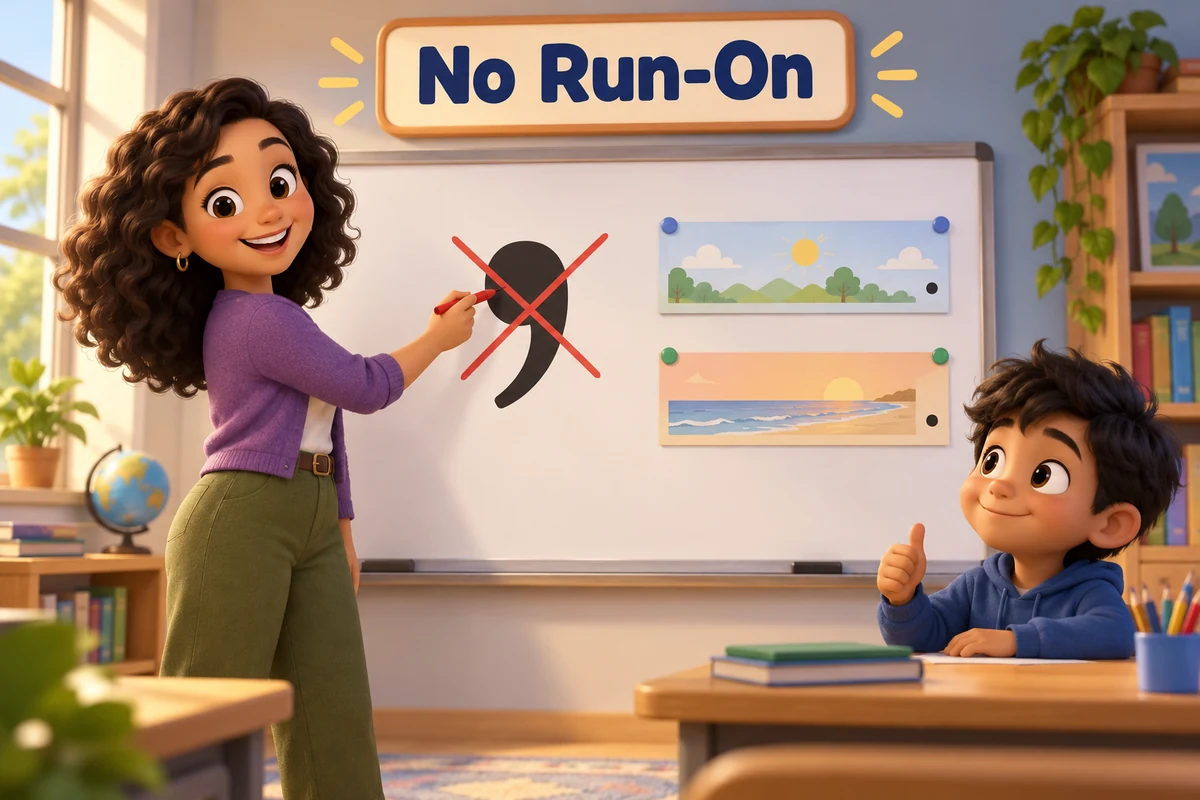
Mistake 1: the run-on. Incorrect: The rain stopped we went out. Correct: The rain stopped, so we went out. Rule: two independent clauses need a conjunction, a semicolon, or a full stop.
Mistake 2: the missing verb. Incorrect: The tall boy in the red coat. Correct: The tall boy in the red coat smiled. Rule: a sentence needs a verb to be complete.
Mistake 3: the double subject. Incorrect: My brother he works here. Correct: My brother works here. Rule: name the subject once.
Mistake 4: the because fragment. Incorrect: Because it was late. Correct: Because it was late, we took a taxi. Rule: a because-clause needs a main clause to lean on.
Mistake 5: wrong agreement. Incorrect: The dogs barks. Correct: The dogs bark. Rule: a plural subject takes the base verb.
Practice using example sentences of simple sentences
- Fill in the blank: The cat ___ on the sofa.
- Choose the simple sentence: (The children played in the yard. / The children played in the yard, and the sun shone.)
- Correct the error: My sister she sings well.
- Build a sentence: write a simple sentence with subject-verb-object about a chef.
- Spot the fragment: which is not a sentence, (a) The door opened slowly, or (b) After the long wait?
- Fill in the blank: two clauses joined by and make a ___ sentence.
Answers
- sleeps, because one subject and one verb complete the clause.
- The children played in the yard, because it holds a single clause.
- My sister sings well, because the subject is named once.
- The chef tasted the sauce, because subject-verb-object forms one clause.
- (b), because After the long wait has no verb of its own.
- compound, because and joins two independent clauses.
The bottom line
Example sentences of simple sentences all share one subject and one verb, and that single clause is the clearest way to state a fact. Keep the pattern when a sentence carries one idea, and reach for and, but, because, or although when two ideas need linking. Writing one clause at a time, then joining only where the meaning demands it, keeps prose readable.
Frequently asked questions about simple sentences
How long can a simple sentence be?
A simple sentence can be quite long, because length comes from extra words, not extra clauses. The sentence The tired old dog in the corner barked loudly at the postman keeps one subject and one verb. As long as a single subject-verb pair remains, the sentence is still simple.
Is a simple sentence always short?
No. A simple sentence is defined by having one independent clause, not by a word count. Short sentences are common because they are easy to read, but a simple sentence may carry several adjectives, adverbs, and phrases. The test is the number of clauses, not the length.
Can a simple sentence have two subjects?
Yes, a compound subject still leaves one clause, as in Sam and Ana swim every morning. The two names share a single verb, so the sentence remains simple. Only when a second subject brings its own verb does the sentence become compound.
Why do simple sentences matter for clear writing?
A simple sentence states one idea without competition, so readers grasp it at once. Mixing short simple sentences with longer ones controls the rhythm of a paragraph and gives emphasis to key facts. Clarity often improves when a writer splits a tangled sentence into two simple ones.