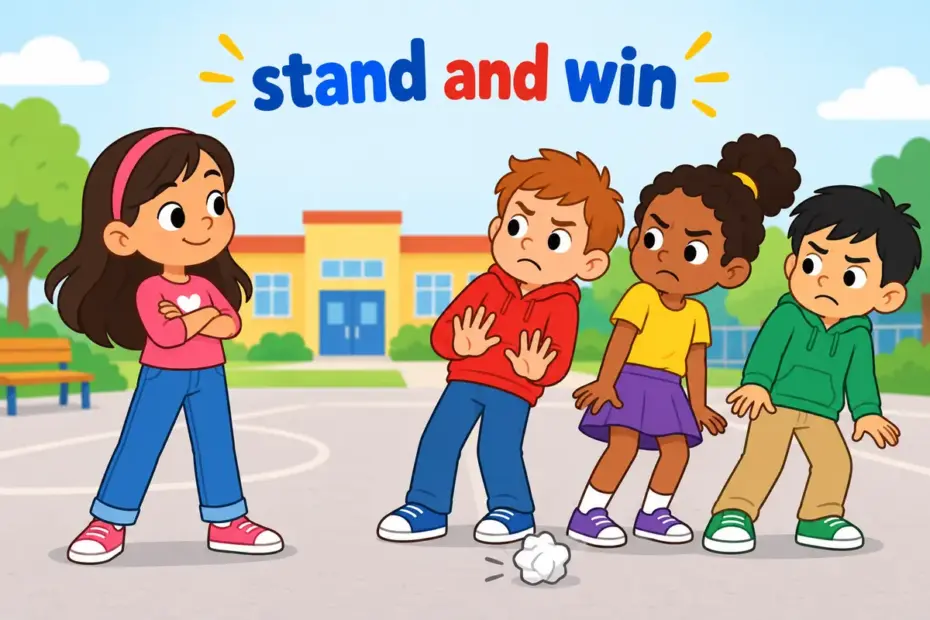
Face down means to confront an opponent, a challenge or an accusation and defeat it. To use face down in a sentence as a verb, put the thing being overcome after the particle or between the two words: “She faced down the critics.” Written with a hyphen, face-down is a different word describing something lying flat.
Face down at a glance
- Face down is a separable phrasal verb; face down an opponent and face an opponent down are both correct.
- Its forms are face down, faces down, faced down and facing down.
- The verb is transitive and means to win a confrontation, not merely to endure one.
- Hyphenated face-down is an adverb or adjective meaning lying flat or turned downward.
- The commonest error is dropping down and writing face, which loses the sense of victory.
What does face down mean?
Face down is a phrasal verb meaning to stand up to someone or something and win. The Cambridge entry for face down keeps the word close to confront and defy, and the outcome matters: whoever faces a threat down is left in control. Spelled with a hyphen, face-down is unrelated in grammar and describes a body or object turned toward the ground.
| Sense | Plain meaning | Example sentence |
|---|---|---|
| Defeat a challenger | Confront a person and win | The captain faced down the mutineers alone. |
| Overcome a problem | Stand firm against a threat or doubt | The town faced down the flood with sandbags and nerve. |
| Lying flat | Hyphenated adverb or adjective, face to the ground | The cards lay face-down on the table. |
One limitation is worth stating plainly. Face down implies that the confrontation ends in a win, so it is the wrong verb for simply enduring something. Where a sentence only needs the idea of holding on, choose stand firm or withstand, which promise resistance rather than victory.
The verb often puts a small subject against a larger force, which is why it dominates stories of underdogs: a lone clerk faces down a company, or a village faces down a developer. That imbalance is part of the meaning rather than decoration, and a sentence that ignores it can make a strong claim sound accidental instead of deliberate.
How do you use face down in a sentence?
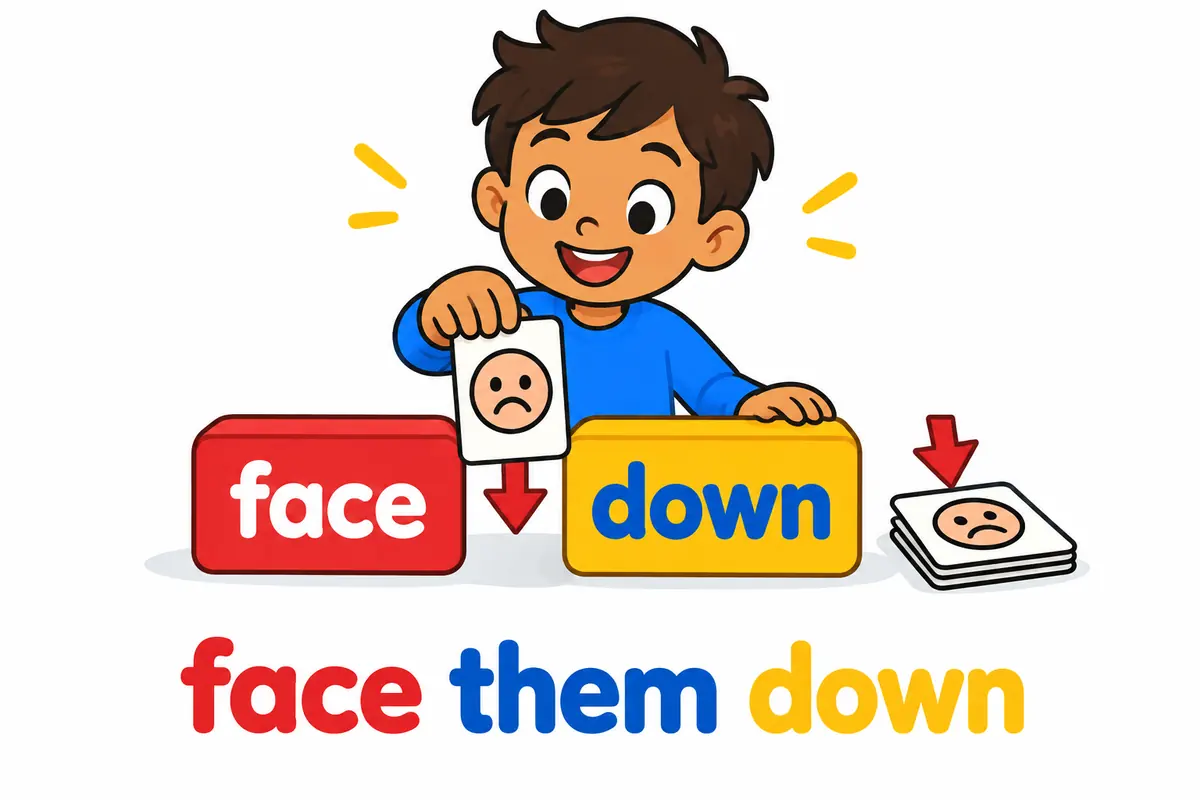
Face down behaves like other separable phrasal verbs. A full noun can follow the particle or sit between the verb and down, but a pronoun must go in the middle, so face them down is correct and face down them is not. The verb stays transitive throughout.
| Pattern | Example | What it signals |
|---|---|---|
| face down + object | She faced down the critics. | The standard order, with the challenger at the end. |
| face + object + down | She faced the critics down. | The split order; identical in meaning and often smoother with a pronoun. |
| be faced down | The strike was faced down by the new manager. | Passive form, used when the defeated side is the topic. |
| face down + challenge / threat | The crew faced down a second storm. | Applies the verb to a thing rather than a person. |
| face down + pressure | He faced down the pressure to resign. | Names an abstract force as the opponent. |
The pronoun rule is the clearest test of fluency. A native writer says the board faced them down, never the board faced down them, and that small word order marks the difference between idiomatic and translated English.
Face down in a sentence: examples across contexts
Face down carries the same fighting sense in every register, but the nature of the opponent changes. The nine sentences below move from a school playground to a business page.
| Context | Example sentence | Why this works |
|---|---|---|
| News report | The mayor faced down a hostile crowd at the town meeting. | Names a person and a public opponent in one line. |
| Politics | The party faced down its critics and kept the policy. | Uses its to tie the opponent to the subject. |
| Sports | The keeper faced down three penalties in the final. | Turns an abstract challenge into a countable threat. |
| Business | The board faced down the takeover bid without raising its offer. | Shows the split order after a full noun. |
| School | Maya faced down her nerves and read the poem aloud. | Applies the verb to an inner obstacle. |
| Conversation | He faced me down about the missing keys, and I gave in. | Puts the pronoun in the middle, the idiomatic slot. |
| Military history | Garrison troops faced down the siege for a month. | Pairs the verb with a long, concrete ordeal. |
| Community | Neighbours faced down the developers and saved the orchard. | Contrasts a small subject with a powerful one. |
| Legal | The union faced down the injunction and won the appeal. | Keeps the tone formal and the outcome clear. |
| Workplace | The new supervisor faced down an old habit of late starts. | Aims the verb at a pattern rather than a person. |
| Family | She faced down the pressure to sell the family shop. | Names pressure as the opponent, a common abstract object. |
Where a sentence only reports that someone refused to yield, writers often prefer resist the plan, because face down promises that the resistance succeeded.
Face down vs back down
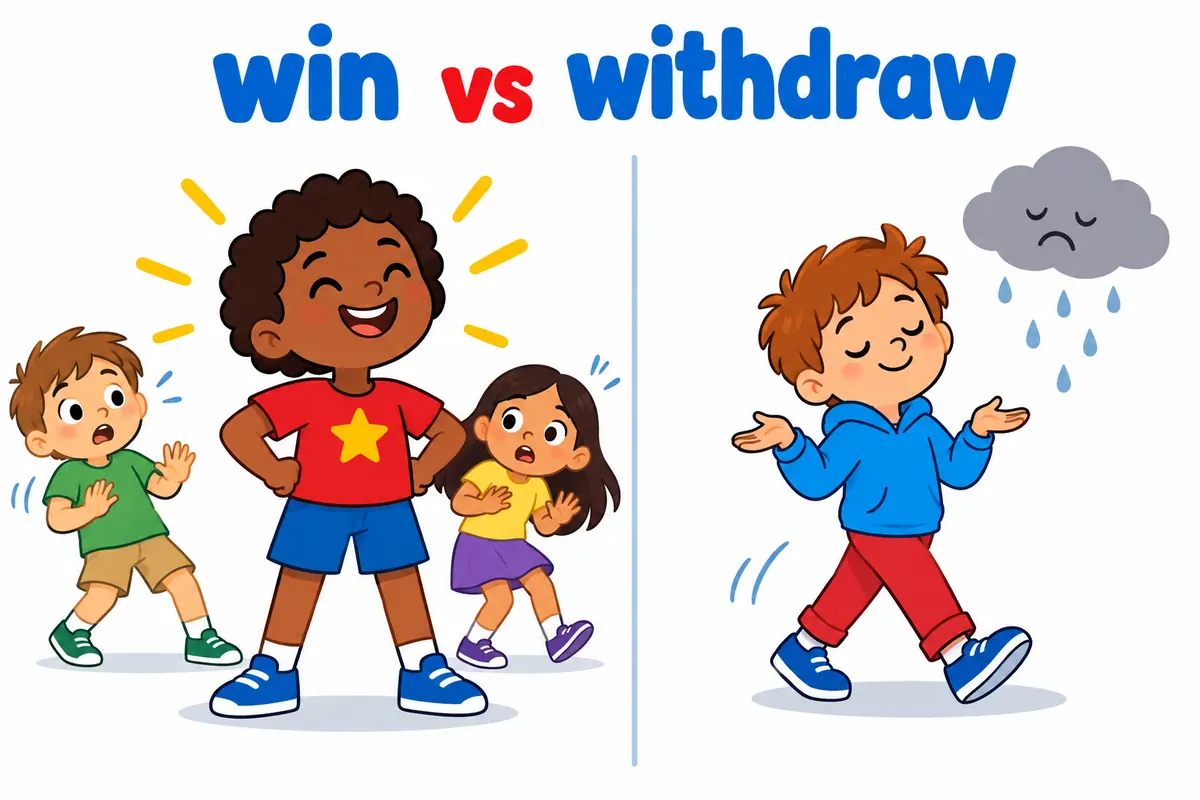
These two are opposites, and the shared particle down hides the reversal. To back down is to withdraw from a confrontation; to face down is to win one.
| Attribute | face down | back down |
|---|---|---|
| Core meaning | Confront and defeat | Retreat from a threat or demand |
| Who acts | The stronger party, or the one who holds firm | The party that yields |
| Transitivity | Transitive; needs an opponent | Intransitive; needs no object |
| Outcome | The challenge collapses | The challenger walks away |
| Register | Formal, journalistic, sports | Neutral, common in speech |
| Typical phrase | face down the critics | refuse to back down |
Verdict: if the sentence needs a winner, use face down; if it needs a withdrawal, use back down, and never treat the two as synonyms because the particle is the same. The transitivity test settles many doubts: if a writer cannot name the object, back down is almost certainly the intended verb.
Word forms and grammar of face down
The verb inflects regularly, and its spelling changes with the job it does. A hyphen appears only when the word describes position rather than confrontation.
| Form | Part of speech | Example |
|---|---|---|
| face down | phrasal verb, base | They face down every challenge together. |
| faces down | verb, third person | She faces down the doubters each season. |
| faced down | verb, past | He faced down the inquiry and kept his post. |
| facing down | verb, present participle | Facing down the crowd, she never raised her voice. |
| face-down | adverb or adjective | The photograph lay face-down on the desk. |
| face off | related phrasal verb | The rivals will face off in the final. |
Do not confuse the confrontation with the position. To face off means to begin a contest, while to be beaten down is the opposite of winning. The particle down carries several jobs, so the verb in front of it decides the meaning. Because face down is separable, the same sentence can move its object without changing the meaning, which is a useful freedom when editing.
Common mistakes with face down
- Incorrect:
He faced down the room with his forehead on the desk.Correct: He lay face-down with his forehead on the desk. Rule: The verb means to confront and win; the position takes the hyphenated form. - Incorrect:
The government faced down.Correct: The government faced down the revolt. Rule: The verb is transitive and needs an opponent. - Incorrect:
She faced down them at the meeting.Correct: She faced them down at the meeting. Rule: A pronoun must sit between the verb and the particle. - Incorrect:
He faced down the long winter.Correct: He endured the long winter. Rule: Face down implies a win, so it misfires on mere endurance. - Incorrect:
The cards were faced down.Correct: The cards were face-down. Rule: No passive verb is needed when the word simply describes a position.
Practice using face down
Work through the six items, then check the reasoning rather than only the answer.
- Fill the gap: The young teacher ______ the noisy class without raising her voice.
- Choose the better word: After months of protest, the council finally (faced down / backed down).
- Correct the error: She faced down them at the gates.
- Build a sentence: use face down about a team that answers its critics by winning.
- Spot the register: which belongs in a news report — the minister faced down the hecklers, or the minister totally faced them down, easy?
- Rewrite with a pronoun: The captain faced the mutineers down. Replace the mutineers with them.
Answers
- faced down — the class is the opponent, and the past tense matches the sentence.
- backed down — the council yielded, which is the opposite of facing a challenge down.
- She faced them down at the gates — the pronoun belongs between face and down.
- Model answer: The team faced down its critics by winning the return match in front of them.
- The minister faced down the hecklers — a report avoids totally and the tag easy.
- The captain faced them down — the pronoun replaces the noun in the split order.
The bottom line
Use face down in a sentence when someone confronts a threat and wins, and remember that the verb is transitive and separable. The two points that decide most sentences are that a pronoun must sit between face and down, and that the hyphenated face-down describes a position rather than a victory. If the sense is withdrawal rather than triumph, back down is the word you want.
Frequently asked questions about face down
Is face down one word or two?
As a verb it is always two words: face down the critics. As an adjective or adverb describing position it takes a hyphen, as in a face-down photograph. The spacing is therefore a reliable clue to which meaning the writer intends, and editors treat it as a real distinction rather than a matter of taste.
What is the difference between face down and back down?
They are near opposites. Face down means to confront an opponent and win, and it needs an object. Back down means to withdraw from a demand or threat, and it takes no object at all. The shared particle makes them look alike, but the direction of the conflict is reversed.
Can you face down a situation rather than a person?
Yes. The object may be a threat, a challenge, pressure or a fear rather than a human opponent. Sentences such as the crew faced down a second storm are entirely natural. What stays constant is the outcome: the thing faced down stops being a danger.
Is face down formal or informal?
Face down belongs to the neutral-to-formal range. It appears in news reports, sports writing and political coverage without sounding stiff, and it is acceptable in conversation too. Only the split order with a pronoun can sound clumsy if a writer gets it wrong.