Key Takeaways
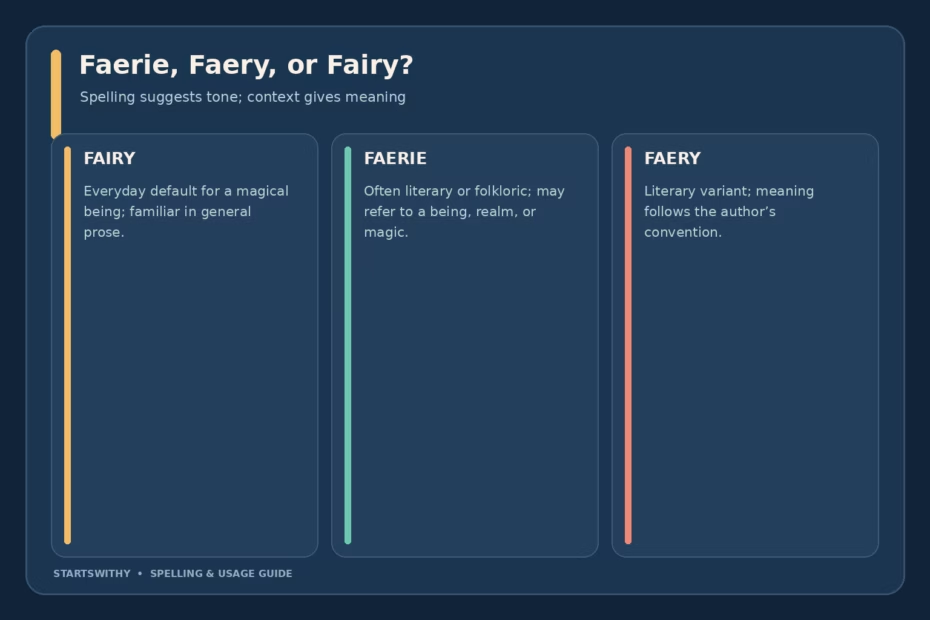
- Faerie, fairy, and faery are all terms used to describe mythological creatures associated with folklore and fantasy.
- Faeries are often portrayed as small, winged beings with magical powers, while fairies can refer to any supernatural being with magical abilities.
- Faery is a variation of the term, emphasizing the mystical and otherworldly nature of these creatures.
- Understanding the subtle differences between faerie, fairy, and faery allows for more accurate and appropriate usage in writing and communication.
- Faerie is often used to refer to the area or domain where fairies reside, while faery specifically refers to the creature itself.
- Fairy is a broader term that encompasses various interpretations of mythical creatures associated with nature and magic.
What is a Faerie?
A faerie, also spelled as fairy or faery, is a mythological creature often associated with folklore and fantasy. There are different interpretations and meanings of faeries, with variations in different cultures and literary works. Understanding the difference between these terms can be helpful in using them appropriately.
- The term “faerie” is often used to refer to a specific type of magical creature that is elegant, ethereal, and enchanting. They are commonly portrayed as small, winged beings with magical powers, living in forests, meadows, or other natural settings. Faeries are often depicted as mischievous but benevolent creatures, interacting with humans in tales and legends.
- On the other hand, “fairy” is a more general term that encompasses a broader range of magical creatures. It can refer to any supernatural being with magical powers, often associated with nature, elemental forces, or the spirit world. Fairies can take various forms and have different characteristics depending on the cultural and literary context.
- “Faery” is another variation of the term, often used to emphasize the mystical and otherworldly nature of these creatures. It is sometimes used to differentiate them from the more childlike and whimsical depictions of fairies in popular culture.
While the terms faerie, fairy, and faery are often used interchangeably, understanding their subtle differences can enhance your writing and communication. It allows you to choose the most appropriate term based on the context and the image you want to convey.
By using the correct term, you can ensure clear and effective communication, avoiding any potential confusion or misinterpretation. So, whether you’re writing a fantasy story or discussing folklore, having a grasp of the difference between faerie, fairy, and faery can help you accurately convey your ideas and create a captivating narrative.
Remember, language is a powerful tool, and using it correctly can greatly enhance the impact and clarity of your writing. Understanding the definition and nuances of words like faerie, fairy, and faery ensures that your communication accurately conveys your intended message. So, the next time you come across these terms, you’ll be able to use them confidently and appropriately.
What is a Faery?
When it comes to magical creatures, the term “faery” carries a certain mystical allure. So, what exactly is a faery?
A faery is a creature that is often associated with folklore and mythology. It is believed to dwell in a area that is separate from our own, known as Faerie, which is a magical and enchanting place. Faeries are often depicted as small, ethereal beings with wings, who possess magical powers and can interact with the natural world.
The term “faery” is used to emphasize the whimsical and otherworldly nature of these enchanting creatures. Unlike the more general term “fairy,” which encompasses a wider range of magical creatures, “faery” specifically refers to a specific type of magical being that is elegant, mysterious, and deeply connected to nature.
A key difference between faeries and other magical creatures is their close association with the natural world. They are often believed to be guardians of the forests, rivers, and meadows, playing a vital role in maintaining the balance of nature. This connection to the environment highlights their importance and unique characteristics.
To summarize, a faery is a magical creature that resides in the area of Faerie, exuding an ethereal and enchanting aura. They possess magical abilities and are closely connected to nature, making them mystical guardians of the natural world.
How does the term “Faery” differ from “Faerie”?
You may have noticed that the term “faery” is spelled differently from “faerie.” Both spellings, though similar, have slightly different connotations.
The spelling “faerie” is often used to refer to the area in which faeries reside. It emphasizes the magical and otherworldly nature of this area. On the other hand, the spelling “faery” is used to describe the actual creature itself, emphasizing its elegance, mystique, and connection to nature.
While these spellings may seem interchangeable, they subtly differentiate between the place and the being. Understanding this distinction can help to enhance our writing and accurately convey the desired meaning.
To conclude, while the spellings “faerie” and “faery” may seem similar, they possess nuanced differences that emphasize the magical area and the mystical creature, respectively.
Let’s continue exploring the intriguing area of magical creatures by delving into the meaning and characteristics of fairies.
What is a Fairy?
To fully understand the distinctions between “faerie,” “faery,” and “fairy,” it’s important to start by delving into the definition of a fairy. Fairies are mythical creatures that have captivated the human imagination for centuries. These magical beings are often associated with folklore and mythology and are believed to inhabit a area called Faerie.
Definition of a Fairy:
A fairy is typically depicted as a small, ethereal being with wings. They are often portrayed as beautiful and delicate, with an enchanting aura. Fairies are known for their connection to nature and are often thought of as guardians of the natural world. They possess magical powers and can perform feats that defy the laws of nature. This mystical ability frequently includes the power to grant wishes, cast spells, or influence human events.
Difference between Faerie, Faery, and Fairy:
Let’s address the confusion surrounding the terms “faerie,” “faery,” and “fairy.” The first thing to note is that “faerie” and “faery” are usually used to refer to the area or domain where fairies reside, whereas “fairy” specifically describes the creature itself.
“Faerie” is often used to denote the magical area or enchanted land where fairies live. It represents a place of wonder, untouched by the confines of our reality. Think of it as a separate, ethereal world that exists parallel to our own.
On the other hand, “faery” is the term used to describe the actual fairy creature. It refers to the small, winged beings associated with magical powers and a deep bond with nature.
By understanding these distinctions, you can better navigate the usage of “faerie,” “faery,” and “fairy” in your writing. It’s important to note that these terms are often used interchangeably, but being aware of the subtle differences can enhance your ability to accurately convey meaning.
As we continue our exploration of “faerie vs faery vs fairy,” we will investigate deeper into the characteristics, legends, and popular depictions of these enchanting creatures. Stay tuned for the next section, where we will unravel the intriguing area of fairies in even more detail.
Differences between Faerie, Faery, and Fairy
When it comes to the mystical area of magical creatures, there can often be confusion surrounding the terms faerie, faery, and fairy. While they may seem similar, each term actually has its own distinct meaning and usage. Let’s investigate into the differences between these enchanting words.
Faerie: The term “faerie” is used to refer to a place or domain where fairies are said to reside. It describes the magical area or enchanted land that is associated with the fairy creatures. Picture lush forests, shimmering lakes, and ethereal landscapes—these are the realms of faerie.
Faery: On the other hand, “faery” refers to the actual fairy creature. It specifically defines the mythical beings themselves, known for their connection to nature and possession of magical powers. When you envision fairies dancing in the moonlight, granting wishes, and spreading joy, you’re picturing the area of faery.
Fairy: Now, let’s talk about the term “fairy.” While both “faerie” and “faery” relate to the mystical beings, “fairy” is a broader term that encompasses various interpretations of mythical creatures. Fairies are generally thought of as small, delicate beings with wings, associated with nature and magic. These enchanting creatures are often depicted in folklore, mythology, and popular literature.
To summarize, the key differences between these terms can be described as follows:
| Term | Definition |
|---|---|
| Faerie | The place or domain where fairies reside. |
| Faery | The actual fairy creature with magical powers. |
| Fairy | The broader term referring to mythical creatures, |
| often associated with nature and possessing magic. |
Understanding the distinctions between faerie, faery, and fairy is essential for accurate communication and writing. By using these terms appropriately, you can bring precision and clarity to your descriptions of magical realms, creatures, and folklore.
Next, we will explore the fascinating characteristics, legends, and popular depictions of fairies, further enhancing our understanding of these captivating creatures.
When to Use Faerie
When it comes to using the word “faerie,” it’s important to understand its specific meaning and when it is appropriate to use. So, let’s investigate into the definition of “faerie” and explore its usage.
The term “faerie” refers to the area or domain where fairies reside. It is often used to describe the enchanted or magical world in which these mythical creatures live. “Faerie” can also refer to the land or kingdom ruled by the fairy queen or king.
- Writing fantasy literature: If you’re a writer or aspiring author in the fantasy genre, using “faerie” can add depth and richness to your world-building. It helps create a sense of wonder and enchantment, immersing readers in a magical area.
- Discussing folklore and mythology: When exploring the stories, legends, and myths surrounding fairies, using “faerie” can be more specific and accurate. It helps differentiate between the actual creatures and the world they inhabit.
- Describing a mystical or ethereal setting: If you encounter a place that has an otherworldly or mystical ambiance, incorporating “faerie” into your description can evoke a sense of enchantment and mystery.
- In poetic or artistic expressions: “Faerie” lends itself well to poetic or artistic expressions, allowing for a more whimsical or fantastic tone. It can be used to capture the imagination and transport readers or viewers to a magical area.
Remember, “faerie” is not interchangeable with “faery” or “fairy.” Each of these terms has its own unique meaning and usage. Understanding the distinctions between them is crucial for clear and accurate communication.
So, when crafting your writing or engaging in discussions about fairies and their mystical area, consider using “faerie” to convey that magical sense of wonder and transport your audience to a world where fairies reign.
Next, we’ll explore the characteristics, legends, and popular depictions of fairies, giving you a deeper understanding of these fascinating mythical creatures.
When to Use Faery
Faery is a term that refers specifically to the mythical creature itself. It is important to use the term “faery” when you are talking about the creature and want to specifically emphasize its magical qualities and characteristics. Here are a few situations in which it is appropriate to use “faery”:
- Fantasy Literature: When writing or discussing works of fantasy literature that feature these magical creatures, using the term “faery” adds an enchanting touch to your descriptions. It helps create vivid imagery and transports readers into a world filled with mystical beings.
- Folklore and Mythology: In the context of folklore and mythology, “faery” is the preferred term to refer to specific beings of folklore, often depicted as small, ethereal creatures with magical abilities. Using “faery” helps maintain accuracy and respect for traditional folklore.
- Describing Mystical Settings: If you are describing a magical setting, such as an enchanted forest or a hidden area inhabited by mythical creatures, using the term “faery” adds an element of wonder and whimsy. It conveys a sense of otherworldliness and invites readers to immerse themselves in a mystical world.
- Poetic or Artistic Expressions: “Faery” is often used in poetry and artistic expressions to capture the essence of magic, beauty, and wonder. It adds a touch of elegance and mysticism to the creative work, enhancing the overall emotional impact and imagery.
Summarizing, “faery” is the term to use when you want to specifically refer to the mythical creature itself and emphasize its magical qualities. Whether you’re discussing fantasy literature, delving into folklore and mythology, describing mystical settings, or engaging in creative endeavors, using “faery” adds a touch of enchantment and brings the magic to life. Remember, the distinctions between “faerie,” “faery,” and “fairy” are important to maintain accurate communication and writing.
When to Use Fairy
As mentioned earlier, the term “fairy” is a broader term that encompasses various interpretations of mythical creatures associated with nature and magic. Understanding when to use “fairy” is important for accurate communication and writing. Here are a few situations where the term “fairy” is appropriate:
- Fantasy Literature: In the area of fantasy literature, the term “fairy” is commonly used to describe magical creatures that possess enchanting qualities. From Tinker Bell in Peter Pan to the fairies in A Midsummer Night’s Dream, these beings are often depicted as ethereal and otherworldly. Using “fairy” in this context adds a touch of whimsy and allows readers to easily identify these mystical creatures.
- Folklore and Mythology: In traditional folklore and mythology, “fairy” is used to refer to supernatural beings that are often associated with nature and possess magical powers. These creatures can be mischievous or benevolent, interacting with humans in various ways. As such, “fairy” is the appropriate term when discussing folklore and mythological tales that involve these mystical beings.
- Describing Mystical Settings: When describing a setting that is infused with magic and wonder, using the term “fairy” helps create a vivid image in the reader’s mind. Whether it’s a hidden fairy glen in the forests or a sparkling fairy area, “fairy” evokes a sense of enchantment and beauty.
- Poetic or Artistic Expressions: In the area of poetry or artistic expressions, using “fairy” can evoke a sense of whimsy, magic, and delicate beauty. From poetry to paintings, this term is often used to convey the ethereal and mystical aspects of these mythical creatures.
Remember, while “fairy” is a widely used term, it is not interchangeable with “faerie” or “faery.” Understanding the distinctions between these words allows for accurate communication and effective writing.
The next topic we’ll explore in this text is the characteristics, legends, and popular depictions of fairies. Stay tuned for an enchanting journey into the area of these mythical creatures.
Conclusion
Understanding the distinctions between “faerie,” “faery,” and “fairy” is crucial for accurate communication and writing. While “faerie” refers to the place or domain where fairies reside, “faery” specifically refers to the fairy creature itself. On the other hand, “fairy” is a broader term that encompasses various interpretations of mythical creatures associated with nature and magic.
Throughout this article, we have explored the usage of the word “faerie” in different contexts, such as fantasy literature, folklore and mythology, describing mystical settings, and poetic or artistic expressions. It is important to note that “faerie” is not interchangeable with “faery” or “fairy.”
Moving forward, we have discussed when to use the term “fairy” and in what contexts it is appropriate. Using “fairy” adds an enchanting touch and emphasizes the magical qualities of the mythical creature. This is particularly suitable in situations such as fantasy literature, folklore and mythology, describing mystical settings, and poetic or artistic expressions.
In our next topic, we will investigate into the characteristics, legends, and popular depictions of fairies. Stay tuned for a deeper exploration of these fascinating mythical beings.
Frequently Asked Questions
Q: What is the difference between “faerie,” “faery,” and “fairy”?
A: “Faerie” refers to the place where fairies live, while “faery” is the actual fairy creature. “Fairy” is a broader term encompassing different interpretations of mythical creatures associated with nature and magic.
Q: Why is it important to understand the distinctions between the terms?
A: Understanding the differences is crucial for accurate communication and writing. It helps in using the appropriate term in different contexts, such as fantasy literature, folklore, mythology, poetry, or artistic expressions.
Q: When should I use the term “faerie”?
A: “Faerie” should be used when referring to the place or domain where fairies reside.
Q: In what contexts is it appropriate to use the term “fairy”?
A: “Fairy” adds an enchanting touch and emphasizes the magical qualities of the mythical creature. It is suitable for fantasy literature, folklore, mythology, describing mystical settings, and poetic or artistic expressions.
Q: What is the next topic to be explored in the article?
A: The next topic will cover the characteristics, legends, and popular depictions of fairies.
Faerie vs. Faery vs. Fairy: A Practical Usage Note
The place-versus-creature distinction described above can work as a writer’s convention, but it is not a dependable spelling rule for every book, dictionary, or folklore tradition. Modern dictionaries give faerie as a variant spelling of fairy and also record faerie as a noun for an imaginary land, its magic, or its customs. The spelling alone does not always tell a reader whether a sentence means a being or a realm. For example, Cambridge lists both a faerie whose spirit is trapped in a tree and “the realm of faerie.”
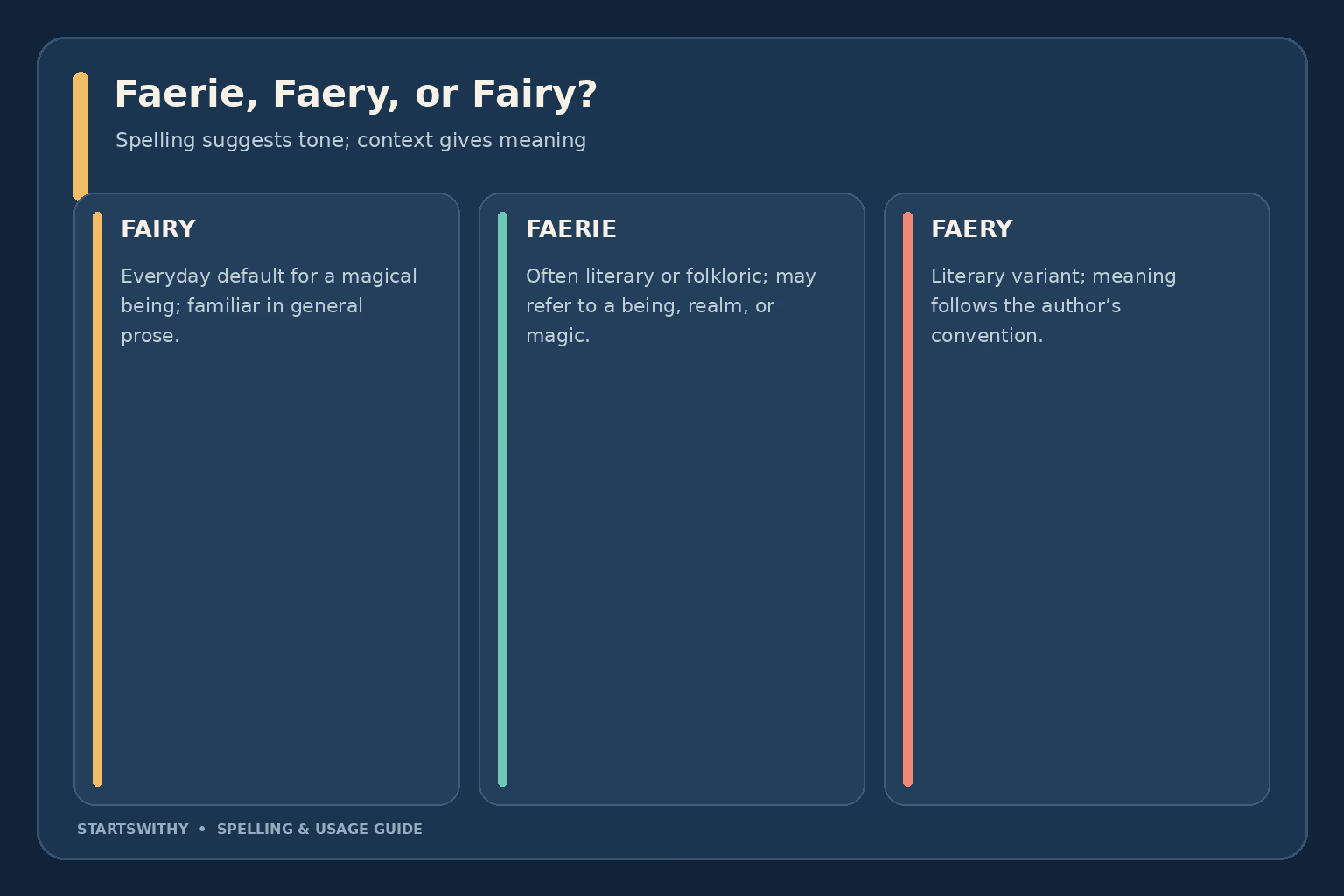
For a neutral, contemporary text, fairy is the clearest default for the creature and fairyland or fairy realm for its imagined home. Faerie often signals an older, literary, or folklore-focused register; depending on context, it can name a being, a realm, or the magic associated with that realm. Faery is another literary spelling, but its meaning is especially dependent on an author’s or publisher’s house style. Treat these associations as tendencies rather than universal definitions. The Cambridge Dictionary entry for faerie explicitly gives both a countable creature sense and an uncountable land-or-magic sense.
Which spelling should you choose?
Start with the reader and the type of writing. In everyday explanations, school assignments, general nonfiction, and familiar expressions such as fairy tale, choose the standard spelling fairy. Oxford defines fairy as a magical creature in stories and traces the word’s history through Middle English and Old French faerie; that history helps explain why the spellings overlap, rather than proving that modern writers must assign each one a separate meaning. For a historical discussion, an adaptation, a poem, or a fantasy setting, use faerie or faery when the source text or a deliberate stylistic choice calls for it.
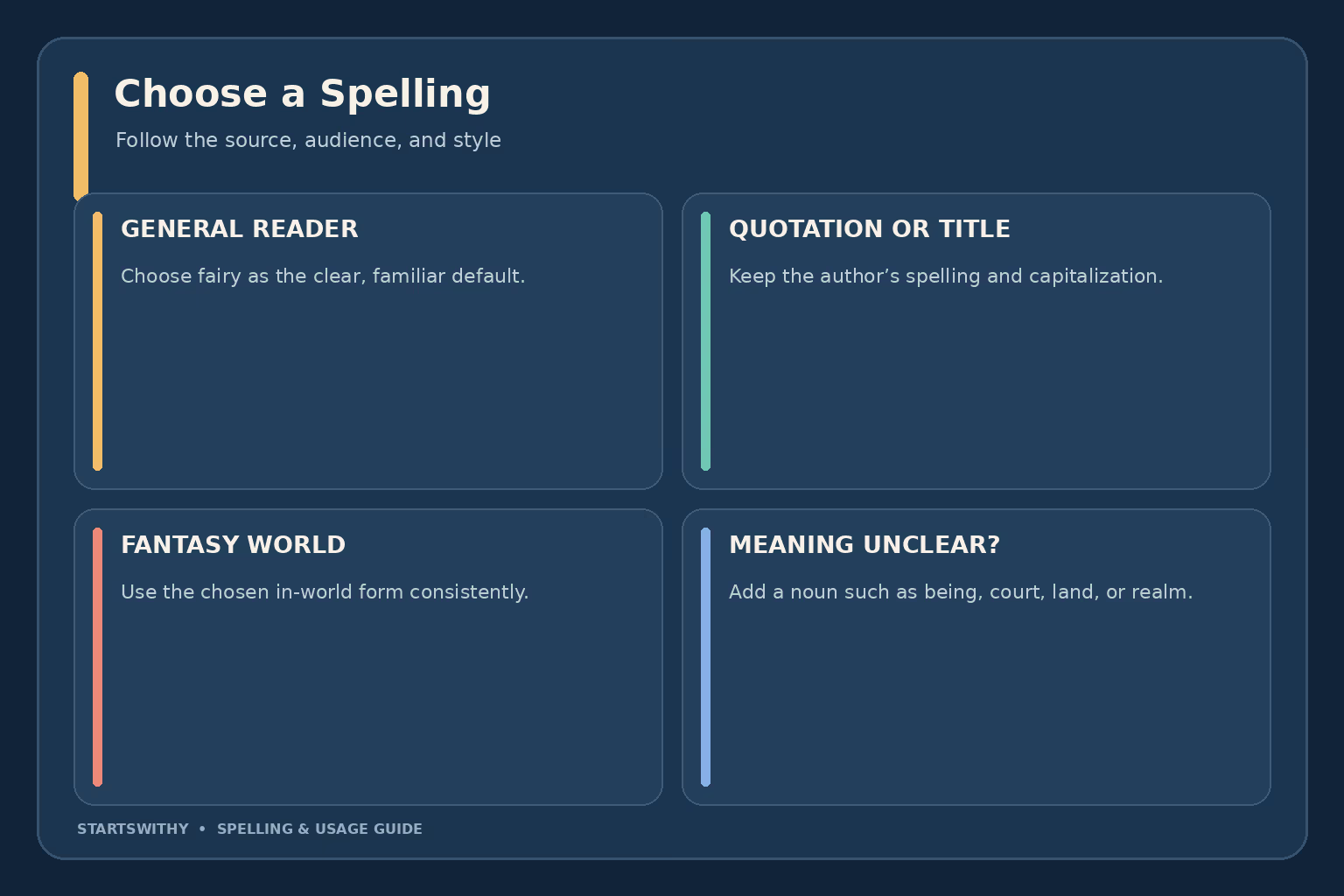
When writing about a specific novel, poem, game, or community, follow the spelling used by that source. If a book names its people the Faery, retain that capitalization and spelling when summarizing the book. If a folklore collection or scholar uses fairy, do not silently replace it with faerie just because the latter looks more archaic. In quotations and titles, preserve the original form. In your own surrounding prose, explain an unusual spelling on first use if readers could mistake it for a typo.
Examples in sentences
These examples show how context makes the intended sense clear, even when a literary spelling is used:
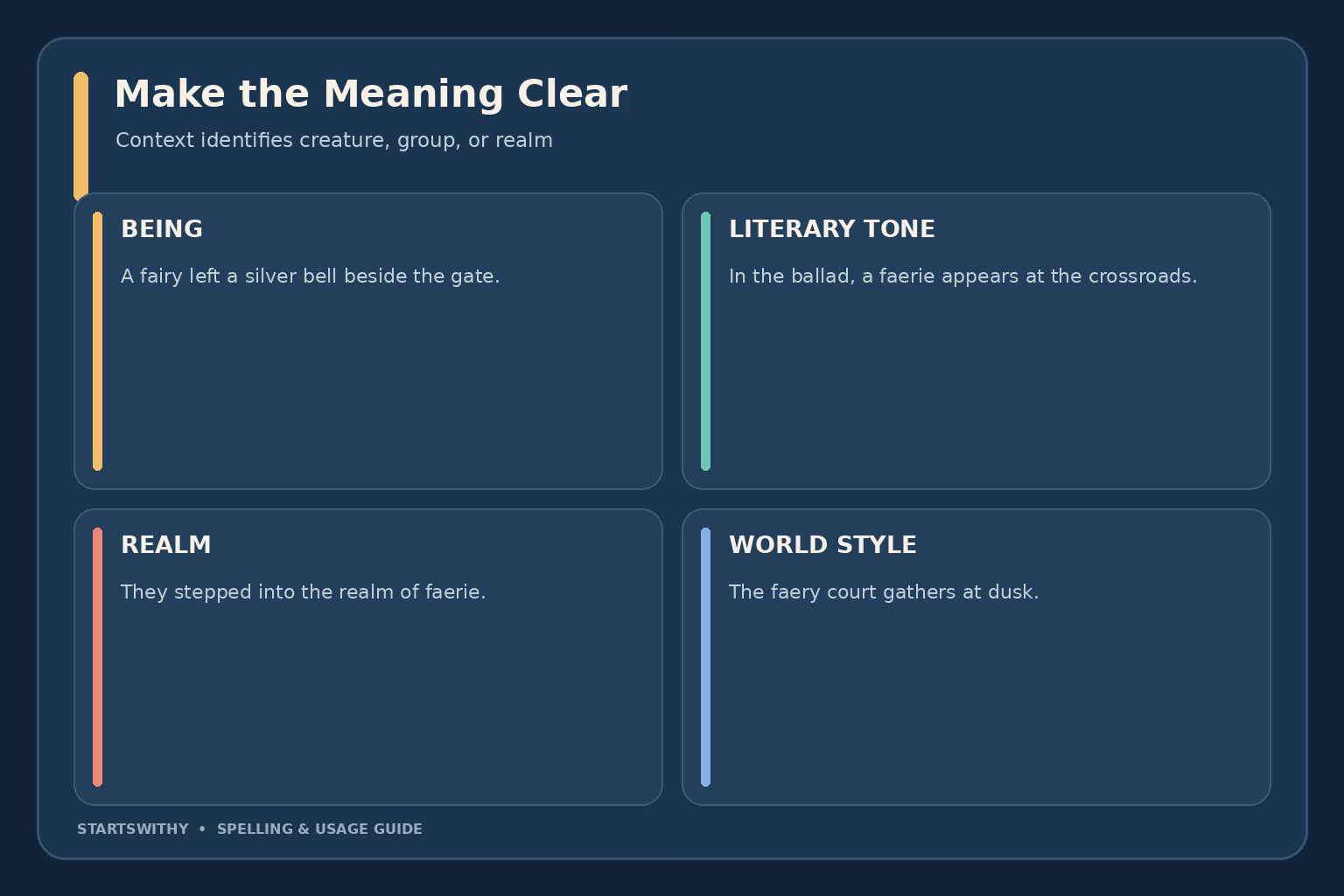
- General creature: “A fairy left a silver bell beside the gate.” This is the plain everyday spelling.
- Folkloric or literary tone: “In the ballad, a faerie appears at the crossroads.” The variant cues register; the sentence still identifies a being.
- Realm: “The travelers stepped into the realm of faerie.” The surrounding words make the place sense explicit.
- World-specific terminology: “The faery court gathers at dusk.” This can suit a fictional world if the author has established faery as that group’s name.
These sentences are examples of editorial choices, not proof of four separate dictionary definitions. If the meaning matters, add a noun such as being, court, land, or realm instead of expecting spelling alone to carry the distinction.
Capitalization, compounds, and consistency
Capitalize Faerie when it is a proper name in a particular story, place-name, or title; otherwise, lowercase forms are common. Writers may also capitalize a people or court as a world-building choice, but they should establish that convention and keep it steady. Capitalization does not create a universal grammar rule that Faerie must mean a country while faery must mean one inhabitant.
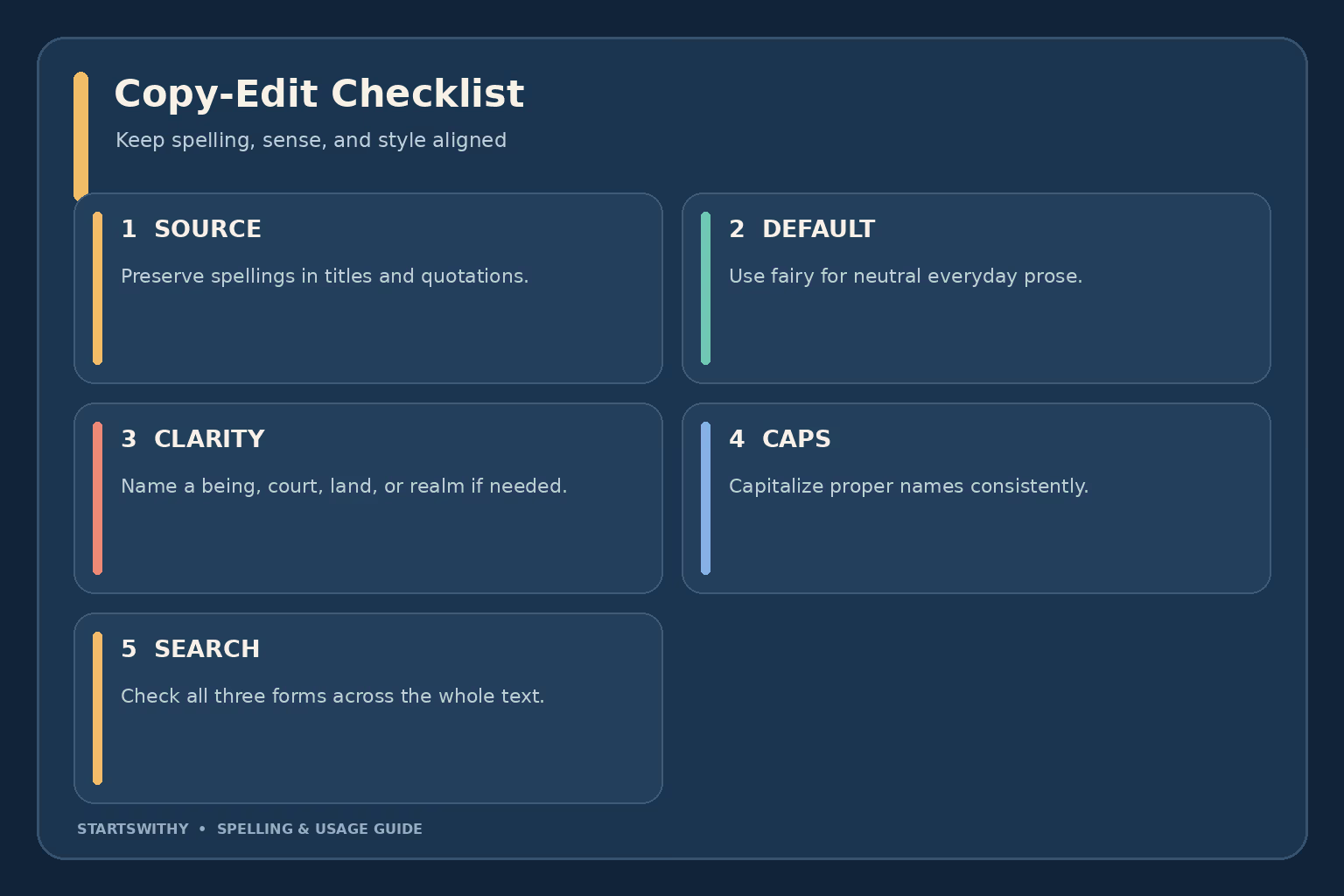
In ordinary prose, write fairy tale as two words when it is a noun (She read a fairy tale) and fairy-tale with a hyphen when it modifies another noun (a fairy-tale ending), following the style guide you use. Do not automatically change it to faerie tale; that spelling may be an intentional title or stylistic choice, but it is not the neutral default. For copy editing, search the whole document for all three spellings, decide whether they refer to separate ideas or simply reflect one consistent house style, then make each use intentional.
How to explain a spelling choice
In a language lesson or copy-editing note, separate the question of spelling from the question of belief or interpretation. A dictionary can describe current English usage, while a particular writer may build a more exact distinction into a story. Neither automatically supplies a rule for every community or text. When writing about a living religious or cultural tradition, name the community or source whose terminology you are describing, and avoid presenting one fantasy writer’s taxonomy as a universal folklore system.
A simple editing method is to mark each use as one of three things: the standard general word, a source’s own spelling, or a deliberate stylistic variant. Then check whether readers can infer the referent from the sentence. “A fairy crossed the meadow” identifies a being; “the realm of faerie” identifies a place. If you use faery for a specific class of beings, define that choice once and carry it through the article. This keeps your distinction useful without suggesting that the spelling itself has a single fixed meaning.
In short, use fairy when clarity and familiarity matter most. Use faerie or faery when a source, genre, or deliberate voice warrants the variant, and define the distinction if your text assigns one. Because dictionaries and writers allow the forms to overlap, consistency and context do more work than spelling alone.


