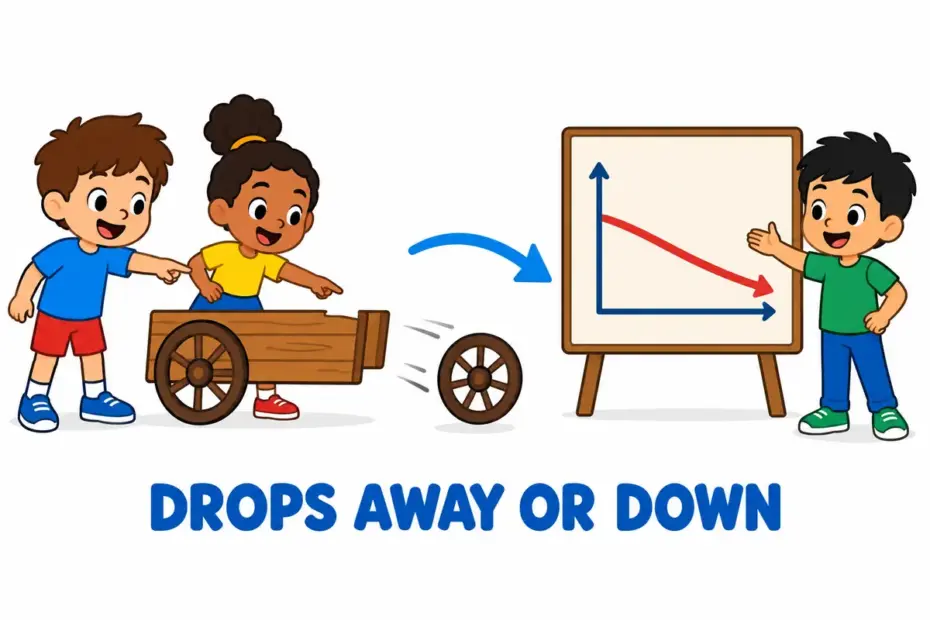
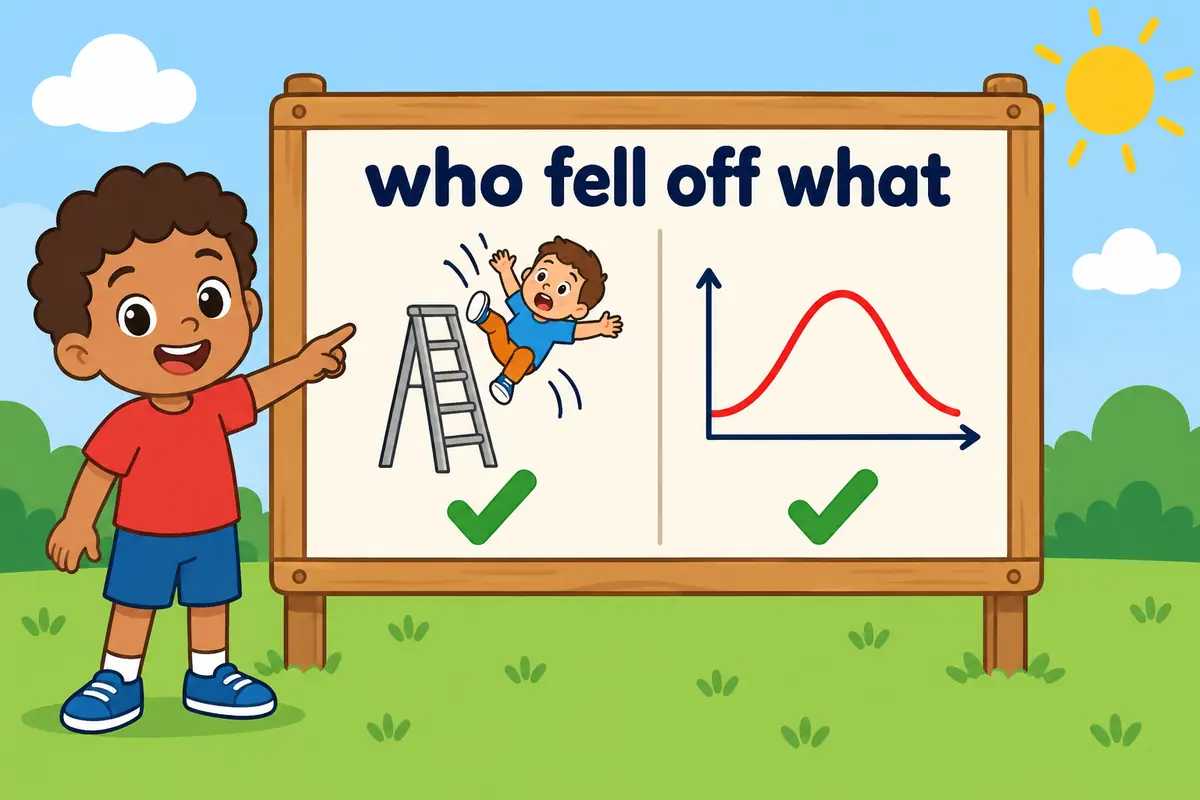
Fall off means to become detached and drop from something, or to decrease in amount or quality over time. To use fall off in a sentence, decide which sense you need: “A wheel fell off the cart” describes a physical drop, while “Sales fell off in winter” describes a decline.
Fall off at a glance
- Fall off is a phrasal verb meaning to drop away from something or to decrease.
- Its forms are fall off, falls off, fell off and falling off; the past tense is fell, not falled.
- In the physical sense a noun follows the particle: he fell off the ladder.
- In the decline sense nothing follows the verb: demand fell off sharply.
- The commonest error is confusing fall off with fall out, which means to quarrel or to drop out.
- Fall off works with both objects and figures, so the subject decides which sense applies.
What does fall off mean?
Fall off is a phrasal verb meaning to become loose and drop from a surface, or to grow smaller in amount, rate or quality. The Cambridge entry for fall off records both the physical and the numerical senses, and the grammar separates them neatly. A noun after off signals the thing it dropped from; no noun at all signals a figure or a standard that has slipped.
| Sense | Plain meaning | Example sentence |
|---|---|---|
| Detach and drop | Become loose and come away from a surface | A wheel fell off the cart. |
| Decrease in amount | Become lower in number, rate or level | Sales fell off after the holidays. |
| Decline in quality | Become weaker or worse than before | His form fell off towards the end of the season. |
One limitation is worth stating plainly. The decline sense is common and natural in speech, but it is vague about size, so a report that needs a precise figure should use decline or fall by a stated amount instead. The same sense is also intransitive, so a sentence can never fall off something in the way a physical object does; demand falls off, but nobody falls off demand.
How do you use fall off in a sentence?
The two senses take different grammar, and that is the whole difficulty of the verb. In the physical sense a noun follows off to name the surface; in the decline sense the verb stands alone. Five patterns cover almost every real sentence.
| Pattern | Example | What it signals |
|---|---|---|
| fall off + surface | The lid fell off the jar. | Physical detachment, naming the source. |
| fall off + vehicle | She fell off her bike at the corner. | The commonest physical use, with a vehicle as source. |
| subject + fall off | Attendance fell off in June. | Intransitive decline, with nothing after the verb. |
| fall off + adverb | Demand fell off sharply. | An adverb shows how large or fast the decline was. |
| be falling off | Enrolment is falling off this term. | Progressive form, for a decline still in progress. |
An easy check is to read the sentence without off: if the verb still needs a surface, the sentence is physical, and if it can stand alone, the sentence is about a decline.
Fall off in a sentence: examples across contexts
Fall off keeps one shape while the subject tells you whether something dropped or something shrank. The eleven sentences below move from a workshop to a sales report, and each one settles the sense through its grammar. To describe the opposite movement, use rise.
| Context | Example sentence | Why this works |
|---|---|---|
| Classroom | A poster fell off the classroom wall during the storm. | A concrete object and surface make the physical sense clear. |
| Home | The handle fell off the cupboard again. | An everyday repair, with the source named after off. |
| Transport | He fell off his scooter on the wet path. | A vehicle follows off, the standard physical pattern. |
| Retail | Sales fell off once the sale ended. | The decline sense, with no noun after the verb. |
| Sports | The striker’s form fell off in the final weeks. | Quality rather than quantity, still intransitive. |
| Farming | Leaves fell off the trees early that autumn. | A natural process with a surface named after off. |
| Workplace | Attendance fell off sharply after the timetable change. | An adverb measures the size of the decline. |
| News report | Demand for the fuel fell off as prices climbed. | A formal register using the bare intransitive form. |
| Music | Her voice fell off in the closing verse. | A performance quality that weakens, still no object. |
| Gardening | Two pears fell off the branch overnight. | A countable subject and a clear source surface. |
| Conversation | Traffic usually falls off after six o’clock. | Relaxed speech with the decline sense intact. |
| Public services | Attendance at the clinic fell off once the road reopened. | A decline sense in a formal public-service register. |
Notice that only the sentences with a noun after off describe something falling; every sentence about a figure, a standard or a form leaves the verb bare.
Fall off vs fall out
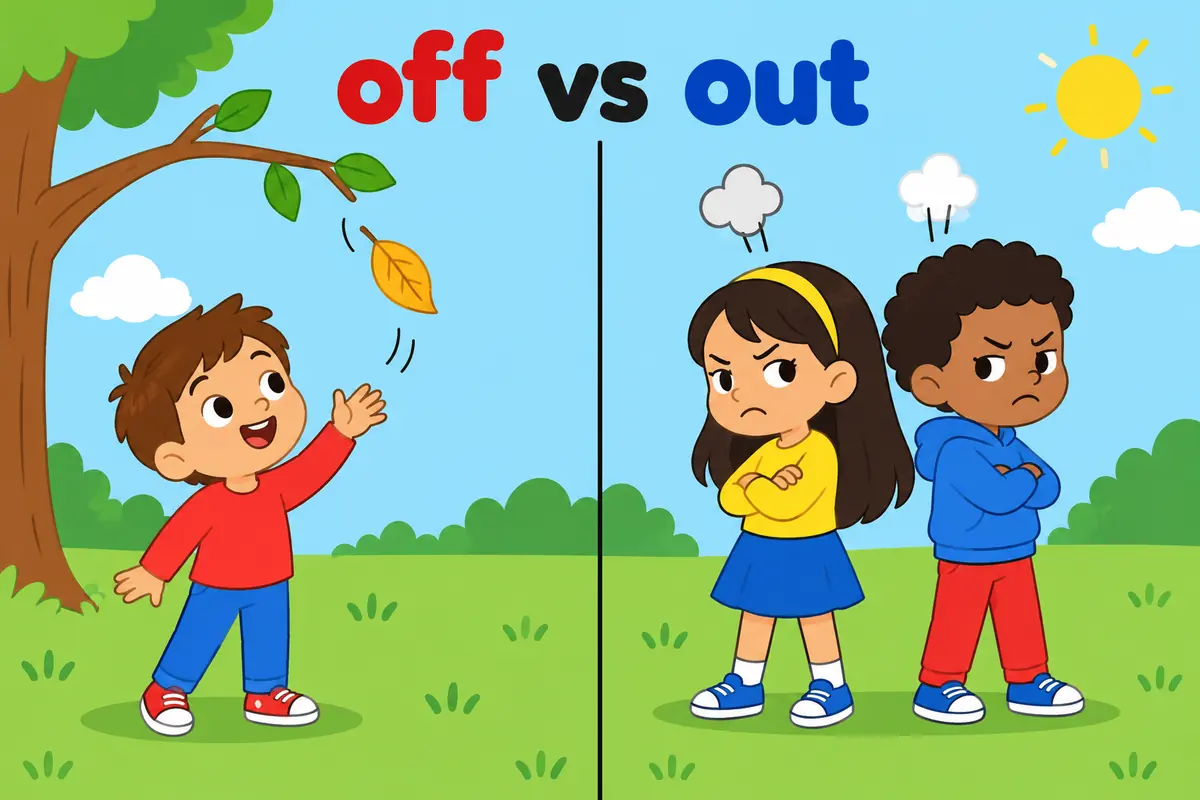
fall out and fall off look almost identical but mean very different things. Fall out is mostly about a quarrel or about leaving a group, while fall off is about dropping away or declining. A similar-looking phrase, drop, overlaps with the decrease sense and is often the plainer choice.
| Attribute | fall off | fall out |
|---|---|---|
| Core meaning | Drop away or decrease | Quarrel, or leave a group |
| Typical subject | A wheel, a leaf, sales, attendance | Two friends, hair, a plan, a soldier |
| Grammar | May be followed by a surface noun | Commonly followed by with |
| Decline sense | Yes, for figures and quality | No |
| Register | Neutral, common in reporting | Neutral, common in speech |
| What it implies | Something separated downward or shrank | A relationship or a group came apart |
Verdict: use fall off for a wheel, a leaf, sales or form, and fall out for a quarrel or a departure. When the meaning is simply that a number went down, drop is often the shortest accurate verb.
The same test sorts the other near neighbours: dwindle suggests a slow shrinking, plunge suggests a sudden drop, and fall off sits between them as the neutral choice.
Word forms and grammar of fall off
Fall is an irregular verb, so the past tense is fell and the past participle is fallen. The hyphenated noun fall-off names a decline itself, and the related verb fall through shares the base but means a plan collapsing.
| Form | Part of speech | Example |
|---|---|---|
| fall off | base phrasal verb | Do not let the sign fall off the wall. |
| falls off | third person singular | The paint falls off in damp weather. |
| fell off | past tense | The bolt fell off during the journey. |
| falling off | present participle | Numbers are falling off again. |
| fallen off | past participle | The tiles have fallen off the roof. |
| fall-off | noun, hyphenated | A sharp fall-off in orders worried the team. |
Common mistakes with fall off
- Incorrect:
He falled off the swing.Correct: He fell off the swing. Rule: Fall is irregular, so the past tense is fell. - Incorrect:
Sales fell off the company.Correct: Sales fell off or the company’s sales fell. Rule: The decline sense is intransitive and cannot take an object. - Incorrect:
They fell off after the argument.Correct: They fell out after the argument. Rule: Falling out means quarrelling; falling off means dropping or declining. - Incorrect:
The handle fell off of the door.Correct: The handle fell off the door. Rule: Off alone is enough; off of is informal and best avoided in writing. - Incorrect:
The wheel fell from the bike.Correct: The wheel fell off the bike. Rule: For something detaching from a surface, off is the natural particle.
Practice using fall off
Work through the seven items, then check the reason as well as the answer.
- Fill the gap: A slate ______ the roof during the gale.
- Choose the better word: Membership (fell off / fell out) sharply after the fees rose.
- Correct the error: The mirror falled off the wall.
- Build a sentence: use fall off in the decline sense about ticket sales.
- Spot the register: which belongs in a sales report — orders fell off in the third quarter, or orders went right down?
- Fill the gap: The two brothers ______ out over the business.
- Rewrite with the noun: There was a sharp fall in demand. Use fall-off instead.
Answers
- fell off — the past tense of fall is fell, and the surface follows off.
- fell off — membership declined, which is the intransitive decrease sense.
- The mirror fell off the wall — fall is irregular, so the past tense is fell.
- Model answer: Ticket sales fell off in the final week.
- Orders fell off in the third quarter — a report prefers the measured phrasal verb.
- fell out — falling out is the quarrel sense, followed by over here.
- There was a sharp fall-off in demand — the hyphenated noun names the decline.
The bottom line
Use fall off in a sentence when something detaches and drops, or when a figure or standard declines, and let the grammar show which sense is meant. The two points that decide most sentences are transitivity, since only the physical sense takes a noun after off, and the particle, since fall off never means to quarrel the way fall out does. When a number simply goes down, drop or decline is often the plainer verb.
Frequently asked questions about fall off
Is fall off one word or two?
As a verb, fall off is always two words, as in the sign fell off the wall. The hyphenated noun fall-off is one unit with a hyphen, as in a fall-off in demand. Keeping the two-word verb and the hyphenated noun apart is the easiest way to avoid a common spelling slip.
Does fall off take an object?
It depends on the sense. In the physical sense a noun follows off to name the surface, as in he fell off the ladder. In the decline sense the verb is intransitive and takes no object, as in sales fell off. Applying the physical pattern to figures produces an error.
What does fall off mean for sales?
For sales, fall off means that the volume or value of sales has decreased over time. The verb is intransitive, so the sentence reads sales fell off, not sales fell off something. An adverb or a time phrase usually follows, as in sales fell off after the launch.
What is the past tense of fall off?
The past tense is fell off, and the past participle is fallen off. She fell off her bike is correct, and the sign has fallen off is correct too. Falled is not a word, so it is one of the most frequent mistakes learners make with this verb.