Fill Out in a Sentence: Meaning, Examples & Practice
Fill out is a phrasal verb meaning to complete a form by writing the information in its blank spaces, and it also describes a body becoming fuller or rounder. To use fill out in a sentence, name the form or the person as the object, as in she filled out the application, because the transitive sense needs something to complete.
Fill out at a glance
- Fill out is a phrasal verb; its forms are fill out, fills out, filled out and filling out.
- The commonest sense is to complete a form, and the object is the document being written on.
- A second intransitive sense means to become fuller or rounder, as in he filled out after training.
- A third transitive sense means to add material until something looks complete, as in fill out the chapter.
- The verb is separable in the form sense, so a pronoun sits inside: fill it out, never fill out it.
- The commonest error is confusing American fill out with British fill in when writing for one audience.
What does fill out mean?
Fill out is a phrasal verb meaning to complete a document by writing in its blank spaces. The Cambridge entry for fill out records that form sense and the separate sense of a body becoming fuller, and the object tells you which is meant: you fill out a form, or a person fills out over time. An applicant who answers every line has filled out the form, and a teenager who gains healthy weight after a growth spurt has filled out. Where the point is adding detail until a text feels complete, expand is the closer verb, because fill out also carries the idea of reaching a required whole.
| Sense | Plain meaning | Example sentence |
|---|---|---|
| Complete a form | Write the requested answers in the blanks | Please fill out the medical form before your appointment. |
| Become fuller | Gain weight or grow rounder in shape | The puppy filled out once it started eating properly. |
| Add material to complete | Supply extra content until something looks whole | She filled out the report with two more examples. |
One limitation is worth stating plainly. Fill out is the American preference for paperwork, while British English usually says fill in, and mixing the two in one document looks careless. The word also suits forms and figures rather than abstract ideas, so you would not fill out a friendship; for supplying what is missing, supply is the plainer choice.
How do you use fill out in a sentence?
The form sense is transitive and separable, so the object can follow the phrase or sit between the two words. The body sense is intransitive and takes no object at all, which is the split that catches learners.
| Pattern | Example | What it signals |
|---|---|---|
| fill out + object | Fill out the questionnaire. | Standard order, with the form after the phrase. |
| fill + object + out | Fill the questionnaire out in ink. | Separated order, common and equally correct. |
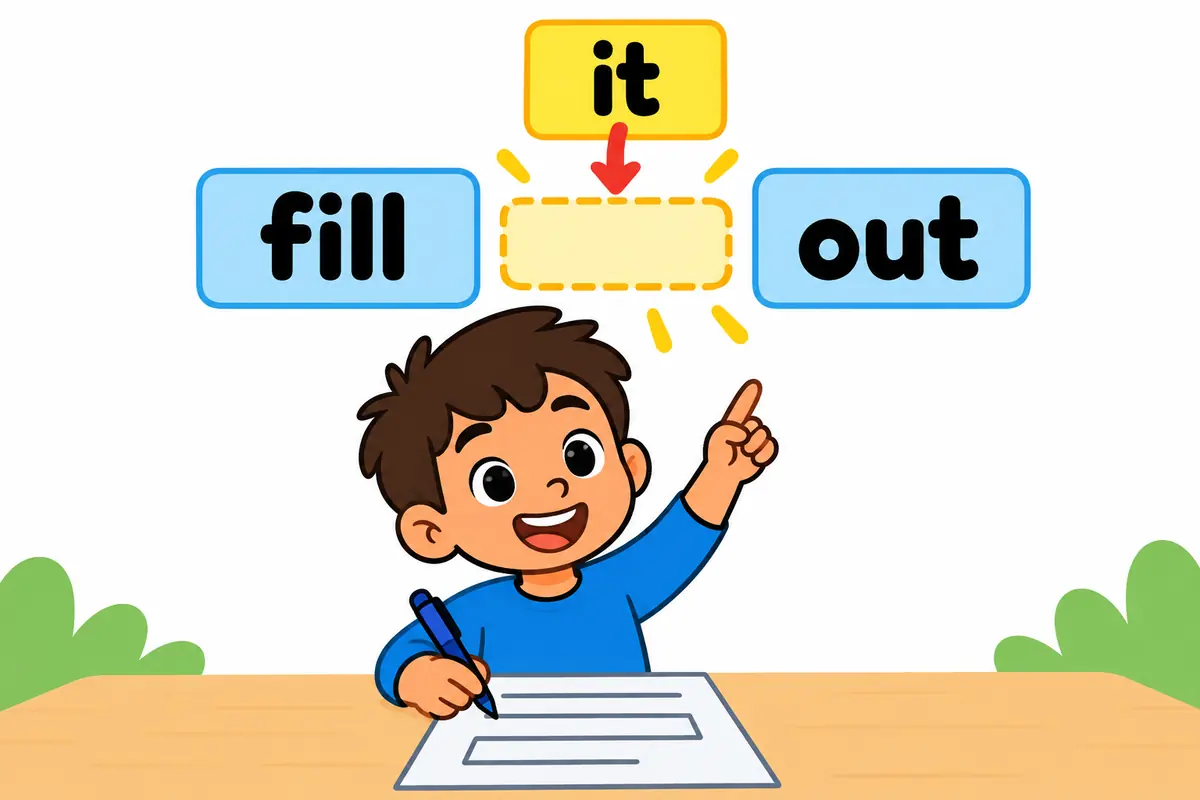
| fill + pronoun + out | Fill it out before Friday. | With a pronoun, the middle position is the only correct one. |
| be filled out | The visa form was filled out in error. | Passive voice, usual in instructions and reports. |
| fill out (no object) | He filled out during the summer. | Intransitive body sense: gaining weight or shape. |
| fill out + text | Add a chart to fill out the section. | The object is material, not a person or a form. |
Separability decides most errors. Because a pronoun cannot follow out, the natural sentence is fill it out, and the same rule covers fill them out and fill this out. The intransitive sense breaks the pattern entirely, since nobody is being completed.
Fill out in a sentence: examples across contexts
The phrase keeps its sense of completing something while the setting changes. The ten sentences below move from a school office to a gym, and each shows which sense the object selects.
| Context | Example sentence | Why this works |
|---|---|---|
| Classroom | Every pupil must fill out a reading record each week. | The form sense with a clear object. |
| School office | Please fill the consent form out and return it tomorrow. | Uses the separated order in an instruction. |
| Workplace email | Fill out the timesheet before you leave on Friday. | Names the document and a deadline. |
| Job application | Candidates who fill out the form incorrectly are not considered. | Shows the form as the object of a habit. |
| Healthcare | Fill it out at the desk and hand it to the nurse. | Pronoun sits between fill and out. |
| Immigration | Each traveller fills out a landing card on the plane. | Formal context with the third person singular. |
| Banking | The clerk helped her fill out the direct-debit mandate. | Another form, with a helper as subject. |
| Conversation | He filled out a lot after he joined the rowing club. | Intransitive sense of gaining healthy weight. |
| Fitness writing | Puppies fill out quickly once they are on a steady diet. | Same body sense applied to an animal. |
| Editing | Two maps will fill out the final chapter. | The object is material that completes a text. |
Notice that only the last three rows drop the form idea. When the subject is a living body, fill out points at shape; when the object is a document or a text, it points at completion. Choosing deliberately is what fatten cannot do, because fatten keeps only the weight sense.
Fill out vs fill in
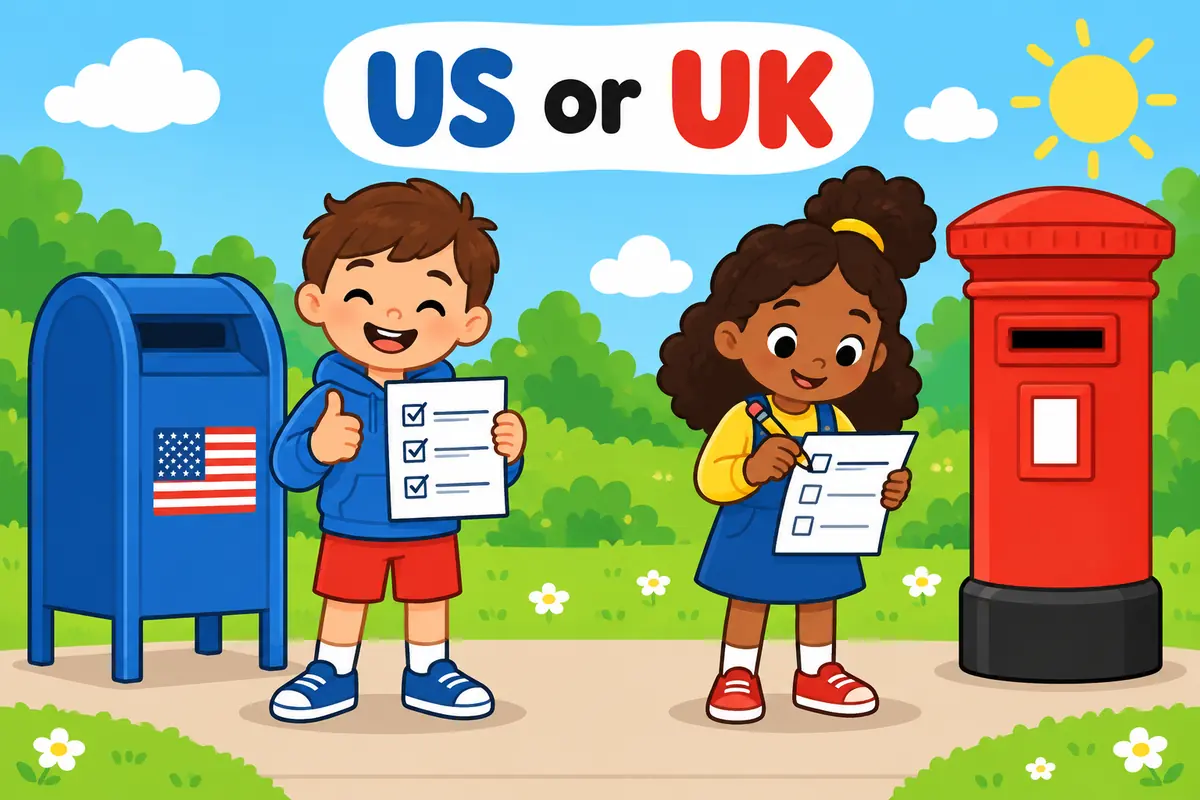
Fill out and fill in mean the same thing for paperwork, and the choice is mostly regional. American English prefers fill out a form, while British English prefers fill in a form, so a consistent document should follow its audience rather than mixing the two phrases.
| Attribute | fill out | fill in |
|---|---|---|
| Core meaning | Complete a form or become fuller | Complete a form or add missing detail |
| Regional preference | Common in American English | Common in British English |
| Body sense | Yes: he filled out | No body sense |
| Gap sense | No gap sense | Yes: fill in the blanks |
| Typical object | a form, an application, a chapter | a form, a blank, a detail |
Verdict: choose fill out for an American audience and when you mean the body becoming fuller, and choose fill in for a British audience or when you mean adding a missing detail. Once a matching form is complete, the next step is to submit it, which both varieties word the same way.
Word forms and grammar of fill out
Only fill changes, so the phrase inflects like the base verb and never like a single word. The noun is hyphenated, and the intransitive sense has no passive at all.
| Form | Part of speech | Example |
|---|---|---|
| fill out | phrasal verb, base form | Fill out the form in black ink. |
| fills out | phrasal verb, third person singular | She fills out a log after every visit. |
| filled out | phrasal verb, past and past participle | He filled out the forms yesterday. |
| filling out | phrasal verb, present participle | She is filling out the census online. |
| fill-out form | noun, attributive, rare | Incorrect in most writing: a fill-out form. Prefer the verb. |
| back out | phrasal verb, different meaning | He tried to back out of the deal at the last minute. |
A hyphenated noun such as a fill-out sheet sounds forced, so most writers keep the verb and say a sheet to fill out. The particle out also builds unrelated verbs, and the contrast is worth learning: fill out completes, while back out withdraws.
Common mistakes with fill out
- Incorrect:
Please fill out it before the deadline.Correct: Please fill it out before the deadline. Rule: a pronoun object must sit between fill and out. - Incorrect:
The puppy filled out its coat for winter.Correct: The puppy filled out before winter. Rule: the body sense is intransitive and takes no object. - Incorrect:
She filled out in the missing answers.Correct: She filled in the missing answers. Rule: fill in supplies a missing detail, while fill out completes a whole document. - Incorrect:
Fill the form out it in blue ink.Correct: Fill the form out in blue ink. Rule: when the object is separated, no pronoun is repeated after out. - Incorrect:
He fill out the application.Correct: He filled out the application. Rule: the tense is marked on fill, whose past form is filled.
Practice using fill out
Work through the seven items below, then read the reason with each answer, because the reason is what transfers to your own writing. Near neighbours such as complete and ask out appear among the choices.
- Fill the gap: Every guest should ______ a registration card at the desk.
- Choose the better word: The kitten (filled out / filled in) after a month of good food.
- Correct the error: Kindly fill out it and email it back.
- Build a sentence: use fill + pronoun + out about a visa form that must be finished online.
- Spot the register: which suits a British school letter — fill out the slip, or fill in the slip?
- Change the form: She ______ the survey on the train yesterday. Use the past tense.
- Choose the sense: In the puppy filled out, is the verb transitive or intransitive?
Answers
- fill out — the card is a form that guests complete.
- filled out — the body is becoming fuller, which is the intransitive sense.
- Kindly fill it out and email it back — the pronoun belongs between fill and out.
- Model answer: You must fill it out before your interview on Monday.
- fill in the slip — British English prefers fill in for paperwork.
- filled out — the past form of fill is filled.
- intransitive — no object is completed, so the sentence has no direct object.
The bottom line
Use fill out in a sentence to complete a form or to describe a body becoming fuller, and let the object tell the two apart. The two details that settle most sentences are that the form sense is separable, so a pronoun goes in the middle as fill it out, and that the body sense takes no object at all. When you are writing for a British audience or adding a single missing detail, switch to fill in instead.
Frequently asked questions about fill out
Is fill out one word or two?
The phrasal verb is two words, fill out, as in fill out the form. A hyphen appears only in a rare attributive noun, and even then a fill-out sheet sounds forced. In ordinary writing, keep the verb open and let the object move between fill and out when you separate it.
What does fill out a form mean?
To fill out a form means to write the requested information in every blank space so the document is complete. An applicant fills out a job form, and a traveller fills out a landing card. The object is always the document itself, not the information you write into it.
Can you say fill out or fill in?
Both are correct for paperwork, and the choice is largely regional. American English prefers fill out, and British English prefers fill in. Only fill out also means a body becoming fuller, and only fill in also means supplying a missing detail, so the two phrases overlap but do not match completely.
What does it mean to fill out as a person?
To fill out as a person means to become fuller or rounder in build, usually in a healthy way as someone grows. It is the intransitive sense, so it takes no object: the teenager filled out over the summer. For gaining weight in a negative sense, writers often choose the plainer verb fatten instead.