Flair vs Flare: The Difference in Everyday Writing
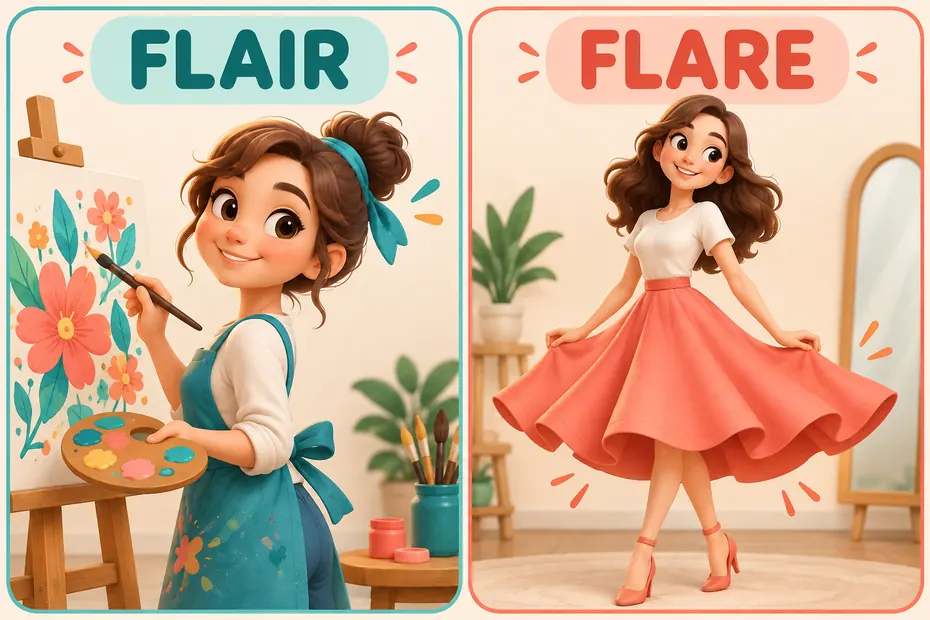
Flair is talent, aptitude or distinctive style: “She has a flair for design.” Flare can describe a burst of light, a sudden intensification, or an outward spreading shape: “The skirt flares at the hem.” Flair is ordinarily a noun; flare can be a noun or a verb. The words normally sound alike, so choose by meaning.
Correction to the retained article: “Her anger flared up” means anger suddenly intensified, not that it became physically cone-shaped. Flare is not a general synonym for any “visible problem.” For dashboard indicators, came on or flashed is usually clearer unless you specifically mean a sudden brightening. “Flaring gemstones” is also an unusual example; sparkling gemstones better describes ordinary reflected light.

Key Facts and Comparison Table
| Word | Useful meaning | Common pattern | Example |
|---|---|---|---|
| Flair | Talent or aptitude | A flair for something | He has a flair for storytelling. |
| Flair | Distinctive style | With flair | She presented the idea with flair. |
| Flare | Sudden light or intensity | Flare up | The dispute flared up again. |
| Flare | Spread outward | Flare at the bottom | The trousers flare below the knee. |
| Flare | Signal light or device | A flare | The illustration shows a signal flare. |
Flair: Talent and Style
Someone with a flair for a task has a knack or aptitude for it. “Mina has a flair for explaining complex ideas” praises her ability. Flair is not restricted to painters, performers or fashion designers. It can describe a talent for making friends, arranging spaces, telling stories or solving a communication problem.
A second use concerns distinctive appeal: “The room has a cheerful flair.” “The chef serves a simple dish with flair.” These sentences emphasize style in the result or presentation. Merriam-Webster records aptitude and attractive style in its flair entry.
The useful pattern is a flair for followed by a noun or an -ing phrase: “a flair for color,” “a flair for writing,” or “a flair for making visitors feel welcome.” Use with flair when describing how an action is performed. “She writes with flair” and “She has a flair for writing” are both natural, but their grammar differs.
In a review, explain what the flair looks like. “The presenter spoke with flair” is a judgment. “The presenter used vivid examples and a lively delivery” gives readers a concrete basis for that judgment. The spelling rule does not require extravagant praise.
Flare: Outward Shape
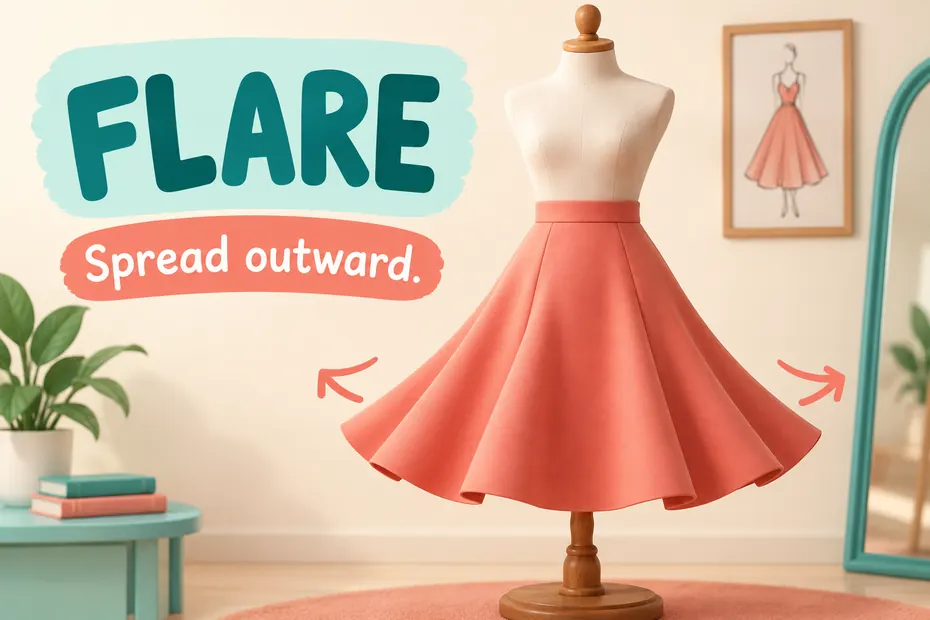
Use flare when a shape opens or spreads outward. “The skirt flares at the hem.” “The trousers have a pronounced flare.” The verb describes the spreading, while the noun names the shape or spreading portion. Merriam-Webster includes these senses in its flare entry.
The forms are flare, flares, flared, and flaring. Notice that flaring drops the final silent e. “A flared sleeve” describes shape, whereas “a sleeve with flair” describes style. A sleeve could have both: it might widen at the wrist and have a distinctive decorative design.
“The dancer’s skirt flared as she turned” concerns outward movement. “The dancer performed with flair” concerns expressive style. The same person or object can appear in both sentences, so the topic alone does not choose the spelling.

Flare: Light and Sudden Intensification
A flame can flare, meaning burn or shine suddenly or intensely. A flare can also be a bright signal or the device producing it. These are language examples rather than instructions for handling signaling equipment.
The word extends to sudden intensification: “Tempers flared during the discussion.” “The argument flared up after a misunderstanding.” Neither sentence describes literal flames. The image is a quick increase in intensity. Do not replace these uses with flair; talent and attractive style are not the intended meanings.
As a noun, flare-up commonly uses a hyphen: “There was a flare-up of the dispute.” As a verb, write two words: “The dispute may flare up.” Follow the publication’s preferred dictionary for a specialist expression, but keep the noun-versus-verb distinction clear.
A Quick Choice Test
- Replace the word with talent or style. If that fits, choose flair.
- Replace it with spread outward, brighten suddenly, or intensify. If that fits, choose flare.
- Check the grammar. “Has a ___ for” suggests flair; “tempers ___” requires flare.
Practice: “She has a ___ for choosing jackets whose sleeves ___.” The answers are flair and flare. The first names aptitude; the second describes outward shape.
Frequently Asked Questions
Is it a flair or flare for writing?
A flair for writing. The phrase describes aptitude or talent.
Is it temper flared or temper flaired?
Temper flared. Flare is the verb for sudden intensification; flair is ordinarily a noun.
Are flared trousers stylish by definition?
No. Flared describes their outward-widening shape. Whether they have flair is a separate judgment about style.
Do flair and flare sound different?
They ordinarily sound the same. Meaning and grammar distinguish their spellings.
Is flare-up one word?
The noun is commonly hyphenated: a flare-up. The verb phrase is two words: flare up.
Earlier Article, Preserved for Reference
The original text follows. Use the updated examples above for figurative intensity, outward shape and the difference between brightening and merely indicating a problem.
Have you ever been confused about when to use “flair” and when to use “flare”? Well, I’ll help you clear up the confusion once and for all. In this text, I’ll discuss the differences between “flair” and “flare” and provide you with some tips on how to use them correctly.
Many people often mix up these two words, but they actually have distinct meanings and uses. Understanding the nuances between “flair” and “flare” will not only improve your writing but also enhance your communication skills. So, let’s immerse and unravel the mystery behind these two commonly confused words.
By the end of this article, you’ll have a solid grasp on when to use “flair” and when to use “flare,” allowing you to express yourself with confidence and precision. So, let’s get started and master the art of using “flair” and “flare” appropriately.
Key Takeaways
- “Flair” and “flare” are two distinct words with different meanings and uses.
- “Flair” is a noun that refers to a unique or distinctive style or talent, emphasizing individuality and personal expression.
- “Flare” can be both a noun and a verb. As a noun, it refers to a sudden and intense burst of light, flame, or emotion. As a verb, it means to become wider or expand outward.
- Understanding the precise meanings and appropriate usage of “flair” and “flare” is crucial for effective communication.
- “Flair” is used to describe someone’s distinctive style, personal expression, artistic talents, or creativity in various fields.
- “Flare” is used to describe situations involving bursts of light, fire, sudden intensity, or spreading outwards.
The Difference Between “Flair” and “Flare”
Understanding the difference between similar-sounding words is crucial for effective communication. In this section, I’ll investigate into the distinct meanings and usage of “flair” and “flare,” ensuring that you can confidently choose the correct word in your writing.
What is “flair” and its definition?
“Flair” is a noun that refers to a unique or distinctive style or talent. It is often associated with a special aptitude or creativity in a particular area. Here are a few key points to remember about “flair”:
- It emphasizes individuality and personal expression.
- It can refer to a natural talent or a developed skill.
- “Flair” is often related to creativity, originality, and a sense of style.
For example: She has a flair for fashion, always putting together trendy and unique outfits.
What is “flare” and its definition?
On the other hand, “flare” is both a noun and a verb that has a completely different meaning. It has several distinct uses, but here I’ll focus on the most common one:
- As a noun, “flare” refers to a sudden and intense burst or outburst of light, flame, or emotion. It suggests a brief period of increased brightness or intensity.
For example: The fireworks lit up the night sky with a colorful flare.
- As a verb, “flare” means to become wider or expand outward, usually in a conical or rounded shape. This can refer to physical objects or even emotions.
For example: Her anger flared up when she heard the news.
The Difference:
While “flair” and “flare” may sound similar, their meanings and usage are distinctly different. Here’s a quick summary of the differences:
| Word | Part of Speech | Meaning |
|---|---|---|
| Flair | Noun | Unique style or talent |
| Flare | Noun/Verb | Burst of light or outward expansion |
Remember, “flair” relates to personal expression and creativity, while “flare” refers to bursts of light or objects expanding outward. By understanding these differences, you’ll be able to use the correct word in your writing, improving your overall communication.
When to Use “Flair”
Flair is a word that often adds a touch of creativity and personal style to our language. It refers to a unique or distinctive talent or style that sets someone apart. Here’s a breakdown of when to use “flair”:
- Definition of Flair: Flair is a noun that represents a knack or talent for doing something, usually associated with creativity or personal expression. It’s the ability to add a special touch or unique twist to something, whether it’s in fashion, art, writing, or any other area where individuality shines.
- Distinctive Style: One common use of “flair” is to describe someone’s distinctive or unique style, whether it’s in fashion, design, or even cooking. For example, you might say, “She has a flair for fashion, always wearing bold and unconventional outfits that turn heads.”
- Personal Expression: “Flair” can also refer to someone’s ability to express themselves in a creative or captivating way. It suggests a certain charm or talent for making things interesting and engaging. For instance, you might say, “He writes with such flair, his words effortlessly painting vivid pictures in the reader’s mind.”
- Artistic Talents: Artists, musicians, writers, and performers often have their own unique flair that separates them from others in their field. This term acknowledges their individuality and the special qualities they bring to their craft.
- Use in Professional Settings: In a professional context, having flair can be seen as a positive attribute. It implies an ability to think outside the box, bring fresh ideas to the table, or add a touch of creativity to one’s work.
Remember, “flair” is all about showcasing individuality and personal expression in various aspects of life. It’s a word that celebrates creativity and unique talents. By understanding its definition and appropriate usage, you can confidently incorporate “flair” into your writing and conversations.
Examples of Using “Flair” Appropriately
As I mentioned earlier, “flair” is a noun that represents a unique or distinctive talent or style. It can be used to describe someone’s personal expression, artistic talents, or distinctive style. Now, let’s investigate into some examples to further illustrate how to use “flair” appropriately in different contexts:
- Fashion: Sarah has a real flair for fashion. She effortlessly combines different patterns and colors to create stunning outfits.
- Culinary Skills: My grandmother has a flair for cooking. She can take basic ingredients and transform them into mouthwatering dishes.
- Interior Design: The interior designer added a touch of flair to the living room with vibrant artwork and eclectic furniture.
- Writing: The author’s novels are known for their vivid descriptions and imaginative storytelling. She truly has a flair for writing.
- Public Speaking: The keynote speaker delivered a powerful presentation, captivating the audience with her charisma and flair.
- Sports: Alex’s flair on the basketball court is unmatched. His incredible ball-handling skills and fancy footwork make him a standout player.
- Performance: The theater troupe’s production was filled with energy and creativity. Each actor brought their own unique flair to their roles.
These examples highlight the various areas where “flair” can be used appropriately. From fashion and cooking to writing and public speaking, “flair” is all about showcasing one’s distinctive talents and style. Remember, using “flair” adds a touch of creativity and personal expression to your vocabulary.
Understanding the definition and appropriate usage of “flair” allows individuals to confidently incorporate it into their writing and conversations. So, start using “flair” to describe your unique abilities and talents, and add that extra touch of style to your communication.
Now that we have explored examples of using “flair” appropriately, let’s move on to understanding the difference between “flair” and “flare”.
When to Use “Flare”
Flare and flair are two words that are often confused due to their similar spelling. But, they have distinct meanings and should be used appropriately in different contexts. In this section, I will focus on when to use the word “flare” and provide you with a clear understanding of its definition and usage.
Definition of “Flare”:
Flare, as a verb, refers to the act of burning or glowing brightly. It can also mean to burst out suddenly or to become more intense. As a noun, flare can describe a sudden burst of light or flame, a signal to attract attention, or a gradual widening or spreading outwards.
Examples of Using “Flare” Appropriately:
- When there is a fire, flames can flare up and engulf the surroundings.
- She wore a necklace with flaring gemstones that caught everyone’s attention.
- The sunset painted the sky with vibrant colors, creating a beautiful flare of light.
Difference Between “Flare” and “Flair”:
It’s essential to understand the distinction between “flair” and “flare” to ensure accurate usage. While “flare” relates to light, fire, or sudden intensity, “flair” refers to a person’s unique and stylish expression or talent in a particular area.
- Flare refers to burning or glowing brightly, bursting out suddenly, or spreading outwards.
- “Flare” can be used as both a verb and a noun.
- “Flare” should be used to describe situations involving light, fire, sudden bursts, or spreading out.
- Make sure to differentiate “flare” from “flair,” which relates to personal expression or talent.
Using words appropriately enhances our communication skills. Understanding the precise meanings and proper usage of “flare” allows us to confidently incorporate it into our writing and conversations. In the next section, we will explore the definition and appropriate usage of “flair” to further enhance our linguistic prowess.
Examples of Using “Flare” Appropriately
When it comes to using the word “flare” appropriately, it’s essential to understand its precise meaning and context. Let me provide you with some examples to illustrate how “flare” can be used correctly in different situations:
- Burning Brightly: “The fireworks displayed a spectacular flare in the night sky, illuminating the entire city.”
- Bursting Out Suddenly: “The protesters set off flares, creating a momentary flare of chaos and commotion among the crowd.”
- Spreading Outwards: “In the distance, I could see a vivid flare of light coming from the lighthouse, guiding ships safely to the shore.”
- Intense Burst of Emotion: “Emily’s temper flared as she fiercely defended her viewpoint during the heated debate.”
- Visible Sign of a Problem: “The warning lights on the car’s dashboard started to flare, indicating an issue with the engine.”
By seeing these examples, you can better grasp the different ways in which “flare” can be used accurately. Remember to use this word when referring to something that burns or glows brightly, bursts out suddenly, spreads outward, or signifies an intense burst of emotion or a visible problem.
Understanding the difference between “flair” and “flare” is crucial to avoid confusion and communicate effectively. While “flair” refers to personal expression and distinctive style, “flare” pertains to burning or glowing brightly, bursting out suddenly, or spreading outwards. So, let’s continue exploring the definition and appropriate usage of “flair” in the next section to further enhance our linguistic prowess.
Conclusion
Understanding the appropriate usage of “flare” is essential for effective communication. Throughout this article, we have explored the different contexts in which “flare” can be used accurately. From its association with burning or glowing brightly to indicating a sudden burst of emotion or a visible problem, “flare” has a range of meanings that should be used with precision.
By distinguishing between “flair” and “flare,” we can avoid confusion and convey our thoughts more clearly. The examples provided in this text serve as valuable illustrations of how “flare” can be employed correctly in various situations.
Moving forward, the next section will investigate into the definition and appropriate usage of “flair,” further enhancing our linguistic prowess. Stay tuned to expand your knowledge and develop a deeper understanding of this intriguing word.
Remember, mastering the nuances of language is a continuous journey, and by honing our skills, we can become more effective communicators.
Frequently Asked Questions
1. What does the word “flare” mean?
“Flare” can mean burning or glowing brightly, bursting out suddenly, spreading outwards, or indicating an intense burst of emotion or a visible problem.
2. How can “flare” be used in different contexts?
“Flare” can be used to describe a fire or torch that burns brightly, a sudden burst of light or energy, the spreading out of something like a skirt or a flower, or to convey intense emotions or visible issues.
3. Why is it important to understand the difference between “flair” and “flare”?
Understanding the difference between “flair” and “flare” is important to avoid confusion and communicate effectively. “Flair” refers to a distinctive or stylish elegance, while “flare” refers to the various meanings mentioned above.
4. What is the next topic that will be covered?
The next section will explore the definition and appropriate usage of the word “flair” to enhance linguistic prowess.


