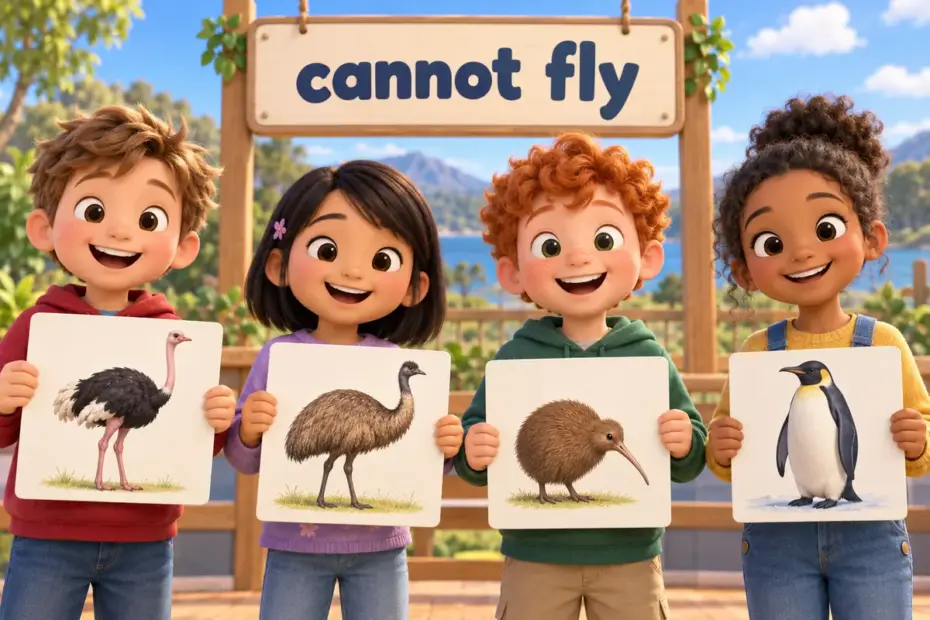
Flightless birds name in english covers the birds that lost the ability to fly, from the towering ostrich and emu to the swimming penguin and the shy kiwi. Each species traded flight for another strength, so a useful list pairs every bird with the trait that replaced its wings.
flightless birds name in english at a glance
- Flightless birds are birds that cannot fly because their wings are small or weak for their body weight.
- The group includes ostriches, emus, rheas, cassowaries, kiwis and penguins.
- Some flightless birds run fast across open ground, while penguins use their wings as flippers to swim.
- Several island species, such as the dodo, died out after people and their animals arrived.
- The commonest mistake is assuming that every flightless bird is a penguin.
What are flightless birds?
A flightless bird is a bird whose wings cannot lift it off the ground, usually because the wings are small for the body or the flight muscles are weak. The group is not a single family, so an ostrich, a kiwi and a penguin each lost flight separately, and each gained a different skill in return. A phrase in real use appears in flightless bird in a sentence, which shows the adjective beside the noun.
| Group | Example birds | Why they cannot fly |
|---|---|---|
| Ratites | ostrich, emu, rhea, cassowary | heavy bodies and small wings suit running |
| Kiwis | kiwi | tiny wings and a hidden, ground-based life |
| Penguins | emperor, gentoo, rockhopper | wings became flippers for swimming |
| Island rails | weka, takahe | isolated islands had few ground predators |
| Water birds | steamer duck, flightless grebe | diving replaced flight for food |
| Extinct kinds | dodo, moa | loss of flight left them open to new predators |
One honest limit sits beside the label. Flightless birds are defined by what they cannot do rather than by what they share, so the list gathers very different species under one heading. A penguin dives for fish while an ostrich sprints across dry plains, and the only strong link between them is the lost ability to fly.
A second useful split is between birds that run and birds that swim. Running birds such as the ostrich, emu and rhea have long legs and live on open ground, while swimming birds such as the penguin have dense feathers and flipper-like wings and live near cold water. Naming the replacement skill beside the bird, as in a swimming flightless bird such as the penguin, gives the clearest picture in the fewest words.
How do you name a flightless bird in a sentence?
Most sentences give the missing skill, classify the bird or name its habitat, and each frame follows a short, repeatable pattern.
| Pattern | Example | What it signals |
|---|---|---|
| a + bird + cannot fly | A penguin cannot fly. | the defining trait |
| a + bird + runs instead | An ostrich runs instead of flying. | the replacement skill |
| the + bird + is a + group | The emu is a ratite. | classification |
| a + bird + lives in + place | A kiwi lives in the forests of New Zealand. | habitat |
| flightless + bird + such as + name | A flightless bird such as the rhea grazes the plains. | an example |

Flightless birds name in english: examples across contexts
The same bird names move from a classroom to a zoo label and a conservation leaflet, and each setting asks for a different sentence. A familiar phrase sits in flightless in a sentence, nesting language appears in birds nest in a sentence, and a contrast with flight sits in birds eye view in a sentence.
| Context | Example sentence | Why this works |
|---|---|---|
| Classroom | Sort each bird into the running group or the swimming group. | a sorting task |
| Nature guide | The ostrich cannot fly but it outruns every other bird. | a factual note |
| Zoo label | The emu is a flightless bird of Australia. | an exhibit note |
| Conservation leaflet | The kiwi is threatened by introduced predators. | a shared cause |
| Travel writing | Penguins waddled along the cold shore. | a scene detail |
| Conversation | Which flightless bird swims best? | an everyday question |
| Children’s book | The little kiwi hid among the ferns. | a simple image |
| Museum sign | The dodo lived on an island and could not fly. | a history note |
| Birdwatching note | A weka pecked along the forest path. | a field note |
| Exam answer | Flightless birds have wings but cannot use them for flight. | a formal definition |
Which flightless bird is which?
Match the bird to the strength you are describing rather than to its fame, because the group is united only by the loss of flight.
| Situation | Pick | Example |
|---|---|---|
| Fastest on land | ostrich | The ostrich is the fastest running bird. |
| Best in water | penguin | A penguin swims using its wings as flippers. |
| Smallest | kiwi | The kiwi is a small, round forest bird. |
| Tallest | ostrich | The ostrich stands taller than a person. |
| Lives in deep cold | penguin | Penguins breed on cold southern shores. |
The ostrich is the bird to name for speed on land, while the penguin is the bird to name for swimming, so choose the species that matches the skill in your sentence.
Word forms and grammar of flightless bird names
The word flightless is an adjective, and its noun form flightlessness describes the state. For a wider set of birds, the list of birds a to z extends the same vocabulary.
| Form | Part of speech | Example |
|---|---|---|
| flightless | adjective | The penguin is a flightless bird. |
| flightlessness | noun | Flightlessness evolved on many islands. |
| flight | noun | The ostrich has lost the ability to fly. |
| ratite | noun | The emu is a large ratite. |
| flipper | noun | A penguin uses each flipper to steer. |
| waddle | verb | Penguins waddle on land and swim at sea. |
| plumage | noun | Its dense plumage keeps it warm. |
Common mistakes with flightless bird names
Mistake 1: all birds can fly. Incorrect: All birds can fly. Correct: Most birds can fly, but flightless birds such as the penguin cannot. Rule: flightless birds are a real group, so all is too strong a claim.
Mistake 2: penguins in the Arctic. Incorrect: Penguins live in the Arctic. Correct: Penguins live in the southern hemisphere. Rule: penguins breed in the south, while the Arctic has no penguins at all.
Mistake 3: a penguin is a ratite. Incorrect: The penguin is a ratite. Correct: The emu and the ostrich are ratites, but the penguin is not. Rule: ratites are a running group, and a penguin is a swimming bird.
Mistake 4: no wings at all. Incorrect: Flightless birds have no wings. Correct: Flightless birds have wings, but the wings cannot lift them. Rule: a flightless bird keeps its wings and uses them for balance or swimming.
Mistake 5: the plural of ostrich. Incorrect: Two ostrichs crossed the road. Correct: Two ostriches crossed the road. Rule: nouns ending in -ch add -es for the plural.
Practice using flightless birds name in english
- Fill in the blank: The ___ is the fastest running bird.
- Choose the better word: A (penguin / eagle) is a flightless bird.
- Correct the error: Penguins live in the Arctic.
- Build a sentence: use cannot fly to describe the ostrich.
- Spot the register: which line suits a nature guide, (a) That big bird can’t fly, funny, or (b) The ostrich cannot fly but it outruns every other bird?
- Fill in the blank: The ___ is a small flightless bird of New Zealand.
Answers
- ostrich, because the ostrich runs faster than any other bird.
- penguin, because a penguin cannot fly while an eagle can.
- Penguins live in the southern hemisphere; the Arctic has none.
- The ostrich cannot fly, so it runs across the open plains.
- (b), because a nature guide uses clear, factual wording.
- kiwi, because the kiwi is a small flightless bird of New Zealand.

The bottom line
Flightless birds name in english gather very different species under one heading, so the skill that replaced flight matters more than the label itself. Keep penguins in the south, remember that flightless birds still have wings, and write the plural as ostriches. A list that names the bird, its group and its replacement skill is the one readers remember.
Frequently asked questions about flightless birds
What are flightless birds?
Flightless birds are birds that cannot fly because their wings are too small or their flight muscles too weak for their body weight. The group includes ostriches, emus, rheas, cassowaries, kiwis and penguins, each of which lost flight separately and gained another skill instead.
Why can penguins not fly?
Penguins cannot fly because their wings became stiff flippers better suited to swimming, and their bodies are heavy and dense for diving. The same features that stop flight let a penguin move fast underwater to catch fish and escape predators.
What is the largest flightless bird?
The ostrich is the largest flightless bird, standing taller than a person and running faster than any other bird. Its long legs and small wings suit open grassland rather than the air, so speed on the ground replaced flight and made it a runner.
Do flightless birds live only on islands?
No. Many flightless birds such as the ostrich, emu and rhea live on large continents, while others such as the kiwi and the extinct dodo evolved on islands. Island life often produced flightless birds because there were few ground predators.