Frivolous describes something that lacks seriousness, weight or good sense. To use frivolous in a sentence, place it before the noun it judges: “a frivolous complaint” or “a frivolous purchase.” The adjective carries a hint of disapproval, so it suits writing about spending, objections and behaviour more than neutral description.
Frivolous at a glance
- Frivolous is an adjective; its derived forms are the adverb frivolously and the nouns frivolity and frivolousness.
- The core sense is a lack of seriousness, so it usually judges spending, objections, remarks or behaviour.
- Attributive use (a frivolous claim) is far more common than predicative use (the claim was frivolous).
- Its commonest collocations are frivolous lawsuit, frivolous spending, frivolous remark and frivolous pleasure.
- The commonest error is treating frivolous as a warm synonym for fun; it actually signals waste or poor judgement.
What does frivolous mean?
Frivolous is an adjective meaning not serious, sensible or worth serious attention. The Cambridge entry for frivolous separates two strands: a light, playful attitude, and a thing too unimportant to deserve effort. The word also has a legal life, where a frivolous claim is one brought without any real basis. Where the mood is innocent and cheerful rather than wasteful, carefree and light-hearted is the fairer word, because frivolous always keeps a note of criticism.
| Sense | Plain meaning | Example sentence |
|---|---|---|
| Light and unserious | Behaviour that refuses to be serious | Their frivolous jokes broke the tension in the staffroom. |
| Too unimportant to matter | A detail or amount with no real weight | The auditor ignored the frivolous difference of two pence. |
| Legally baseless | A claim brought with no proper ground | The tribunal threw out the frivolous complaint in a single morning. |
One limitation is worth stating plainly. Frivolous is a judgement, not a measurement. A purchase can be modest and still frivolous, and an expensive one can be perfectly sensible, so the word reports the writer’s view of its purpose rather than its price. It never means simply cheap, and it never means fun.
How do you use frivolous in a sentence?
The adjective attaches to the thing being judged, and the verb that introduces it often does the dismissing. Five patterns cover almost every real sentence, and the attributive one is the workhorse of formal writing.
| Pattern | Example | What it signals |
|---|---|---|
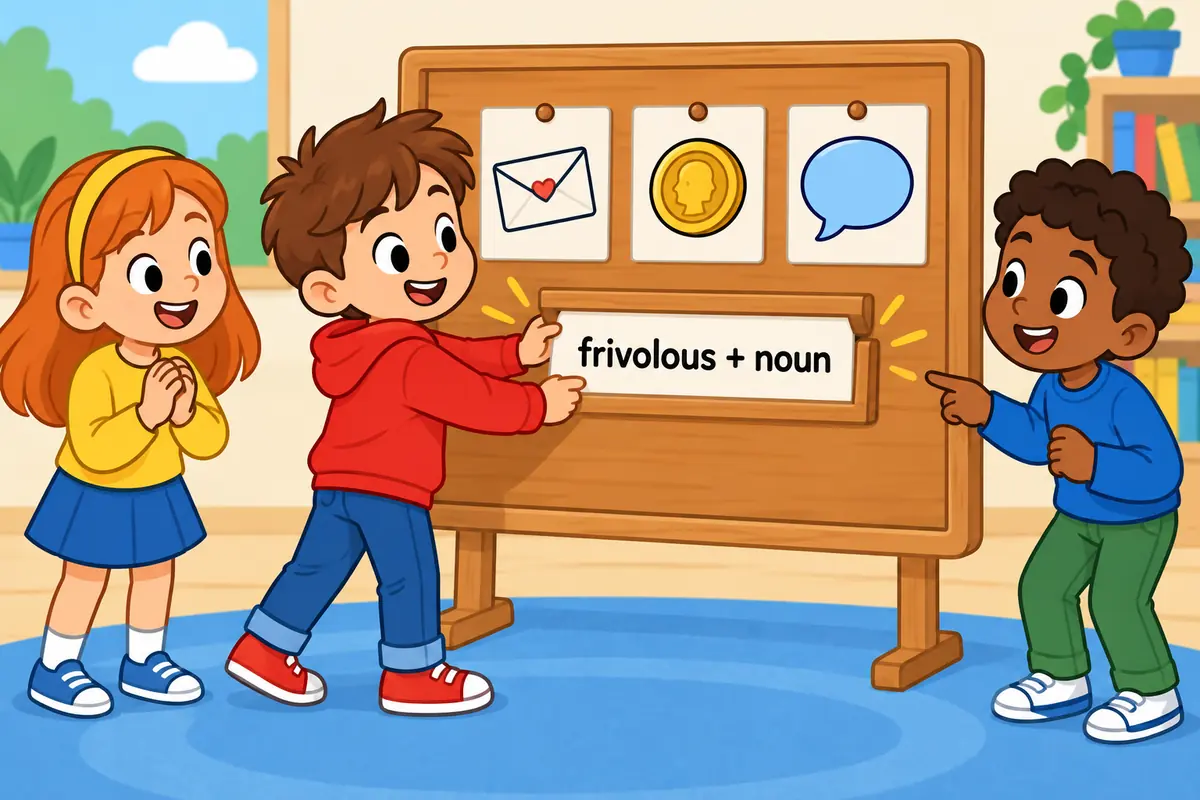
| frivolous + noun | A frivolous objection delayed the vote. | The writer judges the thing as not worth serious attention. |
| linking verb + frivolous | The application was frivolous. | States the judgement directly, common in legal and formal prose. |
| more / most frivolous | The second appeal was even more frivolous than the first. | Ranks two things by how little weight they deserve. |
| treat or dismiss as frivolous | The chair dismissed the point as frivolous. | Reports how one person judged another’s contribution. |
| verb + frivolously | The committee spent frivolously on catering. | Describes the manner of an action rather than the thing itself. |
Frivolous in a sentence: examples across contexts
Frivolous keeps its judgement as it moves between registers, but the thing being judged changes. The nine sentences below shift from a classroom to a tribunal, and each one names what is being called unworthy of serious effort.
| Context | Example sentence | Why this works |
|---|---|---|
| Classroom | The class spent the trip fund on a frivolous mascot instead of the museum tickets. | A concrete purchase shows the word judging a wasteful choice. |
| Workplace email | Please confirm that no frivolous expenses were claimed during the conference. | The formal register fits a written internal instruction. |
| News report | The mayor dismissed the recall petition as a frivolous stunt. | Reports how a public figure judged an opponent’s action. |
| Legal writing | Costs may be awarded when a party makes a frivolous application. | Uses the technical sense: no proper legal basis. |
| Conversation | We bought a frivolous ice-cream machine and have used it twice. | The first person and the light tone show the word works in speech. |
| Academic writing | The study set aside what it called the frivolous question of colour preference. | Signals that a line of enquiry was judged not serious. |
| Performance review | A pattern of frivolous leave requests affected the whole team. | Ties the adjective to a repeated behaviour rather than one act. |
| Council meeting | Residents said the new fountain was a frivolous use of public money. | Names who is making the judgement, which is typical of civic debate. |
| Advertising critique | The campaign promised nothing beyond a frivolous slogan. | Dismisses the work by attacking its seriousness, not its cost. |
Frivolous vs trivial
Frivolous and trivial both shrink a thing, but they shrink different things. Frivolous attacks seriousness and good sense; trivial attacks size and importance. Flippant is a close cousin, but it judges the tone of flippant answers rather than the waste in an action.
| Attribute | frivolous | trivial |
|---|---|---|
| Core meaning | Without seriousness or good sense | Small, unimportant, of little value |
| What it judges | Motive, propriety or seriousness | Size, importance or difficulty |
| Typical collocations | frivolous lawsuit, frivolous spending | trivial detail, trivial matter |
| Strength | Stronger; implies criticism of waste | Milder; implies the thing merely does not matter |
| Register | Formal, legal and journalistic as well as everyday | Neutral and everyday across all registers |
| Describing a person | Can describe a person’s manner or attitude | Rarely describes a person directly |
Verdict: use frivolous when something shows a lack of seriousness or good judgement, and use trivial when the point is only that something is small and unimportant. When the point is only that something is trivial or minor, the milder adjective is the honest choice.
Word forms and grammar of frivolous
Frivolous stays an adjective in every position, so the noun and adverb slots are filled by different words. The matching noun frivolity keeps the same judgement in a smaller, often literary form.
| Form | Part of speech | Example |
|---|---|---|
| frivolous | adjective | a frivolous remark |
| frivolously | adverb | They argued frivolously about the colour of the chairs. |
| frivolity | noun | a few hours of harmless frivolity |
| frivolousness | noun | the sheer frivolousness of the scheme |
| frivolities | plural noun | the frivolities of the season |
| frivolousity | non-standard noun — do not use | write frivolity instead |
Common mistakes with frivolous
- Incorrect:
The children felt frivolous and ran laughing through the garden.Correct: The children felt carefree and ran laughing through the garden. Rule: Frivolous adds disapproval; for innocent high spirits choose carefree or playful. - Incorrect:
She answered the serious question frivolous.Correct: She answered the serious question frivolously. Rule: Use the adjective before a noun or after a linking verb; use the adverb to describe how an action is done. - Incorrect:
The delay was pure frivolous.Correct: The delay was pure frivolity. Rule: Frivolous is an adjective; the matching noun is frivolity or frivolousness. - Incorrect:
a frivalous and pointless formCorrect: a frivolous and pointless form. Rule: The spelling keeps the -ous ending: f-r-i-v-o-l-o-u-s.
Practice using frivolous
Work through the six items, then check the reason rather than only the key.
- Fill the gap: The auditor removed the ______ items from the budget because they had no useful purpose.
- Choose the better word: The children were (carefree / frivolous) as they paddled in the cold sea.
- Correct the error: The board rejected the proposal frivolous.
- Build a sentence: use frivolous spending about a club that bought a golden statue.
- Spot the register: which belongs in a formal complaint to a council — the new clock is a frivolous waste of funds, or the new clock is such a silly waste of money?
- Rewrite with the noun: The whole plan seemed frivolous. Use frivolity instead.
Answers
- frivolous — the items had no useful purpose, which is exactly what the adjective judges.
- carefree — paddling in the sea is harmless fun, so the word must not carry criticism.
- The board rejected the proposal as frivolous — the adjective needs a linking verb or the word as before it.
- Model answer: The club’s frivolous spending on a golden statue emptied the accounts.
- The new clock is a frivolous waste of funds — a formal complaint keeps the register and drops the word silly.
- The whole plan had an air of frivolity — the noun takes an article and replaces the adjective.
The bottom line
Use frivolous in a sentence when you want to judge something as lacking seriousness or good sense, and let the surrounding words supply the detail. The two points that decide most sentences are these: the word carries built-in criticism, so it can never simply mean cheerful, and the legal sense applies the same idea in a stricter, more costly setting. For a quality that is shallow rather than wasteful, superficial charm is the better term.
Frequently asked questions about frivolous
Is frivolous always a criticism?
Frivolous nearly always carries disapproval, because it says something lacks seriousness or good sense. Even the lighter sense, a frivolous remark, hints that the speaker should have been more serious. If you want to describe innocent fun without blame, use carefree, playful or light-hearted instead, and keep frivolous for choices you are judging.
What is the noun form of frivolous?
Frivolous is an adjective, so it cannot follow an article directly. Its two nouns are frivolity, which is the more common and more literary choice, and frivolousness, which is clumsier but equally correct. Write the frivolity of the scheme, never the frivolous of the scheme.
Can frivolous describe a person?
Yes, but it describes a person’s manner or attitude rather than the person as a whole. A frivolous young man behaves without seriousness, while a trivial person is rare because trivial usually describes things. The adjective keeps the same meaning whether it points at a person, an action or a claim.
What is a frivolous lawsuit?
In legal writing, a frivolous lawsuit is a case brought without any reasonable basis, so it wastes the court’s time. Judges can impose costs on the party who filed it. The phrase keeps the general meaning of frivolous, but here the lack of seriousness has a precise legal consequence.
Have you ever heard of the word “frivolous” and wondered what it meant? In essence, “frivolous” refers to something that is not serious, important, or sensible, often characterized by a lack of purpose or value.
These frivolous actions, statements, or decisions are often viewed as trivial or unimportant in nature, lacking depth or significance. When labeling something as frivolous, it suggests that it is done in a light-hearted or whimsical manner, without much thought or consideration.
7 Examples Of Frivolous Used In a Sentence For Kids
- Eating candy for every meal is a frivolous choice.
- Buying toys we don’t need is frivolous spending.
- Dressing up in a fancy costume for no reason is frivolous fun.
- Spending hours on a silly game is a frivolous use of time.
- Wasting paper on doodles is a frivolous activity.
- Getting upset over small things is a frivolous reaction.
- Trying to juggle too many tasks at once is a frivolous mistake.
14 Sentences with Frivolous Examples
- Frivolous spending on unnecessary items can lead to financial troubles for college students.
- Some students engage in frivolous debates instead of focusing on their studies.
- It is important to prioritize academics over frivolous activities during the exam season.
- Joining numerous frivolous clubs may distract students from their main goals.
- Spending hours on social media can be seen as frivolous when there are assignments to complete.
- Some students prefer to engage in frivolous gossip rather than meaningful conversations.
- Skipping classes for frivolous reasons can negatively impact academic performance.
- Entering into frivolous relationships can divert focus away from personal growth and development.
- Constantly checking notifications on your phone during lectures is considered frivolous behavior.
- Engaging in frivolous arguments with classmates can create unnecessary tension within the college community.
- Focusing on frivolous fashion trends may lead to overspending on clothes and accessories.
- Using college resources for frivolous purposes can hinder other students’ access to those resources.
- Students should be wary of falling into frivolous peer pressure situations that could harm their academic progress.
- Frivolous spending on expensive gadgets may strain a college student’s limited budget.
How To Use Frivolous in Sentences?
Frivolous means not having any serious purpose or value, being lighthearted or silly in nature. Here is a simple guide to help you use this word in a sentence effectively:
-
Identify the context: Think about a situation, behavior, or action that is not serious or important.
-
Choose the appropriate sentence structure: Use the word frivolous to describe something that is trivial, unnecessary, or not worth serious attention.
-
Build your sentence: Start by introducing the subject, followed by the word frivolous, and then provide details to explain why it is considered frivolous.
-
Examples:
- “She spent all her money on frivolous items like designer handbags and fancy coffee drinks.”
- “Instead of focusing on important tasks, he indulged in frivolous activities like playing video games all day.”
- “The debate quickly turned into a frivolous argument about who was the best superhero.”
-
Practice using the word: Try incorporating frivolous into your conversations or writing to become more comfortable with its usage. Remember, the word is usually used in a negative context to describe things that lack seriousness.
By following these steps, you can confidently use the word frivolous in your everyday language to accurately convey ideas or describe situations that are trivial or unimportant.
Conclusion
In conclusion, the use of frivolous sentences can detract from the overall clarity and impact of communication. When sentences are characterized by frivolity, they often lack substance and fail to convey meaningful information. Instead, frivolous sentences may come across as superficial, distracting, or even unprofessional.
To ensure effective communication, it is essential to avoid the use of frivolous sentences and instead focus on delivering concise, purposeful, and relevant content. By prioritizing clarity and coherence in our writing and speech, we can effectively convey our ideas and engage our audience in a more meaningful manner.


