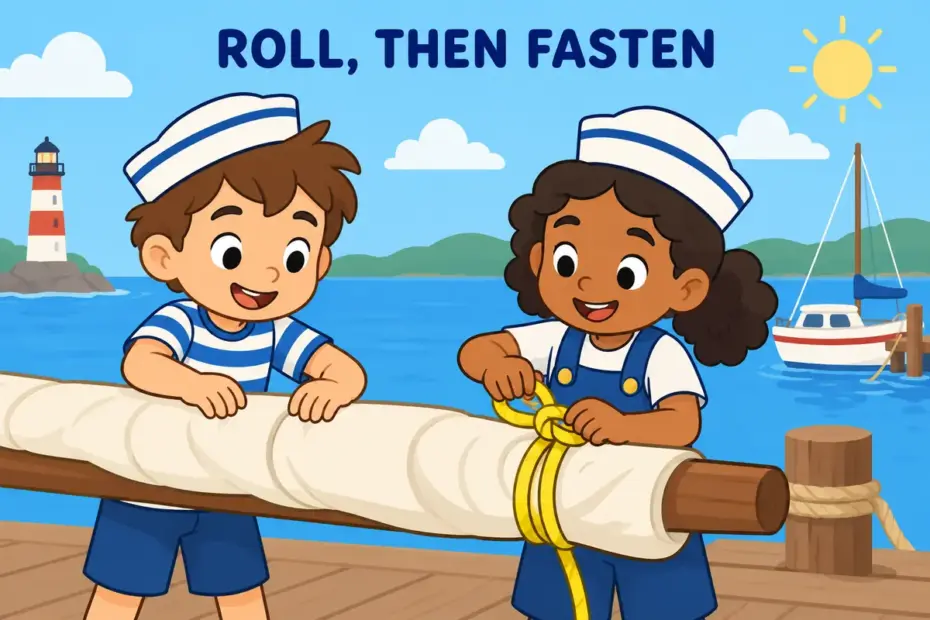
Furl means to roll up and fasten something soft and broad, such as a sail, a flag or an umbrella. To use furl in a sentence, name the thing being rolled and the action that follows: “The crew furled the sail before the squall.” The verb is usually transitive, so the material being rolled is the object.
Furl at a glance
- Furl is a verb; its forms are furl, furls, furled and furling.
- The verb is transitive in its main sense: furl the sail, furl the flag, furl the umbrella.
- The object is always broad, flexible material fixed to a spar, pole or frame.
- Furl belongs to sailing, stagecraft and ceremonial writing rather than everyday speech.
- The commonest error is using furl where its opposite, unfurl, is meant.
What does furl mean?
Furl is a verb meaning to roll up and fasten a broad piece of material, or to be rolled up in that way. The Cambridge entry for furl gives the sail sense first, and that sense still dominates. A third use is figurative: a campaign that is furled has been wound down deliberately, exactly as a banner is rolled around its pole at the end of a parade.
| Sense | Plain meaning | Example sentence |
|---|---|---|
| Roll and secure | Roll fabric up and tie it fast | The sailors furled the mainsail at dusk. |
| Be rolled and secured | Of a sail or flag, fold away on its spar | The flag furled quickly in the gust. |
| Bring to an end | Wind down a campaign or claim figuratively | The committee furled its campaign after the vote. |
One limit is worth stating plainly. Furl is not a general word for folding. You fold the map along its creases and you roll up a sleeve, but you furl only material that hangs from a support and can be gathered around it. Where the material is flat, fold is the honest choice.
How do you use furl in a sentence?
The verb follows four shapes, and the choice between them depends on whether you care about the person doing the rolling or only about the material. Sailors roll up the awning on the same principle that they furl a sail, so the two words often appear together.
| Pattern | Example | What it signals |
|---|---|---|
| furl + object | The deckhand furled the jib. | The plain transitive use; the object is the fabric. |
| furl + object + adverb | She furled the umbrella tightly. | The adverb describes how the roll was finished. |
| be furled | The banner was furled at sunset. | Passive, used when the material matters more than the crew. |
| furl (no object) | The sail furls in seconds. | Intransitive, with the sail doing the folding itself. |
Only the intransitive pattern drops the object, and it is rare outside technical writing about boats and awnings.
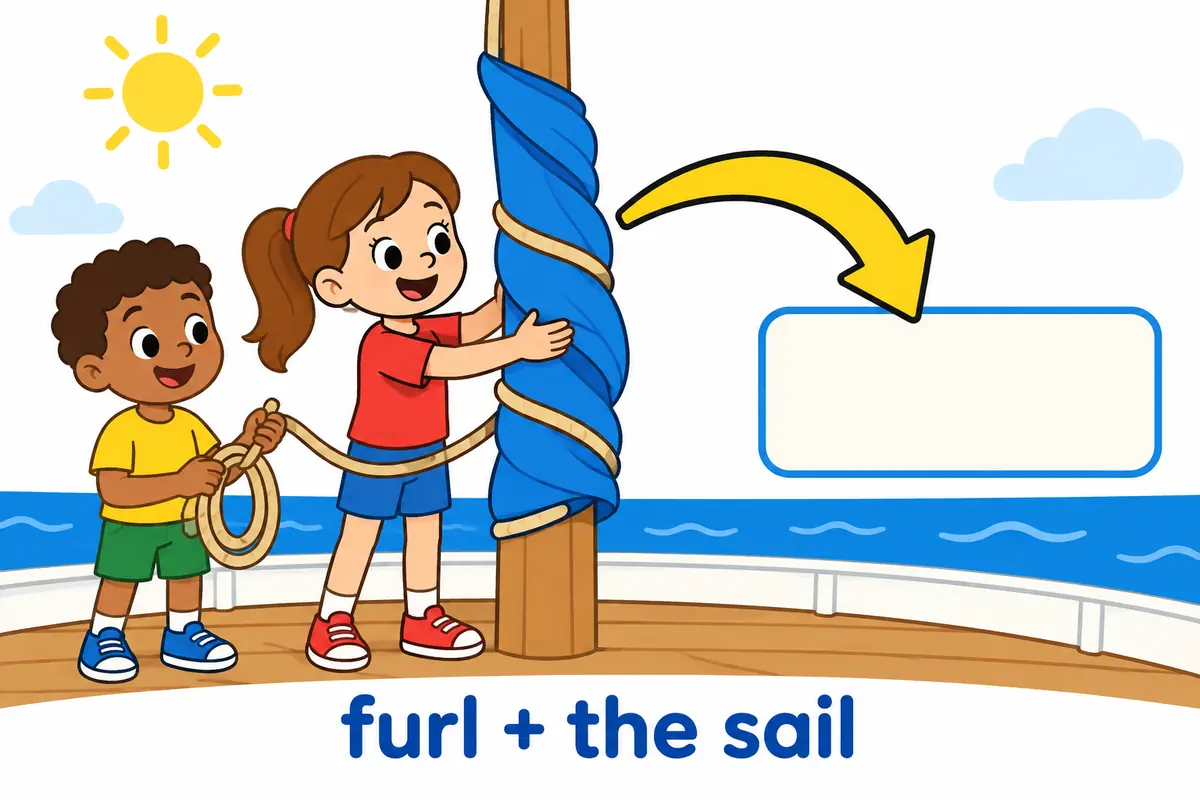
Furl in a sentence: examples across contexts
The verb changes register more than it changes meaning. The nine sentences below run from a harbour to a theatre, and each one names the material that is being gathered. Stagehands wind the cord around the cleat after they furl the backdrop.
| Context | Example sentence | Why this works |
|---|---|---|
| Sailing | The crew furled the topsail as the wind rose. | The sail is the standard object of the verb. |
| Ceremony | Two officers furled the flag at the end of the parade. | Names who rolls and what is rolled. |
| Everyday speech | He furled the umbrella and shook off the rain. | The object is familiar, which softens the technical verb. |
| Theatre | The stagehand furled the backdrop between acts. | Extends the verb to a hanging cloth in a new setting. |
| News report | Protesters furled their banners as the march ended. | Shows the verb in a public, orderly scene. |
| Technical writing | The awning furls around a spring-loaded roller. | Intransitive use that explains a mechanism. |
| History essay | Regiments furled their colours before the surrender. | A formal, slightly literary register suits the period. |
| Business writing | The firm furled the campaign after weak sales. | Figurative sense: the effort is wound down. |
| Conversation | Furl that parasol before it catches the wind. | An imperative that treats the verb as practical advice. |
Only the business sentence uses the verb without any fabric present, which is exactly why it sounds figurative.
Furl vs unfurl and fold
Furl has three near neighbours and is interchangeable with none. Its opposite, unfurl, opens the same material out again; fold bends something flat along a line; roll turns material around itself. You wrap the banner around its pole, which is the everyday cousin of furl.
| Attribute | furl | unfurl | fold |
|---|---|---|---|
| Core job | Roll up and fasten | Open out and spread | Bend flat along a line |
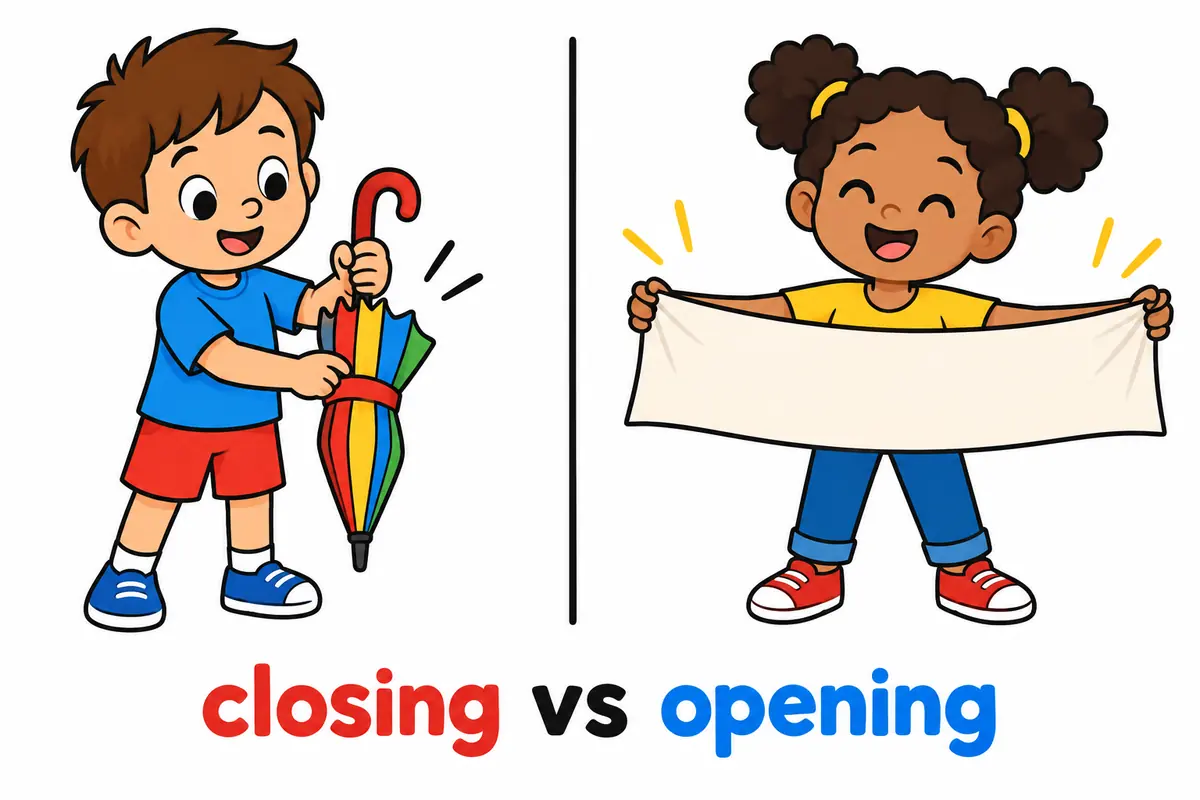
| Direction | Closing | Opening | Neither |
| Typical object | A sail, flag or umbrella | A sail, banner or wing | Paper, laundry or arms |
| Needs a support | Yes, a spar or pole | Yes, the same support | No |
| Register | Technical and literary | Neutral to literary | Everyday |
Verdict: choose unfurl to open material out, fold to bend something flat, and furl to roll fabric up around the support it hangs from. To spread the cloth is to undo exactly what furl does.
Word forms and grammar of furl
Furl inflects regularly, and its apparent relatives are a trap. The table separates the forms that belong to furl from the ones that merely look like it.
| Form | Part of speech | Example |
|---|---|---|
| furl | verb, base form | They will furl the sail at the harbour mouth. |
| furls | verb, third person singular | The boom furls the canvas in one turn. |
| furled | verb, past and past participle | The colours were furled at noon. |
| furling | verb, present participle | She was furling the parasol as we arrived. |
| unfurl | verb, opposite meaning | The crew will unfurl the sail at dawn. |
| furlough | noun and verb, unrelated meaning | The airline announced a temporary furlough. |
The last two rows are the ones learners reach for by mistake. Unfurl reverses the action, and furlough means a leave of absence, so a sentence about sailors furloughing the sail makes no sense at all.
Common mistakes with furl
- Incorrect:
The crew unfurled the sail down for the night.Correct: The crew furled the sail for the night. Rule: Unfurl opens material; furling closes it. - Incorrect:
He furled up the umbrella.Correct: He furled the umbrella. Rule: Furl already contains the idea of up, so the particle is redundant. - Incorrect:
The company furled its seasonal staff.Correct: The company furloughed its seasonal staff. Rule: Furlough means give leave; furl means roll fabric. - Incorrect:
She furled the letter and slid it into the envelope.Correct: She folded the letter and slid it into the envelope. Rule: Flat material is folded, not furled.
Practice using furl
Work through the six items, then read the reasons, which explain the choice rather than only the key.
- Fill the gap: The sailors ______ the mainsail before the storm arrived.
- Choose the better word: At sunrise the guard will (furl / unfurl) the flag and raise it.
- Correct the error: She furled up the picnic blanket and put it in the boot.
- Build a sentence: use furl about an umbrella in a shop doorway.
- Spot the register: which belongs in a sailing manual — furl the jib before mooring, or roll that thing up?
- Rewrite in the passive: The crew furled the banner. Keep the banner as the subject.
Answers
- furled — a sail is gathered around its spar before bad weather.
- unfurl — the flag is being opened out, the opposite of furled.
- She folded the picnic blanket — a flat blanket is folded, and furl adds no value here.
- Model answer: He furled his umbrella in the doorway and stepped into the dry.
- Furl the jib before mooring — a manual uses the precise verb and drops the casual phrase.
- The banner was furled by the crew — the passive keeps the material as the subject.
The bottom line
Use furl in a sentence for material that is rolled up and fastened around a support, and keep its opposite, unfurl, for the moment it is opened again. The two points that decide most sentences are the object, which must be something broad and flexible such as a sail or flag, and the direction of the action, because furling always closes and never opens. Where the material is flat, fold is the better verb.
Frequently asked questions about furl
Is furl only used for sails?
Sails and flags are the commonest objects, but the verb also covers awnings, umbrellas, parasols and theatre backdrops. The shared feature is broad material gathered around a spar, pole or roller. A flat sheet of paper is never furled, because it has no support to roll around.
What is the difference between furl and furlough?
The two words are unrelated in meaning despite looking alike. Furl is a verb meaning to roll up fabric, so a crew furls a sail. Furlough is a noun and verb about a leave of absence, so a firm furloughs its staff. Only one of the pair belongs in a sentence about boats.
Can furl be used without an object?
Yes, though the intransitive use is uncommon outside technical writing. In the sentence the awning furls in one motion, the material performs the action itself. Most writers keep the transitive form and name the crew or the mechanism, which is clearer for readers who do not know the equipment.
Does furl mean the same as fold?
No. Fold bends something flat along a crease or line, which suits paper, laundry and arms. Furl rolls up material that hangs from a support, which suits a sail, a flag or an umbrella. A folded map and a furled flag are different shapes, so the two verbs are never interchangeable.
Ever wondered what it means to “furl” something? In simple terms, to furl is to neatly roll or fold an object, typically a flag, sail, or umbrella, in a compact and organized manner. This action is often done to secure the item, protect it from damage, or simply to tuck it away.
When you furl an item, you are essentially creating a tight bundle by carefully winding and arranging it. By mastering the art of furling, you can effectively manage various objects and keep them safe and tidy when not in use.
7 Examples Of Furl Used In a Sentence For Kids
- The wind made the furl go round and round.
- I saw a beautiful furl in the garden.
- Let’s make a colorful furl using paper.
- The dancer waved a bright furl during the performance.
- Can you show me how to make a big furl?
- Look at the kite’s long tail furl in the sky.
- I love watching the furl of the ribbon as I dance.
14 Sentences with Furl Examples
- Furl your umbrella before entering the classroom to avoid causing a mess.
- Make sure to furl your bedsheet neatly after washing and drying it.
- Furl your notes and keep them organized in your bag.
- Remember to furl your yoga mat after class to prevent it from collecting dust.
- It’s important to furl the edges of your project report before submission for a clean presentation.
- Furl your scarf tightly if you’re traveling on a bike to prevent it from flying off.
- Before playing outdoor sports, make sure to furl your sleeves to avoid any hindrance during the game.
- Don’t forget to furl your headphones properly to prevent them from tangling in your bag.
- When it’s windy, remember to furl your hair to keep it from getting messy while on your way to college.
- Furl your backpack straps for a comfortable fit while commuting on public transport.
- It is essential to furl your paper notes neatly to easily find what you need during exam preparations.
- To maintain the hygiene of your toothbrush, always remember to furl it after use.
- Keep your smartwatch safe by furling the band securely when not in use.
- Furl your dupatta properly to avoid it getting caught in the door while entering the classroom.
How To Use Furl in Sentences?
Furl is a verb that means to roll up tightly or neatly. When using Furl in a sentence, it is important to place emphasis on the action of rolling or folding in a neat and compact manner.
For example, you can use Furl in a sentence like this:
– She decided to furl up her umbrella before entering the building.
To use Furl correctly, follow these steps:
1. Identify the object or item that needs to be rolled or folded tightly.
2. Use the word furl in place of other words that describe a similar action, such as “fold” or “roll up”.
3. Ensure that the sentence conveys the action of neatly and tightly rolling or folding the object.
Remember that using Furl in a sentence can add specificity to your description of an action, particularly when referring to the act of rolling or folding something tightly. It can help to create a vivid image in the reader’s mind of an item being neatly packed or stored.
Practice using Furl in different situations to get a better understanding of how it can be incorporated into sentences effectively.
Conclusion
In conclusion, “furl” refers to the act of rolling or gathering something, like a sail or an umbrella, into a neat and compact form. Sailors furl their sails to secure them and reduce wind resistance, while individuals might furl their umbrellas to store them easily. Understanding how to furl correctly is essential for ensuring the longevity and functionality of the item being furled.
By properly furling items like sails and umbrellas, individuals can maintain their equipment in good condition and ready for future use. Whether on a boat or during a rainy day, knowing how to furl efficiently can make the process smoother and more convenient. Mastering the art of furling is a practical skill that can save time and keep belongings organized.


