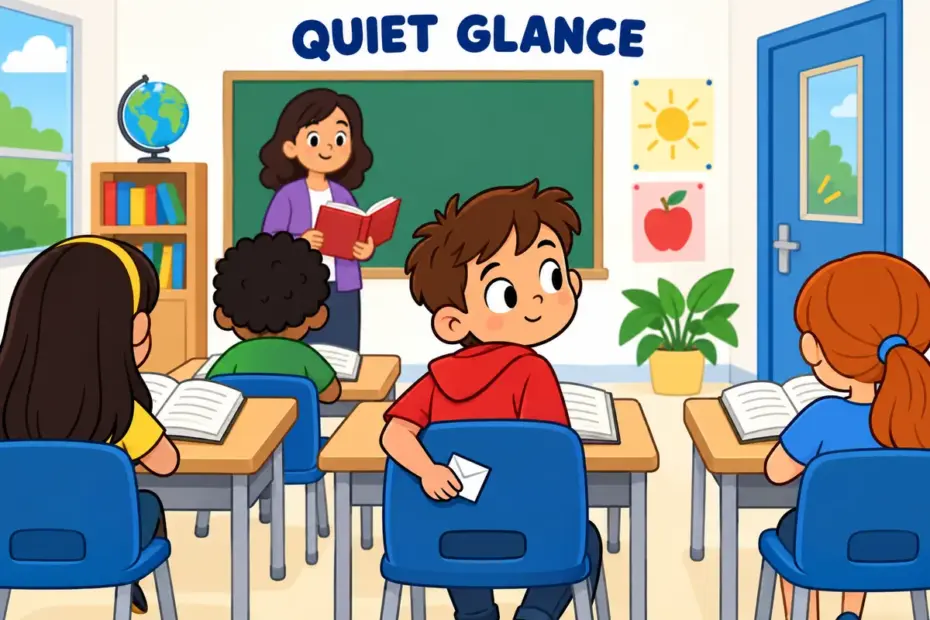
Furtive is an adjective meaning secretive and quiet, done to avoid being noticed. To use furtive in a sentence, place it before the noun it describes: “She cast a furtive glance at the clock.” The word carries a hint of guilt, so it suits a hidden look, a whisper or a small movement, not an open, confident action.
Furtive at a glance
- Furtive is an adjective; its adverb is furtively and its noun is furtiveness.
- The dominant pattern is furtive + noun, as in a furtive glance.
- It suits written description and appears in fiction, news and formal prose.
- Common collocates are glance, look, movement, whisper and behaviour.
- The commonest learner error is confusing furtive with festive or futile.
What does furtive mean?
Furtive is an adjective meaning done quietly and secretly to avoid being noticed. The Cambridge entry for furtive stresses the secret, stealthy quality, and the word usually adds a hint of guilt. A clandestine meeting is fully hidden by planning, while a furtive look is a small, quick action that hopes not to be seen.
| Sense | Plain meaning | Example sentence |
|---|---|---|
| Secretive action | Done quietly to escape notice | She cast a furtive glance at the clock. |
| Guilty manner | Suggesting that the person has something to hide | His furtive behaviour made the guard suspicious. |
| Shy movement | A small, hesitant action | A furtive hand reached for the last biscuit. |
How do you use furtive in a sentence?
| Pattern | Example | What it signals |
|---|---|---|
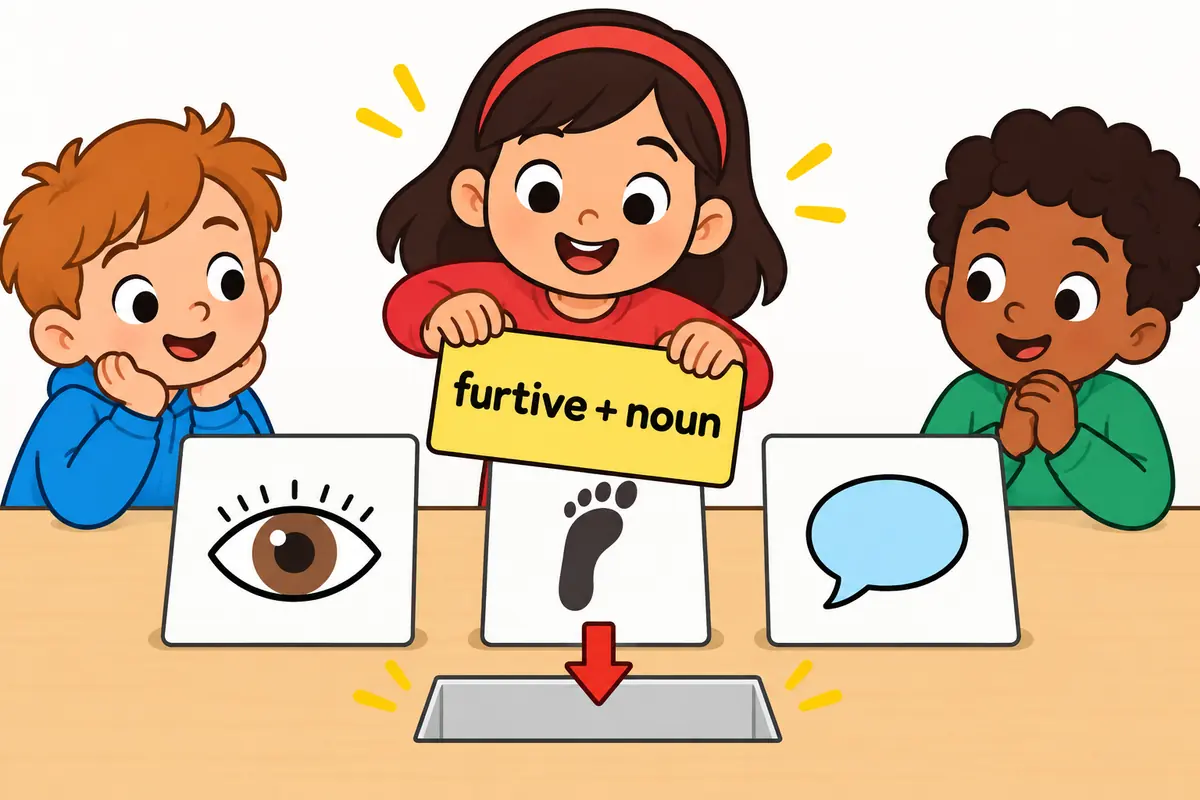
| furtive + noun | He gave a furtive nod. | the adjective names the secret quality |
| a furtive + noun + of + noun | a furtive glance at the letter | points to the thing being watched |
| be + furtive + about | She was furtive about her plans. | shows secrecy over a subject |
| adverb + furtive | His manner was strangely furtive. | a modifier sharpens the impression |
| furtive + noun + verb | Furtive footsteps crossed the hall. | the adjective leads the image |
Furtive in a sentence: examples across contexts
| Context | Example sentence | Why this works |
|---|---|---|
| Fiction | He shot a furtive glance at the locked drawer. | builds suspense in narrative prose |
| News report | Witnesses described furtive movements near the gate. | precise description without accusation |
| Workplace email | Her furtive tone in the meeting worried the team. | formal, careful observation |
| Classroom | The pupil gave a furtive nod when the teacher turned away. | a small, concrete school moment |
| Academic prose | The study links furtive behaviour to feelings of shame. | analytical register and a clear focus |
| Conversation | Why are you being so furtive about the surprise? | spoken tone with a playful edge |
| Travel writing | A furtive cat slipped along the harbour wall. | vivid, economical description |
| Legal writing | The report noted furtive conduct before the deal closed. | measured, factual phrasing |
Furtive vs stealthy
| Attribute | Furtive | Stealthy |
|---|---|---|
| Core meaning | secretive and slightly guilty | quiet and skilfully silent |
| Feeling it suggests | nervousness or shame | calm control |
| Typical doer | a person with something to hide | a hunter, cat or trained walker |
| Register | literary and descriptive | neutral and practical |
| What it implies | the action wants to escape blame | the action is meant to be unheard, not hidden |
| Typical noun | glance, whisper, manner | movement, approach, steps |
Use furtive when secrecy carries a hint of guilt, and use stealthy footsteps when the quietness is simply skilful.
Word forms and grammar of furtive
| Form | Part of speech | Example |
|---|---|---|
| furtive | adjective | a furtive glance |
| furtively | adverb | She glanced furtively at the door. |
| furtiveness | noun | The furtiveness of his manner troubled her. |
| more furtive | comparative adjective | His second look was more furtive. |
| most furtive | superlative adjective | It was the most furtive movement of the night. |
A person may be secretive about money, while a covert operation is planned secrecy and a surreptitious entry is one hidden act. The adverb is furtively, and it often replaces the adjective when the verb needs the emphasis.
Common mistakes with furtive
Incorrect: She gave a furtive at the letter.Correct: She gave a furtive glance at the letter. Furtive is an adjective and needs a noun.Incorrect: The festive child hid the note.Correct: The furtive child hid the note. Festive means cheerful and celebratory, not secretive.Incorrect: Their efforts were furtive because they failed.Correct: Their efforts were futile because they failed. Futile means useless, not secret.Incorrect: He walked furtive down the hall.Correct: He walked furtively down the hall. The verb needs the adverb.Incorrect: She was furtive to the plan.Correct: She was furtive about the plan. Use about before the subject of the secrecy.
Practice using furtive
- Fill in the blank: The boy gave a ___ look at the open gate.
- Choose the better word: The cat crossed the garden with ___ steps. (furtive / festive)
- Correct the error: She glanced furtive at the clock.
- Build a sentence: use a furtive glance about a sealed envelope.
- Spot the register: which sentence belongs in a formal report? (a) He acted sneaky. (b) Witnesses noted furtive behaviour near the gate.
- Fill in the blank: The plan failed, so their effort was ___. (furtive / futile)
Answers
- furtive – the adjective describes the look.
- furtive – the steps are secret, not celebratory.
- She glanced furtively at the clock – the verb needs the adverb furtively.
- He gave a furtive glance at the sealed envelope – the adjective sits before the noun.
- Sentence (b) – furtive behaviour suits a measured written report.
- futile – the effort was useless because the plan failed.

The bottom line
To use furtive in a sentence, place it right before the noun it describes, as in a furtive glance at the door. The adjective means secretive and slightly guilty, so it suits fiction, news and formal description better than casual talk. Keep it apart from festive and futile, which look similar but mean cheerful and useless.
Frequently asked questions about furtive
Is furtive a positive or negative word?
Furtive is usually negative, because it suggests that someone is hiding something or expects blame. A furtive glance implies guilt or nervousness rather than simple shyness. If you want to praise quiet skill without any hint of wrongdoing, stealthy or nimble is a better choice for that sentence.
What is the adverb of furtive?
The adverb is furtively, formed by adding ly, and it describes how an action is done, as in she glanced furtively at the door. Use the adverb when you want to modify a verb, and keep the adjective furtive for the noun, as in a furtive glance. The noun form is furtiveness.
Can furtive describe an object?
Furtive describes people and their actions rather than plain objects. You can write a furtive movement or a furtive whisper, because a person performs them. A furtive drawer sounds odd, since the drawer does nothing by itself. Describe the person, the glance or the movement instead.
How is furtive different from concealed?
Furtive describes the manner of an action, while concealed describes a state of being hidden. A furtive hand moves quietly and hopes to avoid notice; a concealed hand is already out of sight. The two can appear together, as in a concealed pocket reached by a furtive movement, but they answer different questions.
Have you ever witnessed someone behaving in a furtive manner, sneaking around with a secretive air about them? The word “furtive” describes actions that are done in a stealthy or sly manner, often to avoid detection.
When someone is being furtive, they are typically trying to hide their true intentions or actions from others. This can manifest in behaviors such as avoiding eye contact, speaking in hushed tones, or quickly looking around to make sure no one is watching.
7 Examples Of Furtive Used In a Sentence For Kids
- Furtive squirrels hide nuts in the park.
- The cat made a furtive jump onto the couch.
- A furtive bunny nibbled on a carrot quietly.
- A furtive fox peeked out from behind a tree.
- The thief made a furtive escape from the garden.
- A furtive puppy dug a hole to hide its bone.
- The raccoon made a furtive grab for the shiny object.
14 Sentences with Furtive Examples
- During the exam, he made a furtive attempt to peek at his neighbor’s answer sheet.
- They shared a furtive laugh in the library, trying not to disturb the other students studying.
- She made a furtive gesture to her friend across the classroom to pass her a note.
- The student’s furtive glances towards the clock revealed his eagerness for the lecture to end.
- He made a furtive attempt to sneak out of the classroom without the professor noticing.
- Despite their furtive whispers, their excitement about the upcoming college fest was palpable.
- The group huddled together in a furtive manner, discussing the upcoming group project plans.
- With furtive movements, she quickly checked her phone under the desk during the lecture.
- The student eyed the snack hidden in his bag with a furtive look, hoping the professor wouldn’t notice.
- They shared a furtive smile across the lecture hall, secretly communicating their agreement on the topic.
- The student made a furtive escape from the hostel to attend a late-night party.
- Despite their best efforts at being furtive, their laughter during the lecture drew unwanted attention.
- She quickly typed a furtive message on her phone before the professor could catch her.
- The group of friends exchanged furtive glances as they made plans for the weekend getaway.
How To Use Furtive in Sentences?
To use Furtive in a sentence, you can follow these simple steps!
-
Identify the word: Furtive means attempting to avoid notice or attention, typically because of guilt or a belief that discovery would lead to trouble.
-
Choose a context: Think about a situation where someone is being secretive or trying to hide something.
-
Formulate a sentence: Start by incorporating Furtive into your sentence. For example, “She cast a furtive glance over her shoulder before slipping the key into her pocket.”
-
Experiment with sentence structure: You can place Furtive at different points in the sentence to see where it fits best. For instance, “With a furtive movement, he pocketed the stolen necklace.”
-
Check for understanding: Make sure your sentence makes sense and effectively conveys the meaning of Furtive.
-
Practice using Furtive in different contexts: Try using Furtive in various sentences to become more comfortable with the word and its meaning.
-
Get feedback: Share your sentences with others to see if they correctly interpret the use of Furtive in your sentences.
Remember, practice makes perfect! Keep using Furtive in sentences to improve your understanding and ability to incorporate it naturally into your language.
Conclusion
In conclusion, sentences with “furtive” carry a sense of secrecy or stealth. They often describe actions or glances that are done quickly and with the intention of not being noticed. These sentences evoke a feeling of sneakiness or covert behavior, adding a layer of mystery or suspicion to the narrative.
By using “furtive” in sentences, writers can create an atmosphere of intrigue and suspense, keeping readers engaged and intrigued by the hidden motives or intentions of characters. Overall, sentences with “furtive” help to add depth and complexity to storytelling by subtly hinting at characters’ hidden agendas or concealed emotions.


