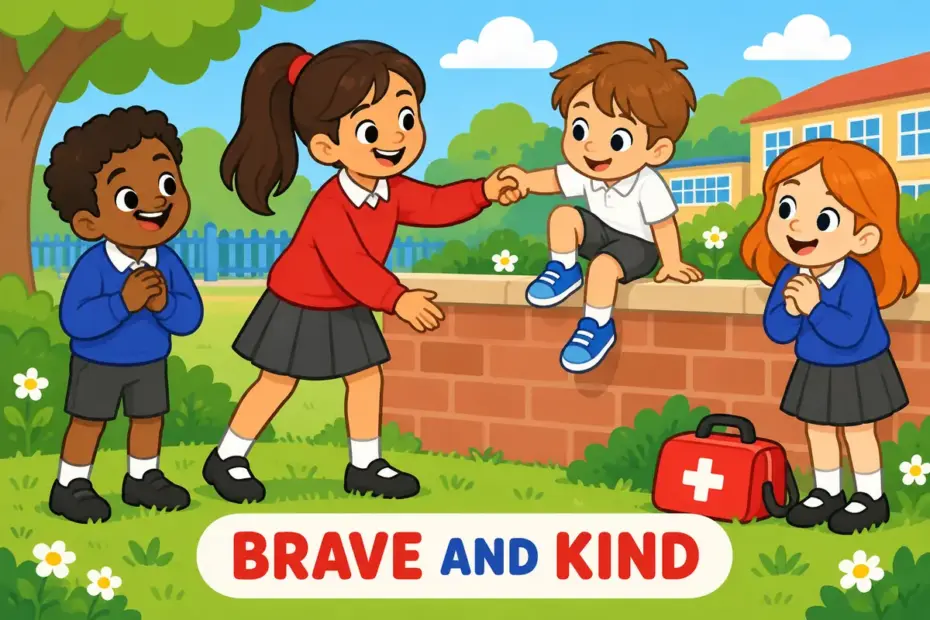
Gallant means brave and noble in the face of danger, or courteous and attentive in the way a knight behaves. To use gallant in a sentence, pick the sense first: “The gallant firefighter carried the child to safety” praises courage, while “a gallant compliment” praises courtesy.
Gallant at a glance
- Gallant is an adjective; its forms include gallantly, the adverb, and gallantry, the noun.
- The brave sense describes people and actions such as rescues, stands and defences.
- The courteous sense describes attentive, old-fashioned good manners toward someone.
- Gallant usually appears directly before its noun: a gallant attempt, a gallant officer.
- The commonest error is swapping gallant for gallivant, a verb meaning to roam for pleasure.
What does gallant mean?
Gallant is an adjective meaning brave and honourable, especially when facing danger, or courteous and attentive in a chivalrous, old-fashioned way. The Cambridge entry for gallant records both senses, and the difference decides your sentence: the first describes courage under threat, the second describes manners toward another person.
| Sense | Plain meaning | Example sentence |
|---|---|---|
| Brave and noble | Shows courage when it costs something | The gallant climbers stayed to help a stranger on the ridge. |
| Courteous and chivalrous | Shows attentive, old-fashioned good manners | He gave up his seat with a gallant tilt of the hat. |
| Splendid, showy | Makes an impressive display, mostly in older writing | The town staged a gallant show of flags for the returning crew. |
One limitation matters. Gallant is far stronger than polite. A cashier who says hello is friendly, not gallant; the word expects either genuine danger or a deliberate, slightly theatrical courtesy. For plain courage, brave is the safer everyday choice.
How do you use gallant in a sentence?
Gallant behaves like most adjectives, but the two senses prefer different patterns. Five patterns cover nearly every real sentence, and the attributive one, placed before the noun, is by far the most common.
| Pattern | Example | What it signals |
|---|---|---|
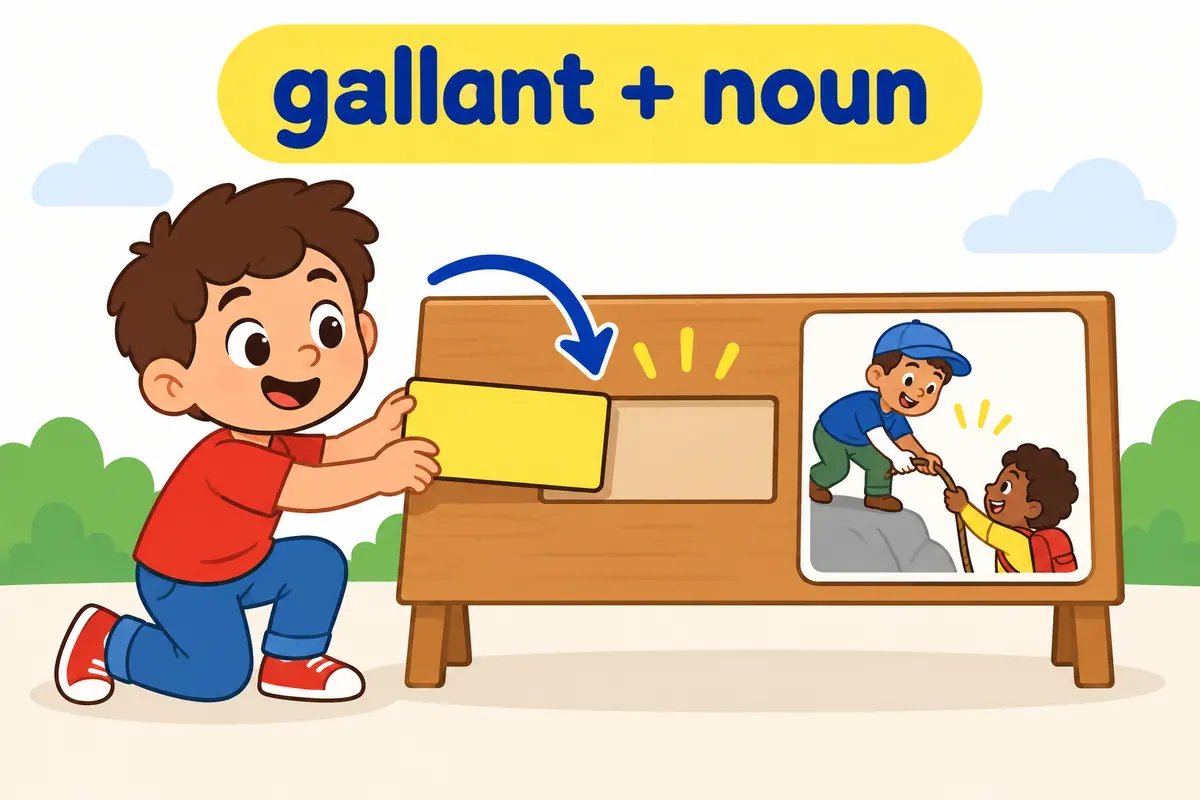
| gallant + noun | The gallant rescuers searched all night. | The default pattern; the adjective sits before its noun. |
| be / look / seem + gallant | The losing team looked gallant in defeat. | Describes the subject after a linking verb. |
| gallant + act or attempt | Her gallant attempt to fix the engine failed. | The brave sense applied to an effort, not a person. |
| gallant + to / towards + person | He was gallant to every guest at the table. | The courteous sense, aimed at somebody else. |
| how gallant of + person | How gallant of you to walk her home. | Spoken praise, usually gently teasing. |
Because gallant is an adjective, it never takes an object and never forms a past tense. The verb people are reaching for when they make that mistake is a different word entirely.
Gallant in a sentence: examples across contexts
Gallant shifts meaning with its context more than most adjectives. The nine sentences below move from a playground to a history essay while keeping either the brave or the courteous sense clear.
| Context | Example sentence | Why this works |
|---|---|---|
| Classroom | Leo made a gallant effort to read the long poem aloud. | Applies the brave sense to an effort a child can picture. |
| Workplace email | Her gallant defence of the junior staff earned quiet respect. | Praises courage that carried a cost at work. |
| News report | The gallant crew stayed aboard until every passenger was clear. | Names a group and a dangerous duty, the news register. |
| Storytelling | The gallant knight bowed low before the old queen. | Uses the chivalrous sense in a familiar fairy-tale frame. |
| Formal speech | We honour the gallant service of those who never returned. | The word suits solemn, ceremonial praise. |
| History essay | Historians debate whether the gallant stand delayed or hastened defeat. | The sense is courage, while the tone stays analytical. |
| Sports writing | The gallant underdogs held the champions to a single goal. | Describes brave effort even in a losing result. |
| Conversation | That was a gallant thing to do, waiting with her bus. | Warm spoken praise for a small courteous act. |
| Literary description | He offered his arm with a gallant flourish. | The old-fashioned courtesy the word still carries. |
Gallant vs gallivant
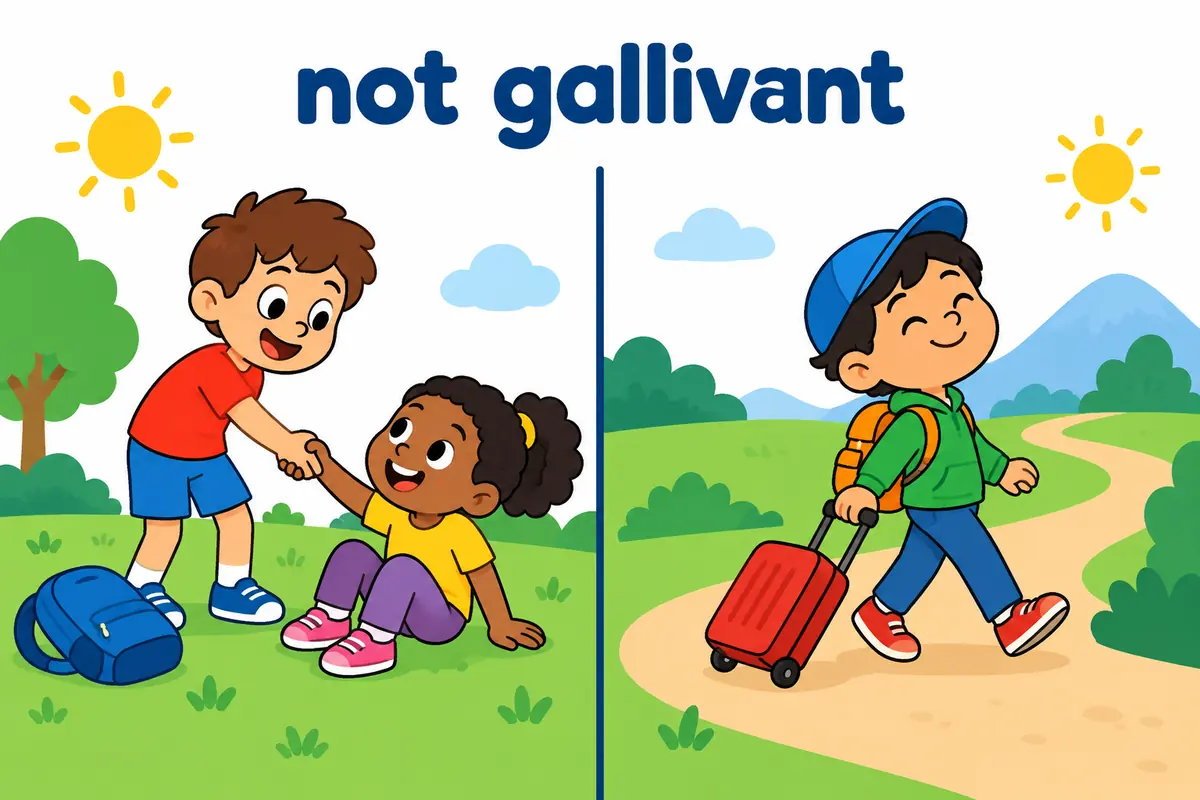
Gallant and gallivant sound alike and share a starting syllable, which is exactly why learners confuse them. One is an adjective about courage or courtesy; the other is a verb about wandering for fun. Compare chivalrous for a close synonym of the courteous sense.
| Attribute | gallant | gallivant |
|---|---|---|
| What it is | Adjective | Verb |
| Core meaning | Brave or courteously attentive | To travel about seeking pleasure |
| Typical subject | A person, act, attempt or defence | A person, often a young one, on the move |
| Object needed | None | None, but it often takes around or off |
| Register | Formal, literary, ceremonial | Informal, often mildly disapproving |
| Example | The gallant officer refused to leave. | They gallivanted around the coast all summer. |
Verdict: if you can say brave or courteous in its place, write gallant; if the sentence is about roaming from place to place for pleasure, the verb is gallivant, and the two never swap.
Word forms and grammar of gallant
Gallant inflects like a regular adjective: it has a comparative and superlative but no verb forms. Two related words, the adverb and the noun, do most of the extra work, and one lookalike belongs to a different family.
| Form | Part of speech | Example |
|---|---|---|
| gallant | adjective | The gallant pilot landed on one engine. |
| gallantly | adverb | She gallantly gave up her place in the final. |
| gallantry | noun | He won a medal for gallantry under fire. |
| gallant | noun, archaic | An old novel might call a suitor a gallant. |
| gallivant | verb — different word | They gallivanted off to the fair. |
| gallantlyed | non-standard | Never used; the verb is gallivanted. |
The noun gallantry is worth knowing because it fixes the sense in formal writing: a gallantry award praises courage, while the older noun gallant now sounds deliberately antique. For the attention sense, courteous is the plainer modern alternative.
Common mistakes with gallant
- Incorrect:
The soldier was given a medal for his gallant.Correct: The soldier was given a medal for his gallantry. Rule: The quality is the noun gallantry; gallant on its own is an adjective. - Incorrect:
They gallanted around the market all afternoon.Correct: They gallivanted around the market all afternoon. Rule: The verb of roaming is gallivant, never a form of gallant. - Incorrect:
The waiter was gallant when he brought the menu.Correct: The waiter was courteous when he brought the menu. Rule: Gallant needs danger or old-fashioned chivalry, not ordinary politeness. - Incorrect:
She gallant saved the child.Correct: She bravely saved the child. Rule: An adjective cannot modify a verb; use the adverb gallantly. - Incorrect:
He gallantly a speech about the troops.Correct: He gave a gallant speech about the troops. Rule: Gallant describes a noun, so attach it to the noun rather than to the verb.
Practice using gallant
Work through the six items, then read the reasons in the answer list rather than checking only the key.
- Fill the gap: The ______ dog ran back into the smoke to find the lost puppy.
- Choose the better word: The cousins (gallant / gallivanted) through three countries in a week.
- Correct the error: He was rewarded for his gallant during the flood.
- Build a sentence: use gallant about a classmate who stood up for someone being teased.
- Spot the register: which belongs in a formal tribute — the gallant crew held their post, or the crew was super gallant?
- Rewrite with the adverb: She was gallant when she volunteered for the hardest task. Use the adverb instead.
Answers
- gallant — the adjective sits before the noun dog and marks its courage.
- gallivanted — the sentence is about roaming for pleasure, so the verb is gallivant.
- He was rewarded for his gallantry during the flood — the quality needs the noun form.
- Model answer: Mia made a gallant stand beside her friend at the fence.
- The gallant crew held their post — a tribute avoids intensifiers such as super.
- She gallantly volunteered for the hardest task — the adverb modifies the verb volunteered.
The bottom line
Use gallant in a sentence when someone shows real courage or a deliberate, old-fashioned courtesy, and keep it in front of the person or act it praises. The two details that settle most sentences are that gallant is an adjective, so it never takes an object or a past tense, and that its lookalike gallivant is a verb about roaming for fun. Reserve the word for danger or chivalry, since plain politeness calls for polite instead.
Frequently asked questions about gallant
Is gallant a compliment?
Gallant is usually a warm compliment, praising either courage or courteous, old-fashioned manners. Because it can sound theatrical, it lands best in storytelling, tributes and gentle teasing. Said about a small everyday politeness, it can feel overdone, so many speakers choose brave or courteous when they want a plain, modern tone.
What is the noun form of gallant?
The noun is gallantry, meaning courage, especially in battle, or chivalrous behaviour. A medal for gallantry rewards bravery, while an act of gallantry may be a bold courtesy. Gallant itself can also be a noun for a fashionable, attentive man, but that use now sounds deliberately old and appears mostly in older novels.
Can gallant describe a woman?
Gallant can describe anyone, and the brave sense is wholly neutral: a gallant officer may be a man or a woman. The courteous, chivalrous sense grew from an old tradition of men attending to women, so it still carries a slightly old-fashioned flavour there. Modern writers often switch to brave or courteous to avoid that echo.
How is gallant pronounced?
As an adjective for a brave or courteous person, gallant is usually said with the stress on the first syllable, roughly GAL-unt. Some speakers stress the second syllable, guh-LANT, and both are understood. The archaic noun for a stylish man tends to take that second-syllable stress, so the pronunciation itself can hint at the older meaning.
Have you ever wondered what the word “gallant” means and how it is used in sentences? Allow me to shed some light on this intriguing term.
“Gallant” is an adjective that describes someone who is brave, chivalrous, and courteous, especially towards women. This word is often used to praise someone’s noble and honorable qualities.
7 Examples Of Gallant Used In a Sentence For Kids
- The gallant knight saved the princess from the dragon.
- The soldiers were gallant as they marched into battle.
- The gallant superhero fought the villain to protect the city.
- The gallant firefighter rescued the kitten from the tree.
- The gallant police officer helped the lost child find their way home.
- The gallant doctor healed the sick patients with care and kindness.
- The gallant teacher encouraged the students to be brave and work hard.
14 Sentences with Gallant Examples
- Gallant students often volunteer to lead group projects and presentations.
- It is considered gallant to help a classmate in need with their studies.
- Many college students aspire to be a part of the gallant student council.
- Being gallant in interactions with professors can help in building a good rapport.
- Students are encouraged to be gallant by participating in charity events and community service.
- It is seen as gallant to stand up against injustices and support social causes on campus.
- Showing gallant behavior in academic competitions can earn respect from peers and faculty.
- Students who are gallant often contribute positively to campus culture and environment.
- It is seen as gallant to mentor junior students and help them navigate college life.
- Campus safety ambassadors are known for their gallant efforts in ensuring student security.
- Participating in sports tournaments and representing the college is a gallant achievement.
- Students who excel academically while also being gallant in extracurricular activities are admired by all.
- During cultural festivals, showcasing gallant talents in dance and music performances is highly appreciated.
- It is essential for college students to practice gallant behavior both inside and outside the campus.
How To Use Gallant in Sentences?
Gallant means brave, noble, or chivalrous. When using this word in a sentence, remember that it is typically used to describe a person or their actions in a positive light.
Here are some examples of how to use gallant in a sentence:
- Jason showed his gallant nature by rescuing the injured dog from the busy street.
- The knight’s gallant gesture of defending the village from the invaders earned him the admiration of the townspeople.
- Sarah was touched by the gallant act of kindness when a stranger helped her carry her groceries to the car.
- Despite facing great danger, the firefighters remained gallant in their efforts to save the people trapped in the burning building.
- The explorer’s gallant expedition into the uncharted territory inspired others to push beyond their limits.
Remember to use gallant when you want to convey a sense of bravery, nobility, or chivalry in your writing. Practice using the word in different contexts to become more comfortable incorporating it into your vocabulary.
Conclusion
In writing, using gallant in sentences can convey valor, bravery, and chivalry. Examples of sentences with gallant include “The gallant knight rescued the princess from the dragon,” “He made a gallant effort to save his fellow soldiers in battle,” and “She was impressed by his gallant gesture of holding the door open for her.” Such sentences paint a picture of courage, courtesy, and nobility, adding depth and emotion to the narrative.
By incorporating gallant into sentences, writers can evoke images of heroism and gallantry, creating vivid and memorable portrayals of characters and their actions. Whether describing a valiant act in battle or a courteous deed in everyday life, using gallant in sentences helps to capture the essence of bravery and honor, making the writing more engaging and impactful.


