Gauche is an adjective for someone or something that is socially awkward, tactless or unpolished. To use gauche in a sentence, name the person, remark or gesture it describes: “His gauche comment about her salary silenced the table.” The word judges social ease, not physical coordination.
Gauche at a glance
- Gauche is an adjective; it has no verb form, and its noun is gaucherie.
- It describes social awkwardness rather than physical clumsiness.
- The usual targets are a person, a remark, a gesture, an outfit or a manner.
- Gauche is a formal, judgemental label that belongs mainly to written description.
- The commonest errors are using it for physical clumsiness and misspelling it as gauge.
What does gauche mean?
Gauche is an adjective meaning socially awkward or tactless, especially when the awkwardness breaks the unwritten rules of a situation. The Cambridge entry for gauche records that core sense. An ordinary failure of tact is a tactless remark, while someone who offends by habit is a boorish guest.
| Sense | Plain meaning | Example sentence |
|---|---|---|
| Social | Lacking ease or tact with people | His gauche question about the inheritance embarrassed everyone. |
| Stylistic | Awkwardly done, lacking taste | The film’s gauche ending undercut its careful build-up. |
| Self-aware | Feeling out of place in company | She felt gauche in a room full of diplomats. |
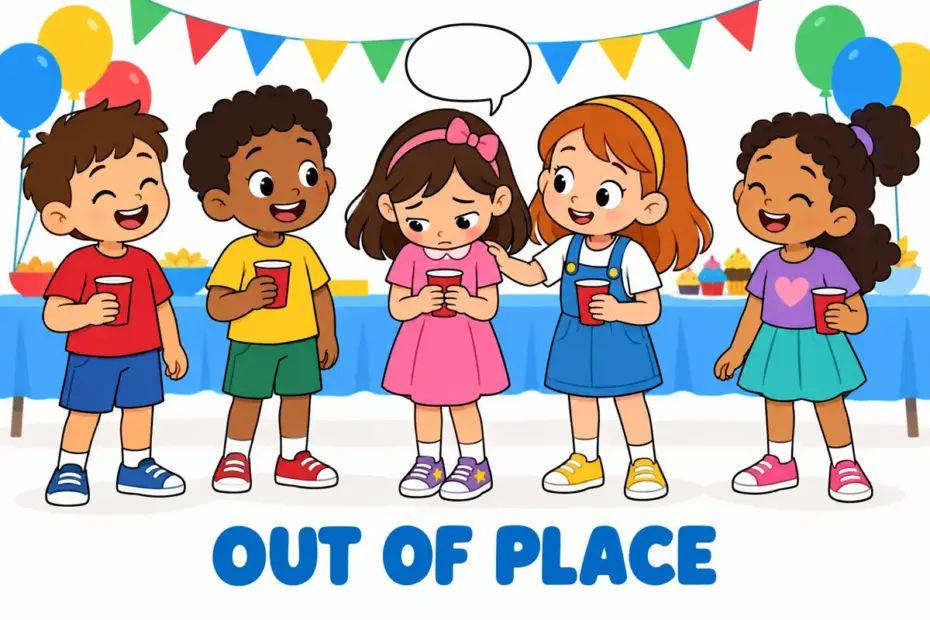
One limitation is worth stating plainly. Gauche is not a synonym for clumsy, which is about bodies, and it is harsher than unpolished, which is about finish. The adjective also carries a whiff of snobbery: where a person is merely new to local customs, out of place is the fairer description.
The word rarely appears alone as a bare judgement. Writers usually name the offence in the same breath, so the reader can decide whether the verdict is fair, and they often soften it with almost, rather or just a little. A sentence that offers only a label, with no example of the behaviour, tends to sound like a sneer rather than a description.
How do you use gauche in a sentence?
The adjective works in five frames. It follows a linking verb when the whole person is judged, and it sits before a noun when one act is judged. Comparative and superlative forms use more and most.
| Pattern | Example | What it signals |
|---|---|---|
| be + gauche | Her thank-you note was gauche. | The whole act is judged, not one detail. |
| gauche + noun | He made a gauche joke about the funeral. | The adjective pins the fault on a specific act. |
| feel + gauche | I felt gauche among the diplomats. | Reports self-awareness; common in first-person writing. |
| more / most gauche | It was the most gauche toast of the evening. | Grades the fault; avoids the awkward form gauchester. |
| too gauche to + verb | He was too gauche to read the room. | Links the awkwardness to a failure of judgement. |
Register matters as much as grammar here. The adjective belongs to written description and criticism, where a measured verdict is welcome; in spoken English it can sound like an insult, and native speakers usually reach for a phrase such as a bit out of place instead, which delivers the observation without the damning label.
Gauche in a sentence: examples across contexts
Gauche keeps one meaning across registers but changes the social cost. The eight sentences below move from a playground to a published review, and each names the act that breaks the rules.
| Context | Example sentence | Why this works |
|---|---|---|
| Classroom | The new boy’s gauche attempt to join the game made everyone wince. | A social mistake a child can picture, not a physical one. |
| Workplace email | Please avoid the gauche assumption that everyone celebrates the same holidays. | Turns the adjective on a shared habit rather than a colleague. |
| News report | The minister’s gauche joke drew a swift rebuke from the opposition. | Names the public act and the reaction it caused. |
| Review writing | The novel’s gauche metaphors distract from an otherwise sharp plot. | Applies the stylistic sense to a work of art. |
| Conversation | I felt gauche clutching a gift when nobody else had brought one. | Uses feel gauche, the one frame at home in speech. |
| Academic writing | The essay’s gauche opening undercuts its careful argument. | Keeps the judgement impersonal by blaming the text. |
| Travel writing | A gauche bow marked the visitor as a stranger at once. | Shows awkwardness as a clash of custom, not of character. |
| Sports commentary | His gauche celebration after a lucky win annoyed the home crowd. | Puts the fault in the moment, not the athlete’s skill. |
| Customer service | A gauche greeting can undo a carefully prepared sales pitch. | Shows the cost of a single wrong note in a scripted exchange. |
| University essay | The proposal is not wrong, merely gauche in its opening flattery. | Pairs the verdict with merely to keep the criticism proportionate. |
Notice that only the conversation row names a speaker directly. Gauche prefers the third person because a label of bad taste sounds softer when it is not aimed at the person beside you.
Gauche vs awkward
Gauche and awkward overlap, but only one of them can describe a stubbed toe. Gauche is also narrower than uncouth, which suggests coarse manners rather than a single misjudged moment.
| Attribute | gauche | awkward |
|---|---|---|
| Core meaning | Socially tactless or in poor taste | Uneasy, ungraceful or inconvenient |
| What it describes | People, remarks, gestures, style | People, movements, silences, timing |
| Physical clumsiness | No; never | Yes; its central sense |
| Tone | Formal, judgemental, faintly snobbish | Neutral and often sympathetic |
| Register | Written description and reviews | Everyday speech and writing |
| Typical sentence | a gauche toast at the wedding | an awkward pause after the question |
Verdict: reach for awkward when the discomfort is ordinary or physical, and keep gauche for a real failure of social taste; the two words are not interchangeable.
Word forms and grammar of gauche
The adjective does not inflect for number or tense. Its noun gaucherie names a single act of social clumsiness, and the table below separates the forms a learner should keep apart.
| Form | Part of speech | Example |
|---|---|---|
| gauche | adjective | a gauche attempt at small talk |
| gaucherie | noun | His gaucherie at the reception was remembered for years. |
| gaucheness | noun | Her gaucheness faded once she knew the group. |
| gauchely | adverb, rare | He bowed gauchely to the host. |
| more / most gauche | comparative | the most gauche remark of the evening |
| gauchester | non-standard | Avoid it; write most gauche instead. |
Two traps follow from these forms. First, gaucherie is a countable noun for one embarrassing act and an uncountable noun for the quality, so a gaucherie is fine but gaucheries in the plural describes a series of separate incidents. Second, the adverb is so rare that using it in ordinary prose draws more attention to the writer than to the behaviour.
How do you soften gauche?
Because the adjective carries a judgement, careful writers hedge it or replace it with a description of the situation. The table shows four ways to keep the observation without the sting.
| Situation | Blunt verdict | Softer wording | Why the change works |
|---|---|---|---|
| A newcomer at dinner | His gauche questions | His questions showed he was new here | Moves the fault from character to circumstance. |
| A mismatched outfit | a gauche jacket | a jacket that missed the dress code | States the rule that was broken. |
| A joke at a funeral | a gauche joke | a joke that landed badly | Describes the effect rather than the person. |
| A formal review | the ending is gauche | the ending feels forced | Keeps the verdict on the text and hedges it. |
None of the softer versions is vague. Each names the custom, the rule or the effect that a bare gauche would only imply, which is the test of a fair rewrite: the reader should still learn exactly what went wrong.
Common mistakes with gauche
- Incorrect:
She was gauche on the ice rink.Correct: She was clumsy on the ice rink. Rule: clumsy covers physical coordination; gauche covers social judgement. - Incorrect:
He is a gauche.Correct: He is gauche. Rule: gauche is an adjective; the matching noun is gaucherie. - Incorrect:
a gauge remarkCorrect: a gauche remark. Rule: gauge is a separate verb and noun meaning measure or estimate. - Incorrect:
the gauchester toastCorrect: the most gauche toast. Rule: use more and most rather than adding -er or -est to this French borrowing. - Incorrect:
He felt gauchely at the party.Correct: He felt gauche at the party. Rule: feel is a linking verb, so it takes the adjective, not the adverb.
Practice using gauche
Work through the six items, then read the reasons rather than only the answers.
- Fill the gap: His ______ question about her divorce ended the dinner.
- Choose the better word: She tripped over the rug, a (gauche / clumsy) moment rather than a social one.
- Correct the error: The host made a gauge remark about the gift.
- Build a sentence: use feel gauche about starting at a new school.
- Spot the register: which belongs in a formal review, the film’s gauche ending, or the ending was, like, so awkward?
- Rewrite with the noun: His awkward attempt at a toast embarrassed the room. Use gaucherie.
Answers
- gauche — the question broke a social rule, which is exactly what the adjective labels.
- clumsy — the rug caused a physical stumble, not a failure of tact.
- The host made a gauche remark — gauge means measure, so it cannot describe a remark.
- Model answer: I felt gauche on my first morning, when I did not know where to stand.
- The film’s gauche ending — a review keeps the formal adjective and drops the filler like.
- His attempt at a toast was an act of gaucherie — the noun names one clumsy episode.
The bottom line
Use gauche in a sentence when you are judging social taste rather than physical skill, and place it in front of the person, remark or gesture it labels. The two decisions that matter most are choosing awkward for ordinary or physical discomfort and saving gauche for a genuine failure of tact. The noun gaucherie names one embarrassing act, and the adjective stays formal, so it rarely fits a friendly chat.
Frequently asked questions about gauche
Is gauche a harsh word?
Gauche is more judgemental than awkward because it implies bad taste as well as discomfort. In a review it sounds confident, but aimed at a person it can wound. Where somebody is simply new to local customs, out of place or unsure is fairer, because it criticises the situation instead of the person.
Can gauche describe things as well as people?
Yes. Gauche can label a remark, a gesture, an outfit, a design or a whole attempt, so a gauche lampshade and the film’s gauche ending are both natural. The adjective still carries a social judgement, which is why it suits reviews and written criticism more than neutral description.
What is the noun form of gauche?
The noun is gaucherie, meaning an act or a quality of social awkwardness, as in a moment of pure gaucherie. Gaucheness also exists but is rarer. Both nouns take an article, so you write a gaucherie, and neither is used as a count noun without one.
How do you pronounce gauche?
Gauche keeps its French spelling, so it is pronounced gohsh, with a long o and a sh sound at the end. The final letters are silent. The noun gaucherie ends with a long e sound, and its middle keeps the same sh that English speakers already use.