To get round to something is to finally find the time for a task you had been putting off. Use get round to before a noun or an -ing verb: “I finally got round to fixing the gate.” The phrase is chiefly British, and to is fixed, so never write get round to do.
Get round to at a glance
- Get round to is a fixed expression meaning to finally find time for a delayed task.
- It is followed by a noun or an -ing verb, never by a bare verb: get round to painting, not get round to paint.
- Only get changes with tense; round, to and the following verb stay put.
- The American spelling of the same idiom is get around to.
- The commonest error is treating to as part of an infinitive and writing get round to do.
What does get round to mean?
Get round to is an idiomatic phrase meaning to find the time to do something you have been meaning to do. The Cambridge entry for get round to records it as a phrasal expression used when a task is finally started after a delay. The idea always includes the delay: you do not get round to something immediately, you get round to it once the chance arrives. A reader of the phrase would also look up tackle for starting a task and eventually for the sense of time that has passed.
| Sense | Plain meaning | Example sentence |
|---|---|---|
| Finally do a delayed task | Find time for something long intended | I finally got round to clearing the loft. |
| Reach a pending job | Move on to work that was waiting | We never got round to the accounts. |
| Express an intention still unmet | Mean to do something but not yet | She keeps saying she will get round to it. |
One limitation matters. Get round to describes only the act of finding time; it says nothing about finishing. You can get round to a job and still leave it half done. It also suggests a small, ordinary task, so it can sound too casual for a formal report, where writers choose address or complete instead.
How do you use get round to in a sentence?
The phrase has one fixed frame: get plus round plus to, followed by the task. Because to works as a preposition here rather than as part of an infinitive, the task appears as a noun or an -ing verb. Five patterns cover the way it is really used.
| Pattern | Example | What it signals |
|---|---|---|
| get round to + -ing verb | I got round to painting the shed. | The delay ends and the task begins. |
| get round to + noun | She never got round to the washing-up. | Names the task as a thing, not an action. |
| get round to it | I keep meaning to, but I never get round to it. | it stands for the whole task already mentioned. |
| have not got round to | We have not got round to booking yet. | Marks a job that is still waiting. |
| adverb between round and to | He got round to finally sorting the files. | Adverbs sit before to, never after it. |
The practical rule is to treat to as a preposition: whatever follows must be a noun or an -ing form. If you want a plainer verb for the same idea, manage works in a neutral sentence such as I managed to paint the shed at last.
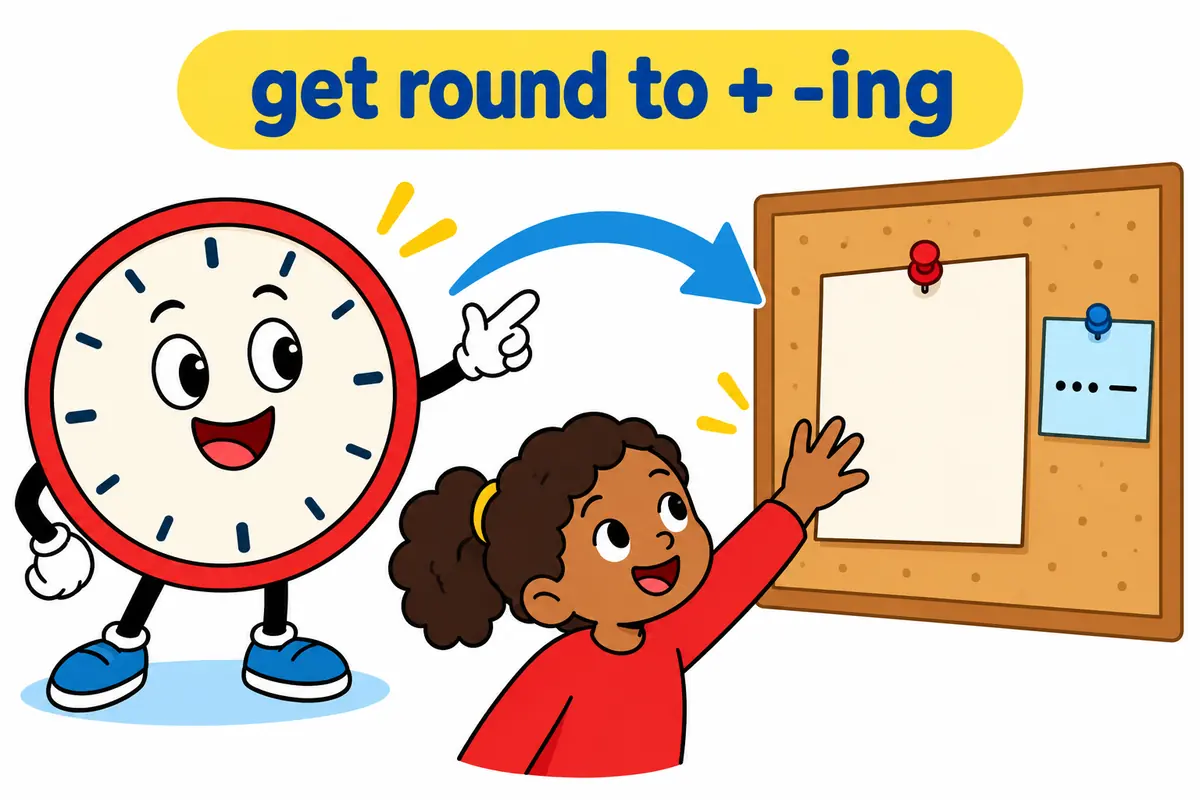
Get round to in a sentence: examples across contexts
The phrase keeps one meaning while changing tone. The nine sentences below move from a note in a kitchen to a line in an office email, and each one keeps the fixed frame get round to plus a noun or an -ing verb.
| Context | Example sentence | Why this works |
|---|---|---|
| Home note | I finally got round to mending the kitchen chair. | A small, concrete task suits the casual phrase. |
| Workplace email | We have not got round to updating the staff list yet. | The perfect tense shows the job is still pending. |
| News report | The council only got round to repairing the bridge last year. | The adverb only stresses how long the delay lasted. |
| Academic writing | The team got round to analysing the samples in June. | Keeps the idiom while naming a date for the task. |
| Conversation | I must get round to calling my aunt. | Must expresses an intention the speaker has not met. |
| Diary entry | Got round to sorting the recycling at last. | A dropped subject is fine in an informal note. |
| Business memo | Once we get round to reviewing the figures, we will reply. | Once marks the moment the delayed task starts. |
| Review | The studio never got round to fixing the obvious faults. | Never underlines a job that was avoided entirely. |
| Teaching example | Did you get round to handing in the form? | A question uses do-support with the base form get. |
Every row keeps to as a preposition, which is the single habit that separates natural use from the common mistake. The tense sits on get alone; nothing after to ever changes to agree with it.
Get round to vs get around to
The two spellings describe one idiom, and the choice between them is regional rather than grammatical. The table sets out what actually differs.
| Attribute | get round to | get around to |
|---|---|---|
| Meaning | Find time for a delayed task | The same |
| Region | Chiefly British | Chiefly American |
| Grammatical frame | to plus noun or -ing verb | to plus noun or -ing verb |
| Tense changes on | get only | get only |
| Register | Neutral and conversational | Neutral and conversational |
Verdict: choose get round to for a British audience and get around to for an American one, and keep the same frame either way, because the two phrases are interchangeable in every sentence that uses them well.
Word forms and grammar of get round to
The phrase is fixed, so grammar changes only the verb get. The table lists the forms and the regional variant, and marks the one form learners build by mistake.
| Form | Part of speech | Example |
|---|---|---|
| get round to | fixed phrase, base form | I must get round to the tax form. |
| gets round to | third-person singular | He never gets round to his emails. |
| got round to | past and participle | We got round to it at last. |
| getting round to | -ing form | She is finally getting round to the garden. |
| get around to | American variant | They will get around to it next week. |
| get round to do | non-standard | Do not write this; to needs an -ing verb or a noun here. |
What may vary inside the phrase is small: round or around, and the tense of get. What may not vary is to and the form of the following verb. That fixed quality is what makes the expression an idiom rather than a loose phrase.
Common mistakes with get round to
- Incorrect:
I finally got round to fix the tap.Correct: I finally got round to fixing the tap. Rule: To is a preposition here, so the verb after it takes -ing. - Incorrect:
She got round to do her homework.Correct: She got round to doing her homework. Rule: Get round to is not followed by a bare infinitive, unlike want to or need to. - Incorrect:
We got round to the meeting at last.Correct: We got round to attending the meeting. Rule: With a noun that names an event, add an -ing verb so the task, not the event, is the object. - Incorrect:
I will get it round to soon.Correct: I will get round to it soon. Rule: The pronoun follows to and stays at the end; the phrase does not split around it. - Incorrect:
They got round the invoice quickly.Correct: They got round to the invoice quickly. Rule: Get round without to means to avoid a problem, so dropping to changes the meaning entirely.
Practice using get round to
Work through the six items, then read the reason beside each answer rather than only the key.
- Fill the gap: I still have not ______ replying to that email.
- Choose the better form: We finally got round to (paint / painting) the fence.
- Correct the error: She got round to book the tickets yesterday.
- Build a sentence: use get round to it about a broken light you keep meaning to fix.
- Spot the register: which belongs in a formal report — the department did not get round to addressing the fault, or the department did not address the fault?
- Rewrite with the American variant: I got round to sorting the files. Use around instead of round.
Answers
- got round to — the perfect tense marks a task still waiting, and to takes replying.
- painting — to is a preposition, so the task needs the -ing form.
- She got round to booking the tickets yesterday — booking, not book, follows to.
- Model answer: I will get round to it once the shops reopen.
- The department did not address the fault — a formal report prefers the precise verb to the casual idiom.
- I got around to sorting the files — around is the American variant of round.
The bottom line
Use get round to in a sentence when a delayed task is finally started, and keep to as a preposition, so a noun or an -ing verb always follows. Two nuances decide most sentences: the tense changes only on get, never on the words after to, and dropping to turns the phrase into get round something, which means to avoid a problem rather than to find time. For a plainer verb, undertake or complete will often read better in formal writing.
Frequently asked questions about get round to
Is get round to followed by -ing or a base verb?
It is followed by an -ing verb or a noun, because to works as a preposition in this phrase. That gives I got round to painting the shed, never I got round to paint the shed. The same rule explains why a pronoun sits after to, as in I got round to it.
Is get round to British or American?
Get round to is chiefly British, and its American twin is get around to. Both mean exactly the same thing and take the same frame, so the choice is regional rather than grammatical. In a single piece of writing, pick one and keep it throughout for consistency.
What is the difference between get round to and get round?
Get round to means finally find time for a task. Get round on its own, as in get round a problem, means to avoid or bypass it. Dropping to changes the meaning completely, which is why the fixed preposition is the part learners should never omit.
Can get round to describe a finished task?
Not by itself. The phrase marks the moment a delayed task is started or reached, not the moment it is completed. You can say I got round to cleaning the car and still add that you stopped halfway. To show completion, pair it with a separate result clause.