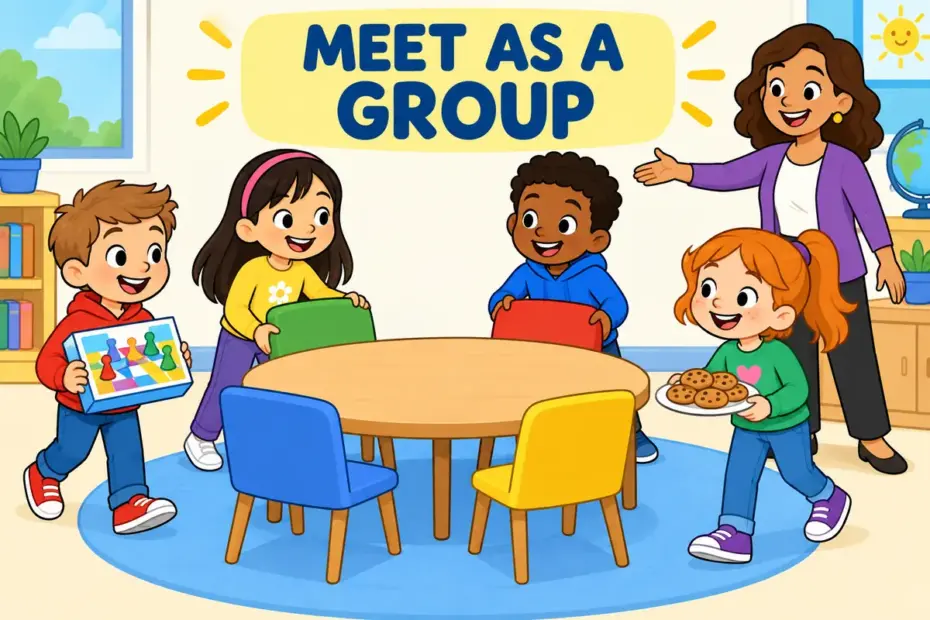
Get together means to meet to spend time with people or to gather for a shared purpose. To use get together in a sentence, name the people and the reason: “The neighbours get together every Sunday.” The phrase is a phrasal verb, and it becomes the hyphenated noun a get-together when the meeting itself is the event.
Get together at a glance
- Get together is a phrasal verb built from the verb get plus the particle together.
- It carries two common senses: meeting socially, and gathering to do a task.
- The people who meet are usually the subject, as in we got together.
- As a noun the phrase is hyphenated: a get-together, an office get-together.
- The verb keeps get flexible: gets together, got together, getting together.
- The commonest error is using the two-word form for the noun event.
What does get together mean?
Get together is a phrasal verb meaning to meet with other people, either socially or to combine efforts on something. The Cambridge entry for get together records both the social sense and the noun form. The social sense is the everyday one: friends get together for a meal. The working sense describes people who assemble to finish a task, and the combining sense describes separate parts that join into a whole. When exactly two people arrange to meet, arrange to meet is the plainer option, because get together usually implies a group and a relaxed tone.
| Sense | Plain meaning | Example sentence |
|---|---|---|
| Social meeting | People meet to enjoy one another’s company | The cousins get together every summer. |
| Working meeting | People gather to finish a shared task | The committee got together to plan the fair. |
| Combining parts | Separate things join into one | Stir the ingredients until they get together. |
| Noun event | A planned, informal meeting | She hosted a get-together for the new team. |
How do you use get together in a sentence?
Get together behaves like other phrasal verbs, so its grammar depends on whether the people meet themselves or someone arranges the meeting. The table shows the patterns that sound natural to native speakers.
| Pattern | Example | What it signals |
|---|---|---|
| subject + get together + time | We get together every Friday. | a habitual social meeting |
| subject + get together + to + verb | The staff got together to thank her. | a shared purpose |
| get + object + together | Can you get the team together? | arranging other people |
| get together + with + person | I got together with an old friend. | a one-to-one or pair meeting |
| get together + for + noun | The class got together for a picnic. | the occasion that draws people |
Get together in a sentence: examples across contexts
| Context | Example sentence | Why this works |
|---|---|---|
| Classroom | The reading club gets together in the library on Wednesdays. | Names a recurring group meeting and its place. |
| Workplace email | Let us get together on Monday to review the budget. | Proposes a working meeting without sounding stiff. |
| News report | Residents got together to clear the storm damage. | Shows community effort after a specific event. |
| Conversation | We should get together sometime soon. | A warm, open-ended invitation. |
| Family | The whole family gets together for the holidays. | Describes an annual gathering. |
| Academic writing | The committee got together to agree the final wording. | Reports a working session plainly. |
| Sports | The squad got together before the final match. | A team meeting timed before an event. |
| Volunteering | Neighbours got together to paint the fence. | Name a collective task with a clear goal. |
| Business memo | Departments get together each quarter to share results. | Describes a recurring cross-team routine. |
Get together vs gather
Gather is the single verb a learner often substitutes for get together, and the two differ in tone more than in meaning.
| Attribute | Get together | Gather |
|---|---|---|
| Core meaning | Meet, often socially | Come or bring into one place |
| Register | Relaxed, spoken-friendly | Neutral to formal |
| Typical subject | People who choose to meet | People, and also objects or data |
| What it implies | Company and a reason to mingle | Collection and accumulation |
| Noun form | A get-together | A gathering |
Choose gather when things accumulate and get together when people meet for company, because only get together carries the social warmth. Where a crowd forms without an invitation, congregate describes the movement better than get together, and a formal body may convene instead. When the point is talking with others rather than meeting, socialize can replace get together.
Word forms and grammar of get together
The verb get changes tense while the particle together stays fixed, and the noun form adds a hyphen.
| Form | Part of speech | Example |
|---|---|---|
| get together | phrasal verb, base | We get together on Fridays. |
| gets together | verb, third person singular | She gets together with her study group. |
| got together | verb, past | They got together last week. |
| getting together | verb, -ing form | Getting together takes only an hour. |
| get-together | noun | The get-together starts at six. |
| get-togethers | noun, plural | Summer get-togethers fill the park. |
Two neighbours share the same particle and are worth keeping apart: cobble together a plan means to make something quickly from what is available, while piece together the facts means to reconstruct something from fragments.
Common mistakes with get together
Dropping the particle. Incorrect: We should together this weekend. Correct: We should get together this weekend. The verb get must keep its particle, or the sentence loses its verb phrase.
Hyphenating the verb. Incorrect: The club get-togethers every Friday. Correct: The club gets together every Friday. The hyphen belongs only to the noun; the verb is always two separate words.
Using the noun as two words. Incorrect: They held a get together after work. Correct: They held a get-together after work. As a noun the phrase is one hyphenated unit.
Adding an unnecessary object with. Incorrect: We got together ourselves. Correct: We got together. The subject is already the group, so a reflexive object is wrong.
Confusing it with get to. Incorrect: We will get together the museum at noon. Correct: We will get to the museum at noon. Get to marks arrival, while get together marks a meeting.
Practice using get together
- Fill in the blank: The book club ______ every second Tuesday in the staff room.
- Choose the better verb: After the exam, the students (got together / gathered) at a cafe to celebrate.
- Correct the error: Our team get-together every Monday to set weekly goals.
- Build a sentence: describe a family that meets every summer, using get together plus a time phrase.
- Spot the register: which sentence belongs in a message to a teacher, “Let us get together about my essay.” or “Me and the lads are gonna get together to moan.”
- Fill in the blank: The volunteers got together ______ clean the riverbank.
Answers
- gets together — a singular club takes the -s form.
- got together — the tone is social, and get together fits a celebration better than gather.
- Our team gets together every Monday to set weekly goals. — the verb is two words; only the noun is hyphenated.
- The family gets together every August for a reunion. — the time phrase shows the routine.
- The first sentence belongs in a message to a teacher. — the second is too casual and contains slang.
- to — the infinitive of purpose follows get together.
The bottom line
Get together is a two-word phrasal verb for meeting people, working on a task, or joining parts. Keep it two words as a verb and hyphenate it as a noun, so get together in a sentence always shows the right shape. The phrase is neutral to informal, which makes gather the safer pick in a formal report.
Frequently asked questions about get together
Is get together one word or two words?
As a verb it is always two words: we get together, they got together, she is getting together with friends. It becomes one hyphenated word only when it works as a noun, as in a neighbourhood get-together. So the spelling tracks the grammar, not the meaning.
Can get together be split by an object?
No. Get together is an intransitive phrasal verb, so nothing goes between get and together. You cannot say get the team together in the meeting sense while splitting the phrase, and instead you keep the pair whole: the team gets together. To arrange others, use a different verb such as assemble.
How is get together different from meet up?
Both describe meeting people and both are informal, but meet up stresses the appointment itself while get together stresses the shared time. Meet up works for two people or a group, and get together is a little warmer. In a sentence such as let us get together soon, the emphasis falls on enjoying company.
Is get together formal or informal?
It sits in the middle. The phrase is common in speech, friendly emails and news writing, so it suits most everyday contexts. In a legal document or an academic paper, gather or convene reads more formal, and a reader may find get together too relaxed for a formal register.
Are you unsure of how to properly use the phrase “get together” in a sentence? Let’s shed some light on this common expression. To “get together” means to meet or gather with others in a social context.
This versatile term can be used in various situations to indicate coming together for an event, meeting, or simply to spend time with friends and family. Stay tuned to discover the correct ways to incorporate “get together” in your conversations.
7 Examples Of Get Together Used In a Sentence For Kids
- Let’s get together and play with our toys.
- We can get together and sing songs in circle time.
- It’s fun to get together and share our snacks.
- We should get together and dance to music.
- Let’s get together and make a colorful craft.
- We can get together and listen to a story.
- It’s nice to get together and have a picnic in the garden.
14 Sentences with Get Together Examples
- Get together with your classmates to form study groups for better exam preparation.
- Are you planning to get together with friends this weekend for a movie night?
- Let’s get together and organize a potluck dinner for the whole college group.
- Don’t forget to get together with your project team to discuss the upcoming deadline.
- It’s always fun to get together with roommates and cook a meal together.
- Why don’t we get together and plan a trip during the next college break?
- Get together with your seniors to seek advice on career opportunities and internships.
- Make sure to get together with your club members to plan the next event.
- Let’s get together and attend that workshop on campus next week.
- Are you excited to get together and celebrate your friend’s birthday?
- Don’t miss out on the opportunity to get together with industry professionals during networking events.
- It’s important to get together with your professors for guidance on your academic projects.
- Get together with your sports team for practice sessions and team bonding activities.
- Joining a student organization is a great way to get together with like-minded individuals and make new friends.
How To Use Get Together in Sentences?
Get Together is a powerful tool that helps you connect and collaborate with others effectively. To use Get Together, first, create an account on the platform by signing up with your email address. Once you have your account set up, you can start inviting friends, colleagues, or other individuals to join your group.
To Get Together with others, you can create events, discussions, or share important information within your group. Make sure to communicate with your group members to coordinate schedules and activities effectively. The platform also allows you to send messages and notifications to keep everyone informed and engaged.
When using Get Together, you can easily customize your group settings to meet your preferences. You can control who can join the group, approve new members, and set specific rules or guidelines. This helps create a safe and inclusive environment for everyone involved.
Additionally, Get Together offers features such as event RSVPs, polls, and photo sharing to enhance your group experience. Take advantage of these tools to organize gatherings, collect feedback, and document memorable moments.
In conclusion, Get Together is a versatile platform that facilitates communication, collaboration, and community-building. By following these steps and utilizing the various features, you can make the most out of your Get Together experience and strengthen your connections with others.
Conclusion
In conclusion, “get together” is a versatile phrase that can be used in various contexts to describe people coming together for social interactions, gatherings, or meetings. Whether it is organizing a family get together, planning a get-together with friends, or scheduling a business get together, the phrase conveys a sense of unity and camaraderie. These sentences showcase how “get together” can be used in different scenarios, emphasizing the importance of social connections and relationships in our lives. Overall, the phrase “get together” highlights the significance of spending time with others and fostering meaningful connections that contribute to a sense of community and togetherness.


