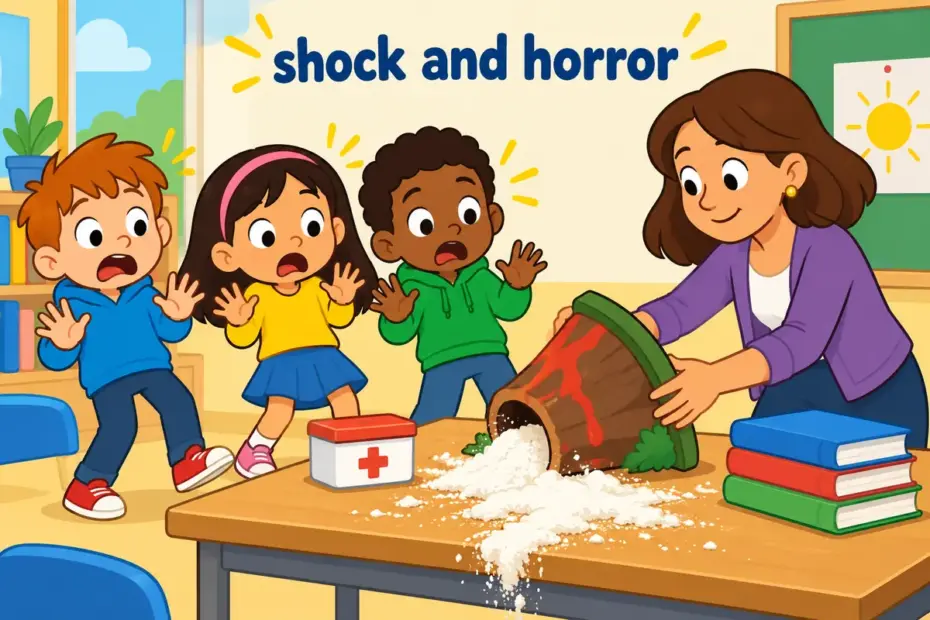
Ghastly is an adjective meaning causing horror or shock, and it also describes something merely very unpleasant. To use ghastly in a sentence, put it before a noun or after a linking verb: “a ghastly accident,” “the smell was ghastly.” The word is strong, so it needs a subject that justifies it.
Ghastly at a glance
- Ghastly is a gradable adjective; its forms are ghastlier, ghastliest and the noun ghastliness.
- The two main senses are causing horror and being extremely unpleasant, with a third British sense of looking or feeling unwell.
- It works both before a noun (a ghastly error) and after a linking verb (the story sounded ghastly).
- The strongest collocations are ghastly mistake, ghastly accident, ghastly weather and ghastly sight.
- The commonest error is confusing ghastly with ghostly, which means pale and faint like a ghost.
What does ghastly mean?
Ghastly is an adjective meaning causing horror or shock, or, more loosely, extremely unpleasant. The Cambridge entry for ghastly separates a sense of being shocking from a sense of being very bad. The split explains why the word can describe a real disaster and a disappointing meal in the same paragraph, though only one of those uses is literal. A close cousin in meaning is macabre, which leans toward the grim and deathly rather than the merely bad.
| Sense | Plain meaning | Example sentence |
|---|---|---|
| Shocking | Causing horror or fear | The wreckage made a ghastly sight in the morning light. |
| Very bad | Extremely unpleasant or poor | We made a ghastly mistake in the invoice. |
| Unwell or pale | Looking ill or deathly pale | She looked ghastly after the overnight flight. |
One honest limitation matters here. Ghastly is not a neutral word for anything slightly annoying. Calling a short delay ghastly tells a reader you are exaggerating, and in formal writing that exaggeration costs you authority. Where a plainer word serves better, choose unpleasant, serious or disappointing and keep ghastly for matters that truly shock.
How do you use ghastly in a sentence?
Ghastly behaves like most descriptive adjectives, so the pattern you pick decides where the emphasis lands. The four patterns below cover almost every real sentence, from an urgent news line to a casual remark about the weather. Note that the informal sense accepts degree words such as absolutely and utterly, while the literal horror sense rarely needs one.
| Pattern | Example | What it signals |
|---|---|---|
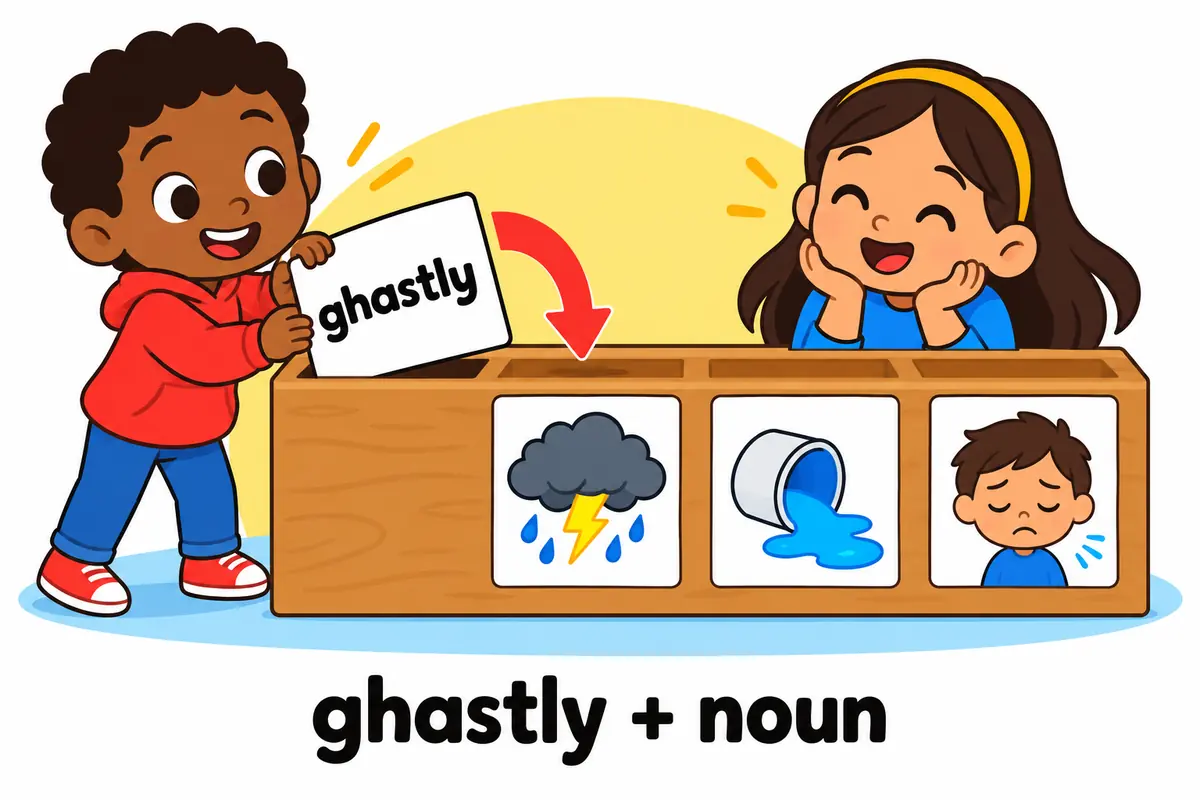
| ghastly + noun | They uncovered a ghastly error in the records. | Attributes the quality directly, the tightest and commonest form. |
| be / seem / sound + ghastly | The whole arrangement sounds ghastly. | Predicative use, natural when reacting to a plan or report. |
| look / feel + ghastly | He looked ghastly the morning after the fever. | The illness sense, mostly British and usually about a person. |
| absolutely / utterly + ghastly | The traffic on the ring road was absolutely ghastly. | Informal intensifier, fine in speech, out of place in a report. |
| it + be + ghastly + to-infinitive | It was ghastly to watch the roof collapse. | Places the reaction before the event, common in first-person writing. |
The near-synonym hideous covers the same ground for things that are ugly as well as shocking, so a hideous dress and a hideous crime both work, while ghastly keeps a stronger note of dread.
Ghastly in a sentence: examples across contexts
Ghastly shifts register more than it shifts meaning. The nine sentences below keep the same adjective while moving from a classroom to a news bulletin, and each one names the thing that earns the strong wording.
| Context | Example sentence | Why this works |
|---|---|---|
| Classroom | The class agreed that the ending of the play was ghastly. | Lets a pupil judge a fictional event, which is a safe use of the word. |
| Workplace email | Please check the figures, because a ghastly error slipped into yesterday’s summary. | Names the error, so the strong adjective has a specific target. |
| News report | Residents described a ghastly scene as floodwater filled the street. | Attributes the wording to witnesses, which keeps reporting factual. |
| Memoir | It was ghastly to wait for news that never came. | Uses the infinitive pattern to express dread rather than describe a thing. |
| Conversation | The soup was absolutely ghastly, so we left it. | Puts the informal intensifier where it belongs, in speech. |
| Sports writing | A ghastly defensive error handed the match to the visitors. | Applies the very-bad sense to a single specific moment. |
| Weather small talk | The wind was ghastly all weekend, so the ferry stayed in port. | Shows the mild British sense, softened by the everyday subject. |
| Travel writing | After two nights without sleep, every passenger looked ghastly. | Uses the pallor sense, which needs people rather than objects. |
| Art review | The painter turns a ghastly subject into something unexpectedly calm. | Pairs the horror sense with a formal, analytical frame. |
Only the news and sports examples would read naturally in a professional bulletin; the intensifier and the weather remark belong in speech. That asymmetry is the quickest way to place the word correctly. For a related but gentler tone, appalling names strong disapproval without the note of physical dread.
Ghastly vs ghostly and gruesome
Two words sit one letter or one shade away, and both pull readers off course. Ghostly describes something pale, faint and ghost-like, while gruesome describes something physically shocking, often with blood involved. Ghastly covers both ideas without committing to either.
| Attribute | ghastly | ghostly | gruesome |
|---|---|---|---|
| Core meaning | Horrifying or extremely bad | Pale and faint like a ghost | Physically shocking, often gory |
| Typical subject | Accident, mistake, weather, sight | Face, figure, silence, light | Injury, crime scene, detail |
| Strength | Strong, gradable in the informal sense | Quiet and eerie rather than strong | Strongest, usually literal |
| Register | Broad, from speech to journalism | Literary and descriptive | Journalism and horror writing |
| Implies fear | Yes, alongside disgust | Yes, but a soft unease | Not fear, mostly revulsion |
Verdict: choose ghostly for anything pale and spectral, gruesome for physical horror, and ghastly when you want a single word that can carry shock, dread or plain awfulness. The adjective gruesome is the wrong choice for a minor annoyance, where ghastly at least allows a hint of exaggeration.
Word forms and grammar of ghastly
Ghastly inflects like a regular two-syllable adjective, and its noun is common in literary criticism. The table also lists the adverb, which is grammatical but rare enough that most writers avoid it. The compound ghastly-looking behaves as one adjective.
| Form | Part of speech | Example |
|---|---|---|
| ghastly | adjective, base form | The house wore a ghastly shade of green. |
| ghastlier | adjective, comparative | His second draft was ghastlier than the first. |
| ghastliest | adjective, superlative | It was the ghastliest meal of the whole trip. |
| ghastliness | noun | The ghastliness of the report silenced the room. |
| ghastlily | adverb, rare | The wound was ghastlily described in the diary. |
| ghastly-looking | compound adjective | A ghastly-looking bruise covered his arm. |
Learners often try to build ghastfully by analogy with beautifully, but that form does not exist. Match the adjective to a noun or use the noun ghastliness instead.
Common mistakes with ghastly
- Incorrect:
The fog gave the garden a ghastly, transparent look.Correct: The fog gave the garden a ghostly, transparent look. Rule: Ghastly means horrifying; ghostly means pale and spectral, which is what fog actually does. - Incorrect:
The manager spoke ghastly about the delay.Correct: The manager spoke in a ghastly tone about the delay. Rule: Ghastly is an adjective, so it cannot modify a verb; attach it to a noun. - Incorrect:
She felt ghastly about the small typing mistake.Correct: She felt bad about the small typing mistake. Rule: Save ghastly for real shock; a trivial slip does not justify the force of the word, and feel ghastly means unwell. - Incorrect:
The report was very ghastly and quite thorough.Correct: The report was ghastly in its detail and quite thorough. Rule: Do not stack a general intensifier on the literal horror sense; it flattens the effect. - Incorrect:
We had a ghastly time waiting, it was fine really.Correct: We had a ghastly time waiting, though the staff were kind. Rule: Keep the clause that follows consistent with the strong word rather than contradicting it.
Practice using ghastly
Work through the six items below, then check the reasons rather than only the keys.
- Fill the gap: The hikers described a ______ night on the exposed ridge.
- Choose the better word: In the old photograph her face looked (ghastly / ghostly) and very pale.
- Correct the error: The team celebrated ghastly after the narrow win.
- Build a sentence: use ghastly + noun about a spelling mistake in a school newsletter.
- Spot the register: which belongs in a police statement — a ghastly error in the log, or the whole shift was absolutely ghastly?
- Rewrite with the noun: The details of the crash were ghastly. Use ghastliness instead.
Answers
- ghastly — the exposed ridge is the specific subject that earns the strong adjective.
- ghostly — a pale face in an old photograph is spectral, not horrifying.
- The team celebrated wildly after the narrow win — ghastly is an adjective and cannot describe how they celebrated.
- Model answer: The newsletter contained a ghastly error in the head teacher’s name.
- A ghastly error in the log — a formal statement avoids the informal intensifier absolutely.
- The ghastliness of the crash details silenced the room — the noun takes an article and an of-phrase.
The bottom line
Use ghastly in a sentence when something genuinely shocks or horrifies, or when you want the informal sense of extremely unpleasant, and always give it a specific subject. Two nuances decide most sentences: the literal horror sense is not gradable with very, and the British sense of looking unwell applies to people rather than things. Where the feeling is disapproval rather than dread, dreadful is often the safer choice.
Frequently asked questions about ghastly
Is ghastly a formal word?
Ghastly ranges from informal speech to serious journalism. The very-bad sense with an intensifier, as in absolutely ghastly traffic, belongs in conversation, while the horror sense suits reports and literary writing. Matching the sentence to the sense matters more than any single label, and the word rarely sounds out of place in either register.
What is the difference between ghastly and ghostly?
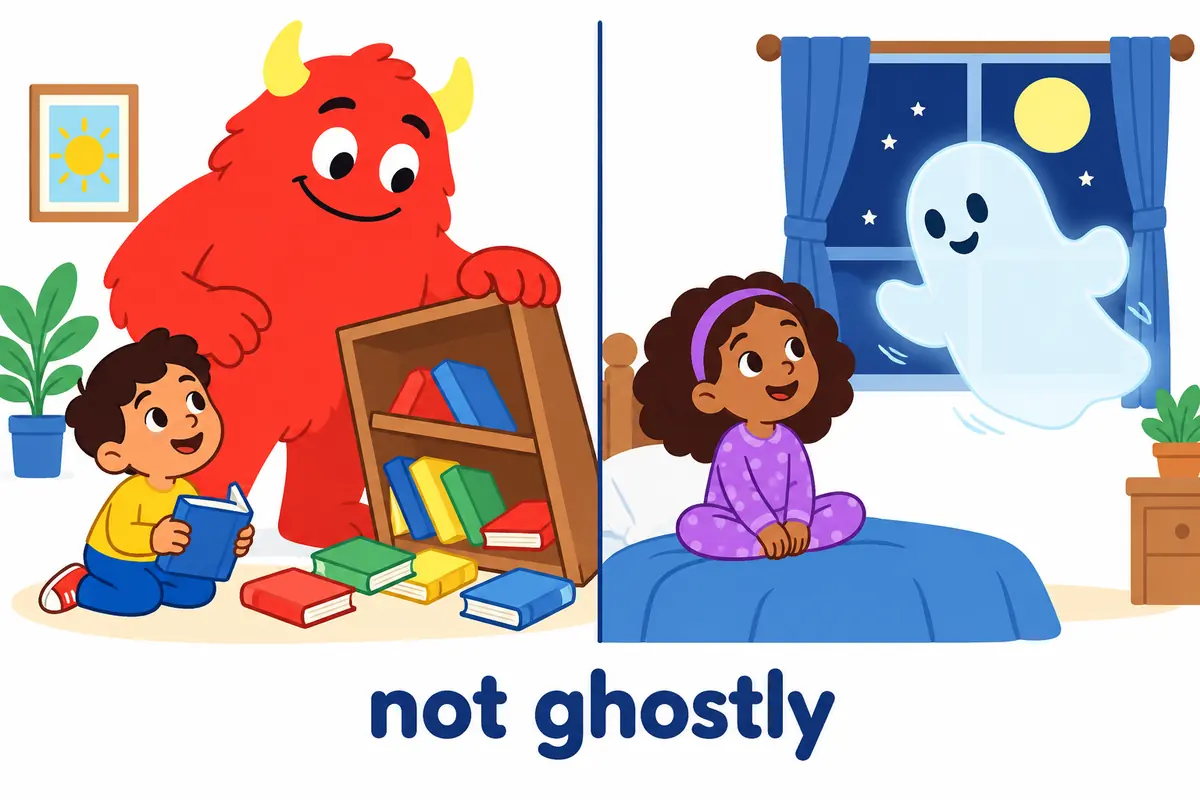
Ghastly means causing horror or shock, or extremely bad. Ghostly means pale, faint and ghost-like in appearance. A ghastly mistake is a shocking error; a ghostly figure is a pale shape that seems to belong to a ghost. Keeping the two apart prevents one of the most common spelling slips in descriptive writing.
Can ghastly describe a person?
Ghastly can describe a person in the British sense of looking or feeling very unwell. She looked ghastly means she seemed pale and ill, not that she shocked anyone. To describe a person as horrifying you would normally attach ghastly to something they did or made, as in a ghastly deed.
Does ghastly have a comparative form?
Ghastly takes the regular comparative and superlative forms ghastlier and ghastliest. Ghastlier weather and the ghastliest meal both read naturally. The adverb ghastlily is grammatical but rare, so most writers avoid it and rephrase, while the noun ghastliness handles the abstract sense cleanly.
Have you ever come across a sentence so dark and unsettling that it sends shivers down your spine? This type of chilling sentence can be described as “ghastly.”
The word “ghastly” is used to portray something shockingly frightful, unpleasant, or dreadful. When a sentence is described as ghastly, it often encompasses a sense of horror or grimness that can evoke strong emotions in the reader.
7 Examples Of Ghastly Used In a Sentence For Kids
- The witch’s cackle was ghastly.
- The haunted house had a ghastly glow.
- The monster’s roar sounded ghastly.
- The graveyard at night looked ghastly.
- The skeleton’s dance was ghastly.
- The ghost’s wail was ghastly.
- The vampire’s teeth were ghastly.
14 Sentences with Ghastly Examples
- The food in the college canteen looked ghastly after being left out for hours.
- The exam room was filled with a ghastly silence as students concentrated on their papers.
- The chemistry experiment resulted in a ghastly smell that lingered in the lab for hours.
- The state of the hostel bathrooms was ghastly and caused complaints among the students.
- The previous year’s question paper revealed a ghastly difficulty level that left many students anxious.
- The cafeteria’s attempt at a new dish was met with ghastly reviews from the student body.
- The college’s Wi-Fi connection was ghastly slow during peak hours, frustrating students trying to complete assignments.
- The sight of the lecture hall after a rowdy party was ghastly, with chairs overturned and trash strewn everywhere.
- The sight of the stray dogs fighting outside the hostel was ghastly and distracting for students trying to study.
- The group project presentation was deemed ghastly when the slides failed to work and the team members stumbled over their words.
- The consequences of missing a deadline with a strict professor were ghastly, resulting in a significant drop in grades.
- The professor’s ghastly singing during the college fest left many students covering their ears in discomfort.
- The state of the college library during exam season was ghastly, with books scattered around and students frantically searching for resources.
- The results of the surprise quiz were ghastly, with the majority of the class failing to meet the passing mark.
How To Use Ghastly in Sentences?
To use the word “Ghastly” in a sentence effectively, you need to understand its meaning first. Ghastly typically describes something that is shockingly horrific, dreadful, or terrifying. Here is a step-by-step guide on how to use Ghastly in a sentence:
-
Choose a subject: Decide on the person, place, or thing you want to describe as Ghastly.
-
Form a sentence: Construct a simple sentence structure that includes your chosen subject and the word Ghastly.
-
Be descriptive: Add details or adjectives that emphasize the shocking or dreadful nature of the subject.
-
Check grammar: Ensure that your sentence is grammatically correct and makes sense.
-
Example: “The abandoned house had a ghastly appearance, with broken windows and eerie shadows lurking in every corner.”
Remember to use the word Ghastly in context, keeping in mind its meaning of being extremely unpleasant or horrifying. Practice constructing sentences with Ghastly to become more comfortable incorporating it into your writing.
Conclusion
In conclusion, the use of “ghastly” in sentences helps to vividly describe something horrifying or shockingly unpleasant. For instance, “The ghastly sight of the haunted house sent shivers down her spine” paints a clear image of a terrifying and unsettling scene. Similarly, “The ghastly smell of decay lingered in the abandoned building” conveys a sense of revulsion and dread brought on by a foul odor.
These examples showcase how the word “ghastly” is effective in communicating intense emotions and creating a strong impact on the reader. By incorporating such descriptive language, writers can evoke powerful sensations and create memorable images that enhance the overall tone and atmosphere of their writing.


