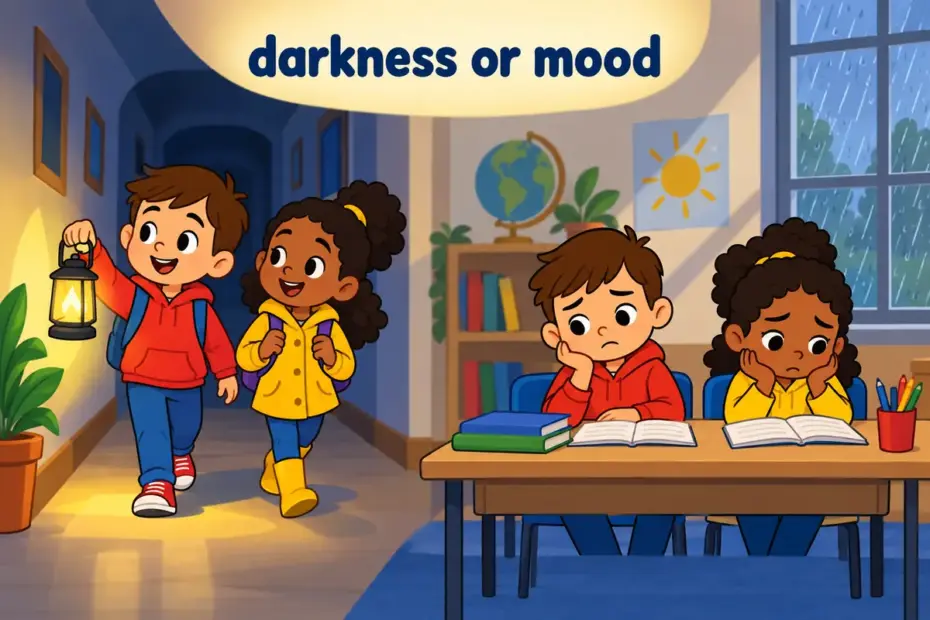
To use gloom in a sentence, decide first whether it names physical darkness or a low, sad mood. In the first sense the gloom of a cellar is literal; in the second, economic gloom describes a shared feeling. The noun usually follows in or of: “The gloom deepened as the meeting wore on.”
Gloom at a glance
- Gloom is a noun, normally uncountable, meaning either dim darkness or a mood of sadness.
- Its adjective is gloomy and its adverb gloomily; the noun has no standard plural.
- The noun follows in or of: in the gloom, a mood of gloom.
- It collocates with deepening, gathering, economic and general.
- The commonest error is using gloom where the adjective gloomy belongs.
What does gloom mean?
Gloom is a noun meaning either a dim, shadowy darkness or a mood of sadness and hopelessness. The Cambridge entry for gloom records both, and the physical sense is the older everyday one: a room can fill with gloom before anyone feels anything. Where a sentence describes how something looks rather than what it is, English needs the adjective gloomy. Because gloom is uncountable, it takes no article in the general sense, exactly like true darkness.
| Sense | Plain meaning | Example sentence |
|---|---|---|
| Physical darkness | Dim, shadowy light | The gloom of the cellar hid the step. |
| Low mood | Sadness or hopelessness felt by one person | A deep gloom settled on the team after the loss. |
| Public pessimism | A widespread mood of doubt about the future | Economic gloom spread through the coastal towns. |
One limitation matters for learners. Gloom is not a clinical word, so a doctor writes depression rather than gloom, and a person in despair has moved beyond it. The noun also refuses the plural: a sentence such as she had many glooms is not standard English.
How do you use gloom in a sentence?
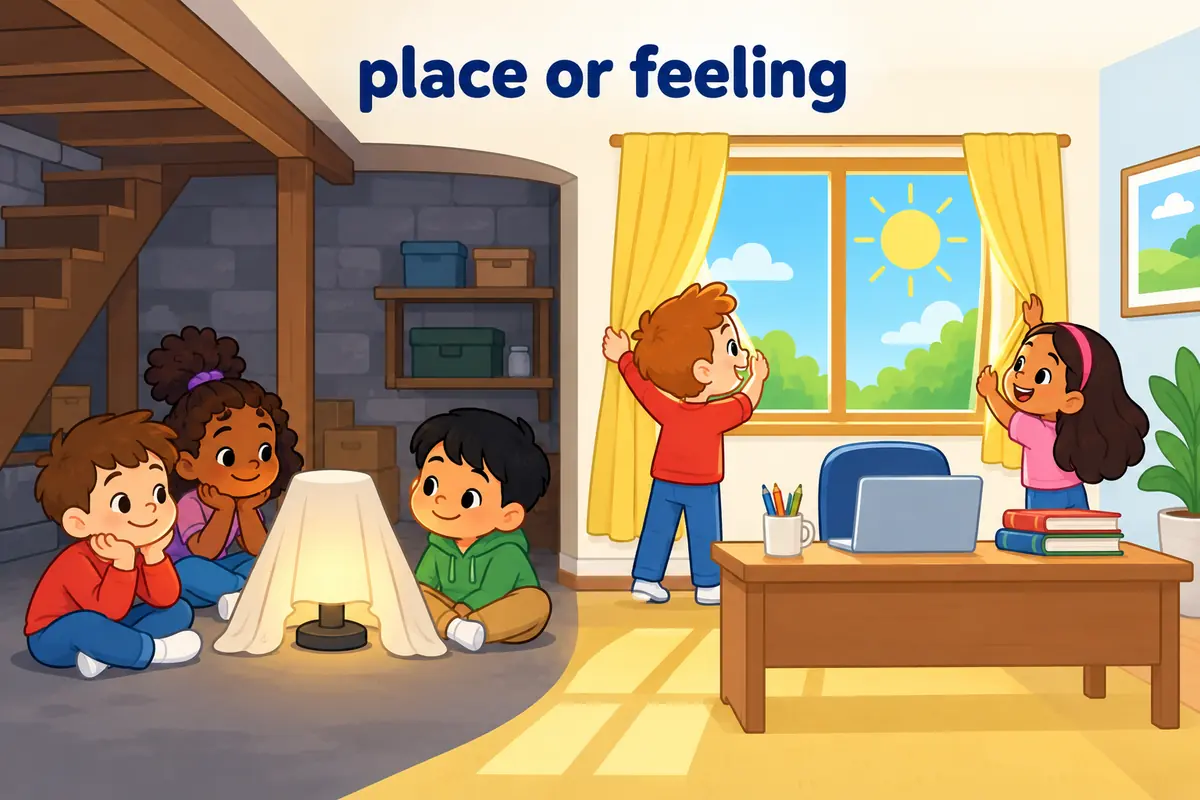
Put gloom in the position a noun normally takes, then let the preposition decide whether the gloom is a place or a feeling. Five patterns cover almost every real sentence, and the weather and the mood share all of them, which is why the same verb works for both.
| Pattern | Example | What it signals |
|---|---|---|
| in the gloom / into the gloom | The torch cut through the gloom. | Names a place or condition of darkness. |
| a mood, air or pall of gloom | A pall of gloom hung over the office. | Names an emotional atmosphere. |
| gloom settles, descends or deepens | Gloom descended when the results arrived. | Makes gloom the actor in the sentence. |
| economic, political or general gloom | Retailers reported months of economic gloom. | Frames a public, measurable pessimism. |
| the gloom lifts or clears | The gloom lifted once the funds were secured. | Describes recovery from either sense. |

Gloom in a sentence: examples across contexts
Gloom shifts register more than meaning. The nine sentences below keep the same noun while moving from a classroom to an economic report, and each one supplies a concrete source for the darkness or the mood.
| Context | Example sentence | Why this works |
|---|---|---|
| Classroom | Gloom filled the room when the trip was cancelled. | A named event explains the mood in one clause. |
| Weather report | The gloom lifted by noon as the fog burned away. | Pairs the noun with a measurable change in light. |
| Workplace email | The quarterly figures brought gloom to the sales floor. | Numbers act as the cause, which suit formal writing. |
| News report | A pall of gloom hung over the factory town. | The fixed phrase signals collective mood at a glance. |
| Sports writing | Gloom settled on the dressing room after the final whistle. | Places the mood in a specific room and moment. |
| Literature | He sat in the gloom, listening to the rain. | The physical sense carries atmosphere without emotion words. |
| Economics | Months of economic gloom followed the closure. | A plain modifier keeps the claim reportable. |
| Conversation | There was real gloom at home when the dog went missing. | The informal tone still uses the uncountable noun. |
| Film review | The director lets gloom gather before the first joke lands. | Treats gloom as a designed effect, not a feeling. |
Only one of these sentences names a single feeling; the rest treat gloom as a condition that surrounds people rather than lives inside them.
Gloom vs despair, melancholy and dejection
Gloom overlaps with three sad nouns and matches none of them. despair is the loss of all hope, melancholy is a thoughtful, lingering sadness, and dejection is the low mood that follows a specific defeat.
| Attribute | gloom | despair | melancholy |
|---|---|---|---|
| Core meaning | Darkness, or a spreading low mood | The loss of all hope | A thoughtful, lingering sadness |
| Intensity | Moderate; often shared | Extreme | Mild to deep |
| Usual subject | A place, an economy, a room | A person facing ruin | A reflective person |
| Can be physical | Yes | No | No |
| Register | Neutral to journalistic | Formal and literary | Literary |
Verdict: choose gloom for a darkness or a mood that surrounds people, despair when hope itself is gone, and melancholy when the sadness is quiet and reflective.
Word forms and grammar of gloom
Gloom inflects through its adjective and adverb rather than through a plural. The table also shows the fixed pairing that learners meet long before the noun itself.
| Form | Part of speech | Example |
|---|---|---|
| gloom | noun, uncountable | Gloom filled the hallway. |
| gloomy | adjective | The forecast was gloomy all week. |
| gloomily | adverb | She answered gloomily and looked away. |
| gloominess | noun, rare | The gloominess of the painting surprised me. |
| doom and gloom | fixed noun phrase | He predicted doom and gloom for the project. |
Keep the noun and the adjective apart in your own writing: the noun names a thing that exists, while the adjective describes a thing or a face.
Common mistakes with gloom
- Incorrect:
The sky turned gloom before the storm.Correct: The sky turned gloomy before the storm. Rule: Gloom is a noun; a linking verb such as turn or feel needs the adjective gloomy. - Incorrect:
She was filled with a gloom.Correct: She was filled with gloom. Rule: Gloom is uncountable, so it takes no article in this general sense. - Incorrect:
The defeat left a deep gloat in the dressing room.Correct: The defeat left a deep gloom in the dressing room. Rule: gloat is a verb meaning to enjoy another person’s failure; the mood is gloom. - Incorrect:
Gloom was descended on the town.Correct: Gloom descended on the town. Rule: Descend is intransitive here, so gloom acts without the helping verb was. - Incorrect:
There were several glooms in the report.Correct: There was a note of gloom throughout the report. Rule: The uncountable noun is counted through a partitive such as a note or a mood.
Practice using gloom
Work through the six items, then check the reasoning rather than only the key.
- Fill the gap: The candle barely pierced the ______ in the cave.
- Choose the better word: After the announcement the office felt (gloomy / gloom) for a week.
- Correct the error: A heavy gloom were hanging over the classroom.
- Build a sentence: use gloom descends about a town that loses its main employer.
- Spot the register: which belongs in a news report — a pall of gloom hung over the market, or everything felt totally gloom?
- Rewrite with the adjective: Gloom filled the waiting room when the train was delayed.
Answers
- gloom — the noun fills the object position after pierced the.
- gloomy — felt takes an adjective; gloom is the noun.
- A heavy gloom was hanging over the classroom — the singular uncountable noun takes was, not were.
- Model answer: Gloom descended on the town when the mine closed for good.
- A pall of gloom hung over the market — it keeps the fixed phrase that a report would print.
- The waiting room was gloomy after the delay — the adjective describes the room, not a separate thing.
The bottom line
Use gloom in a sentence for a darkness or a mood that surrounds people rather than one that is diagnosed, and let in, of or a collocation such as deepening do the grammatical work. Two nuances decide most sentences: the noun is uncountable, so it takes no plural, and it stays moderate, which is why shared sadness is closer to it than despair is. Where a sentence describes how something looks, switch to the adjective gloomy.
Frequently asked questions about gloom
Is gloom a countable noun?
Gloom is normally uncountable, so it takes no article and no plural: we say the gloom lifted, not the glooms lifted. When a writer needs to count it, English supplies a partitive noun such as a mood of gloom or a note of gloom, which keeps the uncountable head word intact.
What is the difference between gloom and gloomy?
Gloom is the noun, naming a darkness or a mood, while gloomy is the adjective that describes a room, a forecast, a face or a mood. A sentence needs gloomy after linking verbs such as be, feel, seem and turn, and gloom when the thing itself is named as the subject.
Is doom and gloom a fixed phrase?
Doom and gloom is a fixed pairing, usually found as the compound noun doom and gloom, and it means a pessimistic outlook. The order matters to most writers: doom and gloom is far more common than gloom and doom. It often appears after predict, warn or forecast.
Can gloom describe a place rather than a feeling?
Yes, and the physical sense is the original everyday one. The gloom of a cellar, a forest or a corridor is a matter of light, not emotion. Because the two senses use the same noun and the same prepositions, context and the surrounding verbs usually tell a reader which one is meant.
Have you ever felt enveloped by a sense of darkness and heaviness, as if a heavy cloud is hanging over you? This feeling of gloom, characterized by sadness, despair, and hopelessness, can sometimes cloud our thoughts and emotions.
An example sentence with “gloom” may look like this: “Despite the warm weather, Jane couldn’t shake off the feeling of gloom that lingered in her heart.”
7 Examples Of Gloom Used In a Sentence For Kids
- The gloom in the sky means it might rain soon.
- In the forest, the gloom makes it hard to see the animals.
- I don’t like the gloom because it makes me feel sad.
- When the sun goes down, the gloom starts to appear.
- The dark clouds bring a sense of gloom to the day.
- The gloom of the night makes everything quiet and still.
- The gloom lifts when the bright sun comes out again.
14 Sentences with Gloom Examples
- Gloom settled over the classroom as the professor announced a surprise test.
- The heavy rain added to the gloom as students slogged through the flooded streets to get to college.
- The constant workload and impending deadlines cast a shadow of gloom over the students.
- As the sun set early in the winter, a feeling of gloom descended on the campus.
- The gloom of exam season was alleviated by the colorful decorations for the college fest.
- Gloom hung in the air as the electricity went out during an important group study session.
- The news of campus restrictions due to COVID-19 brought a wave of gloom among the students.
- The never-ending assignments added to the sense of gloom among the exhausted students.
- The disappointment of canceled college events contributed to the prevailing gloom on campus.
- The uncertainty of future job prospects created a cloud of gloom over graduating students.
- The lack of social interaction due to online classes contributed to a feeling of gloom among the students.
- The loss of a beloved professor cast a shadow of gloom over the entire college community.
- The gloom of a power outage forced students to study by the dim light of their phone screens.
- The onset of monsoon season brought with it a sense of gloom as students struggled to navigate through puddles and mud.
How To Use Gloom in Sentences?
Gloom is a versatile word that can be used in various contexts to describe feelings of sadness, darkness, or despair. Here is a guide on how to use gloom in a sentence:
-
As a Noun: When used as a noun, gloom refers to a state of darkness or sadness. Example: “The gloom of winter settled over the town.”
-
As a Verb: When used as a verb, gloom means to make dark or depressed. Example: “The bad news seemed to gloom his mood.”
-
Adjective Form: The adjective form of gloom is gloomy, which describes something that is dark, dim, or depressing. Example: “The gloomy weather matched her mood.”
-
Idioms and Phrases: There are also several idioms and phrases that use the word gloom, such as “in the gloom of night” or “cast a gloom over the party.”
-
Synonyms: You can substitute the word gloom with synonyms like darkness, despair, sadness, or melancholy in your sentences to convey similar meanings.
Remember to always consider the context in which you are using the word gloom to ensure that it accurately reflects the mood or situation you are trying to describe.
Conclusion
In conclusion, sentences with “gloom” often convey a sense of darkness, sadness, or pessimism. They are commonly used to describe a feeling of heaviness or a lack of hope in a situation. The word “gloom” creates a vivid image of a shadowy atmosphere or a somber mood in writing.
When writers incorporate “gloom” into their sentences, they are able to evoke emotions of despair or melancholy in readers. By using this word, they can effectively set a tone of gloominess or foreboding in their narratives. Overall, sentences with “gloom” serve as a powerful tool for establishing a mood of darkness or sorrow in literature.


