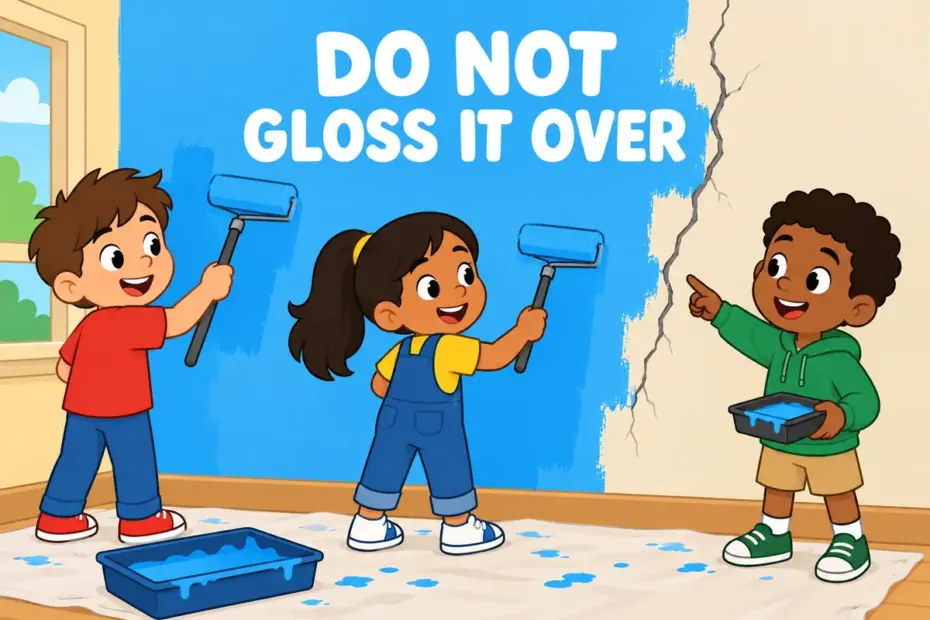
Gloss over means to avoid discussing something or to treat it as less important than it is. To use gloss over in a sentence, put the object straight after the particle and name what is being played down: “The report glossed over the safety failures.” The phrasal verb is transitive and inseparable.
Gloss over at a glance
- Gloss over is a transitive phrasal verb meaning to avoid discussing something or to play it down.
- It is inseparable: write gloss over the error and gloss over it, never gloss the error over.
- It takes the thing played down as its object, such as facts, a mistake, a problem or a difference.
- The tone is faintly critical, because the writer has noticed that something important was passed over.
- The commonest error is treating it as a synonym for overlook, which means failing to see rather than choosing not to dwell.
What does gloss over mean?
Gloss over is a phrasal verb meaning to avoid talking about something important or to treat it as less serious than it is. The Cambridge entry for gloss over records the sense of avoiding explanation, and that sense is the useful one: the speaker knows about the fact and chooses not to dwell on it. Where the aim is to hide something completely, conceal the truth is the stronger verb. Gloss over is milder; it describes a shrug of emphasis rather than a lie.
| Sense | Plain meaning | Example sentence |
|---|---|---|
| Avoid discussing | Skip a difficulty on purpose | The chair glossed over the broken promise. |
| Treat too lightly | Mention something as if it hardly matters | The summary glossed over two serious delays. |
| Pass over quickly | Read or move past material without pausing | He glossed over the fine print. |
One limitation is worth stating. Gloss over is not simply a synonym for skip. Skipping can be neutral, as when a reader jumps past a dull paragraph, but gloss over implies that the omitted thing deserved attention. It also does not mean to deceive outright; a gloss is an omission of emphasis, not always a falsehood.
How do you use gloss over in a sentence?
Gloss over behaves like a fixed unit. It is transitive, so it always needs an object, and it is inseparable, so the object and any pronoun follow the particle rather than splitting it.
| Pattern | Example | What it signals |
|---|---|---|
| gloss over + noun | The manager glossed over the missed targets. | Names the topic that was played down. |
| gloss over + it or them | They mentioned the delay but glossed over it. | The pronoun follows over, confirming the verb is inseparable. |
| gloss over + the fact that | The review glossed over the fact that costs doubled. | A common clause pattern for the omitted detail. |
| tend to gloss over | Editors tend to gloss over small errors. | Frames the habit rather than a single act. |
| conveniently gloss over | The report conveniently glossed over the lost week. | The adverb adds a note of suspicion. |
Two details separate fluent use from translated use. First, the object is the thing played down, never the person hearing it: you gloss over a mistake, not over a listener. Second, gloss over usually carries quiet criticism, so pairing it with minimize the damage keeps that negative colour.
Gloss over in a sentence: examples across contexts
Gloss over keeps the same meaning and changes only its target. The nine sentences below move from a classroom to a news desk, and each one names the detail that was passed over.
| Context | Example sentence | Why this works |
|---|---|---|
| Classroom | The group glossed over the missing page in their project. | The object is concrete, so the omission is easy to picture. |
| Workplace email | Let us not gloss over the two weeks we lost. | A direct request framed as shared honesty. |
| News report | The inquiry glossed over the earlier warnings. | Criticises an official account in one clause. |
| Legal writing | The submission glossed over the key precedent. | Points to an omission that carries weight. |
| Book review | The author glosses over the cost of the reforms. | Names the gap without accusing the writer of lying. |
| Academic prose | Too many studies gloss over the sampling problem. | Identifies a shared weakness in a body of work. |
| Performance review | My manager glossed over the late deliveries. | Reports a mild injustice in neutral language. |
| Conversation | You keep glossing over the part where he apologised. | Everyday speech, pointed but not aggressive. |
| History essay | Standard accounts gloss over the city that resisted longest. | Challenges a familiar narrative with one omission. |
Notice that the object is always a fact, not a feeling. The verb also survives in casual speech, which is unusual for a word that sounds this formal on the page. Where the omission is complete rather than partial, dismiss a complaint is the sharper choice.
Gloss over vs overlook
Gloss over and overlook both suggest that something was not given its due, but only one of them is deliberate. Overlook is accidental; gloss over is a decision.
| Attribute | gloss over | overlook |
|---|---|---|
| Core meaning | Play down on purpose | Fail to notice |
| Intent | Deliberate | Usually accidental |
| Typical object | A fact, fault or difference | A detail, name or typo |
| Register | Journalistic and formal | Neutral |
| What it implies | The speaker knew and chose silence | The speaker simply missed it |
Verdict: choose overlook a detail when nobody meant to hide anything, and gloss over when the silence looks like a choice. To go the other way and stress one point, emphasize the positives is the natural opposite; to linger unhealthily, dwell on the past is its counterweight.
Word forms and grammar of gloss over
Gloss over inflects like an ordinary verb, and the same root supplies a noun and a related adjective. The table keeps the forms that belong to the phrasal verb separate from the ones that do not.
| Form | Part of speech | Example |
|---|---|---|
| gloss over | phrasal verb, base form | They will gloss over the change. |
| glosses over | third person singular | He glosses over every awkward question. |
| glossed over | past and past participle | The memo glossed over the risk. |
| glossing over | present participle | She is glossing over the hard part. |
| gloss | noun, a brief explanation or a shine | The edition adds a gloss on each line. |
| glossary | noun, a word list | A glossary of terms closes the book. |
The noun gloss is a false friend for many learners: it usually means a short note or a surface shine, not an act of avoidance. The phrasal verb is the only form that carries the sense of playing something down, so do not reach for gloss when you mean gloss over.
Common mistakes with gloss over
- Incorrect:
She glossed the problem over.Correct: She glossed over the problem. Rule: The verb is inseparable, so the object never splits it from over. - Incorrect:
They glossed over to the crowd.Correct: They glossed over the disagreement. Rule: Gloss over takes the topic as its object, not an audience. - Incorrect:
The report overlooked the missing data on purpose.Correct: The report glossed over the missing data. Rule: A deliberate omission is gloss over; overlooked suggests an accident. - Incorrect:
He glossed over with a joke.Correct: He glossed over the awkward pause with a joke. Rule: The verb needs its object before the rest of the sentence. - Incorrect:
Do not gloss over.Correct: Do not gloss over the error. Rule: The verb is transitive, so a bare gloss over is incomplete.
Practice using gloss over
Six short tasks follow; the answers give the reason, not only the key.
- Fill the gap: The summary ______ the fact that the test had failed twice.
- Choose the better word: I did not see the small print at all, so I (overlooked / glossed over) it.
- Correct the error: The chair glossed the complaint over.
- Build a sentence: use gloss over about a report that avoids a budget shortfall.
- Spot the register: which belongs in a formal review — the account glosses over the delays, or the account totally skips the slow bits?
- Rewrite with a pronoun: replace the delays in The note glossed over the delays. with a pronoun.
Answers
- glossed over — the object is the fact that follows, and the verb stays whole.
- overlooked — the failure to see was accidental, so gloss over would wrongly imply intent.
- The chair glossed over the complaint — the object must follow the particle, not split the verb.
- Model answer: The report glossed over the budget shortfall.
- The account glosses over the delays — a review keeps the formal verb and drops the casual intensifier.
- The note glossed over them — the pronoun follows the particle in this inseparable verb.
The bottom line
Use gloss over in a sentence when someone avoids a fact or treats it as smaller than it is, and keep the thing played down as the object. The two details that decide most sentences are these: the verb is inseparable, so a pronoun follows the particle rather than splitting it, and the sense is deliberate, which separates it from the accidental overlook. Where the omission is total, conceal is the plainer verb.

Frequently asked questions about gloss over
Is gloss over one word or two?
Gloss over is written as two words, and the object comes after the particle: gloss over the error. A hyphen appears only in the occasional noun gloss-over, which is rare. The everyday verb is always two separate words, so a single word glossingover is never correct.
Do you say gloss over it or gloss it over?
The standard form is gloss over it, because the verb is inseparable and a pronoun cannot sit between the verb and its particle. The version gloss it over is not accepted in careful writing. Keep the two parts of the phrasal verb together and place the object after over.
Does gloss over mean the same as lie?
No. Lying states something false, while glossing over leaves something out or downplays it. A report can gloss over a delay without printing a single untrue sentence. The word signals a choice of emphasis, which is why it carries mild criticism rather than an accusation of dishonesty.
What is the opposite of gloss over?
The nearest opposites are emphasize and dwell on, depending on the tone. To emphasize the positives is to give a point full weight, while to dwell on the past is to give it more weight than it deserves. Both reverse the idea of passing lightly over something important.
Have you ever heard someone use the phrase “gloss over” in a conversation and wondered what it really means? In simple terms, to gloss over something is to quickly and casually skip over or ignore important details or issues.
When someone glosses over a topic, they are typically downplaying its significance or complexity, often in an attempt to simplify the discussion or avoid delving into uncomfortable truths. This can happen in various contexts, from personal relationships to professional settings, and is sometimes done unconsciously.
7 Examples Of Gloss Over Used In a Sentence For Kids
- Gloss over the picture with colorful crayons.
- Can you gloss over this page to find the answer?
- Let’s gloss over the story before bedtime.
- I like to gloss over my drawings with glitter.
- We can gloss over the map to see where we are going.
- Please gloss over the shapes and colors in the book.
- Don’t forget to gloss over your name on the paper.
14 Sentences with Gloss Over Examples
- It is not advisable to gloss over key concepts in your study material if you want to perform well in your exams.
- When writing an essay, make sure not to gloss over important details that can strengthen your argument.
- It’s easy to gloss over the syllabus, but it’s important to study each topic thoroughly for a better understanding.
- You should not gloss over the references section when preparing a research paper, as it can provide valuable information.
- Glossing over your notes before an exam might help refresh your memory and recall important points.
- Do not gloss over the bibliographical information of the books you use for your assignments, as it is crucial for academic integrity.
- While preparing for a presentation, it’s essential not to gloss over the key points that you want to convey to your audience.
- It’s always best to study in a quiet environment to ensure you don’t gloss over any important details.
- As a college student, it is essential to not gloss over the significance of time management in balancing academics and extracurricular activities.
- When working on group projects, make sure to communicate effectively with your team members and not gloss over any responsibilities.
- Attending lectures regularly can prevent you from glossing over important information discussed in class.
- To succeed in college, it’s crucial not to gloss over the feedback provided by your professors on your assignments.
- Understanding the fundamentals of a subject is key; therefore, don’t gloss over basic concepts just to cover more advanced topics.
- It’s important to review your study schedule regularly and not gloss over any subjects that you find challenging.
How To Use Gloss Over in Sentences?
To use Gloss Over in a sentence, simply follow these steps:
-
Identify a situation where you want to Gloss Over details or facts that may be uncomfortable to discuss or confront. For example, you could use it when talking about a mistake you made but don’t want to go into specifics.
-
Begin your sentence as you normally would, providing context or introducing the topic you want to address.
-
When you reach the point where you want to Gloss Over specific details, use the phrase “Gloss Over” in your sentence. This signals to your audience that you are skipping over certain information.
-
You can use Gloss Over before or after mentioning the details you want to skim over. For example, “I made a mistake in the report, but let’s just Gloss Over that and focus on the solutions.”
-
Use Gloss Over as a way to move the conversation forward without dwelling on specific points. This can help maintain a positive or diplomatic tone in discussions.
Remember that Gloss Over is a useful tool for softening information or redirecting the focus of a conversation. Practice using it in different contexts to become comfortable with incorporating it into your communication.
Conclusion
In conclusion, the phrase “gloss over” refers to the act of quickly and superficially addressing or mentioning something without delving into its full implications or details. It often implies a lack of thorough examination or scrutiny. From business reports that gloss over critical issues to personal relationships where problems are swept under the rug, failing to address important matters can lead to misunderstandings and unresolved issues. It is important to approach situations with transparency and honesty, rather than glossing over them, in order to foster clear communication and prevent larger problems from developing.
By recognizing when we are tempted to gloss over important matters and instead choosing to confront them directly, we can build stronger relationships, make more informed decisions, and avoid potential pitfalls in various aspects of our lives. Addressing challenges head-on may require courage and vulnerability, but ultimately leads to greater understanding and resolution.


