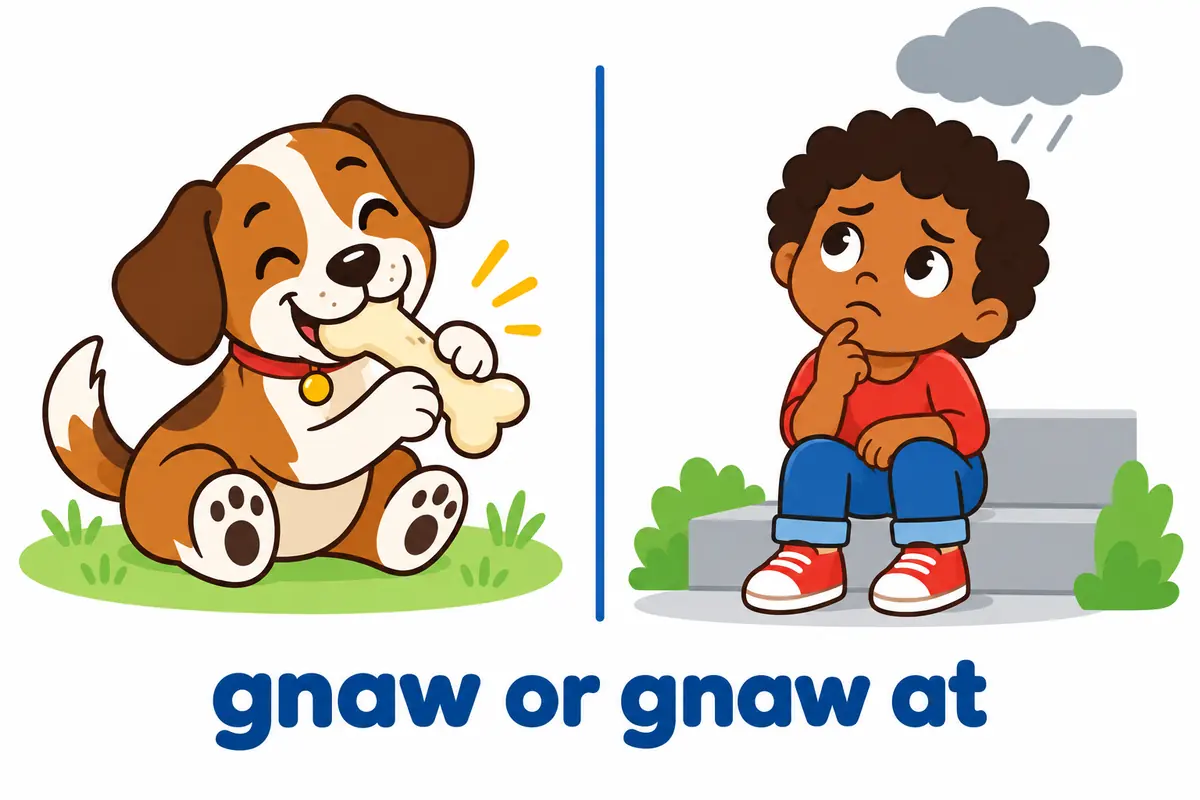
Gnaw means to bite and wear away something with repeated chewing, and, of a feeling, to keep troubling a person. To use gnaw in a sentence, choose the sense first: a dog gnaws a bone, while doubt gnaws at someone. The literal verb often takes a direct object, and the figurative one takes at.
Gnaw at a glance
- Gnaw is a verb with a literal sense, bite repeatedly, and a figurative one, trouble persistently.
- Literal patterns are gnaw a bone or gnaw at a bone.
- Figurative patterns are gnaw at a person and the adjective gnawing, as in gnawing doubt.
- Its forms are gnaw, gnaws, gnawed and gnawing, and gnawing is common as an adjective.
- The commonest error is adding at when the object is something physically bitten.
- The figurative sense describes slow, persistent pain rather than sudden fear.
What does gnaw mean?
Gnaw is a verb meaning to bite something repeatedly so that it wears away, and, by extension, to cause someone slow and lasting distress. The Cambridge entry for gnaw records both the physical and the figurative senses, and repetition is the bridge between them: a rodent keeps working at a surface, and a worry keeps working at a mind. The physical sense is concrete, and the figurative sense almost always takes at.
| Sense | Plain meaning | Example sentence |
|---|---|---|
| Bite repeatedly | Wear something down with the teeth | The puppy gnawed the table leg. |
| Make by biting | Form a hole or path by biting | The rat gnawed a gap in the wall. |
| Trouble persistently | Cause slow, lasting worry | Doubt gnawed at her for weeks. |
The figurative sense has a limit. Gnaw describes a low, ongoing ache, not a sudden shock, so a first pang of fear is not yet a gnawing fear. Used of people, gnawing suggests anxious brooding, and a sentence about a brief worry sounds wrong. Where the pain is sharp and short, or where a good meal ends the feeling, satisfy a real hunger names the cure rather than the ache.
How do you use gnaw in a sentence?
Decide whether the biting is physical or mental, because that choice controls the grammar. Five patterns cover almost every real sentence: the physical verb may take a direct object, while the figurative verb needs at before the person it troubles.
| Pattern | Example | What it signals |
|---|---|---|
| gnaw + object | The puppy gnawed the slipper. | Direct object: the thing actually bitten. |
| gnaw at/on + object | Mice gnaw at the cables. | At or on for repeated biting on a surface. |
| gnaw through + object | The rat gnawed through the pipe. | Through marks a barrier broken by biting. |
| gnaw at + person | Doubt gnawed at her all week. | Figurative: persistent mental distress. |
| gnawing + noun | A gnawing hunger kept him awake. | Participial adjective for an ongoing feeling. |
Compare the plain physical verbs. Chew a mouthful of bread names the ordinary action of eating, while gnaw adds force and repetition. That extra effort is why the word transfers so easily from teeth to worries.
Gnaw in a sentence: examples across contexts
The verb moves easily from animals to emotions, and the register stays neutral throughout. The ten sentences below name either the thing worn down or the person worn down, and each keeps the sense clear.
| Context | Example sentence | Why this works |
|---|---|---|
| Nature | Beavers gnaw through saplings to build their dams. | Through shows a barrier broken by steady biting. |
| Pets | The puppy gnawed my running shoe again. | A concrete object and a clear agent fit the literal sense. |
| Home repairs | Something gnawed a hole behind the cupboard. | An unknown agent adds mild mystery. |
| Idiom of worry | Doubt gnawed at the whole committee. | At marks the people troubled by the feeling. |
| Hunger | A gnawing hunger woke her before dawn. | The adjective describes an ongoing bodily ache. |
| Geology | Wind and grit gnaw at the cliffs each winter. | Natural forces wear a surface slowly. |
| Fiction | Guilt gnawed at him long after the trial. | The figurative sense suits slow, private pain. |
| News report | Rising costs gnaw at household budgets. | A financial subject shows the figurative extension. |
| Academic prose | Rats gnawed through the laboratory wiring. | Precise and physical, as a report requires. |
| Conversation | Something is gnawing at her, I can tell. | The present continuous fits spoken concern. |
Only the final sentence leaves the object unnamed, and it works because the speaker is guessing at an unspoken worry. Naming the object is otherwise the safer habit.
Gnaw vs nibble
Gnaw and nibble both describe small bites, but they differ in force and in duration. Nibble at a biscuit is light and quick; gnaw is sustained and wears the object down.
| Attribute | gnaw | nibble |
|---|---|---|
| Core meaning | Bite repeatedly and wear down | Take small, quick bites |
| Force | Sustained pressure | Light, brief contact |
| Typical object | Bone, wood, cable, a barrier | Biscuit, cheese, fingernail |
| Figurative use | Persistent worry, with at | Tentative interest, with at |
| Register | Neutral; figurative in literary prose | Neutral, often about food or hesitation |
| Common pattern | gnaw at a problem | nibble at a snack |
Verdict: choose gnaw when teeth or worries work away at something over time, and nibble when the action is small, brief and gentle.
Word forms and grammar of gnaw
Gnaw inflects regularly. What changes across sentences is not the spelling but the choice between a direct object and a preposition, so the table gives both. The last row shows the double preposition learners sometimes add by mistake.
| Form | Part of speech | Example |
|---|---|---|
| gnaw | verb, base form | Rabbits gnaw bark in winter. |
| gnaws | verb, third person singular | The dog gnaws the same toy each night. |
| gnawed | verb, past and past participle | Mice gnawed a hole in the sack. |
| gnawing | verb, present participle and adjective | A gnawing worry kept her awake. |
| gnawer | noun, rare | The squirrel is a patient gnawer of hard shells. |
| gnaw through at + noun | non-standard double preposition | Wrong; through already marks the barrier. |
Keep the two senses apart with grammar: a bite a ripe apple and gnaw a bone both take objects, while the slow wearing sense of erode a riverbank and gnaw at a person both need a preposition.
Common mistakes with gnaw
- Incorrect:
The dog gnawed at the bone clean.Correct: The dog gnawed the bone clean. Rule: When the object is directly bitten, drop at. - Incorrect:
Worry gnawed her all night.Correct: Worry gnawed at her all night. Rule: The figurative sense needs at before the person. - Incorrect:
The river gnawed the bank.Correct: The river gnawed at the bank. Rule: Use at for the gradual wearing of a surface. - Incorrect:
She felt a gnawed hunger.Correct: She felt a gnawing hunger. Rule: An ongoing feeling takes the -ing adjective form. - Incorrect:
The mouse gnawed through at the rope.Correct: The mouse gnawed through the rope. Rule: Through already acts as the preposition, so at is not added.
Practice using gnaw
Work through the six items, then read the answers for the reason behind each key.
- Fill the gap: The puppy ______ the wooden block all afternoon.
- Choose the better word: A quiet worry (gnawed / nibbled) at him for days.
- Correct the error: The rat gnawed through at the cable.
- Build a sentence: use gnaw at about a persistent worry.
- Spot the register: which suits a nature report — Beavers gnaw through saplings, or Worry gnawed at her?
- Rewrite with the adjective: She had a hunger that would not stop. Use gnawing.
Answers
- gnawed — the past tense fits the story, and the block is the direct object.
- gnawed — a worry works away over time, while nibble is light and quick.
- The rat gnawed through the cable — through already marks the barrier, so at is not needed.
- Model answer: A small doubt gnawed at the captain before the final — at introduces the person troubled.
- Beavers gnaw through saplings — a nature report stays with the physical sense.
- She had a gnawing hunger — the -ing adjective describes the ongoing feeling.
The bottom line
Use gnaw in a sentence for steady, repeated biting that wears something down, and for a worry that has the same slow effect on a person. The literal verb usually takes a direct object, while the figurative one needs at, so the grammar itself marks the sense. Two nuances decide most sentences: at belongs with a surface or a person and is dropped for a solid object, and gnawing hunger or doubt is ongoing rather than sudden. Worry about the result is the plain verb that the figurative gnaw dresses up.
Frequently asked questions about gnaw
Is gnaw transitive or intransitive?
Gnaw is both, depending on the sense. The physical sense is often transitive, as in the dog gnawed the bone, and can also take at or on. The figurative sense is intransitive and takes at, as in doubt gnawed at her. The grammar, not the dictionary, tells you which sense is in play.
What does gnawing mean figuratively?
Figuratively, gnawing describes a feeling that keeps working at a person slowly, such as gnawing doubt, guilt or hunger. It suggests something ongoing and hard to shake rather than a sudden emotion. The image is borrowed from an animal wearing a surface down with its teeth.
What is the difference between gnaw and chew?
Chew is the ordinary verb for grinding food with the teeth and is neutral. Gnaw adds repetition and force, and it usually suggests wearing down something hard such as a bone or wood. Use chew for a meal and gnaw for the determined, repeated biting of a tough object.
Can gnaw be used about people?
Yes, but normally in the figurative sense, where a feeling gnaws at a person. Human physical gnawing is rare and literal, as when a nervous child gnaws a pencil. In both cases the verb keeps its core idea of slow, repeated pressure rather than a single action.
Have you ever struggled with finding the right words to express your thoughts? Crafting sentences that truly captivate can be a challenge, but fear not, as we delve into the art of writing effective sentences.
To “gnaw” means to chew on something persistently or wear it away gradually. In language, a sentence is like a puzzle piece, with each word carefully selected to convey a clear message or evoke a specific emotion. Crafted with precision, a well-constructed sentence can linger in the mind of the reader long after it’s been read.
7 Examples Of Gnaw Used In a Sentence For Kids
- Animals use their teeth to gnaw on food.
- Beavers like to gnaw on wood to build their homes.
- Sometimes I can hear a mouse gnaw on something at night.
- Rabbits will gnaw on vegetables for a snack.
- My puppy loves to gnaw on his favorite chew toy.
- Squirrels will gnaw on nuts to get to the inside.
- Woodpeckers gnaw on trees to find bugs to eat.
14 Sentences with Gnaw Examples
- Gnaw on some healthy snacks while studying for exams to keep your energy levels up.
- Don’t let anxiety gnaw at you before a big presentation, take deep breaths and stay calm.
- The idea of a looming deadline can gnaw at your peace of mind, so break down your tasks into smaller chunks.
- Late-night hunger pangs can gnaw at you while working on assignments, keep some snacks handy.
- It’s common for doubts to gnaw at you when starting a new subject, seek help from professors or classmates.
- Comparison with peers can gnaw at your confidence, remember everyone has their own path and pace.
- Financial constraints can gnaw at your ability to enjoy college life to the fullest, look for part-time job opportunities.
- Feeling homesick can gnaw at you during festive seasons, plan virtual celebrations with family and friends.
- Procrastination can gnaw at your productivity, try using time management techniques to stay on track.
- The fear of failure can gnaw at your motivation, remind yourself of your goals and aspirations.
- Uncertainty about the future can gnaw at you, explore internships and career counseling services.
- Peer pressure to conform can gnaw at your individuality, stand firm in your values and beliefs.
- Lack of sleep can gnaw at your concentration in lectures, prioritize a good night’s rest.
- Social media distractions can gnaw at your study time, limit screen time and focus on your academics.
How To Use Gnaw in Sentences?
To use the word Gnaw in a sentence, you can try something like: “The puppy likes to gnaw on his favorite chew toy.” Here, the word “gnaw” is used to describe the action of the puppy chewing on its toy.
When incorporating gnaw into a sentence, it is important to note that the word typically refers to the action of biting or chewing on something persistently, often with the intent to wear it down or consume it gradually. The word gnaw often conveys a sense of repetitive or continuous action.
To enhance your sentence, you could provide more context or detail about what is being gnawed, who or what is doing the gnawing, and why. This can help paint a clearer picture for the reader and make your sentence more engaging.
Remember to use gnaw as a verb in your sentence, as it is an action word that describes chewing or biting. Experiment with different sentence structures and settings to make your use of gnaw more versatile and interesting.
In conclusion, using the word gnaw in a sentence is a fun way to add vivid imagery and action to your writing. Experiment with different sentence structures and contexts to master the art of incorporating gnaw into your sentences effectively.
Conclusion
In conclusion, the examples of sentences containing the word “gnaw” demonstrate its usage in describing the act of persistently chewing or wearing down on something. Whether it’s a physical object like a rodent gnawing on wood or a metaphorical concept like anxiety gnawing at one’s thoughts, the word conveys a sense of gradual erosion or persistent worry. These sentences illustrate the versatility of “gnaw” in depicting both literal and figurative actions, adding depth and vividness to written expressions. By incorporating such descriptive language, writers can effectively convey a sense of relentless chewing or nagging unease in their narratives.


