Gnomic means short and deliberately obscure, like a saying that sounds wise but resists a plain explanation. To use gnomic in a sentence, attach it to a remark, a style or a writer: “He answered with a gnomic proverb about patience.” The adjective is unusual and literary, so most sentences sound formal when they use it.
Gnomic at a glance
- Gnomic is an adjective meaning short and hard to interpret; its related forms are the adverb gnomically and the noun gnome, a maxim.
- It describes remarks, sayings, styles and written works more often than it describes people.
- A gnomic line sounds profound but leaves the meaning deliberately unclear.
- It belongs to literary criticism, reviews and formal writing rather than conversation.
- The commonest error is treating gnomic as praise for clear wisdom, when it also carries the idea of obscurity.
What does gnomic mean?
Gnomic is an adjective meaning expressed in a short, compressed way that is difficult to interpret, often with the flavour of a proverb or maxim. The Cambridge entry for gnomic records the sense of something written or spoken in a deliberately mysterious and hard-to-understand style. The three uses below follow from that, and an oracular remark carries a similar air of compressed authority.
| Use | Plain meaning | Example sentence |
|---|---|---|
| Hard-to-interpret remark | Short speech whose meaning stays unclear | His reply was gnomic: the river knows the way. |
| Aphoristic style | Writing built from short maxims | The essay is gnomic and leans on quotation. |
| Of gnomes, rare | Belonging to a gnome or gnomes | A small gnomic figure stood by the pond. |
One limitation is worth stating plainly. Gnomic is not a compliment for clarity, and it is not the same as concise. A concise sentence is short and clear; a gnomic one is short and hard to pin down. Where you want to praise brevity that still communicates, obscure flips the meaning entirely, so choose concise or pithy instead.
How do you use gnomic in a sentence?
Put the word before the remark or style it describes, or use it after the verb be in a review. Five patterns cover the real uses, and the first is the commonest.
| Pattern | Example | What it signals |
|---|---|---|
| gnomic + remark or saying | She gave a gnomic answer and left. | The standard attributive use. |
| gnomic + style or prose | The novel’s gnomic style divides readers. | Describes a manner of writing. |
| be + gnomic | The ending is deliberately gnomic. | Predicate use, common in reviews. |
| gnomic + about | He was gnomic about his plans. | Limits the obscurity to one topic. |
| gnomic + utterance | A gnomic utterance closed the interview. | A formal noun for a spoken statement. |
Gnomic in a sentence: examples across contexts
The nine sentences below keep the same adjective while the setting changes. A terse reply is short but not necessarily gnomic, because terseness does not hide the meaning.
| Context | Example sentence | Why this works |
|---|---|---|
| Classroom | The teacher’s gnomic hint sent the class back to the text. | Shows a deliberately puzzling remark. |
| Review | The film’s gnomic ending left the audience arguing. | Fits criticism of an ambiguous work. |
| Conversation | He is gnomic about where he goes at weekends. | Limits the obscurity to one subject. |
| Literary note | Her late poems are gnomic and full of silence. | Matches the formal register of criticism. |
| News report | The minister’s gnomic statement puzzled reporters. | Frames a public remark as unclear. |
| Fiction | A gnomic stranger warned them to leave before dark. | Uses the word to build atmosphere. |
| Biography | His gnomic diaries resist any simple reading. | Describes a difficult written source. |
| Business email | The founder’s gnomic email explained nothing. | Adds gentle criticism in a workplace setting. |
| Academic writing | The theory is gnomic until the glossary appears. | Uses the word precisely for dense prose. |
Gnomic vs cryptic
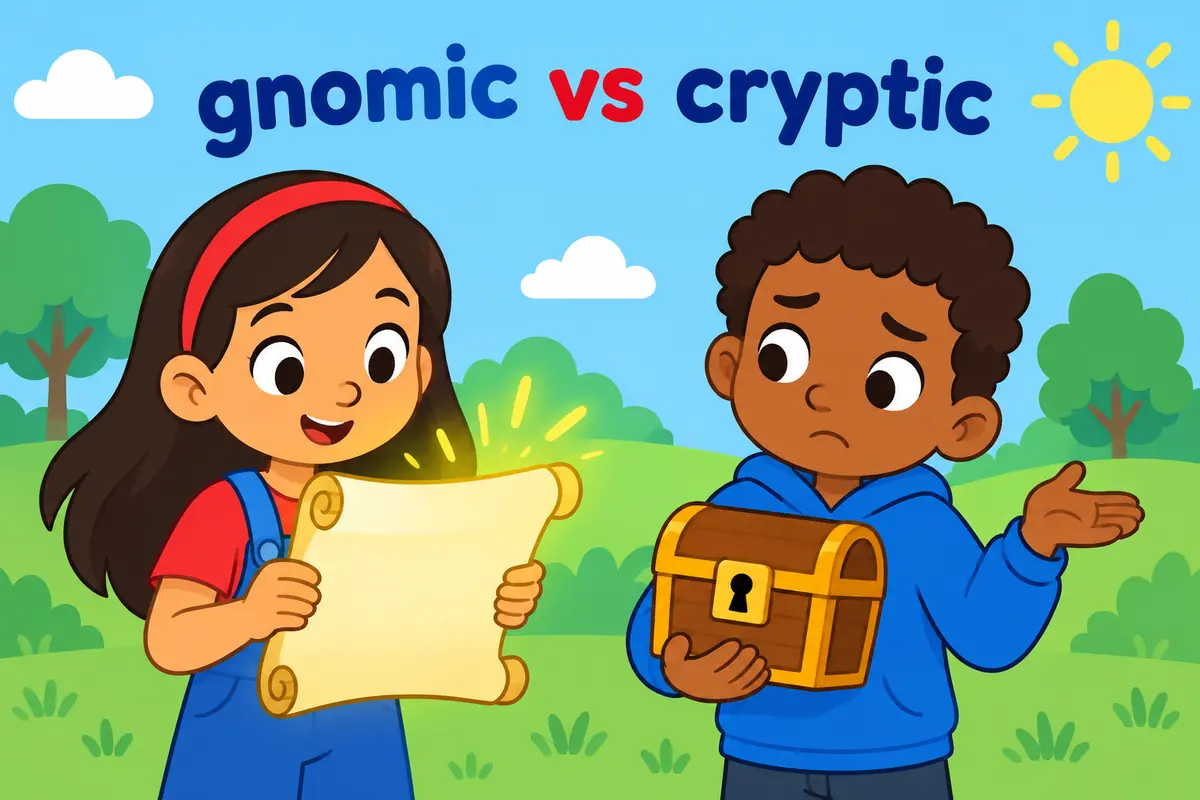
Gnomic remarks sound like proverbs and stay open; cryptic remarks are puzzles that hide a specific answer. A gnomic line may never have one, and a enigmatic person keeps a mystery of character rather than of wording.
| Attribute | gnomic | cryptic |
|---|---|---|
| Source of difficulty | Compression and indirection | Deliberate hiding |
| Tone | Wise and proverbial | Secretive and coded |
| Does an answer exist? | Not necessarily | Usually yes |
| Typical object | A saying, a style or a poem | A message, a clue or a smile |
| Register | Literary and formal | Neutral to literary |
Verdict: choose gnomic when a short saying sounds wise but resists paraphrase, and cryptic when someone is deliberately hiding a definite meaning.
Word forms and grammar of gnomic
Gnomic has a small family behind it, and the table also catches two forms that learners build by mistake.
| Form | Part of speech | Example |
|---|---|---|
| gnomic | adjective | A gnomic phrase closed the speech. |
| gnomically | adverb, rare | She answered gnomically and changed the subject. |
| gnome | noun, a short maxim | The poem ends with a single gnome about time. |
| more / most gnomic | comparative and superlative | Later chapters grow more gnomic. |
| gnomic | noun — non-standard | Non-standard: The gnomic of the ending confused us. |
| gnomicly | adverb — misspelling | Non-standard: He spoke gnomicly about art. |
A style that piles up wise-sounding maxims is sententious, which shares the proverbial flavour but adds a note of self-importance.
Common mistakes with gnomic
- Incorrect:
Her concise report was gnomic and easy to follow.Correct: Her concise report was clear and easy to follow. Rule: Gnomic means obscure, not brief and clear. - Incorrect:
The gnomic child solved the puzzle quickly.Correct: The clever child solved the puzzle quickly. Rule: Gnomic describes words or style, never intelligence. - Incorrect:
He offered a gnomic explanation, so everyone understood at once.Correct: He offered a gnomic explanation that nobody could follow. Rule: The word carries obscurity, so it clashes with instant understanding. - Incorrect:
Gnomic is a compliment for plain speech.Correct: Plain speech is clear and direct, not gnomic. Rule: Gnomic is neutral to critical, never praise for clarity. - Incorrect:
He was gnomic all evening and said nothing.Correct: He was silent all evening and said nothing. Rule: Gnomic describes the quality of what is said, not the fact of saying little.
Practice using gnomic
Work through the six items, then read the reasoning rather than only the key.
- Fill the gap: The novel ends on a ______ line that readers still debate.
- Choose the better word: The note was short, clear and (gnomic / concise).
- Correct the error: Her gnomic summary helped everyone understand the plan.
- Build a sentence: use gnomic about a teacher’s puzzling answer.
- Spot the register: which belongs in a book review — the gnomic final chapter, or the super confusing last bit?
- Change the form: He answered in a gnomic way. Use gnomically instead.
Answers
- gnomic — the adjective describes a line that stays deliberately unclear.
- concise — the note is brief and clear, so gnomic would contradict the rest of the sentence.
- Her clear summary helped everyone understand the plan — gnomic clashes with being understood.
- Model answer: The teacher gave a gnomic answer that sent us back to the chapter.
- The gnomic final chapter — a review keeps the precise literary adjective.
- He answered gnomically and moved on — the adverb modifies how he answered.
The bottom line
Use gnomic in a sentence to describe a short remark, style or work that sounds wise but stays hard to interpret, and place it before the thing it describes. The two points that settle most sentences are these: gnomic suggests obscurity rather than clarity, so it is not praise for plain brevity, and its adverb gnomically is rare, which keeps the word mostly in formal writing. Where a remark is merely brief and clear, profound and simple makes no claim to mystery.
Frequently asked questions about gnomic
What does gnomic mean in simple terms?
Gnomic means short and hard to understand, often in a way that sounds wise. A gnomic saying has the shape of a proverb but leaves its meaning open, so readers can argue about what it means. It describes the style of the words, not the intelligence of the speaker or writer.
Is gnomic a compliment?
Usually not, or only a backhanded one. Calling a remark gnomic suggests it sounds wise but refuses to explain itself, which is closer to a criticism than praise. When you want to compliment brevity that still communicates, use concise, pithy or pointed instead of gnomic.
What is the difference between gnomic and cryptic?
A gnomic remark sounds proverbial and may have no single answer, while a cryptic message hides a definite meaning the writer expects you to find. Gnomic describes a compressed, wise-sounding style. Cryptic describes deliberate secrecy, as in a cryptic clue or a cryptic note left on a desk.
How do you pronounce gnomic?
Gnomic is two syllables and begins with a silent g, so it sounds like NO-mick. The first syllable takes the stress and uses a long o, as in the word no. The second syllable is short, as in the end of comic, and the g at the start is never pronounced.
Have you ever come across a sentence that seems to hold a universal truth or wise statement in just a few words? These succinct and profound sentences are known as gnomic phrases.
A gnomic sentence is a concise statement that imparts general wisdom, advice, or truth in a profound manner. Often seen in literature, philosophy, or speech, gnomic sentences can leave a significant impact despite their brevity.
7 Examples Of Gnomic Used In a Sentence For Kids
- Gnomic means short and wise.
- We can learn from gnomic sayings.
- Let’s listen to a gnomic story!
- Wise people often share gnomic words.
- Can you think of a gnomic phrase?
- The teacher shared a gnomic lesson.
- Remember to be gnomic in your speech.
14 Sentences with Gnomic Examples
- Gnomic truths are often found in ancient texts and philosophical works.
- It’s always beneficial to reflect on gnomic sayings to gain insight into life’s complexities.
- When facing a dilemma, seeking advice from gnomic literature can offer valuable guidance.
- Many college students turn to gnomic quotes for motivation during exams and stressful times.
- Understanding the deeper meaning behind gnomic expressions can lead to personal growth.
- In times of uncertainty, turning to gnomic wisdom can provide clarity and reassurance.
- Exploring different cultures’ gnomic phrases can broaden one’s perspective on life.
- Incorporating gnomic teachings into daily routines can foster a sense of introspection and mindfulness.
- Sharing gnomic insights with friends can spark meaningful discussions and reflections.
- Many successful individuals attribute their wisdom to embracing gnomic principles.
- College students can benefit greatly from incorporating gnomic truths into their decision-making process.
- Keeping a journal of gnomic quotes can serve as a source of inspiration and self-reflection.
- Attending seminars or workshops that focus on gnomic wisdom can enhance one’s philosophical understanding.
- In times of stress, referring to gnomic philosophies can help college students find peace and clarity.
How To Use Gnomic in Sentences?
Gnomic is an adjective used to describe a type of statement or expression that is general truth or wisdom, often in the form of a proverb or aphorism. When using Gnomic in a sentence, it is important to remember its intended meaning as a general truth or wisdom instead of a specific fact.
To properly use Gnomic in a sentence, start by identifying a statement or phrase that reflects universal truth or wisdom. For example, “A stitch in time saves nine” is a Gnomic expression that emphasizes the importance of taking timely action to prevent bigger problems in the future.
When incorporating Gnomic into your writing or speech, consider the context in which the statement is being made. Typically, Gnomic statements are used to convey timeless wisdom or moral lessons that are applicable to a wide range of situations.
Remember that Gnomic statements are not meant to be taken literally but rather as symbolic representations of broader truths. They often rely on metaphorical or figurative language to convey their message.
In summary, using Gnomic in a sentence involves recognizing and employing statements that encapsulate universal truths or wisdom. By understanding the essence of Gnomic expressions, you can effectively incorporate them into your communication to add depth and insight to your message.
Conclusion
In conclusion, gnomic sentences are concise, universal truths or pieces of wisdom that offer insights into human behavior, morality, or the natural world. These short, pithy statements are often found in philosophical texts, religious scriptures, and cultural proverbs, serving as guides for living a meaningful and virtuous life. By encapsulating profound ideas in a few words, gnomic sentences enable individuals to reflect on fundamental truths and navigate life’s complexities with clarity and purpose.
Through their simplicity and depth, gnomic sentences have the power to resonate with people across different cultures and generations, imparting timeless wisdom and moral lessons. Whether through philosophical contemplation or everyday reflection, these succinct statements provoke thought and encourage individuals to ponder the deeper meanings of existence. Embracing the wisdom contained in gnomic sentences can lead to a richer understanding of life and inspire individuals to strive for personal growth and ethical behavior.