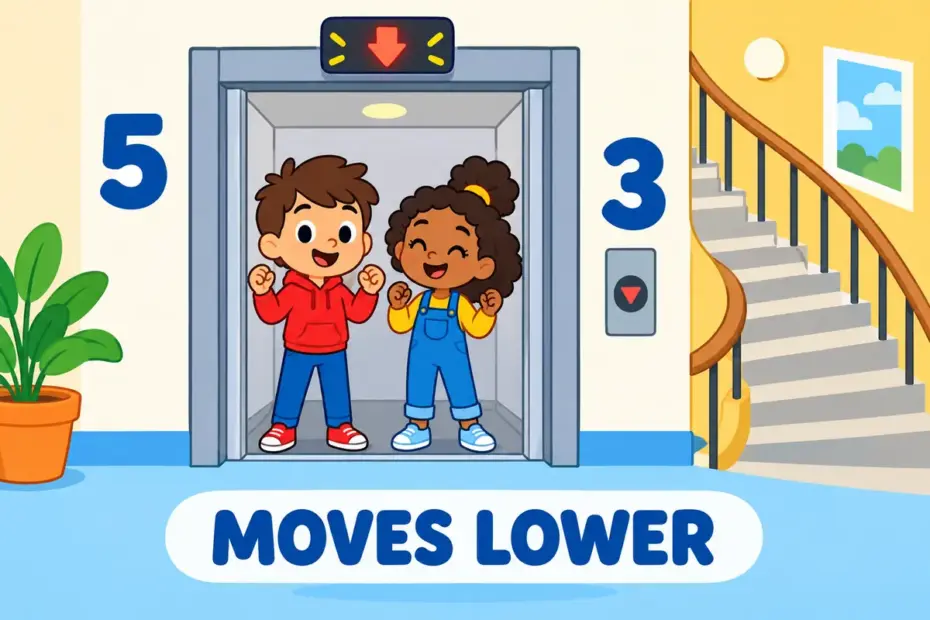
Go down means to move to a lower place, to fall in amount, or to be received in a particular way. To use go down in a sentence, let the subject do the moving, because the verb is intransitive: “The lift went down.” Add well or badly to report how something was received.
Go down at a glance
- Go down is an intransitive phrasal verb; its forms are goes down, went down and going down.
- It never takes a direct object, so nothing is ever gone down.
- The commonest sense is physical movement to a lower level, as with a lift or a path.
- A second sense reports a fall in amount, and a third reports how something was received.
- In computing, a server or network that goes down has stopped working.
What does go down mean?
Go down is an intransitive phrasal verb meaning to move to a lower level, to decrease, to sink or be defeated, or to be received in a stated way. The Cambridge entry for go down lists the physical, the decrease and the received senses. A further sense describes a machine or a service that stops working.
| Sense | Plain meaning | Example sentence |
|---|---|---|
| Move lower | Travel to a lower level | The lift went down to the basement. |
| Decrease | Fall in amount, level or value | Prices went down after the sale. |
| Sink or be defeated | Go beneath the surface or lose | The ship went down off the coast. |
| Be received | Make a stated impression on people | The speech went down well. |
| Stop working | Of a system, fail or shut down | The server went down at noon. |
One limitation is worth stating. Go down is intransitive, so it can never carry a direct object, and it says nothing about a cause. For a formal or literary tone, descend the stairs is the more elevated verb, while in the sinking sense sink below the waves is the stronger choice.
How do you use go down in a sentence?
Let the subject be the thing that moves, falls or is received, and add a prepositional phrase only when you need to say where or by how much. Five patterns cover almost every real sentence.
| Pattern | Example | What it signals |
|---|---|---|
| go down + to + place | The lift went down to the basement. | Physical movement to a lower level. |
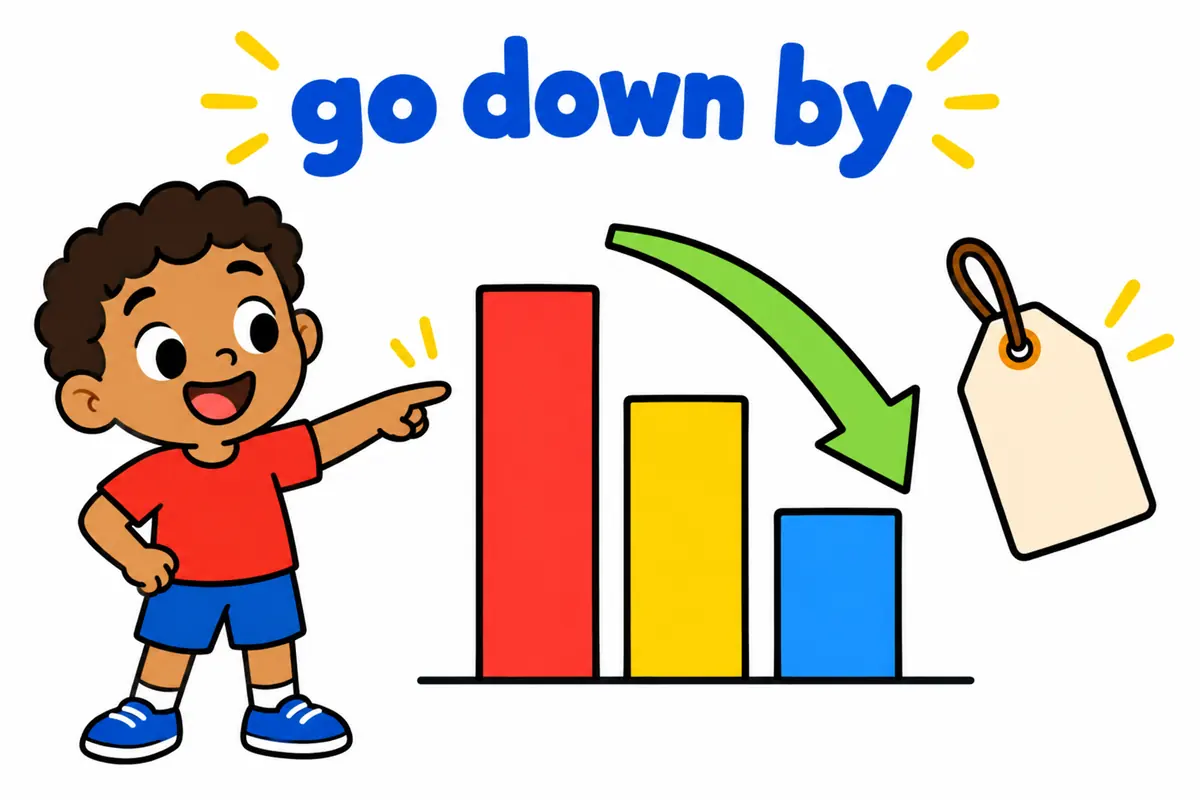
| go down + by + amount | Prices went down by ten per cent. | Reports a decrease with a figure. |
| go down + adverb | The plan went down well. | Reports how something was received. |
| go down in + noun | The day went down in history. | Marks lasting fame or record. |
| go down (no object) | The server went down at noon. | The system simply stopped working. |
The preposition carries the meaning, so the sentence fails if it is wrong: prices go down by an amount and a lift goes down to a floor. Where the subject is a sun or a curtain, the verb set behind the hills is the idiom English prefers.
Go down in a sentence: examples across contexts
Go down changes its subject more than its meaning. The nine sentences below move from a school corridor to a news report, and each one shows which sense the context has chosen.
| Context | Example sentence | Why this works |
|---|---|---|
| Classroom | The thermometer went down overnight, so the pond froze. | The decrease sense pairs with a measurable subject. |
| Workplace email | The shared drive will go down for an hour at six. | The computing sense reports a planned outage. |
| News report | The ferry went down within minutes of the collision. | The sinking sense is clear from the time phrase. |
| Legal writing | The appeal went down well with the families involved. | The received sense reports a reaction, not a decision. |
| Technical writing | The pressure went down by two bars once the valve opened. | The decrease sense carries a precise figure. |
| Conversation | My phone went down and I missed the call. | The everyday computing sense is common in speech. |
| Sports commentary | The second goal went down as an own goal. | The recorded sense marks how an event is remembered. |
| Academic prose | Average rainfall went down across the whole decade. | The decrease sense suits a measured long span. |
| History essay | The name went down in legend long after the battle. | The lasting-record sense gives the sentence its weight. |
The physical and computing sentences describe something happening to a thing, while the received and record sentences describe how people judged it. That split between an event and a reaction is the first thing to check when the verb seems ambiguous.
Go down vs descend and go up
Go down overlaps with two near neighbours and is interchangeable with neither. When the subject is a number, decrease the cost is more precise, and its opposite is to rise sharply rather than to go up.
| Attribute | go down | descend | go up |
|---|---|---|---|
| Core job | Move lower, decrease or be received | Move lower in a formal tone | Move higher or increase |
| Register | Neutral, used in speech | Formal or literary | Neutral, used in speech |
| Typical subject | A lift, price, ship or system | A person, a stair or a plane | A price, a balloon or a lift |
| Transitivity | Intransitive | Usually transitive or intransitive | Intransitive |
| Direction | Downward or falling | Downward only | Upward or rising |
| What it implies | A change in level or reception | A dignified movement | A change in level |
Verdict: choose go down for everyday movement, decrease and reception, descend when the tone is formal, and go up or rise for the opposite movement. When a value drops sharply, fall to a low adds the speed that go down alone does not carry.
Word forms and grammar of go down
Go down inflects by changing the verb, not the particle, so down never varies. The verb is irregular, which is why the past tense is went down rather than good down or goed down.
| Form | Part of speech | Example |
|---|---|---|
| go down | phrasal verb, base form | Prices may go down next month. |
| goes down | phrasal verb, third person singular | The sun goes down early in winter. |
| went down | phrasal verb, past tense | The old bridge went down in the flood. |
| gone down | phrasal verb, past participle | Sales have gone down since spring. |
| going down | phrasal verb, present participle | The lift is going down to the lobby. |
Because the verb is intransitive, it has no passive form: a sentence such as the price was gone down is never correct. If you need a passive, choose a transitive verb such as lower or reduce.
Common mistakes with go down
- Incorrect:
The lift went down the basement.Correct: The lift went down to the basement. Rule: A destination needs to before it. - Incorrect:
Prices went down ten per cent.Correct: Prices went down by ten per cent. Rule: Use by before the size of the change. - Incorrect:
The show went down good.Correct: The show went down well. Rule: The verb takes an adverb, so good becomes well. - Incorrect:
The computer went down off at noon.Correct: The computer went down at noon. Rule: Go down already contains a particle, so off is not added. - Incorrect:
The price was gone down last week.Correct: The price went down last week. Rule: The verb is intransitive and has no passive form.
Practice using go down
Work through the six items, then read the reason with each answer, because the preposition is what decides the sense.
- Fill the gap: The temperature ______ by five degrees overnight.
- Choose the better word: The new policy went down (well / good) with staff.
- Correct the error: The ferry went down the harbour wall.
- Build a sentence: use go down in history about a record-breaking race.
- Spot the register: which belongs in a formal report — the river level went down, or the river level descended?
- Rewrite with decrease: Sales went down by a third. Keep the meaning.
Answers
- went down — the temperature falls, and by introduces the size of the change.
- well — the verb needs an adverb, so well is correct.
- The ferry went down near the harbour wall — the sinking sense is intransitive and takes no direct object.
- Model answer: Her time went down in history as the fastest ever run.
- The river level descended — the formal report prefers descend for a measured fall.
- Sales decreased by a third — decrease is the precise verb for a fall in an amount.
The bottom line
Use go down in a sentence for movement to a lower level, a fall in an amount, or the way something was received, and remember that the verb is intransitive. Two nuances settle most sentences: the preposition carries the meaning, so by, to and in are never interchangeable, and there is no passive form. For a formal tone, descend is the safer verb.
Frequently asked questions about go down
Is go down a phrasal verb?
Yes, go down is an intransitive phrasal verb, which means the particle down is fixed and the verb never takes a direct object. Its senses include moving lower, falling in amount, sinking, being received and, in computing, a system stopping work. The preposition after it decides which sense applies.
What does go down mean in computing?
In computing, go down means that a server, network or website has stopped working, usually unexpectedly. A planned stop is often described as going down for maintenance. The sense is intransitive and informal, and it is common in workplace messages about outages and downtime.
What does it mean when a show goes down well?
When a show or a plan goes down well, it is received favourably by the people who saw or heard it. The phrase reports a reaction rather than an event, and it can take badly in the opposite case. The subject is the thing that was received, never the audience.
What is the difference between go down and descend?
Both describe moving lower, but descend is formal or literary and go down is neutral and common in speech. Descend can also be transitive, as in descend the stairs, while go down never takes a direct object. A news report might use descend for a measured fall and go down for an everyday one.
Have you ever wondered what it means when someone says, “what goes up must come down”? This common phrase highlights a fundamental concept in physics known as gravity. Gravity is the force that pulls objects toward each other, and it is what causes things to fall back to the ground after being lifted up.
In everyday language, when we say something will “go down,” we are often referring to a decrease, decline, or descent. This can apply to various situations, such as prices going down, temperatures going down, or even moods going down. Understanding this phrase and its implications can help us grasp the concept of change and movement in our environment.
7 Examples Of Go Down Used In a Sentence For Kids
- Go down the stairs carefully.
- Please go down the slide slowly.
- Let’s all go down for lunch now.
- The sun will go down in the evening.
- The temperature will go down at night.
- We can all go down to the playground later.
- The ball will go down the hill.
14 Sentences with Go Down Examples
- Make sure to check the schedule for when the library hours go down.
- Are you coming to the canteen before the prices go down?
- Let’s head to the ground floor before the elevator goes down.
- The attendance percentage can go down if you miss too many lectures.
- It’s important to review your notes before the exam scores go down.
- Have you heard about the event happening before the semester goes down?
- Let’s grab some snacks from the cafe before the stock goes down.
- Don’t forget to submit your assignment before the deadline goes down.
- The quality of your project may go down if you don’t put in enough effort.
- You should join the club meeting before the number of members goes down.
- Make sure you recharge your metro card before the balance goes down.
- The interest rates on student loans may go down if the economy improves.
- Have you checked the availability of the textbooks before they go down?
- It’s important to communicate with your professors before your grades go down.
How To Use Go Down in Sentences?
To use the phrase Go Down in a sentence, consider the following examples:
-
As a phrasal verb, go down can mean to descend or move to a lower position. For instance, “The sun will go down soon, so let’s head back home.”
-
Another meaning of go down is to be accepted or received in a particular way. For example, “Her speech really seemed to go down well with the audience.”
-
Additionally, go down can also refer to decreasing or declining in value or quality. You could say, “The temperature tends to go down quickly in the evening.”
Remember to conjugate the verb based on the subject of the sentence. Add appropriate helping verbs or prepositions to make the sentence more meaningful. Using go down in different contexts will help you become more familiar with its various meanings and how to apply them appropriately in your own conversations or writing.
In summary, go down is a versatile phrase that can convey the act of descending, being received positively, or decreasing in value. By practicing with different sentences and contexts, you can improve your understanding and usage of this versatile expression.
Conclusion
In conclusion, whether it’s about stock prices, temperatures, or moods, the phrase “go down” is frequently used to indicate a decrease or decline in various situations. Observing that “sales went down” or “interest rates went down” are common ways to express a reduction in numbers. Similarly, “spirits went down” or “morale went down” describe a lowering of emotions or energy levels. In all these instances, “go down” serves as a straightforward and universally understood way to convey a downward trend or decrease in a clear and concise manner.
By using “go down” in sentences, individuals can efficiently communicate changes in various aspects of life or scenarios. This simple phrase effectively captures the idea of something diminishing or decreasing, making it a versatile and commonly employed expression in everyday language to report declines or negatives trends.


