
Go in a sentence: meaning, forms, and useful patterns
Go is a verb that commonly describes movement to another place, but it also appears in expressions for activities, changes, and events. “We go to the library on Saturdays” describes a habit. Its main forms are go, goes, going, went, and gone; the tense and construction determine which one you need.
- Use go with I, you, we, and they in the simple present.
- Use goes with he, she, or it in the simple present.
- Went is the simple past; gone is the past participle.
- Write go home, rather than go to home.
- Use the base form after do, does, did, and modal verbs.
Corrections to the original guide below: the English verb go is separate from the programming language named Go. Also, “She went to the movies last night” uses went because the event is in the past, not because the subject she is “in the past tense.” Subjects do not have tense; verbs and verb phrases express it.
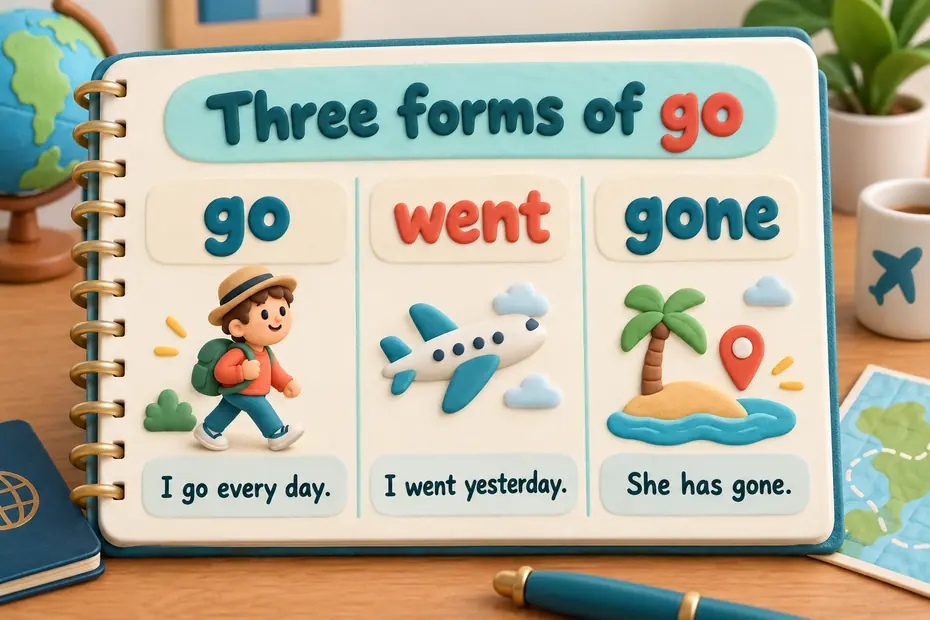
How do you choose the right form of go?
Choose the verb form by checking the time and the surrounding words. A habitual action usually takes go or goes. A completed past event takes went. A perfect construction uses have, has, or had with gone; a continuous construction uses a form of be with going.
| Form | Original sentence | Purpose |
|---|---|---|
| go | I go to work by train. | Present habit |
| goes | She goes to work by train. | Third-person present habit |
| going | They are going to the station. | Movement in progress |
| went | We went to the station yesterday. | Completed past movement |
| gone | He has gone to the station. | Past participle with has |
In questions and negatives, do carries the tense or agreement, so go stays in its base form: “Does she go by train?” and “She doesn’t go by train.” The same rule gives “Did they go yesterday?” and “They didn’t go yesterday.” Avoid the double marking in “Did they went?”
Modal verbs also take the base form: “We can go,” “He should go,” and “They might go later.” An imperative can begin directly with go: “Go upstairs carefully.” Its understood subject is you. The command is a complete sentence even though you is not written.
Go sentence examples by meaning
The words following go often determine its meaning. A destination, an activity ending in -ing, or an adjective can produce very different sentences, even though each uses the same verb.
- We go to the market before breakfast.
- My brother goes home after football practice.
- Please go outside while we clean the room.
- They went upstairs to find a quieter seat.
- I want to go swimming on Sunday.
- The children go cycling along the riverside path.
- The leaves go brown in autumn.
- Keep the lid tight so the biscuits don’t go soft.
- How did your interview go?
- The rehearsal went well despite the power cut.
- These blue cushions go with the striped curtains.
- Go over the instructions before assembling the shelf.
Go can describe how an event proceeds: “The meeting went badly” reports its outcome, without suggesting physical travel. Go with can express compatibility, as in the cushions example. Go over can mean review. Read the whole expression instead of assuming that go always means move.

When do you use go to, go home, and go swimming?
Use go to before many destination nouns: go to the office, go to Paris, and go to a concert. Home behaves differently in this movement pattern, so write go home. Other direction words similarly work without to: go upstairs, go there, and go abroad.
Go to school can describe attending school as an institution. Go to the school can identify a particular school building, such as when a parent visits for a meeting. The article changes the focus; neither version is universally wrong. Choose the expression that matches the intended situation.
Use go plus an -ing activity in familiar combinations such as go shopping, go running, and go skiing. This pattern does not apply automatically to every action. “Go to buy milk” explains a purpose, while “go buying milk” is usually an awkward substitute. Learn the activity expression rather than applying a blanket rule.

Common mistakes with went, gone, and going to
Write “I went yesterday,” rather than “I gone yesterday.” Write “I have gone,” rather than “I have went.” Went stands as the simple past, whereas gone needs the appropriate auxiliary in a perfect verb phrase. These distinctions remain the same when the destination changes.
Going to can describe literal movement or a future intention. “I’m going to the shop” names a destination. “I’m going to bake bread” announces an intended action. The word after to helps identify the pattern: a noun phrase points to a destination, while a base verb commonly points to the future construction.
Gone to and been to often communicate different situations. “Nora has gone to Rome” normally suggests she is there or on her way. “Nora has been to Rome” reports a visit or experience and commonly implies that she returned. Context matters, so avoid treating them as interchangeable travel statements.
A clear go sentence supplies the needed destination, activity, or context. “You can go now” works when the situation is understood; an isolated teaching example may need “You can go home now” to show the pattern.
Frequently asked questions
Can go be a noun?
Yes. Go can name an attempt or turn, as in “Have a go at the puzzle” or “It’s your go.” Those uses differ from the verb meaning movement. Identify the sentence pattern first; the presence of a, your, or another determiner can help reveal the noun use.
Is go and see correct?
Yes. “Go and see the new exhibition” is a standard way to combine movement with the activity that follows. Informal American English also commonly uses “Go see the exhibition.” For a basic learner example, go and see makes the relationship explicit and works comfortably across varieties.
What is the negative command with go?
Use don’t plus go: “Don’t go near the broken glass.” “Do not go” is more formal. Add a reason or a precise destination when readers need to understand the restriction rather than merely obey it.
Does go always require a destination?
No. “It’s time to go” is complete when leaving is the intended meaning. Go also appears in activity, change, and event expressions that have no destination. “The talk went well” evaluates the event.
References: Cambridge: go and Cambridge Grammar: go. The explanations synthesize these patterns; all teaching sentences above are original.

Curious about how to use the word “go” in example sentences? Let’s explore the versatility of this common verb. When you utilize “go,” you’re indicating movement, progression, or action in a sentence.
Whether describing physical travel or figurative advancement, “go” is a dynamic word capable of conveying a range of meanings in various contexts. Let’s delve into some practical ways “go” can be incorporated effectively into example sentences.
7 Examples Of Go Used In a Sentence For Kids
- Go and play with your friends.
- Let’s go for a walk in the park.
- Go and wash your hands before eating.
- It’s time to go to bed, good night!
- Go and pick up your toys from the floor.
- Don’t forget to go and say sorry to your friend.
- Go and give a big hug to your family.
14 Sentences with Go Examples
- Go ahead and ask your professors for clarification if you don’t understand something.
- Go early to the library if you want to secure a study spot during exam season.
- Make sure you go over your notes before the lecture to be better prepared.
- It’s important to go easy on the caffeine, especially during late-night study sessions.
- Go check out the career fair on campus for internship opportunities.
- Don’t forget to go through the syllabus to know the deadlines for your assignments.
- If you’re feeling overwhelmed, go talk to a counselor at the student wellness center.
- Go for group study sessions to benefit from peer learning.
- Remember to go through the previous year’s question papers for exam preparation.
- As a college student, it’s essential to go out and explore new interests and hobbies.
- Go attend networking events to expand your professional circle.
- Make sure you go for regular health check-ups to maintain a balanced lifestyle.
- Don’t hesitate to go to your academic advisor for guidance on course selection.
- Go volunteer for campus events to gain valuable experience and network with other students.
How To Use Go in Sentences?
Go is a versatile programming language known for its simplicity and efficiency. When using Go in a sentence, start by identifying the main subject or action. Then, include the necessary components to complete the sentence.
Begin by writing the subject of the sentence, followed by a Go verb. For example, “I go to the store.” In this sentence, “I” is the subject and “go” is the action being performed.
Next, add any additional information needed to clarify the sentence. For instance, “I go to the store every day.” Here, “every day” provides more context to the action of going.
Remember to pay attention to the verb tense and ensure it aligns with the subject of the sentence. For instance, “She went to the movies last night.” In this case, the verb “went” is used because the subject “She” is in the past tense.
Practice constructing different sentences with Go to become more familiar with how it operates within a sentence structure. Experiment with different subjects, tenses, and additional details to expand your understanding and comfort with incorporating Go into your writing.
Conclusion
In conclusion, the use of sentences with “go” can vary greatly depending on context and purpose. From simple directions like “Go straight ahead” to more complex sentences such as “He decided to go on the trip alone,” the verb “go” plays a significant role in conveying actions, decisions, and movement in the English language.
By examining the diverse examples of sentences with “go” provided in this article, it is clear that this versatile verb is essential for describing a wide range of actions and scenarios. Whether expressing physical movement, emotional states, or decision-making processes, “go” is a fundamental component of English sentences that adds depth and clarity to communication.


