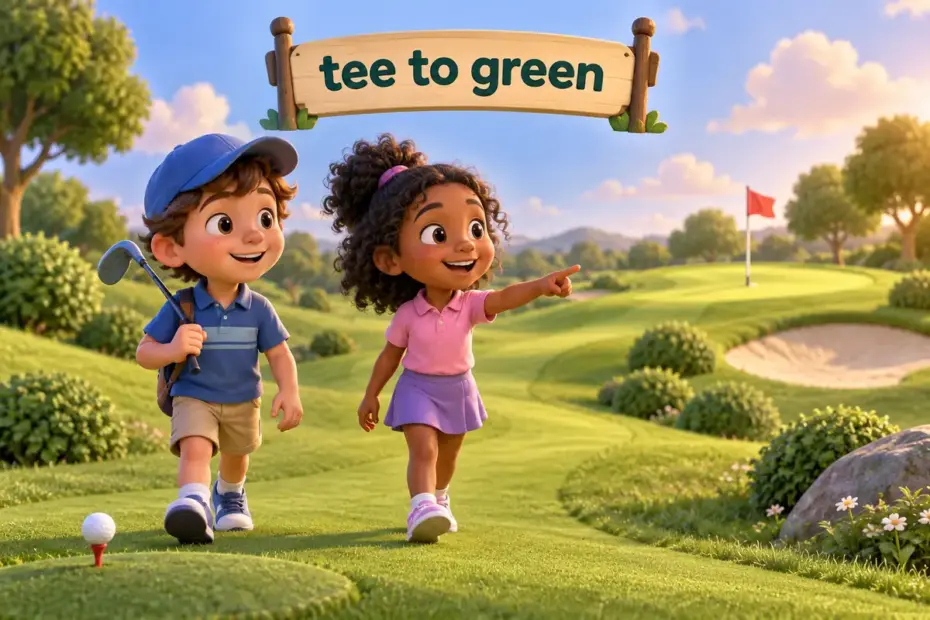
Golf vocabulary is the set of words a player needs to follow a round, from the tee to the green. A tee starts the hole, a fairway runs toward the green, and a birdie means one stroke under par. Learning the scoring and equipment terms first makes any broadcast or scorecard easy to read.
Golf vocabulary at a glance
- The course words are tee, fairway, rough, bunker and green.
- The main clubs are the driver, the irons and the putter.
- A birdie is one under par, and a bogey is one over par.
- A handicap measures a player’s ability so rounds can be compared.
- The commonest beginner error is mixing up par and bogey.
What does the basic golf vocabulary mean?
Golf names each part of the course and each club, so a beginner meets a fresh word at every shot. The tee is where a hole begins, the fairway is the short grass in the middle, and the green is the smooth surface around the hole. The table lists the core words with a sentence for each, and further example frames appear in vocabulary in a sentence.
| Term | Meaning | Example |
|---|---|---|
| tee | the peg or the starting area | She teed the ball up. |
| fairway | the short grass between tee and green | His drive landed on the fairway. |
| green | the smooth area around the hole | The ball rolled onto the green. |
| rough | the long grass beside the fairway | Her shot stopped in the rough. |
| bunker | a hollow filled with sand | He blasted out of the bunker. |
| driver | the club for the longest shots | She hit the driver off the tee. |
| iron | a club for the approach shot | He chose a seven iron. |
| putter | the club for rolling the ball | She used the putter on the green. |
| caddie | the person who carries the clubs | The caddie read the slope. |
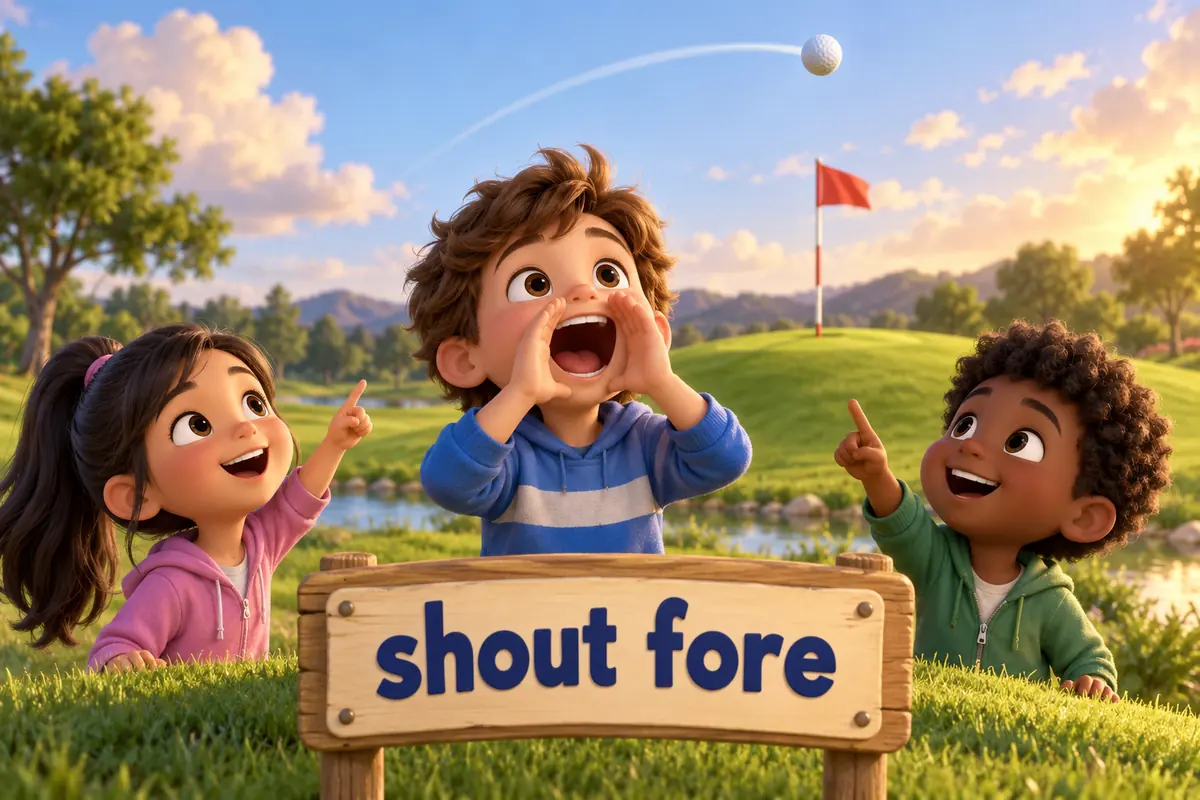
| fore | a warning shout for a stray ball | He called fore as the ball flew. |
What do the scoring terms mean in golf?
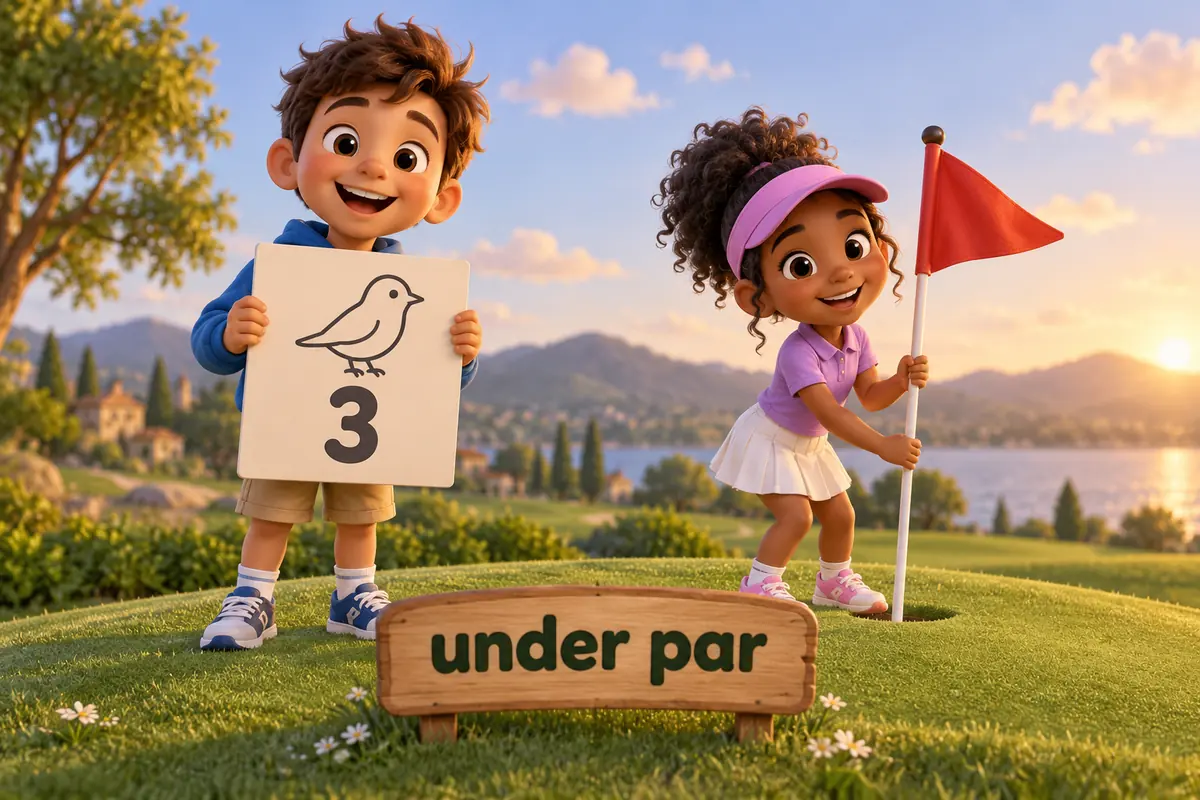
Scoring in golf is measured against par, the number of strokes a good player should need for a hole. A score below par earns a bird or an eagle, and a score above par takes the name bogey. The table sets the scores beside the words that describe them.
| Score | Term | Example |
|---|---|---|
| one under par | birdie | Two strokes on a par four is a birdie. |
| two under par | eagle | She made an eagle on the par five. |
| three under par | albatross | An albatross is very rare. |
| level with par | par | He finished with a par. |
| one over par | bogey | She took a bogey on the last hole. |
| two over par | double bogey | A double bogey cost him the lead. |
| one stroke for the hole | hole in one | He scored a hole in one. |
Course designers set each hole’s par by its length: a short hole is a par three, a medium hole a par four, and a long hole a par five. Knowing the par of a hole is the key to every scoring word, because birdie, bogey and eagle are all measured from it.
Golf vocabulary in context
The same words appear in a live broadcast, a lesson, a scorecard and a clubhouse chat. Reading them in different settings fixes the meaning faster than a list alone, and more example sentences sit in golf vocabulary in sentences.
| Context | Sentence | Term in focus |
|---|---|---|
| Broadcast | She split the fairway with a long drive. | fairway and drive |
| Scorecard | He carded a birdie on the second. | birdie |
| Lesson | Keep your head still on the putt. | putt |
| Clubhouse chat | My handicap dropped to twelve. | handicap |
| Sports report | He saved par from the bunker. | bunker and par |
| Playing partner | Call fore before you swing. | fore |
| Course guide | The ninth is a dogleg to the left. | dogleg |
| Junior clinic | The caddie showed her the line. | caddie |
| Tournament | She scored an eagle on the par five. | eagle |
| Casual round | They allowed a mulligan on the first tee. | mulligan |
Which golf terms confuse beginners most?
A few words look alike but measure different things, so learners mix them in the same round. The table pairs each confused term with what it actually means, and the contrast is worth learning before the first tee shot.
| Term | Might seem to mean | Actually means |
|---|---|---|
| par | a poor score | the expected number of strokes |
| bogey | a bird | one stroke over par |
| birdie | a real bird | one stroke under par |
| eagle | a type of club | two strokes under par |
| handicap | a disadvantage | a number that measures ability |
| fore | the number four | a warning cry |
Word forms and grammar of golf vocabulary
Many golf words work as both a noun and a verb, which is why a learner meets tee as a peg and tees as an action. The table shows the common words with their parts of speech and one use of each.
| Word | Part of speech | Example |
|---|---|---|
| tee | noun and verb | a wooden tee; tee the ball |
| drive | noun and verb | a long drive; drive the ball |
| putt | noun and verb | a short putt; putt for par |
| caddie | noun and verb | a good caddie; caddie for a friend |
| par | noun | a par of four |
| birdie | noun | score a birdie |
| bogey | noun and verb | card a bogey; bogey the last hole |
Common mistakes with golf terms
Mistake 1: par and bogey reversed. Incorrect: He made par when he needed five on a par four. Correct: He made a bogey. Rule: a bogey is one stroke over par, and par is level with it.
Mistake 2: the wrong margin between birdie and eagle. Incorrect: A two on a par four is a birdie. Correct: A two on a par four is an eagle. Rule: one under par is a birdie, and two under par is an eagle.
Mistake 3: a bird for a birdie. Incorrect: She scored a bird on the third. Correct: She scored a birdie on the third. Rule: the golf term is birdie, not bird.
Mistake 4: handicap as a disadvantage. Incorrect: His disadvantage is twelve. Correct: His handicap is twelve. Rule: in golf a handicap is a measure of ability, not a penalty.
Mistake 5: forgetting the warning. Incorrect: He shouted four as the ball flew. Correct: He shouted fore as the ball flew. Rule: fore warns other players of a stray ball.
Practice using golf vocabulary
- Fill in the blank: Two strokes on a par five is an ______.
- Choose the better word: One over par is a (bogey / birdie).
- Correct the error: He shouted four as the ball flew toward the next fairway.
- Build a sentence: use tee and driver about the first shot of a round.
- Name the part: the long grass beside the fairway is the ______.
- Spot the register: which suits a scorecard note, She made a birdie on three, or She did good on the third hole?
Answers
- eagle; two strokes under a par five is an eagle.
- bogey; one over par is a bogey.
- He shouted fore; fore is the warning cry, not the number four.
- Sample: She hit a driver from the first tee; a tee starts the hole.
- rough; long grass beside the fairway is the rough.
- She made a birdie on three; it uses the standard scoring terms.
For more frames that place these words in natural lines, see practice golf vocabulary sentences.
The bottom line
Golf vocabulary divides neatly into course words, clubs and scoring terms, and once those three groups are clear a scorecard reads like plain English. Learn the course from tee to green, then the clubs, then the scores measured against par. A beginner who knows birdie, bogey and handicap can follow any round.
Frequently asked questions about golf vocabulary
What does birdie mean in golf?
A birdie is a score of one stroke under par on a hole, such as a four on a par five or a three on a par four. The word comes from old slang for something excellent, and it sits between a par and an eagle on the scoring scale.
What is the difference between par and bogey?
Par is the expected number of strokes for a hole, set by the course, while a bogey is one stroke more than par. A par four takes four strokes, and a bogey on the same hole takes five. The two words measure the score from opposite sides.
What is a handicap in golf?
A handicap is a number that measures a player’s ability and lets players of different levels compete fairly. A lower handicap means a stronger player. It is not a penalty, and it is used to adjust the total score in a friendly match or a club competition.
What should a beginner learn first?
A beginner should learn the course words first, because tee, fairway, green, rough and bunker come up on every shot. Scoring terms such as par, birdie and bogey come next, followed by the clubs. That order matches the words a player hears during a round.