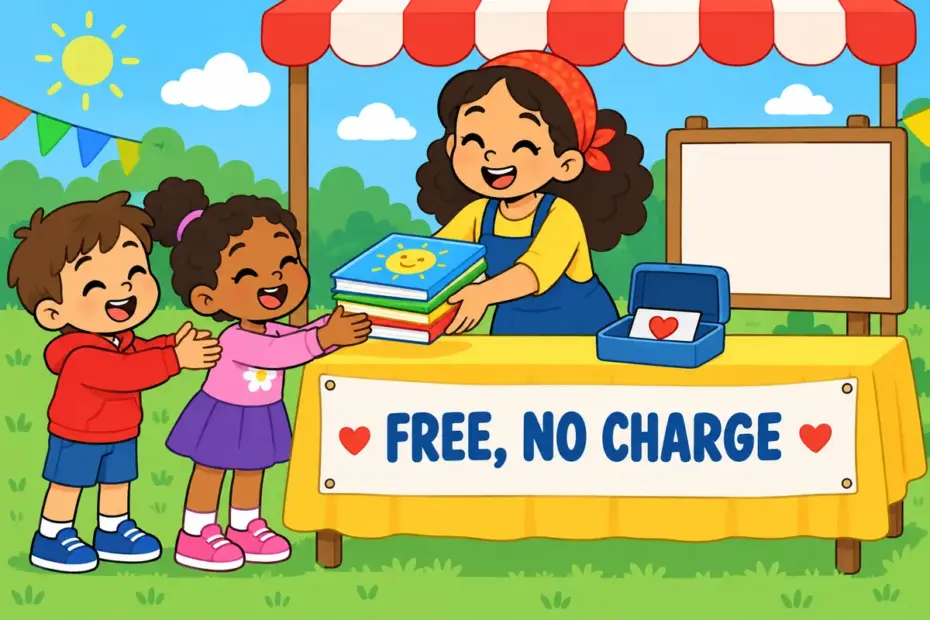
Gratis means free of charge, given or received without any payment. To use gratis in a sentence, place it where it can describe the transaction: “The museum admits members gratis on Sundays.” The word works as both an adjective and an adverb, and it belongs to formal, commercial and legal writing more than to casual talk.
Gratis at a glance
- Gratis is an adjective and an adverb meaning free of charge.
- It has no plural, comparative or superlative form; the spelling never changes.
- It usually follows the verb or sits before a noun such as copy or admission.
- Gratis belongs to contracts, invoices and formal notices rather than to chat.
- The commonest error is confusing gratis with gratuitous, which means unwarranted.
What does gratis mean?
Gratis is an adjective and an adverb meaning free of charge. The Cambridge entry for gratis shows a single sense across both roles, with no suggestion that anything is owed later. The word is narrower than free: it always refers to money not changing hands, never to being at liberty or free of a burden.
| Sense | Plain meaning | Example sentence |
|---|---|---|
| As an adjective | Describes something supplied without payment | Members receive a gratis copy of the journal. |
| As an adverb | Describes how something is given or received | The samples were handed out gratis. |
| In commercial writing | Marks a service or item with no charge | Installation is provided gratis. |
One honest limit applies. Gratis sounds stiff in everyday speech. A shop assistant would say free, not gratis, and a coupon would print free. Gratis earns its place in contracts, invoices and formal notices, where the older word signals a deliberate no-charge term.
How do you use gratis in a sentence?
Gratis either follows the verb like an adverb or sits before a noun like an adjective, and the choice changes nothing about the meaning. A close synonym in commercial writing is complimentary, which means given free as a courtesy.
| Pattern | Example | What it signals |
|---|---|---|
| noun + is or were + gratis | The tickets were gratis. | Gratis follows be as a subject complement. |
| gratis + noun | a gratis copy | Gratis behaves like any adjective before the noun. |
| verb + gratis | The coach travels gratis. | Describes receiving something at no cost. |
| give, provide or offer + object + gratis | They offered the repairs gratis. | The standard commercial frame for a no-charge service. |
| for gratis | non-standard: They gave it for gratis. | Gratis already means without charge, so for duplicates it. |
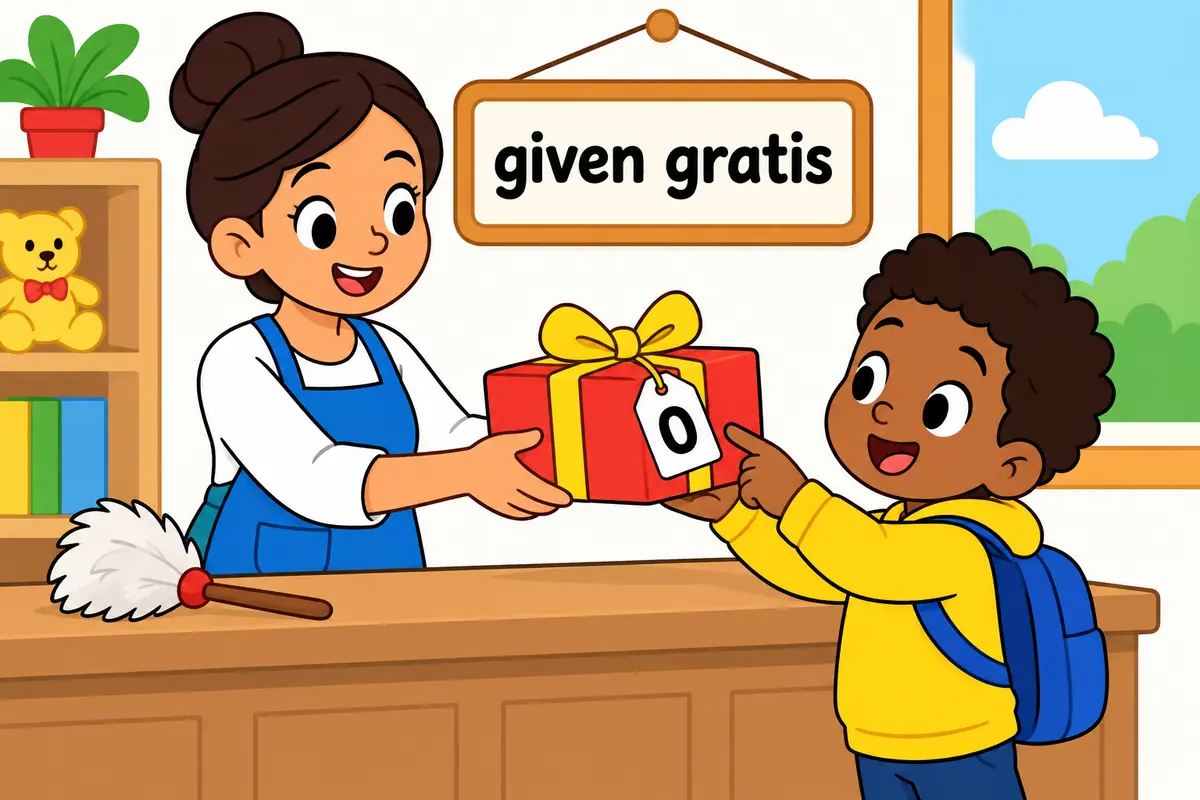
Gratis in a sentence: examples across contexts
Gratis keeps one meaning and changes company. The nine sentences below move from a shop counter to a contract clause, and each one names what is being handed over without payment.
| Context | Example sentence | Why this works |
|---|---|---|
| Retail | The shop ran a free giveaway of samples at the door. | Names the no-charge event in plain terms. |
| Museum admissions | Friends of the gallery enter gratis on the first Sunday. | The adverb marks a standing no-charge rule. |
| Hospitality | The chef sent out a plate of bread on the house. | Shows the everyday phrase that replaces gratis. |
| Legal contract | The contractor will supply the drawings gratis. | A formal term with a fixed no-payment obligation. |
| Workplace | Staff attend the training gratis as part of the scheme. | Distinguishes no charge from paid time. |
| Charity | The books were donated books, given gratis to every family. | Separates the gift from the price. |
| Software | The basic plan is gratis, while support carries a fee. | Splits a free product from a paid service. |
| News report | Tickets were offered gratis to residents near the site. | Names who received the no-charge allocation. |
| Conversation | We got in free. | Speech almost always swaps gratis for free. |
The last row is the one to notice. Outside formal writing, free or on the house does the same job and sounds natural, which is exactly why gratis stands out when it appears.
Gratis vs free
Free does everything gratis does and much more, which is why the choice is about register rather than meaning.
| Attribute | gratis | free |
|---|---|---|
| Core meaning | Without payment only | Without payment, or at liberty |
| Scope | One narrow commercial sense | Many senses, literal and figurative |
| Parts of speech | Adjective and adverb | Adjective, adverb and verb |
| Register | Formal, commercial and legal | Neutral and universal |
| Typical pair | A gratis copy or admission | free entry or free time |
| What it implies | A deliberate no-charge term | Ordinary absence of cost or constraint |
Verdict: use gratis when the no-charge arrangement is formal and worth marking, and free in everything else, because free also covers freedom from constraint and gratis never does.
Word forms and grammar of gratis
Gratis is invariant: it never takes a plural, a comparative or a suffix. Its relatives share a root but not a meaning, so the table keeps them apart.
| Form | Part of speech | Example |
|---|---|---|
| gratis | adjective | The consultation is gratis. |
| gratis | adverb | She advised us gratis. |
| gratis | no plural or inflected form | Incorrect: two gratises. |
| gratuity | noun, different meaning | A gratuity is a tip, not a free item. |
| gratuitous | adjective, different meaning | A gratuitous insult is unwarranted, not free. |
| gratisly | non-standard adverb | Incorrect: given gratisly. |
Common mistakes with gratis
- Incorrect:
The meal was gratis cost.Correct: The meal was gratis. Rule: Gratis already contains the idea of no charge, so cost is redundant. - Incorrect:
They gave it for gratis.Correct: They gave it gratis. Rule: Do not add for; gratis is not a noun. - Incorrect:
The insult was gratis.Correct: The insult was gratuitous. Rule: Gratis means free of charge; gratuitous means unwarranted. - Incorrect:
The gratis were handed out at the door.Correct: The free tickets were handed out at the door. Rule: Gratis is an adjective or adverb, not a noun. - Incorrect:
The service was very gratis.Correct: The service was gratis. Rule: Gratis is absolute; it takes no very and no more.
Practice using gratis
Work through the six items, then check the reasoning as well as the answer.
- Fill the gap: The gallery admits school groups ______ on weekday mornings.
- Choose the better word: The lawyer’s remarks were (gratis / gratuitous) and offended the court.
- Correct the error: They offered the delivery for gratis.
- Build a sentence: use gratis about a repair carried out at no charge.
- Spot the register: which belongs in a contract, the first inspection is gratis or the first inspection is on us?
- Rewrite with a plain synonym: The app is gratis. Use free instead.
Answers
- gratis — the adverb says the admission carries no charge.
- gratuitous — the remarks were unwarranted, so the free-of-charge word is wrong.
- They offered the delivery gratis — drop for, because gratis already means without charge.
- Model answer: The plumber carried out the repair gratis after the first visit failed.
- The first inspection is gratis — a contract wants the formal term.
- The app is free — everyday writing prefers free to the stiff older word.
The bottom line
Use gratis in a sentence to mark something supplied free of charge, usually in a contract, an invoice or a formal notice. The two deciding points are these: gratis is invariant, so it never takes a plural or a comparative, and it means only free of charge, never free of a burden. Where a plainer word will do, free is the safer choice.
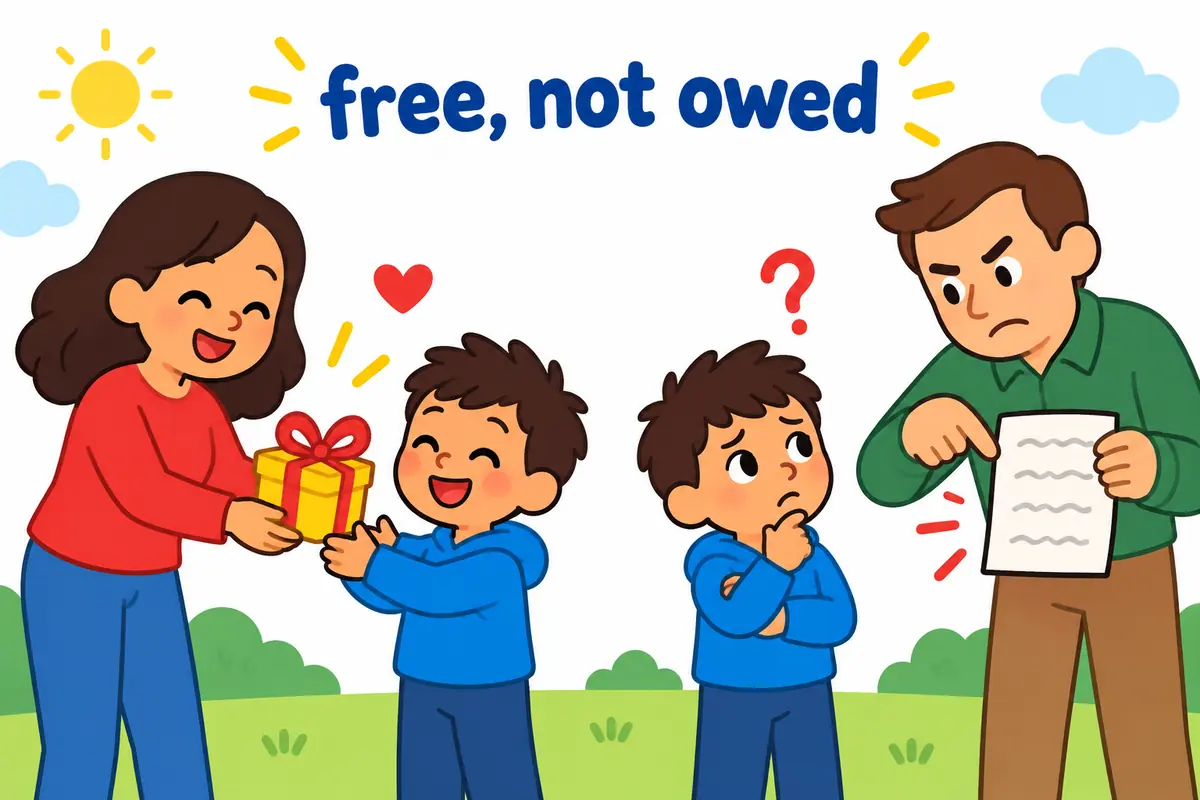
Frequently asked questions about gratis
Is gratis a real word?
Yes. Gratis is a standard word with a long history in commercial and legal English, and it appears in dictionaries as both an adjective and an adverb. It means free of charge. The word is simply old-fashioned in conversation, which is why some readers meet it mainly in contracts and formal notices.
Is gratis an adjective or an adverb?
It is both, and the grammar decides which. In the tickets were gratis it works as an adjective after the verb be. In they gave it gratis it works as an adverb describing how the giving happened. The spelling never changes, and neither use requires a hyphen or a suffix.
How is gratis different from gratuitous?
Gratis means free of charge, while gratuitous means unwarranted or unnecessary, as in a gratuitous insult. The two words share a Latin root about favour and grace, but their modern meanings do not overlap. Calling a rude remark gratis says only that nobody paid for it.
Can gratis be used in everyday conversation?
It can, but it usually sounds stiff and slightly old-fashioned. Most speakers say free, and a restaurant says on the house. Gratis earns its place where a formal record matters, such as a contract stating that drawings are supplied gratis, because the older word signals a deliberate no-charge term.
Have you ever come across the term “gratis” and wondered what it means? In essence, “gratis” refers to something that is given or received willingly, without payment or charge.
This word is often used to describe something provided free of cost, whether it’s a service, a product, or any other form of benefit. Understanding the concept of “gratis” can help you navigate various offerings that may come your way without any strings attached.
7 Examples Of Gratis Used In a Sentence For Kids
- You can get the toys gratis at the shop.
- The cupcakes are gratis for your birthday party.
- I shared my snacks gratis with my friends.
- The stickers are gratis when you buy the coloring book.
- The teacher gave us pencils gratis today.
- You can watch the movie gratis at the library.
- Don’t worry, the balloons are gratis for everyone at the party.
14 Sentences with Gratis Examples
- Gratis access to the library’s online resources is available for all students enrolled in the college.
- Don’t miss out on the gratis workshop on financial literacy being held next week.
- Students can get a gratis meal at the campus canteen by participating in the food survey.
- The college is offering gratis tutoring sessions for difficult subjects to help students excel in their academics.
- Grab a gratis ticket to the college cultural fest by submitting your entry for the talent show.
- Attend the gratis seminar on career opportunities in the IT sector to gain valuable insights.
- Students can avail gratis counseling services for mental health and well-being at the college’s wellness center.
- Join the gratis yoga classes organized by the college to de-stress and improve physical fitness.
- Sign up for the gratis language exchange program to practice speaking a new language with fellow students.
- The college is offering gratis Wi-Fi access in all campus buildings for students to stay connected.
- Get your hands on gratis study materials for upcoming exams from the college’s online learning portal.
- Enjoy a gratis movie screening at the college auditorium this weekend for a fun-filled evening.
- Participate in the gratis sports tournament organized by the college for a chance to win exciting prizes.
- Don’t forget to avail the gratis printing services at the college’s computer lab for your assignments and projects.
How To Use Gratis in Sentences?
When using Gratis in a sentence, remember that it means “free of charge” or “without payment.” Here’s a simple guide to help you use this word correctly:
-
Position in a sentence: Gratis is usually placed before the item or service that is being provided for free. For example, “The concert tickets were gratis.”
-
Synonyms: You can use Gratis interchangeably with phrases like “complimentary,” “at no cost,” or “free of charge.”
-
Formality: Gratis is a slightly formal term, so it may be more appropriate for professional or written contexts than casual conversations.
-
Context: Make sure you are using Gratis in situations where you want to emphasize that something is being provided without any costs or fees attached.
-
Pronunciation: Gratis is pronounced as “GRAH-teez.”
-
Variations: The word “Gratis” originated from Latin and is commonly used in English. However, you may find similar terms like “free” or “complimentary” to convey the same meaning.
Remember to use Gratis when you want to indicate that something is free of charge. Practice incorporating it into your sentences to become more comfortable with using this term accurately.
Conclusion
In conclusion, the concept of receiving something for free, or gratis, is a common practice in various scenarios. Whether it is a free trial of a service, complimentary products with a purchase, or simply a promotional gift, the use of gratis helps businesses attract and retain customers. Consumers benefit from these gratis offerings by enjoying additional value without extra costs.
Understanding the power of gratis in marketing strategies can help businesses generate interest and loyalty from customers. By incorporating complimentary items or services into their offerings, companies can create positive experiences and build lasting relationships with their target audience. Therefore, leveraging the concept of gratis can be a valuable tool for both businesses and consumers in enhancing overall satisfaction and value.


