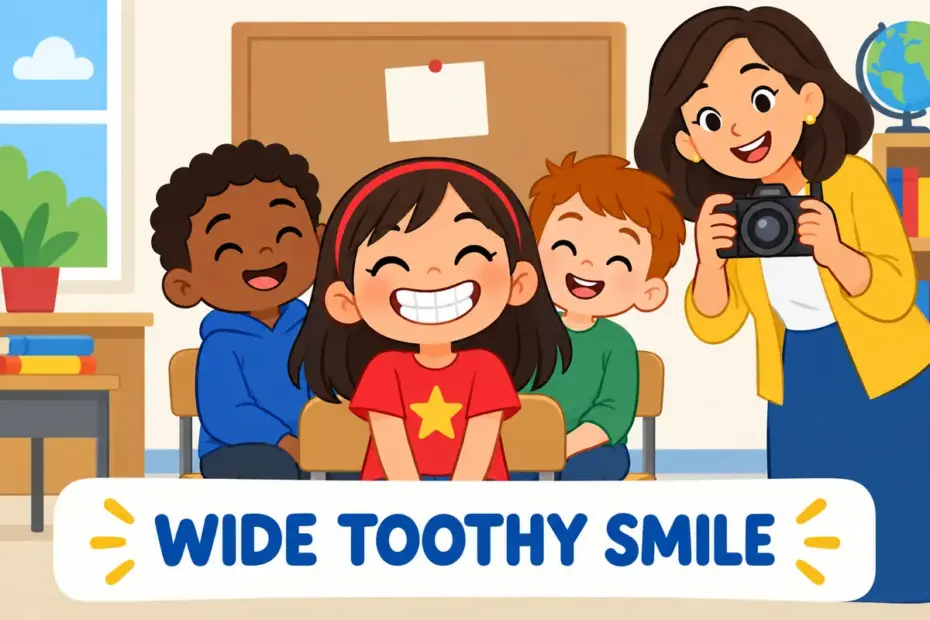
Grin means to smile broadly so the teeth show, and it also names that wide smile. In a sentence, grin usually works on its own or with a preposition: “She grinned at the good news.” The verb is intransitive, so it never takes a person as its direct object.
Grin at a glance
- Grin is both a verb and a noun; its verb forms are grins, grinned and grinning.
- The usual pattern is grin at someone or grin with an emotion.
- Grin implies a wide, toothy smile rather than a small polite one.
- Common collocations are grin broadly, grin from ear to ear, and the idiom grin and bear it.
- The commonest error is using to after grin; the preposition is at.
What does grin mean?
Grin is a verb meaning to smile broadly enough to show the teeth, and a noun for that same broad smile. The Cambridge entry for grin records both. A grin is wider and more open than a smile, and it often carries delight, mischief or embarrassment rather than simple politeness. For an expression that twists from effort or pain instead of pleasure, a grimace is the closer word, and for a beaming, radiant smile many writers choose beam.
| Sense | Plain meaning | Example sentence |
|---|---|---|
| Verb | Smile widely so the teeth show | Maya grinned at her marked test. |
| Verb, fixed idiom | Accept something annoying without complaining | The bus was late, so we grinned and bore it. |
| Noun | A broad, toothy smile | He answered with a confident grin. |
One limitation matters. Grin is not a synonym for laugh: a grin is silent and uses only the mouth, while a laugh makes a sound. Grin also sits oddly in a solemn moment, where a plain smile or a nod reads better.
How do you use grin in a sentence?
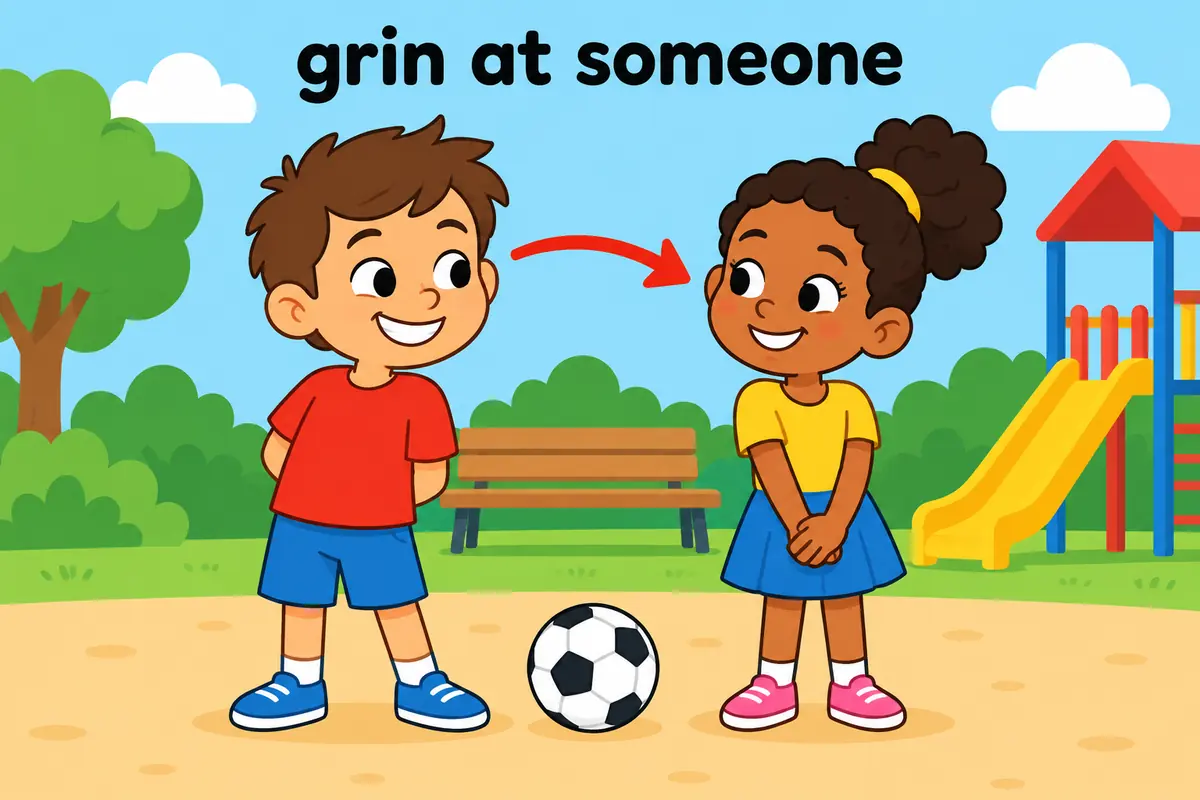
Grin is intransitive, so it never takes a person as its object. Instead it pairs with a preposition or an adverb that names the target or the feeling. The five patterns below cover almost every natural sentence.
| Pattern | Example | What it signals |
|---|---|---|
| grin at + person | She grinned at the photographer. | Names who receives the smile. |
| grin with + emotion | He grinned with relief. | Names the feeling behind the expression. |
| grin broadly / from ear to ear | The winner grinned from ear to ear. | Shows how wide the smile is. |
| grin and bear it | There was nothing to do but grin and bear it. | The idiom means endure quietly. |
| be grinning | You are grinning again. | Describes an expression already in progress. |
Grin in a sentence: examples across contexts
The verb barely changes meaning across these contexts, but the company it keeps does. Notice how formal writing keeps the verb bare while casual writing adds feeling.
| Context | Example sentence | Why this works |
|---|---|---|
| Classroom | Nia grinned when the teacher read her story aloud. | A grin marks quiet pride without the noise of laughter. |
| Text message | I can hear you grinning from here. | Uses the continuous form for an expression in progress. |
| News report | The coach grinned as the final whistle blew. | Reports visible emotion at a public moment. |
| Sports commentary | She grinned at the crowd after the winning point. | The preposition at ties the smile to its audience. |
| Novel | He grinned with the ease of a man who had already won. | Adds manner after with, beyond the bare feeling. |
| Job reference | The candidate grinned through the whole interview. | Through signals the expression lasted under pressure. |
| Conversation | Stop grinning and tell me what happened. | The imperative works because grin needs no object. |
| Diary | We grinned at each other across the crowded hall. | At each other shows a shared, wordless exchange. |
| Social caption | The puppy grinned for the camera. | Light personification suits animals and informal captions. |
Only some of these fit formal writing. The news and reference rows keep the verb plain, which is what reporting prefers.
Grin vs smile and smirk
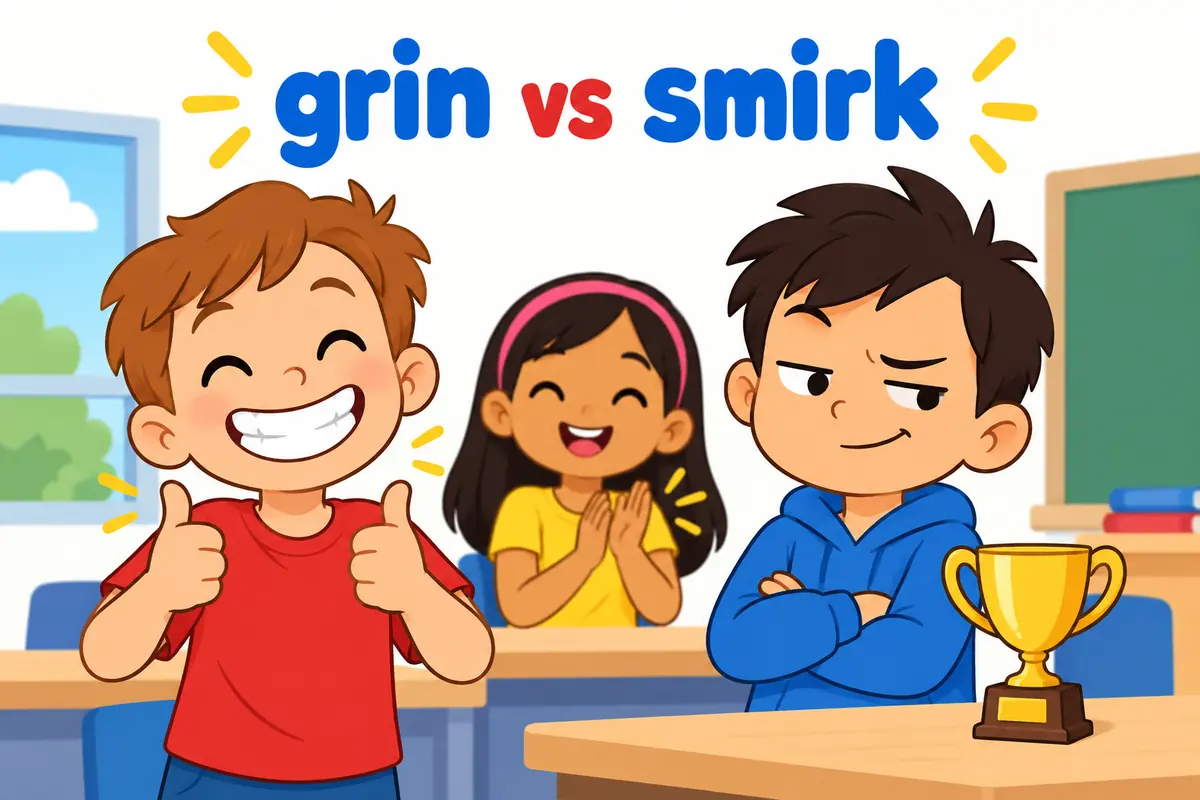
Grin sits between two near neighbours. Smile is the general word for a pleased expression, and a smirk is a lopsided grin that signals smugness or unkind satisfaction.
| Attribute | grin | smile | smirk |
|---|---|---|---|
| Mouth shape | Wide, teeth showing | Closed or slightly open | Lopsided, one-sided |
| Feeling | Delight, mischief, nerves | Warmth or politeness | Smugness or contempt |
| Register | Everyday and friendly | Neutral, most flexible | Negative and judgmental |
| Typical subject | A person or an animal | A person | A person, often a rival |
| Example | The boy grinned at his sister. | She smiled politely. | He smirked at the mistake. |
Verdict: choose smile for simple pleasure, grin when the teeth and width matter, and smirk only when the unkind edge is intended.
Word forms and grammar of grin
Grin inflects like a regular verb and doubles its final consonant in the past and participle. The table also flags the adjective grim, which looks similar but means something quite different.
| Form | Part of speech | Example |
|---|---|---|
| grin | verb, base form | Please do not grin at the camera. |
| grins | verb, third person singular | He grins every time he wins. |
| grinned | verb, past and past participle | She grinned after the announcement. |
| grinning | verb, present participle | They were grinning in the photo. |
| grin | noun | A wide grin spread across her face. |
| grim | adjective, different meaning | The forecast was grim. |
Common mistakes with grin
- Incorrect:
He grinned to me.Correct: He grinned at me. Rule: Grin pairs with at, not to; to describes speech, not a facial expression. - Incorrect:
She grinned her friend.Correct: She grinned at her friend. Rule: Grin is intransitive, so it cannot take a person as a direct object. - Incorrect:
He gave a simpering grin.Correct: He gave a wide grin. Rule: Simper is a weak, affected smile; pairing it with grin muddles two different expressions. - Incorrect:
The joke grinned him.Correct: He grinned at the joke. Rule: People and animals grin; jokes do not. Keep a living subject. - Incorrect:
She was grin at the news.Correct: She was grinning at the news. Rule: After be, use the -ing form to describe an expression in progress.
Practice using grin
Work through the six items, then read the reasons rather than only the answers.
- Fill the gap: The toddler ______ at the clown and clapped.
- Choose the better word: She gave a polite (smile / grin) to the new neighbour.
- Correct the error: He grinned to his teammates after the goal.
- Build a sentence: use grin at about a shy child who spots a friend.
- Spot the register: which fits a news report — the champion grinned from ear to ear, or the champ was, like, grinning so hard?
- Rewrite with the noun: The girl grinned at her brother. Use grin as a noun.
Answers
- grinned — the toddler is the subject and no object follows.
- smile — polite warmth calls for the neutral word; a grin would bare the teeth and feel too broad.
- He grinned at his teammates after the goal — grin takes at, not to.
- Model answer: Sam grinned at his friend across the playground.
- The champion grinned from ear to ear — a report avoids slang and filler.
- The girl gave her brother a wide grin — the noun needs an article and a verb such as give.
The bottom line
Use grin in a sentence to describe a broad, toothy smile, and keep the verb intransitive, pairing it with at, with or an adverb. Two nuances decide the choice: grin is wider and more toothy than smile, so a small polite expression calls for smile, and a grin that implies smugness is better written as smirk. When the mouth twists from effort rather than pleasure, grimace is the exact word.
Frequently asked questions about grin
Is grin a verb or a noun?
Grin is both. As a verb it means to smile widely with the teeth showing, as in the children grinned at the camera. As a noun it names that expression, as in a grin spread across her face. The verb is the commoner use, and its forms are grins, grinned and grinning.
What is the difference between grin and smile?
Smile is the general word for a pleased expression, and it can be small and closed-mouthed. Grin is narrower in use: it means a wide smile that shows the teeth, and it suggests stronger feeling such as delight or mischief. A polite smile to a stranger is rarely called a grin.
Why do we say grin and bear it?
The fixed phrase grin and bear it means to accept something annoying without complaining. Here grin carries an older sense of forcing a smile while putting up with difficulty. The phrase is idiomatic, so the word order is fixed and the verb keeps its base form after the word to.
Can grin take an object?
Grin is intransitive, so it does not take a person as a direct object. You say she grinned at him, not she grinned him. The only object it can carry is a cognate one in rare phrases such as grin a wide grin, which most writers replace with give a wide grin.
Have you ever noticed how a simple smile can brighten someone’s day? That subtle upturn of the corners of the mouth is more powerful than we realize. In linguistics, a grin is a facial expression that conveys happiness, amusement, or friendliness by showing the teeth.
Expressing joy or amusement with a grin is universal across cultures, making it a fundamental form of nonverbal communication. This gesture can create an instant connection between individuals and is often contagious, spreading positivity wherever it is shared.
7 Examples Of Grin Used In a Sentence For Kids
- Grin from ear to ear when you feel happy.
- I love it when you grin and make me smile too.
- Let’s play a game and see who can grin the longest.
- Tell a funny joke and watch everyone grin with delight.
- The sunshine makes me want to grin all day long.
- Grin at your friends to show them you care.
- Remember, a grin is the best way to spread happiness around.
14 Sentences with Grin Examples
- Grin of excitement spread across the college campus as the annual fest approached.
- Seeing a familiar face in a crowd of strangers always brings a grin to my face.
- Grin and bear it, they say, when faced with tough professors and endless assignments.
- The professor’s joke elicited a collective grin from the sleepy students in the lecture hall.
- A surprise test announcement wiped the grin off many students’ faces.
- Grin at the thought of summer break just around the corner after a grueling semester.
- Grin in satisfaction as the final project presentation receives praise from classmates.
- The lure of a piping hot cup of chai at the canteen always brings a grin to tired faces.
- Group study sessions often turn into laugh-filled moments that end with a shared grin.
- Grin sheepishly when caught doodling in the back of the classroom during a boring lecture.
- The anticipation of results day is enough to make anyone grin nervously.
- The prospect of attending a college festival makes it hard for students not to grin with excitement.
- Grin with relief after acing a difficult exam that had everyone stressed out.
- The sight of a food delivery at the hostel door always brings a grin to hungry faces.
How To Use Grin in Sentences?
To use Grin in a sentence, start by identifying the main idea or action you want to convey. Grin is a verb that means to smile broadly, often showing one’s teeth. When incorporating this word into a sentence, consider the context in which someone might display a wide and happy smile.
For example, you could say, “As she opened the birthday present, a huge grin spread across her face.” In this sentence, the word grin is used to describe the expression of joy and excitement shown by the person receiving the gift.
When crafting a sentence with grin, think about the emotions you want to convey and the impact you want the word to have in the reader’s mind. Grin can be used to show happiness, amusement, mischief, or other positive feelings.
Remember to pay attention to the tone and style of your sentence to ensure that grin fits appropriately within the context. Use grin sparingly to emphasize moments of joy or delight in your writing.
By following these simple tips, you can effectively incorporate the word grin into your sentences to add depth and emotion to your writing. Experiment with different scenarios and emotions to fully explore the versatility of this expressive word.
Conclusion
In conclusion, a grin is a facial expression that involves smiling broadly, often indicating happiness or satisfaction. It is characterized by the stretching of the lips and the showing of teeth. Grinning is typically seen as a positive and friendly gesture, reflecting a person’s joy or amusement.
Whether in response to a joke, a happy moment, or simply to convey a sense of warmth towards others, grinning is a universal form of non-verbal communication. It can help build rapport, express approval, or lighten the mood in social interactions. So, don’t hesitate to share a grin with those around you, as it can go a long way in brightening someone’s day and creating a sense of connection and positivity.


