
Grit in a Sentence: Meaning, Examples, and Usage
Use grit in a sentence to describe determination, small rough particles, or the action of clenching teeth. For example, “Maya showed grit by practicing after every setback” uses the determination meaning. The surrounding words tell readers whether grit refers to a personal quality, a physical substance, or an action.
Key facts at a glance
- Grit can name determination or small rough particles.
- Show grit and have grit are useful patterns for describing persistence.
- A grain of grit identifies a small amount of the physical substance.
- Gritted and gritting are verb forms with a doubled t.
- Grit your teeth describes clenching teeth and can suggest enduring difficulty.
What does grit mean in a sentence?
Grit has both physical and figurative meanings. In everyday writing about achievement, grit describes determination in a difficult situation; in writing about cleaning, beaches, or roads, grit refers to rough particles. The American Heritage Dictionary entry also records verb uses involving clenched teeth and treating a surface with grit.
The clearest example contains a clue to the intended meaning. Compare “Her grit impressed the coach” with “The grit scratched the lens.” A coach can admire determination, while particles can scratch a surface. Merely saying “There was grit” gives the reader little help choosing between these meanings.
Grit in a sentence: examples by meaning
| Meaning | Original example | Context clue |
|---|---|---|
| Determination | Lena showed grit by rebuilding the model after it collapsed. | Rebuilding after failure |
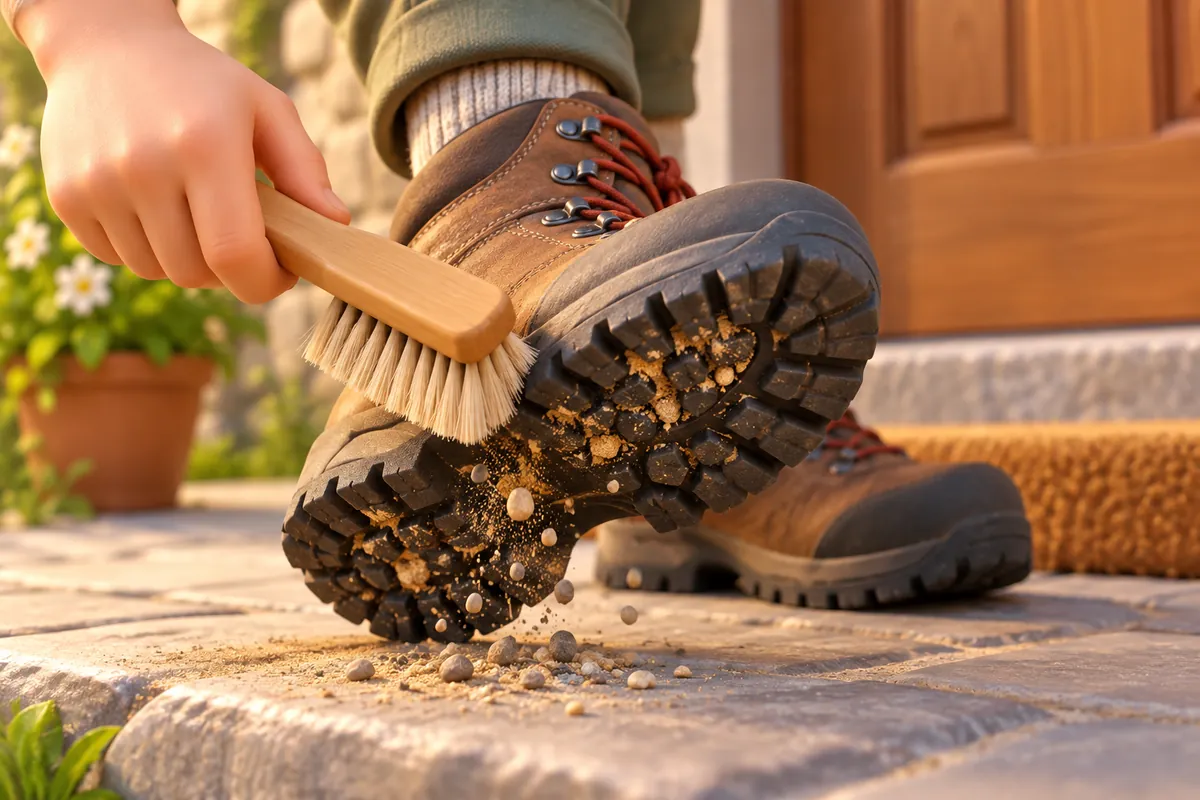
| Rough particles | He brushed the grit from his hiking boots. | Brushed and boots |
| Clenched teeth | I grit my teeth whenever I hear that scraping noise. | Teeth and noise |
| Surface treatment | Workers gritted the icy path before school opened. | Icy path and workers |
Choose the meaning before choosing the rest of the sentence. An example about determination benefits from a setback and a response. An example about particles benefits from a location, object, or physical effect. These details explain the word without adding an awkward definition inside the sentence.
How do you show determination with grit?
Describe an obstacle and the effort that follows it: “After three rejected applications, Noor showed grit by improving her portfolio and applying again.” The second action makes the quality visible. The sentence communicates more than “Noor had grit,” which labels a trait without demonstrating it.
- The team showed grit when it kept defending after falling behind.
- Learning the difficult passage took patience and grit.
- Her quiet grit helped her return to practice after a disappointing audition.
- Finishing the project required grit as well as careful planning.
- He admired the grit of volunteers who worked through repeated setbacks.
Use “grit” as a description of the person’s response, rather than a guarantee of success. “His grit guaranteed victory” makes a stronger claim than the word itself supports. A sentence can recognize determined effort even when the final result remains uncertain.
Physical grit and the verb grit
Physical grit works naturally with verbs such as brush, rinse, remove, scrape, and scratch. “Rinse the grit from the cup before filling it” is a practical instruction. “A grain of grit lodged under the lid” identifies one particle instead of treating the whole substance as a countable object.
For the verb, keep the tense clear: “I grit my teeth at that sound” describes a repeated present reaction; “I gritted my teeth at the sound” describes a past reaction; “She was gritting her teeth” describes an action in progress. The doubled consonant belongs in both gritted and gritting.
“Grit your teeth and finish the last paragraph” uses the expression figuratively. The speaker urges someone to endure an unpleasant task. That expression carries a tougher, more strained tone than “be patient,” so it may be unsuitable when a gentle request would better fit the scene.

Common mistakes and better alternatives
Grit is a noun in “She has grit.” Replace “She is grit” with that pattern, or describe the person as determined. “Gritty” is an adjective, but “a gritty story” can suggest harsh realism rather than a story about perseverance. A related form does not always preserve the exact meaning you intend.
Do not confuse “grit” with “grits,” the food name. “There was grit in the pan” suggests unwanted particles; “There were grits in the bowl” refers to a dish. The spelling difference creates a substantial change in meaning.
- Decide whether the word describes a quality, particles, or an action.
- Choose a matching pattern: show grit, remove grit, or grit your teeth.
- Add a concrete context clue.
- Check the tense and the spelling of gritted or gritting.
- Read the example aloud to confirm that the intended meaning is obvious.
For a short school sentence, “Sam showed grit by trying the puzzle again” is enough. For a longer narrative, explain what went wrong and what Sam changed on the next attempt. Adding a specific response improves clarity more than repeating words such as very or really.
Frequently asked questions
Can grit be used positively?
Yes. Grit often expresses approval when it describes someone’s determination during a challenge. “The team showed grit after losing its captain” praises the team’s response. Still, the sentence should explain the effort or difficulty, because the same word can also describe rough particles that are unpleasant or unwanted.
Is grit the same as talent?
No. In a sentence about achievement, grit emphasizes determination, while talent emphasizes ability. “Her talent impressed us, but her grit kept her practicing” gives the words different jobs. A person may have both qualities, and the sentence can name both without treating them as interchangeable explanations for success.
Should I write a grit or some grit?
Use “some grit” for an unspecified amount of rough material, and “a grain of grit” for one particle. When describing determination, write “She has grit” or “She showed grit.” “A grit” is usually an awkward choice in these common meanings because the noun is not normally counted that way.
What is a simple sentence with gritted?
“He gritted his teeth before opening the difficult letter” is a simple past-tense example. The subject is he, the verb is gritted, and the object is his teeth. The final phrase supplies context, helping the reader understand that the action expresses tension rather than determination as a noun.
Conclusion
To use grit in a sentence, choose the intended meaning first, then add a context clue that makes that meaning clear. Match the grammar and spelling to the example rather than relying on the sound of the word alone.
When faced with challenges, having grit can make all the difference. Grit is the determination and perseverance to keep pushing forward, even in the face of obstacles or setbacks.
This unique trait empowers individuals to stay focused on their goals, maintain motivation, and overcome adversity with resilience.
7 Examples Of Grit Used In a Sentence For Kids
- Grit helps us keep trying when things get tough.
- We show grit by not giving up when we face challenges.
- Grit means staying determined and not giving in to obstacles.
- Let’s use our grit to achieve our goals!
- Having grit means believing in ourselves and our abilities.
- We can develop grit by practicing and never giving up.
- Remember to always have grit and keep working hard.
14 Sentences with Grit Examples
- Grit is essential for overcoming academic challenges and succeeding in college.
- Building grit can help students stay motivated during tough times in their academic journey.
- Developing grit can give students the resilience needed to push through difficult coursework.
- Students with grit are more likely to persevere and achieve their goals in college.
- Cultivating grit can lead to a stronger work ethic and higher levels of achievement.
- It’s important for college students to have grit in order to navigate the complexities of higher education.
- With grit, students can handle setbacks and failures as opportunities for growth.
- College students can enhance their grit by setting realistic goals and staying focused on them.
- Having grit can help students manage stress and pressure effectively during their academic journey.
- By developing grit, college students can improve their problem-solving skills and adaptability.
- Students who exhibit grit are more likely to take on challenges and pursue new opportunities.
- Grit is a valuable trait for college students to cultivate as they prepare for their future careers.
- College students can benefit from practicing grit in their daily academic pursuits.
- By embracing grit, students can build the determination and perseverance needed to excel in college.
How To Use Grit in Sentences?
To use the word Grit in a sentence, start by understanding its meaning. Grit refers to having courage, determination, and a strong will to persevere through difficult situations.
When incorporating Grit into a sentence, consider a scenario where someone is facing a challenging task or obstacle. For example, “Despite facing numerous setbacks, she displayed incredible Grit and continued to pursue her dream of becoming a doctor.”
Another way to use Grit in a sentence is by highlighting someone’s resilience and determination. For instance, “His Grit and unwavering dedication to his goals inspired those around him to never give up.”
Remember that Grit is a positive trait that signifies strength and perseverance. Therefore, when using this word in a sentence, it’s important to frame it in a context that showcases someone’s ability to overcome hardships and stay focused on their objectives.
In summary, to use Grit in a sentence effectively, convey a situation where an individual demonstrates courage, perseverance, and determination in the face of adversity. By grasping the essence of Grit and incorporating it into your sentences, you can effectively express the concept of resilience and strength.
Conclusion
In conclusion, incorporating grit into your daily life can lead to increased perseverance, determination, and success in overcoming challenges. By exemplifying qualities such as passion, resilience, and dedication, individuals can push through obstacles and achieve their goals. Through cultivating a mindset that embraces resilience and persistence, one can navigate difficulties with a sense of tenacity and motivation.
Overall, the significance of grit lies in its ability to drive individuals to push past setbacks, stay committed to their objectives, and ultimately reach their full potential. By embodying grit, individuals can confront adversity head-on, maintain focus on their long-term aspirations, and make strides towards personal growth and success.


