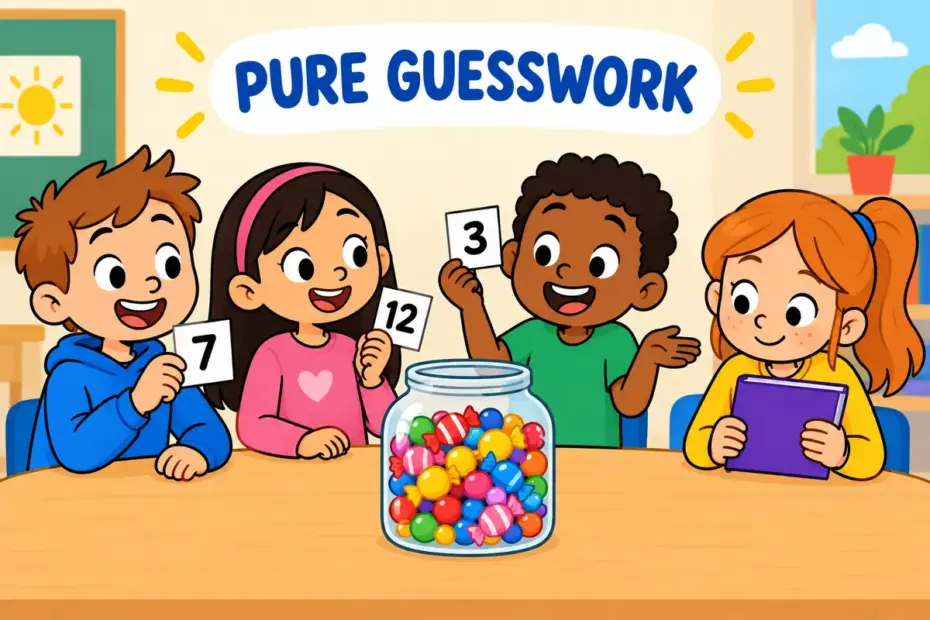
Guesswork is the act of reaching an answer by guessing rather than by evidence, and the word is uncountable. To use guesswork in a sentence, treat it as a single mass noun: “Choosing names from the list was pure guesswork.” It usually signals that information is missing and a result cannot be trusted.
Guesswork at a glance
- Guesswork is an uncountable noun, so it has no plural and takes no article.
- It means a judgement or answer reached by guessing rather than evidence.
- The natural phrases are pure guesswork, a matter of guesswork and take the guesswork out of.
- The usual contexts are forecasts, estimates, diagnoses and unresolved questions.
- The commonest error is writing a guesswork or the plural guessworks.
- The single fixed idiom is take the guesswork out of, which names a task after the phrase.
What does guesswork mean?
Guesswork is an uncountable noun meaning a judgement or answer reached by guessing rather than by evidence. The Cambridge entry for guesswork records that single sense, and it carries a mild criticism: the speaker is saying that real information was missing. Where a formal opinion is reasoned but still unproven, form a conjecture is the scholarly word, while a verified result is simply a matter of fact.
| Sense | Plain meaning | Example sentence |
|---|---|---|
| The activity of guessing | The process of answering without evidence | Sorting the coins by eye was pure guesswork. |
| The result of guessing | An answer that rests on no evidence | The estimate was dismissed as guesswork. |
One limitation is worth stating plainly. Guesswork is a judgement, not an insult aimed at a person: the forecast was guesswork criticises the method, not the forecaster. It also differs from a lucky answer, because the word names the absence of evidence rather than the accuracy of the result. A court treats the noun as no basis at all, which is why it so often follows must not rest on. A forecast built this way usually rests on an unchecked assumption, so readers learn to question an assumption before trusting the number.
How do you use guesswork in a sentence?
Because guesswork is uncountable, it stands alone or follows a phrase such as pure or a matter of. Five patterns cover almost every real sentence, and each one treats the word as a mass that cannot be counted.
| Pattern | Example | What it signals |
|---|---|---|
| be + guesswork | The repair schedule is guesswork. | States plainly that evidence is missing. |
| pure / sheer + guesswork | The winner prediction was sheer guesswork. | Strengthens the criticism of the method. |
| a matter of guesswork | Picking the date was a matter of guesswork. | Softens the claim into a comment on method. |
| take the guesswork out of + noun | The tool takes the guesswork out of pricing. | Presents a method as replacing guesswork. |
| reduce / avoid + guesswork | Better records reduce the guesswork. | Treats guesswork as a quantity to lower. |
Notice that every pattern keeps guesswork bare. Writers who want to name the missing evidence may prefer avoid speculation, which points at the reasoning, or the concrete noun figures, which points at the facts. Experienced people also rely on intuition, which sounds like guesswork yet draws on years of practice.
Guesswork in a sentence: examples across contexts
Guesswork keeps its critical edge while the register shifts. The ten sentences below move from a classroom to a legal opinion, and each names the evidence that is missing.
Two features hold across every context. The word stays bare, with no article and no plural, and it usually sits at the end of a clause after the verb be or after a phrase such as a matter of. When the sentence also names the evidence, as in without usage figures, the criticism lands harder because the reader can see exactly what was left out.
| Context | Example sentence | Why this works |
|---|---|---|
| Classroom | Sorting the shells by colour was pure guesswork. | A simple task shows guessing without measurement. |
| Workplace email | Without usage figures, our forecast is guesswork. | Names the missing data in the same sentence. |
| News report | Police denied that the timeline was guesswork. | Uses the word as an accusation to be rejected. |
| Academic writing | The chapter avoids guesswork by citing census returns. | Contrasts method with the missing evidence. |
| Medical writing | A diagnosis from a rash alone would be guesswork. | Shows why a single sign is not enough. |
| Sports report | Selection for the final came down to guesswork about fitness. | Ties the word to an uncertain judgement. |
| Everyday conversation | Choosing such a long password was guesswork for the attacker. | Applies the word to a failed attempt. |
| Technical writing | The app takes the guesswork out of sizing the cable. | Uses the fixed phrase to praise a tool. |
| Legal writing | The estimate of damages must not rest on guesswork. | Rejects the method as a basis for a ruling. |
| Radio interview | The manager called the transfer rumour pure guesswork. | Uses the word to deny a reported claim. |
Notice that two sentences use the fixed phrase take the guesswork out of. That idiom is the one place the word appears in marketing and product writing, where it usually means the tool supplies the measurement.
Guesswork vs conjecture
Guesswork and conjecture both name conclusions drawn without full evidence, and they are not interchangeable. Guesswork is the everyday term and often a criticism, while conjecture is formal and can describe a reasoned, testable idea. A detective may trust a hunch, but guesswork names the same move when the evidence is simply missing.
| Attribute | guesswork | conjecture |
|---|---|---|
| Meaning | Guessing, or a result reached without evidence | A formal opinion formed from incomplete information |
| Register | Everyday, often mildly critical | Formal, common in maths and scholarship |
| Countability | Always uncountable | Uncountable, but a single conjecture is possible |
| Tone | Can dismiss an answer as unreliable | Can present an unproven idea as worth testing |
| Typical phrase | pure guesswork | the conjecture remains unproven |
| Best for | Estimates, forecasts and quick answers | Scholarly or mathematical proposals |
Verdict: choose guesswork when evidence is missing and the method is weak, and choose conjecture when an unproven idea is still reasoned enough to be tested. The two words also differ in countability, because you can propose a conjecture but you can never propose a guesswork.
Word forms and grammar of guesswork
Guesswork is a compound noun that stays uncountable in every sentence. The table lists the related forms, including the ones that are countable, so the boundaries are clear.
| Form | Part of speech | Example |
|---|---|---|
| guesswork | uncountable noun | The whole schedule was guesswork. |
| guess | verb or countable noun | Do not guess the total. |
| guessing | gerund | Guessing wastes everyone’s time. |
| guesser | countable noun | She is a lucky guesser. |
| guesstimate | countable noun, informal | He gave a quick guesstimate. |
| guessworks | non-standard plural | The guessworks were wrong. |
The final row is the form to avoid. Because guesswork is uncountable, the plural guessworks does not exist in standard English, and the article a cannot stand before the bare noun. Note also that the compound keeps its stress on guess and never takes a hyphen, so guess-work is wrong in every register.
Common mistakes with guesswork
- Incorrect:
That was a guesswork.Correct: That was guesswork. Rule: Guesswork is uncountable, so it never takes the article a or an. - Incorrect:
The two guessworks disagreed.Correct: The two guesses disagreed. Rule: Guesswork has no plural; count the individual attempts with the noun guesses instead. - Incorrect:
We made roughly guesswork.Correct: We made a rough guess. Rule: Use an adjective with the countable noun guess, not with the mass noun guesswork. - Incorrect:
It was by guess work.Correct: It was by guesswork. Rule: Guesswork is a single compound word, never the two-word phrase guess work. - Incorrect:
Her answer was a pure guesswork.Correct: Her answer was pure guesswork. Rule: Qualifiers such as pure still leave the noun bare, because uncountable nouns reject the article.
Practice using guesswork
Work through the six items, then check the reasoning rather than only the answer.
- Fill the gap: Choosing the venue without seeing it was pure ______.
- Choose the better word: The estimate was dismissed as (guesswork / a guesswork).
- Correct the error: The costings were only guessworks.
- Build a sentence: use take the guesswork out of about a measuring app.
- Spot the register: which belongs in a lab report – the reading was taken twice to reduce guesswork, or I just guessed?
- Replace the noun: The forecast rested on guesswork. Use the word guesswork with a qualifier meaning complete.
Answers
- guesswork – the noun is uncountable, so it follows pure with no article.
- guesswork – the article fails because guesswork cannot be counted.
- The costings were only guesswork – the plural guessworks is non-standard.
- Model answer: The measuring app takes the guesswork out of mixing paint.
- The reading was taken twice to reduce guesswork – a report keeps a formal, evidence-led register.
- Model answer: The forecast rested on pure guesswork – pure works with the bare uncountable noun.
The bottom line
Use guesswork in a sentence when an answer rests on guessing rather than evidence, and keep the noun bare because it is uncountable. The two nuances that decide most sentences are these: the word criticises the method rather than the person, and the fixed phrase take the guesswork out of is the one context where it can sound positive. For a formal, testable idea, conjecture is the better noun.
Frequently asked questions about guesswork
Is guesswork one word or two?
Guesswork is one word, written without a space or a hyphen. The two-word phrase guess work is a common error, and the separate word work changes the meaning entirely. Treat guesswork like housework or homework, both of which are single compounds. Only the countable noun guess is written alone.
Why is guesswork uncountable?
Guesswork names an activity and its result as an undivided mass, much like research or advice, so English does not count it. That is why a guesswork and guessworks both sound wrong. When you need to count, switch to the countable noun guesses, as in three guesses, and keep guesswork for the general method.
What is the difference between guesswork and guess?
Guess is a countable noun or a verb, so you can make one guess or several guesses. Guesswork is an uncountable noun naming the practice of guessing without evidence. A single guess may be lucky, but guesswork always implies that proper information was missing, which is why it often carries a mild criticism.
Does guesswork ever mean a lucky result?
No. Guesswork describes how an answer was reached, not whether it turned out to be right. A forecast built on guesswork can still be correct by chance, but the word still reports the missing evidence. If you want to praise a result, say the answer was correct or well judged, not guesswork.