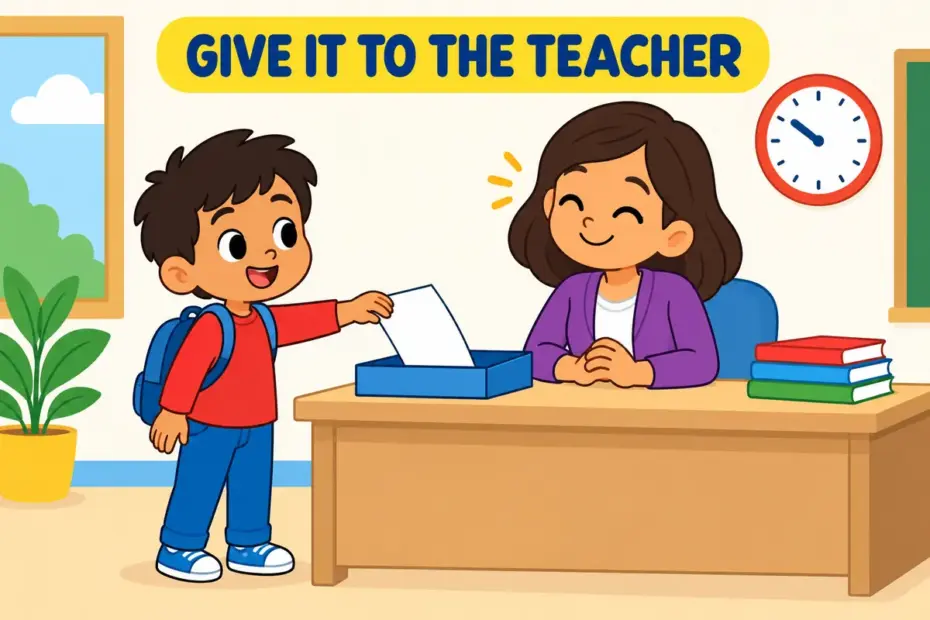
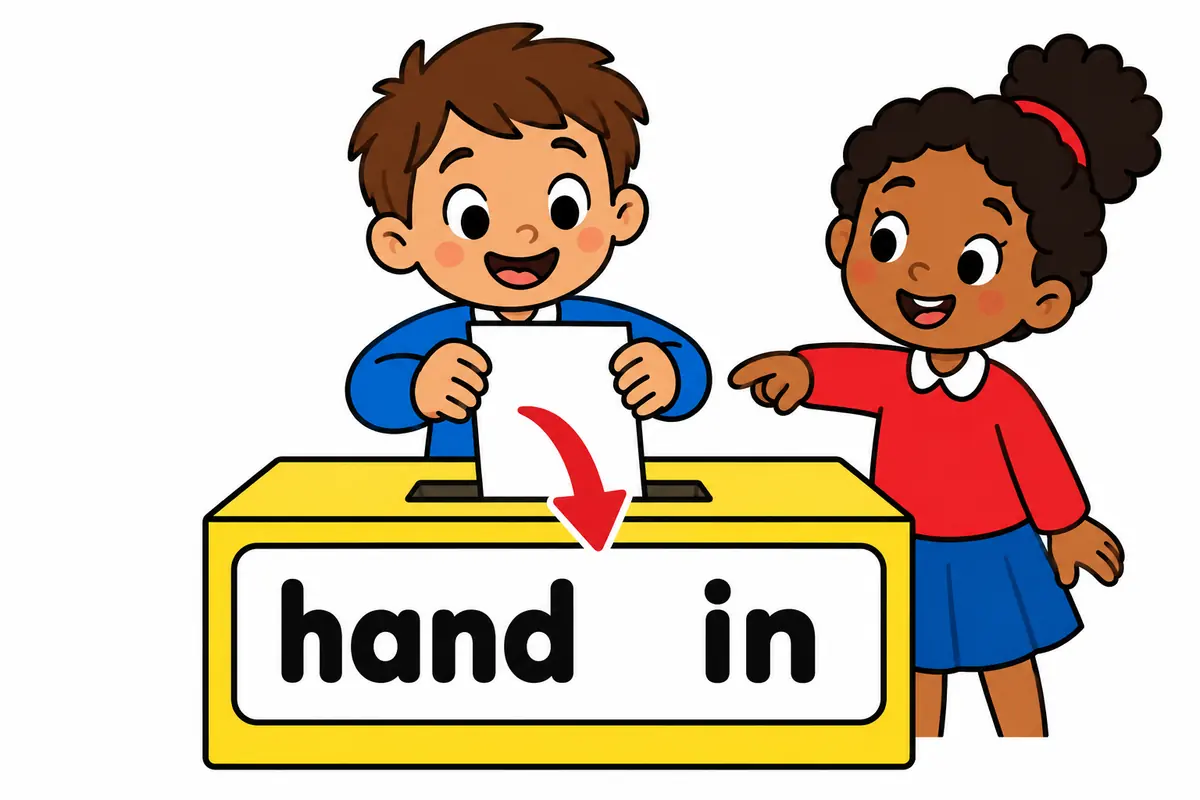
Hand in means to give something to a person in authority, usually an assignment, a form or a piece of equipment. To use hand in in a sentence, keep a pronoun inside the phrase: “Hand it in by Friday.” The phrasal verb is separable, so hand your essay in and hand in your essay are both correct.
Hand in at a glance
- Hand in is a separable, transitive phrasal verb made of the verb hand and the particle in.
- It means to submit something to an authority, or to surrender an item, right or role.
- The object may follow the particle or sit between the verb and the particle.
- A pronoun object must go between the two parts, so hand it in is correct and hand in it is not.
- The passive is handed in, and it is standard in instructions and rubrics.
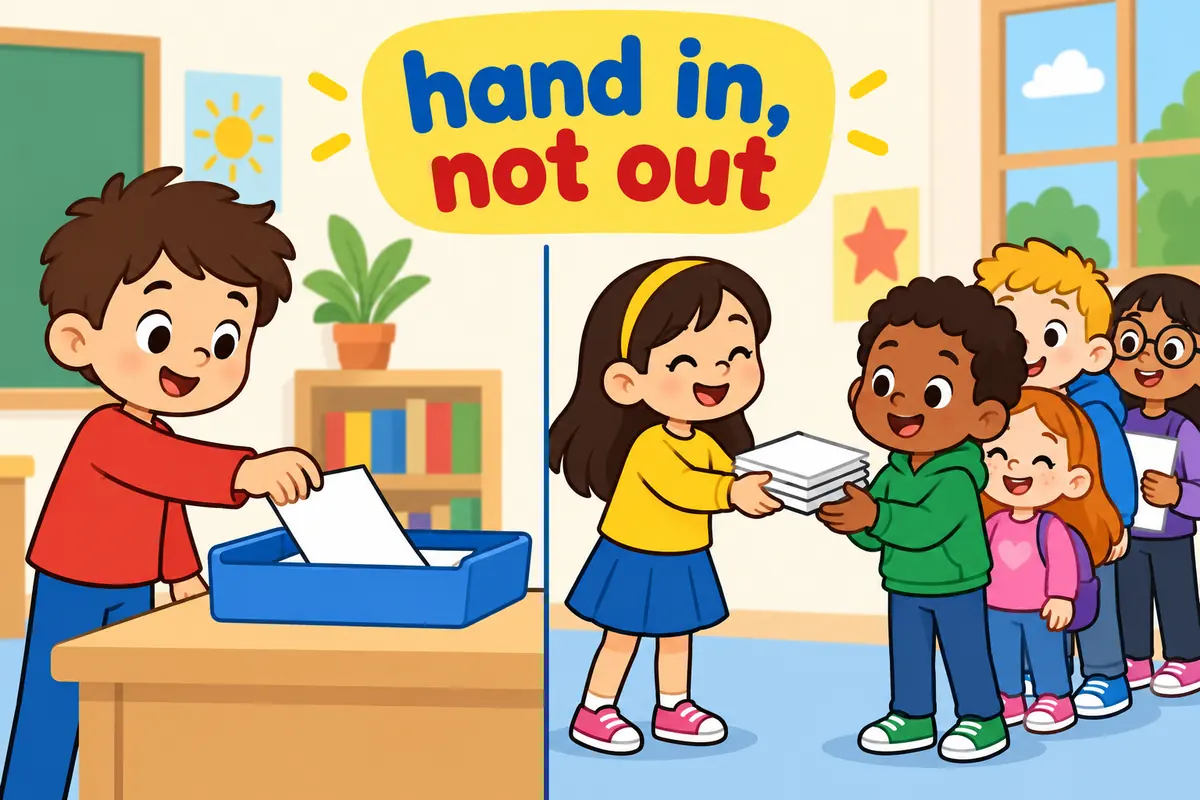
- Its nearest confusables are hand out, which distributes to many, and hand over, which passes control.
What does hand in mean?
Hand in is a phrasal verb meaning to give something to a person in authority, or to surrender an item, right or role. The Cambridge entry for hand in records the sense of giving something to someone in charge, as when a pupil hands in homework. The surrender sense is a natural extension: a badge or a resignation is handed in when it is given up.
| Sense | Plain meaning | Example sentence |
|---|---|---|
| Submit | Give work or a document to an authority | Please hand in your forms at reception. |
| Surrender | Give up an item, right or role | The officer handed in her badge. |
| Return | Give something back to its owner or office | He handed in the wallet he had found. |
Hand in is not the same as hand out or hand over. Hand in moves something upward to an authority, hand out gives things to many people, and hand over passes control or possession, often with reluctance. A teacher hands out worksheets and pupils hand them in, and the two verbs never swap. The return sense is common in libraries, where a reader returns a book by handing it in at the desk, while the opposite act is to keep the item. To surrender a badge or a pass is the formal version of handing it in, which is why the verb suits uniforms and resignations.
How do you use hand in in a sentence?
Hand in is transitive, so it always needs an object, and it is separable, so the object has two possible positions. Five patterns cover most sentences.
| Pattern | Example | What it signals |
|---|---|---|
| hand in + object | Hand in your essay before noon. | The standard order, with the object after the particle. |
| hand + object + in | Hand your essay in before noon. | The separated order, equally correct. |
| hand + pronoun + in | Hand it in before noon. | A pronoun must sit between verb and particle. |
| hand in + resignation | She handed in her resignation on Friday. | The surrender sense, a fixed collocation. |
| be handed in | Projects must be handed in online. | Passive, common in instructions. |
The particle may strand after the object, but never after a pronoun. So a writer can submit a report and hand it in, but not hand in it. Where the tone is formal, deliver the forms is a plain substitute.
Hand in in a sentence: examples across contexts
Hand in keeps the same grammar across registers, which is why it survives in classrooms, offices and news reports alike. The ten sentences below vary the object, not the verb.
| Context | Example sentence | Why this works |
|---|---|---|
| Classroom | Hand in your spelling books at the end of the lesson. | The object follows the particle in the usual school instruction. |
| University | Essays must be handed in through the online portal. | The passive suits a formal rubric. |
| Workplace email | Please hand your timesheet in by Thursday. | The separated order sounds brisk and natural. |
| Job application | Candidates handed in their forms a day early. | Names a completed act by a group. |
| Library | He handed the overdue book in at the desk. | The return sense, with the object in the middle. |
| Equipment return | Staff hand in their radios before going off duty. | The surrender sense in a routine instruction. |
| News report | The minister handed in her resignation after the vote. | A fixed collocation that signals leaving office. |
| Conversation | I still have to hand it in, and the deadline is tonight. | The pronoun sits inside the phrase, as speech demands. |
| Sports writing | The club handed in a transfer request before the window closed. | A formal document is submitted to a governing body. |
| Military writing | He handed in his commission at the end of the year. | The surrender sense applied to a rank. |
Every row keeps the same two-part verb, and only the news and military rows use the fixed surrender collocations. The pronoun row is the one that tests grammar, because the object cannot follow the particle there.
Hand in vs hand out and hand over
Hand in belongs to a family of hand-plus-particle verbs, and each particle reverses or redirects the movement. The table sets the three apart.
| Attribute | hand in | hand out | hand over |
|---|---|---|---|
| Core sense | Submit to an authority | Distribute to many | Pass control or possession |
| Direction | Upward, to a person in charge | Outward, to a group | Across, to a new holder |
| Typical object | Work, forms, a badge | Leaflets, worksheets, flyers | Keys, command, a title |
| Willingness | Neutral, often required | Neutral | Often reluctant or forced |
| Register | Neutral to formal | Neutral | Neutral to formal |
| Separability | Separable, hand it in | Separable, hand them out | Separable, hand it over |
Verdict: choose hand in to submit something to a person in charge, hand out to give copies to a group, and hand over when possession or control changes hands. A teacher hands out the sheets, a pupil hands one in, and a retiring captain hands over the armband.
Word forms and grammar of hand in
The verb hand changes its tense, but the particle in stays fixed. The related noun is hand-in, usually written with a hyphen when it appears before another noun.
| Form | Part of speech | Example |
|---|---|---|
| hand in | phrasal verb, base form | Students hand in their work at noon. |
| hands in | phrasal verb, third person | She hands in a report every Friday. |
| handed in | phrasal verb, past and participle | He handed in the keys. |
| handing in | phrasal verb, present participle | Handing in late costs marks. |
| hand-in | noun, attributive | The hand-in date is next Monday. |
Do not confuse this verb with the fixed phrase hand in hand, which means closely linked and has nothing to do with submitting. The two look identical in writing but carry different meanings, so the surrounding sentence must make the sense clear. The same particle also appears in call in, where a worker rings the office rather than handing something over, so particle families are worth learning together.
Common mistakes with hand in
- Incorrect:
Hand in it by Friday.Correct: Hand it in by Friday. Rule: A pronoun object goes between the verb and the particle. - Incorrect:
Please hand in the teacher your homework.Correct: Please hand your homework in to the teacher. Rule: Do not place a second noun object between hand and in. - Incorrect:
He handed in the flyers to everyone at the gate.Correct: He handed out the flyers to everyone at the gate. Rule: Giving to many people is hand out, not hand in. - Incorrect:
I will hand in myself at the office.Correct: I will report to the office. Rule: Hand in takes a thing as its object, not a reflexive person. - Incorrect:
She handed in the keys to the new owner.Correct: She handed over the keys to the new owner. Rule: Passing an item to a new holder is hand over, not hand in.
Practice using hand in
- Fill the gap: Please ______ your permission slips before the trip.
- Choose the better verb: The coach (handed in / handed out) bibs to the whole squad.
- Correct the error: Hand in them before you leave the lab.
- Build a sentence: use hand + pronoun + in about a library book.
- Spot the register: which belongs in a course handbook — assignments must be handed in online, or you have to hand your stuff in online?
- Rewrite with the noun: You must hand in the form by Monday. Use hand-in instead.
Answers
- hand in — the slips go to a teacher, so the object follows the particle.
- handed out — the bibs go to a whole group, which is the distribute sense.
- Hand them in before you leave — the pronoun must sit inside the phrase.
- Model answer: I have to hand it in at the library desk by closing time.
- Assignments must be handed in online — a handbook favours the passive.
- The hand-in date is Monday — the hyphenated noun works as an attributive modifier.
The bottom line
Use hand in in a sentence to give work, a form or a piece of equipment to a person in authority, and remember that the verb is separable but a pronoun must stay inside it. The two details that decide most sentences are these: the particle never moves past a pronoun, and the verb must not be swapped for hand out or hand over, which move things in different directions. To give something back to a desk, hand in is the natural choice.
Frequently asked questions about hand in
Is hand in a separable phrasal verb?
Yes. The object can sit after the particle, as in hand in your essay, or between the verb and the particle, as in hand your essay in. The only fixed rule concerns pronouns: they must go in the middle, so hand it in is right and hand in it is wrong.
What is the difference between hand in and hand over?
Hand in means to submit something to a person in authority, such as homework, a form or a badge. Hand over means to pass possession or control to someone else, often reluctantly, as in handing over the keys. Both are separable, but the direction of the transfer differs.
Can you say hand in it?
No. When the object is a pronoun, it must sit between the verb and the particle, so the correct order is hand it in. This is a general rule for separable phrasal verbs, and it applies to hand out and hand over as well, giving hand them out and hand it over.
Does hand in always mean homework?
No, though schoolwork is the most common use. The verb also covers handing in a form, a wallet found in the street, a uniform, a resignation or a commission. The shared idea is that an item or a right is given up to whoever is in charge of it.