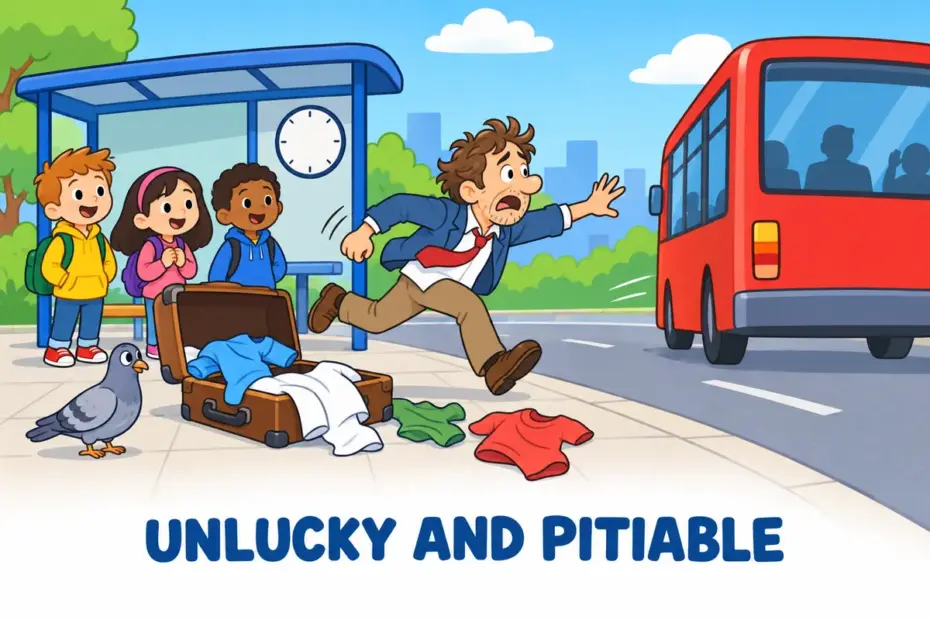
Hapless is an adjective describing a person or effort that is unlucky and slightly pitiable. To use hapless in a sentence, place it before the noun it describes: “The hapless traveller missed every train.” The word often hints at gentle incompetence as well as bad luck, which is why it can sound faintly comic.
Hapless at a glance
- Hapless is an adjective, with the adverb haplessly and the noun haplessness.
- It means unlucky and rather pitiable, often with a suggestion of ineptitude.
- It almost always sits before a noun, as in a hapless victim or a hapless clerk.
- Its commonest partners are victim, traveller, driver, hero and attempt.
- The usual learner error is using hapless after the verb be, where unlucky belongs.
What does hapless mean?
Hapless is an adjective meaning unlucky in a way that invites pity, and often mildly ridiculous. The Cambridge entry for hapless records the core sense of bad luck, and the −less ending marks the absence of luck, since hap once meant fortune. Three shades of the word appear in real writing, and each takes a different kind of noun.
| Shade | Plain meaning | Example sentence |
|---|---|---|
| Unlucky victim | Overtaken by repeated bad fortune | The hapless passengers waited three hours in the rain. |
| Ineffectual bungler | Well meaning but clumsy or inept | A hapless goalkeeper let in three easy goals. |
| Pitiable figure | Arousing sympathy rather than blame | Volunteers rescued a hapless kitten from the drain. |
One limitation is worth stating plainly. Hapless is not a formal word for any misfortune: a flat tyre is unlucky, not hapless, because nothing alive is being pitied. Reserve it for people, or for the plans and efforts they make, and reach for unfortunate when the tone should stay neutral.
How do you use hapless in a sentence?
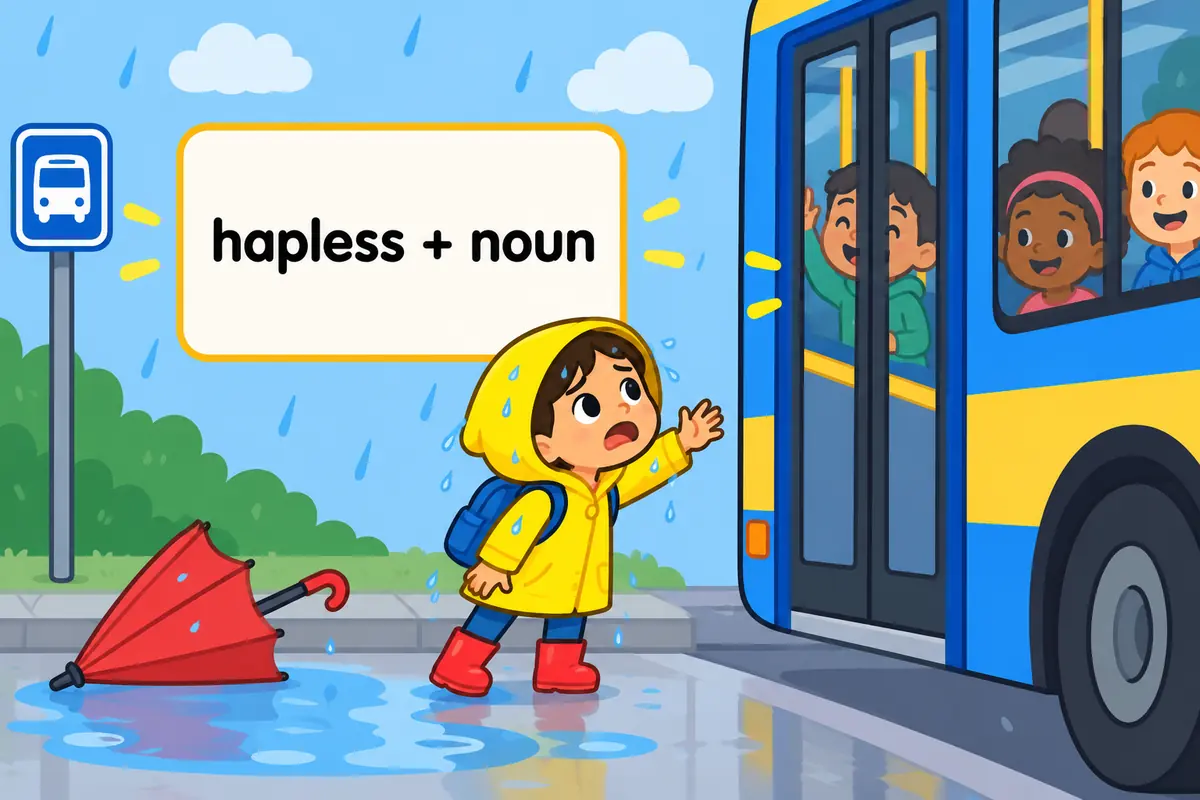
Put hapless in front of the noun it judges, because the adjective is overwhelmingly attributive: a hapless driver, a hapless plan. The pattern below shows the four positions that read naturally, plus the predicative slot that learners reach for too often.
| Pattern | Example | What it signals |
|---|---|---|
| hapless + person | The hapless cyclist lost his keys again. | The noun names who suffers the bad luck. |
| hapless + group | Hapless tourists queued at the wrong gate. | The plural noun makes the misfortune shared. |
| hapless + effort | His hapless attempt at baking filled the kitchen with smoke. | The noun names an inept try, not a person. |
| hapless + animal | A hapless pigeon flew into the window. | The animal draws sympathy without blame. |
| be unlucky | The team was unlucky to lose. | The predicative slot prefers unlucky, not hapless. |
Hapless in a sentence: examples across contexts
Hapless shifts tone as much as meaning. The nine sentences below move from a classroom to a sports report, and each one shows whether the word is pitying somebody or gently mocking them.
| Context | Example sentence | Why this works |
|---|---|---|
| Classroom | The hapless pupil dropped his lunch tray twice. | A small mishap keeps the tone affectionate. |
| News report | Rescuers reached the hapless hikers after two cold nights. | Names the victims and the hardship, as reporting does. |
| Sports writing | The hapless defender turned the ball into his own net. | The error, not bad luck alone, earns the label. |
| Conversation | I felt like the hapless hero of a comedy. | The comparison signals the word’s mock-heroic edge. |
| Travel writing | A hapless family missed the ferry by one minute. | A single missed deadline makes an ironic story. |
| Animal rescue | They freed a hapless fox trapped under a fence. | Sympathy, not blame, drives the choice here. |
| Workplace email | We felt like the hapless department nobody warned. | The word softens a complaint about poor planning. |
| Academic prose | The hapless theory failed every test it met. | The noun is an idea, so the tone turns wry. |
| Story opening | The hapless knight lost his horse and his map. | Pairs two losses to set up a comic adventure. |
Only the classroom and rescue sentences stay entirely kind. The sporting and dictionary-style uses add the second shade, the quiet suggestion that the sufferer was also a little inept.
Hapless vs unlucky
Hapless and unlucky both report bad fortune, but they differ in duration, position and tone. Unlucky is neutral and fits any event; hapless is warmer, slightly literary, and nearly always attached to a living noun.
| Attribute | hapless | unlucky |
|---|---|---|
| Core meaning | Consistently unfortunate and pitiable | Hit by one piece of bad luck |
| Typical position | Before a noun | Before a noun or after be |
| Tone | Slightly literary, often mocking | Neutral and everyday |
| Implies ineptitude | Often, gently | Never |
| Common pair | hapless victim | unlucky break |
Verdict: choose hapless when you pity or gently tease a person, and unlucky when you simply state that fortune went against somebody. A reader who wants the darker version of the same idea may reach for doomed, though that forecloses any hope.
Word forms and grammar of hapless
Hapless behaves like an ordinary adjective for comparisons, but it rarely appears after the verb be. The table lists its forms and the near-relative nouns writers sometimes attach to it by mistake.
| Form | Part of speech | Example |
|---|---|---|
| hapless | adjective, base form | The hapless driver took the wrong exit. |
| more hapless | adjective, comparative | By noon he looked even more hapless. |
| most hapless | adjective, superlative | She was the most hapless contestant of the day. |
| haplessly | adverb | He haplessly reversed into the flowerpot. |
| haplessness | noun | The haplessness of the plan was obvious. |
| hap | noun, rare | The −less ending turns this old word for luck into hapless. |
The related adjective pitiable shares the sympathy but not the bad luck, so the two are close without being interchangeable. An ill-fated venture also looks ahead to failure, while hapless usually looks back at it.
Common mistakes with hapless
- Incorrect:
He was hapless after the crash.Correct: He was unlucky after the crash. Rule: hapless stands before a noun, so use unlucky in the slot after be. - Incorrect:
The hapless team won comfortably.Correct: The hapless team lost again. Rule: hapless means unlucky or ineffectual, so it clashes with easy success. - Incorrect:
He tightened the hapless on the horse.Correct: He tightened the harness on the horse. Rule: hapless is an adjective about misfortune; harness is the noun for the straps. - Incorrect:
The hapless weather ruined the fair.Correct: The unlucky weather ruined the fair. Rule: hapless describes people and their efforts, not impersonal events. - Incorrect:
She gave a hapless smile.Correct: She gave a rueful smile. Rule: the word judges fortune or competence, not the warmth of a smile.
Practice using hapless
Work through the six items, then check the reasoning rather than only the answer.
- Fill the gap: The ______ tourist boarded the wrong ferry twice.
- Choose the better word: The team was (hapless / unlucky) to concede in the last minute.
- Correct the error: Our neighbour was hapless when his car was towed.
- Build a sentence: use hapless attempt about a burnt cake.
- Spot the register: which suits a news report — the hapless villagers lost their homes, or the villagers were really hapless?
- Rewrite with the adverb: The clerk dropped the files twice. Use haplessly instead.
Answers
- hapless — the adjective sits directly before the noun it judges.
- unlucky — the predicative slot after be prefers unlucky, not hapless.
- Our neighbour was unlucky when his car was towed — hapless cannot follow be.
- Model answer: Her hapless attempt at baking filled the kitchen with smoke.
- The hapless villagers lost their homes — a report keeps the adjective before the noun and avoids really.
- The clerk haplessly dropped the files twice — the adverb keeps the sense of mishap.
The bottom line
Use hapless in a sentence to describe somebody who is unlucky and a little pitiable, and keep it in front of the noun. The two points that decide most sentences are position and tone: hapless rarely follows the verb be, and it always carries a flicker of gentle mockery. Where the tone should stay plain, unlucky is the safer choice.
Frequently asked questions about hapless
Is hapless the same as hopeless?
No. Hopeless means without hope or beyond help, a much gloomier judgement. Hapless means unlucky and slightly pitiable, and it often carries a mild comic edge. A hapless cook makes a mess but may try again, while a hopeless cook is given up on entirely.
Can hapless describe an event rather than a person?
Rarely. Hapless belongs to people and to the efforts or plans they make, so a hapless attempt and a hapless driver both work. Weather, traffic and machinery are unlucky or disastrous instead. Using hapless for an impersonal event sounds odd to native readers.
What part of speech is hapless?
Hapless is an adjective. Its adverb is haplessly, as in he haplessly dropped the tray, and its noun is haplessness. The related old noun hap meant luck, and the −less ending turns that into the absence of luck, which is the heart of the meaning.
Where does hapless go in a sentence?
Hapless almost always goes directly before the noun it describes, as in the hapless traveller. It rarely follows the verb be, where unlucky is the natural word. Put hapless in the wrong slot and the sentence will read as slightly foreign even when the meaning is clear.
Have you ever heard of the word “hapless”? In essence, “hapless” describes someone or something that is unlucky or unfortunate. It’s often used to depict individuals who seem to attract misfortune or face constant bad luck in various aspects of their lives.
This adjective, “hapless,” can be employed in storytelling, descriptions, or conversations to paint a vivid picture of a character or situation marred by repeated instances of bad luck. If you’re looking to add depth and nuance to your language or writing, incorporating the word “hapless” can provide a succinct and impactful way to convey the idea of continuous misfortune.
7 Examples Of Hapless Used In a Sentence For Kids
- The hapless puppy lost its favorite toy.
- The hapless bird fell from its nest.
- The hapless kitten got stuck in a tree.
- The hapless frog couldn’t find its way back to the pond.
- The hapless squirrel couldn’t reach the delicious acorns.
- The hapless bunny hopped in the wrong direction.
- The hapless monkey dropped its banana.
14 Sentences with Hapless Examples
- The hapless student forgot to save his project and lost all his hard work.
- Caught in heavy traffic, the hapless student was late for his exam.
- The hapless student’s laptop crashed right before submitting an important assignment.
- Struggling to find a reliable internet connection, the hapless student missed an online lecture.
- The hapless student accidentally spilled coffee on their notes right before an exam.
- The hapless student lost their wallet with all their money and important cards.
- The hapless student’s phone battery died during an online class due to a power outage.
- The hapless student’s roommate accidentally deleted their important study materials.
- The hapless student missed a deadline for a project due to a family emergency.
- The hapless student’s printer ran out of ink right before printing their research paper.
- The hapless student’s presentation crashed during a virtual group project meeting.
- Struggling to meet assignment requirements, the hapless student received a low grade.
- The hapless student forgot to set an alarm and missed an early morning exam.
- In a rush, the hapless student left their bag with all their textbooks on the bus.
How To Use Hapless in Sentences?
To use the word Hapless in a sentence, it is important to understand its meaning first. The term Hapless is an adjective that describes someone who is unlucky or unfortunate in their circumstances.
When incorporating Hapless into a sentence, here are a few tips for beginners to keep in mind:
-
Placement: The word Hapless is usually used before a noun that it describes. For example, “The hapless kitten got stuck in the tree.”
-
Context: Make sure the context of the sentence clearly conveys the sense of misfortune or bad luck associated with the word Hapless. For instance, “The hapless traveler lost all their luggage during the trip.”
-
Tone: Consider the tone of the sentence when using Hapless. It is a formal word that is more commonly used in written language than in casual conversation.
-
Variety: Explore different ways to incorporate Hapless in a sentence to practice using it effectively. For example, “The hapless student forgot about the exam and ended up failing.”
By following these simple guidelines, beginners can confidently include the word Hapless in their writing to accurately convey the sense of misfortune or bad luck.
Conclusion
In summary, the examples of sentences with “hapless” illustrate individuals or situations marked by bad luck, misfortune, or incompetence. These sentences showcase how the word “hapless” is used to describe someone who seems to be constantly unlucky or unfortunate in a variety of contexts. From hapless characters in literature to hapless victims in real-life scenarios, the word conveys a sense of sympathy or pity for those afflicted by unfavorable circumstances.
Through these examples, it becomes clear that the word “hapless” is a powerful descriptor that highlights the struggles and challenges faced by individuals who are seemingly destined for bad luck. By understanding the nuances of this word and its implications, we can better appreciate the complexities of human experiences and the role that fate or circumstance can play in shaping our lives.


