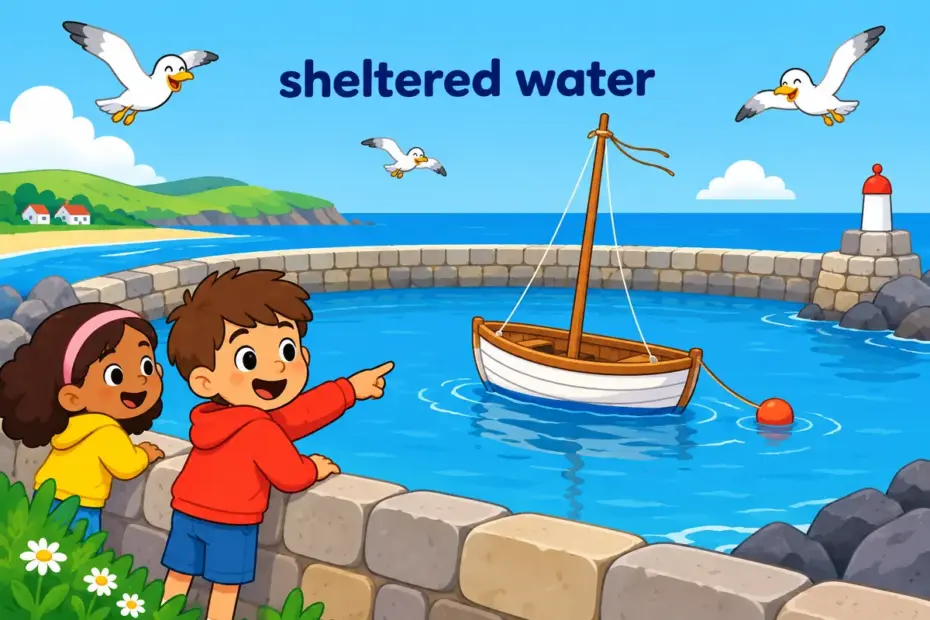
Harbor is both a noun and a verb: the noun is a sheltered stretch of water where boats moor, and the verb means to shelter someone or to hold a feeling such as a grudge or a hope. To use harbor in a sentence, decide which sense you need, because the two behave quite differently.
Harbor at a glance
- Harbor is a noun for a sheltered place for boats and a verb meaning to shelter or to hold.
- Its verb forms are harbors, harbored and harboring; the British spelling is harbour.
- As a verb it is transitive, taking a person, an animal or a feeling as its object.
- The feeling sense usually appears with grudge, doubt, hope, ambition or resentment.
- The commonest error is treating the verb as intransitive, as in the boat harbored, which it is not.
What does harbor mean?
Harbor is a noun meaning a sheltered place where ships can moor, and a verb meaning to give shelter or to keep a thought or feeling in the mind. The Cambridge entry for harbor lists both the physical and the figurative senses, and the figurative one is now the more common in everyday writing.
| Sense | Plain meaning | Example sentence |
|---|---|---|
| Noun: a place for boats | Sheltered water where ships can moor safely | Fishing boats filled the small harbor by dawn. |
| Verb: to shelter | Give safety or hiding to a person or animal | The barn harbored a family through the storm. |
| Verb: to hold a feeling | Keep a thought, hope or resentment in the mind | She harbors a quiet hope of returning one day. |
One limitation matters. The feeling sense does not mean to create an emotion; it means to keep one you already have, and the emotion is usually negative, as in a grudge or a doubt. Where you simply have a feeling, the plain verb have is often enough. The verb also never means to sail into port; that is a refuge for ships and cargo, not a movement.
How do you use harbor in a sentence?
As a verb, harbor keeps an object in every pattern, whether the object is a person or a feeling. The table separates the shelter sense from the emotion sense.
| Pattern | Example | What it signals |
|---|---|---|
| harbor + a feeling | He harbored a deep resentment for years. | The figurative sense, commonest in formal prose. |
| harbor + someone | The farm harbored two travelers for the winter. | The literal shelter sense, often in historical writing. |
| harbor + no + doubt or illusions | She harbors no doubts about the plan. | A fixed negative frame for realism. |
| a + adjective + harbor | A deep-water harbor handles the largest ships. | The noun use, with an adjective describing the water. |
Harbor in a sentence: examples across contexts
The bold rows use harbor as a noun and the rest as a verb, which is the split that catches learners. A related place word such as a busy port can replace the noun in only some of them.
| Context | Example sentence | Why this works |
|---|---|---|
| Geography lesson | The natural harbor gave the town a fine shelter from storms. | The noun sense with a concrete place. |
| Travel writing | Boats bobbed in the harbor as the market opened. | The noun works well in descriptive prose. |
| Workplace email | We harbor real doubts about the delivery date. | The feeling sense suits a careful written tone. |
| News report | Investigators say the warehouse harbored the stolen goods. | The shelter sense applies to things as well as people. |
| History essay | The monastery harbored refugees during the long siege. | Adds moral weight to the shelter sense. |
| Sports writing | The coach harbors no ill feeling after the defeat. | The fixed negative frame sounds graceful. |
| Academic prose | The theory harbors an assumption that few noticed. | Extends the holding sense to ideas. |
| Conversation | I harbor a small hope that the shop will reopen. | Shows the figurative sense in speech. |
| Review | The film harbors a gentle nostalgia for small towns. | Treats an atmosphere as something held. |
Notice that the noun rows always name water or a place, while the verb rows name something held, from hope to stolen goods.
Harbor vs port
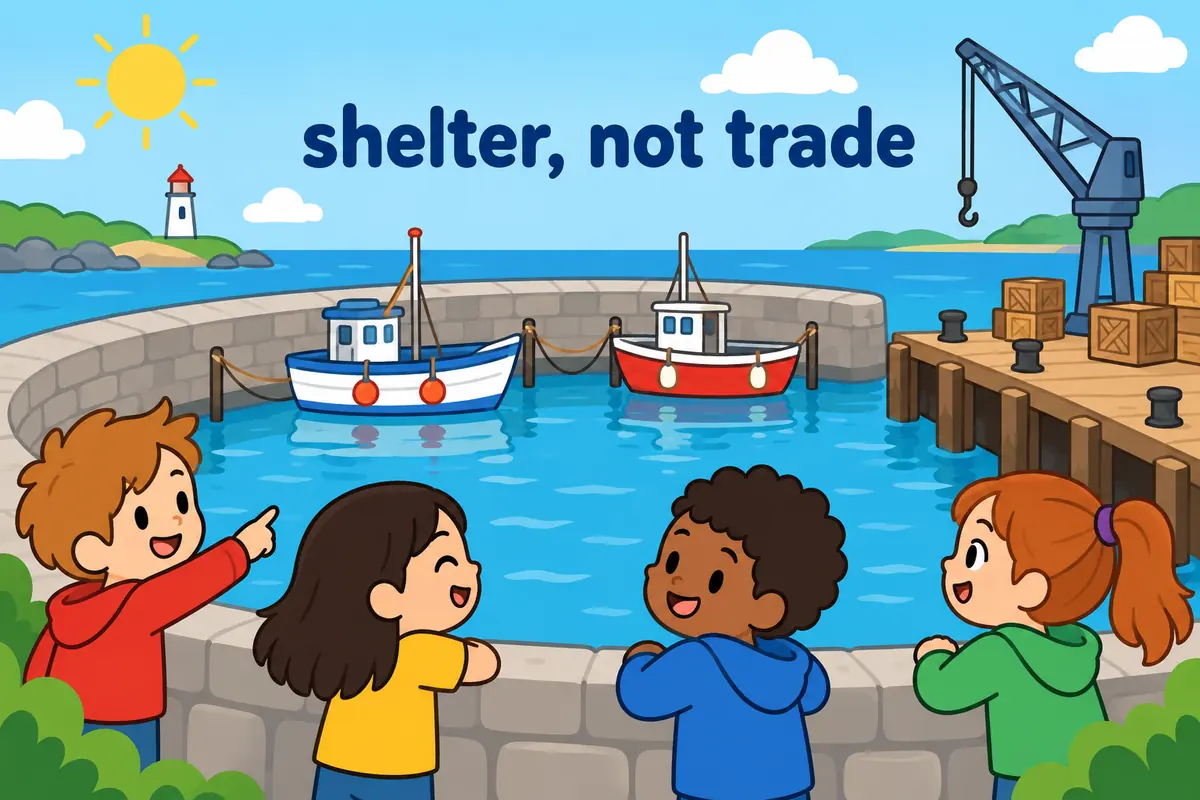
Harbor and port both concern ships, so they are easily swapped. A harbor is the sheltered water itself; a port is the town or facility where cargo and passengers are loaded. The choice between them, and the older synonym a quiet haven, turns on whether you mean shelter, trade or safety.
| Attribute | harbor | port |
|---|---|---|
| Core meaning | Sheltered water for mooring | A place for loading and trade |
| What it names | A natural or artificial basin | A town or a facility |
| Associated idea | Safety from weather | Commerce and transport |
| Figured use | Refuge, including a held feeling | Rare outside shipping |
| Typical collocates | deep-water, natural, sheltered | cargo, ferry, container |
Verdict: choose harbor for shelter and the water itself, and port when ships are trading rather than sheltering.
Word forms and grammar of harbor
The word keeps one form as a noun and a regular set of verb forms. The only systematic difference is spelling, which follows the American and British divide.
| Form | Part of speech | Example |
|---|---|---|
| harbor | noun | The harbor was calm at first light. |
| harbor | verb, base form | They harbor no anger about the delay. |
| harbors | verb, third person singular | She harbors a lasting ambition. |
| harbored | verb, past and past participle | The village harbored them for a week. |
| harboring | verb, present participle | He is harboring doubts about the offer. |
| harbour | British spelling | The British spelling harbour appears in UK writing. |
American writing uses harbor in every sense, so the spelling distinction is regional rather than meaning-based.
Common mistakes with harbor
- Incorrect:
The boat harbored in the bay overnight.Correct: The boat moored in the bay overnight. Rule: The verb harbor is transitive and needs an object, so it cannot describe where a boat goes. - Incorrect:
She is harboring to leave the city.Correct: She is harboring a wish to leave the city. Rule: Harbor takes a noun phrase, never an infinitive. - Incorrect:
I harbor a cold this week.Correct: I have a cold this week. Rule: Harbor is for feelings, people and things, not illnesses. - Incorrect:
He harbored in his mind that he was right.Correct: He harbored a belief that he was right. Rule: A clause needs a noun such as belief to carry it. - Incorrect:
We are harboring to finish the report.Correct: We harbor doubts about finishing the report. Rule: Harbor is not a modal-like verb and never precedes an infinitive.
Practice using harbor
- Fill the gap: The fishing village ______ a hundred boats each summer.
- Choose the better word: Ships load cargo at the (harbor / port).
- Correct the error: The shed harbored three bicycles from the rain. Is it grammatical?
- Build a sentence: use harbor + a feeling about a lost match.
- Spot the register: which suits a history essay — the abbey harbored refugees, or the abbey let them crash?
- Rewrite with the noun: The bay shelters boats from every storm.
Answers
- harbors — the village is the subject and the boats are the object of the verb.
- port — loading cargo points to trade, which is the port sense.
- Yes — harbor can shelter things as well as people, so the sentence is grammatical.
- Model answer: The players harbored a quiet disappointment after the final whistle.
- The abbey harbored refugees — the formal verb suits academic writing.
- The bay is a harbor that shelters boats from every storm — the noun names the sheltered water.
The bottom line
Use harbor in a sentence as a noun for sheltered water or as a transitive verb for sheltering someone and holding a feeling. Two nuances decide most sentences: the verb always needs an object, so a boat cannot simply harbor, and the feeling sense keeps an emotion you already have rather than creating one. Where the feeling is warmly positive, cherish a memory may carry the tone better than harbor.
Frequently asked questions about harbor
Is harbor a noun or a verb?
Harbor is both. The noun names a sheltered place where boats moor, as in a natural harbor. The verb means to shelter someone, as in they harbored the travelers, or to hold a feeling, as in she harbors a hope. The part of speech is clear from the object that follows.
What is the difference between harbor and port?
A harbor is the sheltered water itself, valued for safety from weather. A port is a place built for loading and unloading, valued for trade. A busy port may sit inside a harbor, but the harbor is the water and the port is the facility, so the two words answer different questions.
Why do Americans write harbor and Britons harbour?
The split follows a wider American and British pattern in which some words lose a u after o. American writing uses harbor, and British writing uses harbour, with no difference in meaning or grammar. Choose the spelling that matches your audience and keep it consistent throughout the document.
Can you harbor a positive feeling?
Yes, though the verb leans negative. People usually harbor a grudge, a doubt or a resentment, but harbor a hope or an ambition is perfectly standard. The verb simply means to keep a feeling in mind over time. For a warmer tone, a verb such as cherish or nurture may fit better.
Have you ever tried using the word “harbor” in a sentence and found yourself unsure of its correct usage? The term “harbor” can have both literal and figurative meanings, making it a versatile word in the English language.
In its literal sense, “harbor” refers to a place on the coast where ships dock for shelter or to load and unload cargo. Figuratively, “harbor” can be used to describe holding onto or nurturing certain feelings or thoughts.
7 Examples Of Harbor Used In a Sentence For Kids
- Ships can stay safe in the harbor during a storm.
- I like to watch the boats in the harbor.
- The harbor is a good place to play with toy boats.
- Many fishermen keep their boats in the harbor.
- We can see seagulls near the harbor.
- The harbor is a busy place with boats coming and going.
- Some towns have a big harbor where many ships can dock.
14 Sentences with Harbor Examples
- Many college students in India dream of visiting the harbor during their summer break.
- The harbor is a great spot for college students to relax and unwind after a busy semester.
- Some college students organize picnics at the harbor to enjoy the scenic views and fresh air.
- College students often visit the harbor to take a break from their studies and clear their minds.
- The harbor is a popular destination among college students for photography projects and assignments.
- College students studying marine biology often conduct research at the harbor to observe various species of marine life.
- The harbor is a peaceful place where college students can go for a quiet retreat away from the chaos of city life.
- Many college students in India enjoy taking boat rides from the harbor to explore the nearby islands.
- College students often gather at the harbor for social gatherings and to catch up with friends.
- Some college students participate in volunteering activities at the harbor to support marine conservation efforts.
- College students can find part-time jobs at the harbor working in restaurants, shops, or assisting with boat rentals.
- The harbor is a popular location for college students to practice water sports such as kayaking and paddleboarding.
- College students studying architecture often visit the harbor to study the design and structure of the docks and buildings.
- Some college students organize beach clean-up events at the harbor to contribute to environmental conservation efforts.
How To Use Harbor in Sentences?
To use Harbor in a sentence, follow these steps:
-
Identify the context where you want to use the word Harbor. Make sure you understand the meaning of the word as it can have different interpretations based on the situation.
-
Determine the correct form of the word Harbor that fits your sentence. It can be used as a noun, referring to a place where ships dock, or as a verb, meaning to give shelter or hide a feeling.
-
Construct your sentence with Harbor in the appropriate position based on its part of speech. For example:
- Noun: “The small fishing village had a cozy harbor where boats were anchored.”
- Verb: “She harbored a secret admiration for her colleague.”
-
Check the sentence to ensure that the use of Harbor is grammatically correct and makes sense in the context you intend. Consider any nuances or connotations that may be associated with the word.
-
Practice using Harbor in various sentences to become more familiar with its usage and expand your vocabulary. You can try incorporating it into conversations or writing exercises.
Remember, the best way to use a new word like Harbor is through consistent practice and exposure to different contexts. Enjoy exploring the versatility and richness of language through the use of words like Harbor!
Conclusion
In conclusion, a harbor is a safe haven for ships and boats, providing protection from rough seas and inclement weather. It serves as a point of departure and arrival, facilitating trade and transportation of goods and people. Harbor cities, like New York City and Sydney, boast bustling waterfronts with a myriad of activities and attractions for locals and tourists alike. A harbor plays a crucial role in the economic development of a region, as it enables imports and exports, fostering growth and prosperity. By offering refuge to vessels, harbors ensure the smooth operation of maritime activities, contributing to the interconnectedness of global trade and commerce.
Overall, harbors are vital maritime infrastructures that support the flow of goods and passengers, connecting nations and fostering economic relationships. They not only serve as a physical location for ships to dock but also symbolize a gateway to new experiences and opportunities. The importance of harbors in facilitating trade and enhancing connectivity cannot be overstated, making them integral components of a thriving economy and vibrant coastal community.


