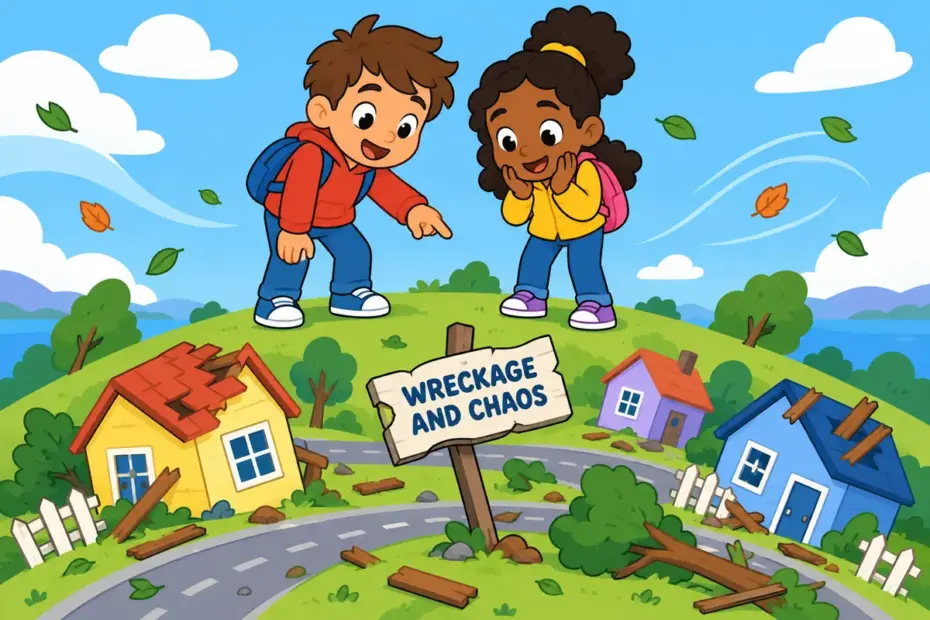
Havoc is a noun meaning widespread destruction or chaotic disorder. To use havoc in a sentence, pick a verb that shows damage being done, then name whatever suffers. In practice the word follows wreak, play or cause far more often than any other verb, and it seldom serves as the subject.
Havoc at a glance
- Havoc is an uncountable noun, so it has no plural and havoces is not a word.
- The dominant pattern is wreak havoc on plus a place, plan or system.
- The verbs that collocate with it are wreak, play, cause and create.
- Havoc appears in weather, news and sports reporting more than in casual talk.
- The commonest error is misspelling the past tense as wrought havoc or wrecked havoc.
What does havoc mean?
Havoc is an uncountable noun meaning violent destruction or a state of wild confusion. The Cambridge entry for havoc records both the physical sense and the abstract one, and the difference shows in the verb you choose. Physical havoc is what a storm or a fire leaves behind; abstract havoc is what a mistake does to a plan or a timetable.
| Sense | Plain meaning | Example sentence |
|---|---|---|
| Violent destruction | Heavy damage across a wide area | The hurricane wreaked havoc on the coastal road. |
| Chaos and disorder | A system or plan thrown into confusion | The missing file played havoc with the audit. |
One limitation is worth stating plainly. Havoc never means total loss or death; for those ideas English uses carnage or devastation, which are heavier and far less common in ordinary writing.
How do you use havoc in a sentence?
Put the damaging force first, the verb wreak or play second, and the thing that suffers after on or with: a storm wreaks havoc on a town. Four patterns cover almost every real sentence.
| Pattern | Example | What it signals |
|---|---|---|
| wreak havoc on + place | Floodwater wreaked havoc on the lower streets. | Heavy physical damage to a location. |
| play havoc with + plan | The delay played havoc with our schedule. | Damage to something abstract, such as a plan. |
| cause havoc | One loose wire can cause havoc in a server room. | Neutral tone, common in explanation. |
| havoc + among / through | Rumours spread havoc through the office. | Disorder moving outward across people. |
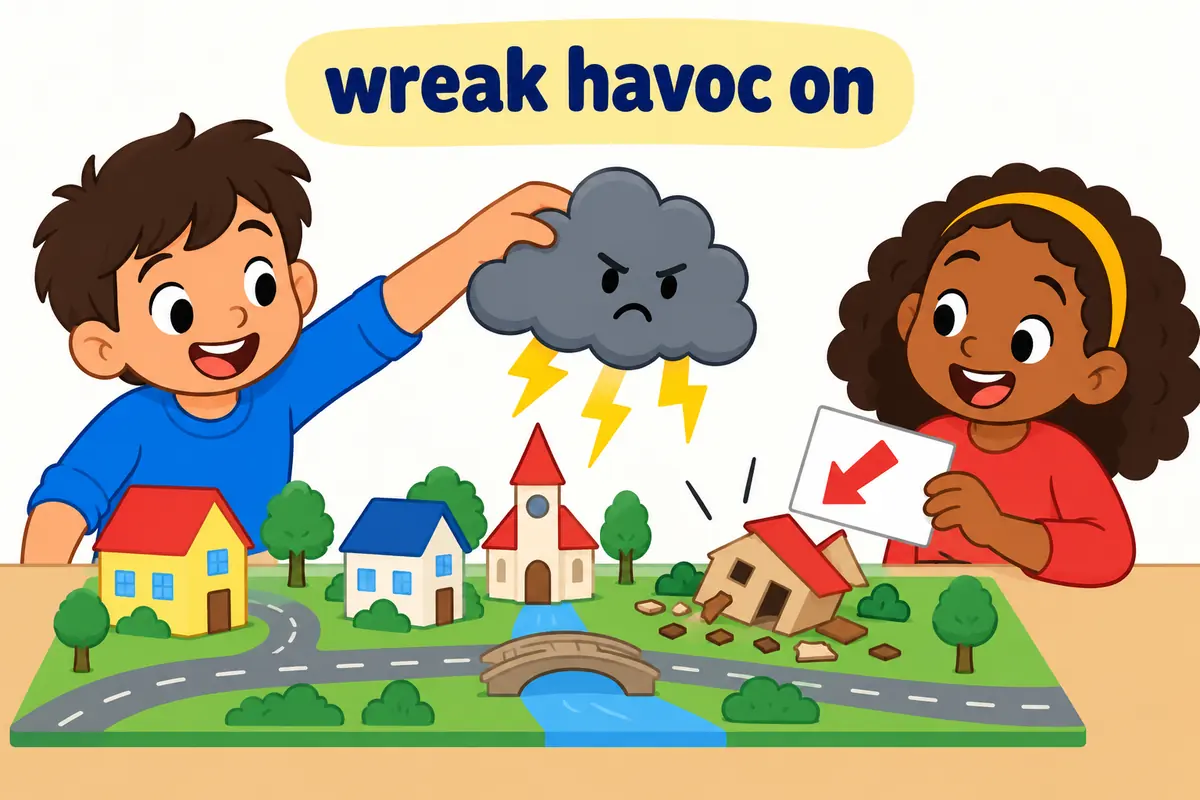
The practitioner rule is simple: if the sentence is about a storm, a fire or an army, use wreak; if it is about a schedule, a plan or a budget, use play. Reserved verbs separate the physical damage from the purely organisational kind.
Havoc in a sentence: examples across contexts
Havoc keeps the same meaning as it moves between registers. The nine sentences below stretch from a school noticeboard to a weather bulletin, and each one names the force doing the damage.
| Context | Example sentence | Why this works |
|---|---|---|
| Classroom | A burst pipe wreaked havoc on the art cupboard. | A concrete object shows the damage a reader can picture. |
| Workplace email | The outage played havoc with the Friday release. | The abstract sufferer justifies play rather than wreak. |
| News report | Flooding wreaked havoc on three coastal towns overnight. | Names the force and the places, as reporting requires. |
| Weather bulletin | Gale-force winds will cause havoc along the northern coast. | The future with cause suits a forecast. |
| Sports writing | The winger’s pace wreaked havoc on the home defence. | Transfers the word to a figurative battle. |
| Technical writing | A single malformed packet can wreak havoc on the scheduler. | A precise cause explains a system failure. |
| Academic prose | Drought played havoc with the harvest figures for a decade. | Abstract damage suits formal analysis. |
| Public announcement | Roadworks will cause havoc near the station next week. | The modal will warns the public in advance. |
| Conversation | The twins made havoc all over the kitchen. | The looser made havoc is informal but understood. |
Havoc vs mayhem
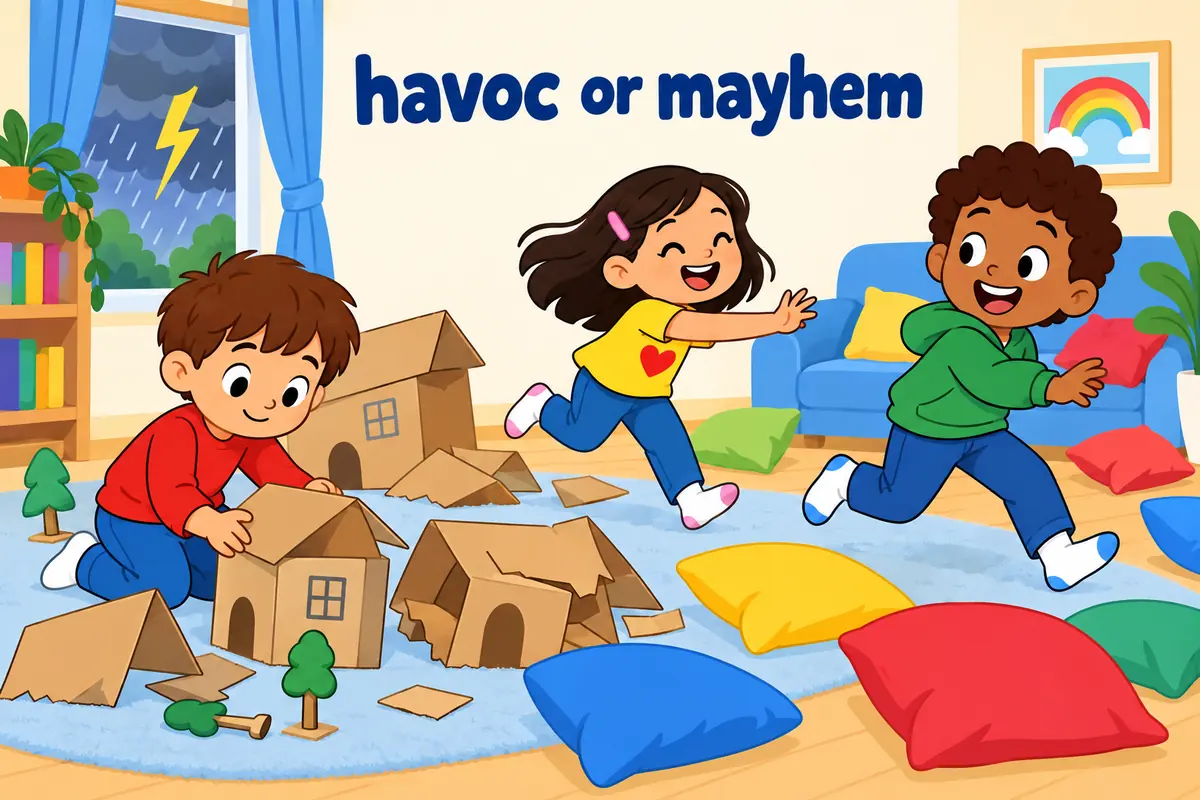
Havoc and mayhem both describe disorder, and writers often treat them as twins. They are not interchangeable, because mayhem usually implies violence or deliberate rowdiness while havoc stresses the damage left behind.
| Attribute | havoc | mayhem |
|---|---|---|
| Core image | Wreckage and ruined systems | Violent, excited confusion |
| Typical cause | A storm, flood, fault or mistake | A crowd, a fight or deliberate mischief |
| Usual partner verb | wreak, play, cause | cause, create, descend into |
| Register | Neutral, common in reports | Informal to journalistic, often lurid |
| Implies intent | No, the force is usually impersonal | Often yes, people make mayhem |
Verdict: choose havoc when you are describing damage to a place or a plan, and mayhem when the scene is a violent, noisy scramble caused by people. Havoc is the broader and calmer word of the two.
Word forms and grammar of havoc
Havoc looks small in a dictionary because it stays in one form. The table pairs the noun with the verb it needs, and marks the forms learners invent by mistake.
| Form | Part of speech | Example |
|---|---|---|
| havoc | noun, uncountable | The flood caused havoc in the valley. |
| wreak | verb, base form | Storms wreak havoc on exposed bridges. |
| wreaked | verb, past and past participle | Last winter’s ice wreaked havoc here. |
| wreaking | verb, present participle | The beetles are wreaking havoc on the crop. |
| havocs | non-standard plural | Never write the storm brought havocs; havoc stays singular. |
| to havoc | non-standard verb | Do not write it havoced the town; use wreaked havoc on. |
Because havoc has no plural, a sentence that needs one should switch to a countable noun such as destruction or disaster, both of which take a plural and a number.
Common mistakes with havoc
- Incorrect:
The storm wrought havoc on the coast.Correct: The storm wreaked havoc on the coast. Rule: The fixed verb is wreak; wrought belongs with wrought iron and overwrought. - Incorrect:
The storm wreaked havoc.Correct: The storm wreaked havoc on the village. Rule: The on or with phrase names what suffers, and its absence leaves the sentence unfinished. - Incorrect:
Several havocs hit the region.Correct: Havoc struck the region several times. Rule: Havoc is uncountable, so it has no plural form. - Incorrect:
The manager havoced the schedule.Correct: The manager’s changes played havoc with the schedule. Rule: Havoc is a noun; the damage is done by wreak or play, never by havoc as a verb.
Practice using havoc
Work through the six items, then read the reasons with the answers.
- Fill the gap: The early frost ______ havoc on the orchard.
- Choose the better word: The power cut played (havoc / mayhem) with the booking system.
- Correct the error: The flood wrought havoc on the shop.
- Build a sentence: use wreak havoc on about a lost set of keys and a morning routine.
- Spot the register: which belongs in a weather warning — the gale will cause havoc on the coast, or the gale totally made havoc?
- Rewrite with on: The burglary caused havoc. Name the shop it damaged.
Answers
- wreaked — the fixed past form is wreaked, not wrought.
- havoc — the sufferer is a booking system, so play havoc with is the natural collocation.
- The flood wreaked havoc on the shop — wrought cannot replace wreaked.
- Model answer: Losing the keys wreaked havoc on an otherwise calm morning.
- The gale will cause havoc on the coast — a warning uses cause and avoids totally.
- The burglary wreaked havoc on the corner shop — the on phrase names the sufferer.
The bottom line
Use havoc in a sentence when you need a single noun for heavy damage or a system in chaos, and let wreak or play carry the action. Two nuances decide most sentences: the word is uncountable, so it never takes a plural, and it needs an on or with phrase to name what suffers. Where the damage is to people rather than things, a word such as turmoil is often kinder and more accurate.
Frequently asked questions about havoc
Is havoc a verb or a noun?
Havoc is a noun, and it stays a noun in standard English. The action comes from a partner verb, most often wreak or play, as in the storm wreaked havoc on the harbour. Sentences such as it havoced the town are not accepted, and writers should keep the verb and the noun apart.
What does wreak havoc mean?
To wreak havoc is to cause heavy damage or serious disruption. Wreak is an old verb meaning to bring about, and it survives mainly in this phrase and in wreak revenge. The phrase normally takes on or with afterwards, naming the place, plan or system that suffers.
Can havoc be countable?
Havoc is uncountable, so it has no plural and never follows a number. You cannot write three havocs or a havoc. When a sentence genuinely needs a countable word, switch to destruction, disaster or disturbance, all of which form plurals and take articles naturally.
What is the difference between havoc and damage?
Damage is the countable or uncountable harm itself, while havoc is the state of wreckage and disorder that damage leaves. A scratch is damage but not havoc; a storm that tears up a whole street is havoc. Use damage for what is broken and havoc for the chaos around it.
Ever found yourself in a situation where everything seemed to be in complete chaos and disorder? This state of reckless mayhem and destruction is what we refer to as “havoc.” When havoc strikes, there is a sense of tumultuous confusion and unruliness that can disrupt normalcy and cause mayhem.
In the midst of havoc, order collapses, and pandemonium reigns. Havoc can turn a peaceful situation upside down within moments, leaving a trail of upheaval and disorder in its wake. The impact of havoc can be far-reaching, affecting not only the immediate environment but also the individuals caught in its whirlwind.
7 Examples Of Havoc Used In a Sentence For Kids
- The storm caused havoc in the village.
- The monkeys created havoc in the garden.
- The class clown’s pranks set off havoc in the classroom.
- The elephants’ playful splashing made a lot of havoc at the waterhole.
- The mischievous kittens wreaked havoc in the living room.
- The strong winds caused havoc by blowing down trees.
- The noisy children created havoc at the playground.
14 Sentences with Havoc Examples
- The sudden rainstorm wreaked havoc on the outdoor college fest.
- Oversleeping and missing morning lectures can cause havoc on your attendance records.
- Submitting assignments at the last minute can create havoc with the quality of your work.
- Procrastination can lead to havoc when trying to prepare for exams.
- Partying too much during exam week can wreak havoc on your grades.
- Joining too many clubs and committees can create havoc with your study schedule.
- Choosing the wrong elective courses can wreak havoc on your academic progress.
- Not budgeting your finances properly can cause havoc on your monthly expenses.
- Getting into a conflict with roommates can wreak havoc on your living situation.
- Not planning ahead for internships can create havoc with your career goals.
- Ignoring health and wellness activities can wreak havoc on your physical and mental well-being.
- Borrowing notes and not giving credit can cause havoc within study groups.
- Ignoring deadlines for scholarship applications can create havoc with your financial aid options.
- Not participating in college events can wreak havoc on your social life and networking opportunities.
How To Use Havoc in Sentences?
Havoc means widespread destruction or chaos. It can be used as a noun or a verb in a sentence. Here’s a helpful guide on how to use havoc in a sentence for beginners:
- As a noun:
- The earthquake caused havoc in the city, destroying buildings and infrastructure.
- The storm wreaked havoc on the coastal town, leaving a trail of destruction in its wake.
- As a verb:
- The protesters havoced the streets, breaking windows and setting fires.
- The virus has havocked the world, disrupting economies and daily life.
When using havoc in a sentence, remember to place it in the appropriate context to convey the idea of chaos or destruction. It is typically used to describe a situation where there is widespread damage, disorder, or confusion. Be sure to provide enough details in your sentence to clearly illustrate the extent of the havoc being caused.
By incorporating havoc into your writing, you can effectively convey the sense of disruption or upheaval in a situation. Practice using havoc in different contexts to become more comfortable with incorporating it into your vocabulary.
Conclusion
In conclusion, the word “havoc” is used to describe extreme chaos, destruction, or disorder. Throughout this article, examples of sentences employing “havoc” have illustrated its usage in various contexts. From natural disasters wreaking havoc on cities to the havoc caused by unruly protests, the term aptly conveys the sense of widespread damage and disruption.
Whether it be metaphorical havoc in relationships or the physical havoc of a war zone, the word “havoc” serves to vividly portray the tumultuous effects of disorder and upheaval. By understanding the versatility and impact of this word, one can appreciate its power to encapsulate the destructive force unleashed in diverse situations.


