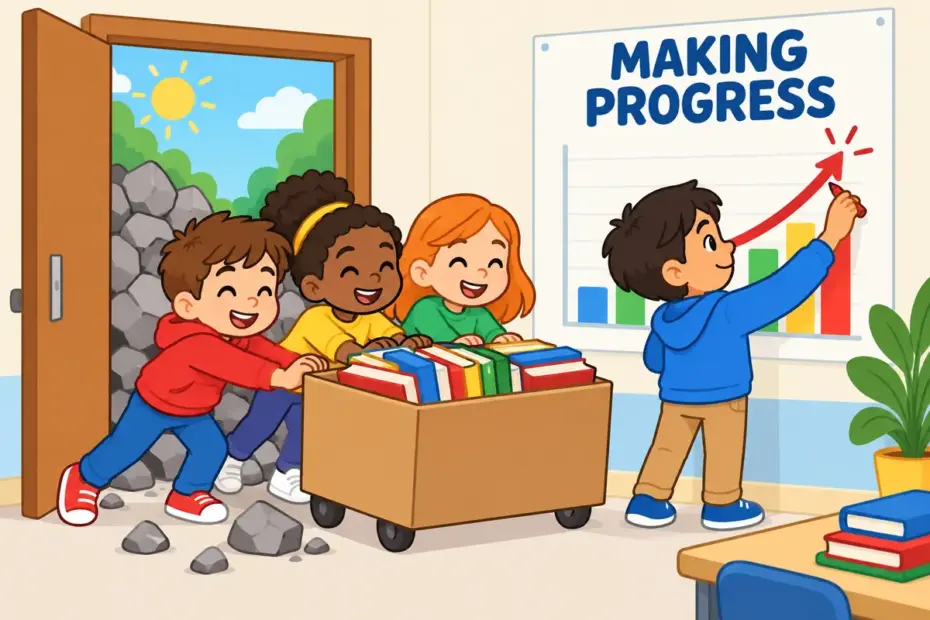
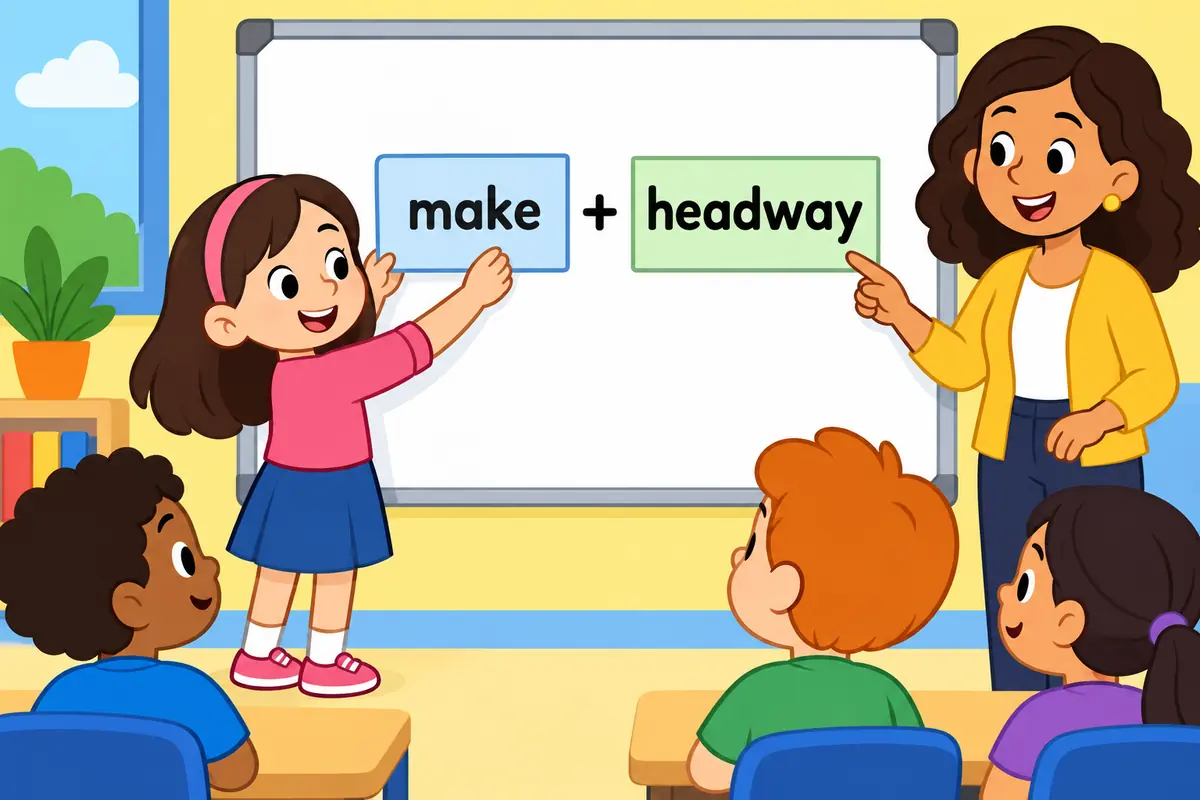
Headway means forward progress that can be measured, and headway in a sentence almost always appears as make headway. To use headway, pair it with make, gain or fail to make, then name the obstacle: the negotiators made headway on the border dispute.
Headway at a glance
- Headway is an uncountable noun meaning forward progress toward a goal.
- It appears mainly in the fixed phrase make headway.
- The usual pattern is make headway on, with or toward something.
- The word belongs to neutral and business writing rather than casual chat.
- The commonest error is using headway as a verb, as in headwayed.
What does headway mean?
Headway is an uncountable noun meaning forward progress toward a goal, especially progress made against an obstacle. The Cambridge entry for headway lists the progress sense first and the transport senses after it, and the split is worth knowing because only one sense is common outside engineering.
| Sense | Plain meaning | Example sentence |
|---|---|---|
| Progress | Forward movement against something that had slowed it | The talks made headway after the mediator arrived. |
| Traffic interval | The time or distance between two buses or trains | Engineers shortened the headway between trains to five minutes. |
| Bridge clearance | The vertical space beneath a bridge | The new footbridge leaves enough headway for small boats. |
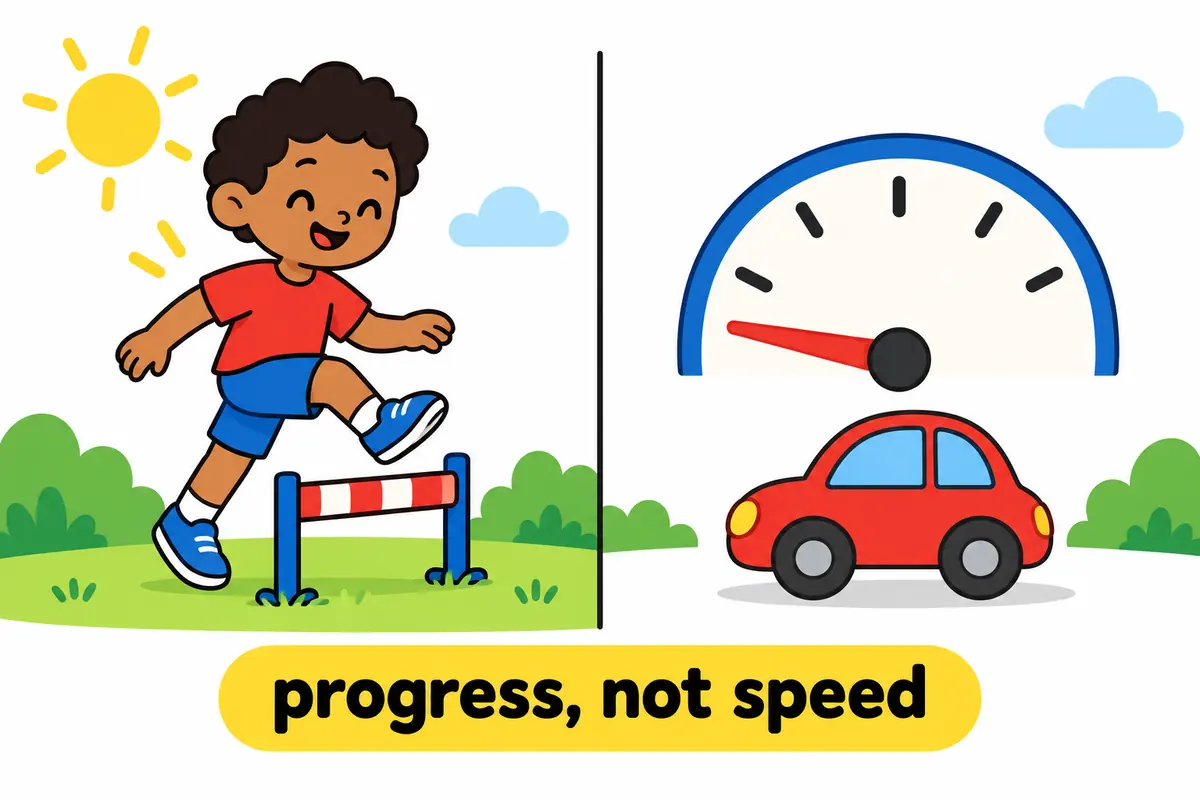
One limitation is worth stating plainly. Headway is not a synonym for speed or for success. Work can make headway and still fail, and a slow project can make headway while a faster rival finishes first.
How do you use headway in a sentence?
Headway is uncountable, so it never takes a or an, and it almost always follows a verb of movement or struggle. Five patterns cover nearly every real sentence, and the negative form is as common as the positive one. Where you simply need the general noun, advance is a plain substitute.
| Pattern | Example | What it signals |
|---|---|---|
| make headway on + obstacle | The rescue team made headway on the blocked tunnel. | Slow progress against a specific problem. |
| make headway with + task or person | She made headway with the difficult report. | Progress on a piece of work or a relationship. |
| make headway toward + goal | The club made headway toward its fundraising target. | Movement toward a measurable end. |
| gain headway | The protest gained headway after the broadcast. | Momentum building, often against resistance. |
| make little or no headway | Negotiators made little headway for two days. | The negative form, used to report a stall. |
Headway in a sentence: examples across contexts
Headway changes register more than it changes meaning. The eight sentences below keep the same noun while moving from a classroom to a transport plan, and each one names the obstacle being overcome.
| Context | Example sentence | Why this works |
|---|---|---|
| Classroom | Our group made headway on the science poster in one afternoon. | Names the task and the time clearly. |
| Workplace email | We made headway on the budget review and expect a decision on Friday. | Business register with a concrete deliverable. |
| News report | Rescue crews made headway against the fire as the winds dropped overnight. | Uses headway against, the idiom for an opposing force. |
| Academic writing | The survey made little headway in explaining the gap between the two cohorts. | The negative form reports a modest result honestly. |
| Conversation | I finally made headway with my tax forms this morning. | Everyday subject and a natural spoken rhythm. |
| Sports writing | The striker made headway down the left wing before the tackle. | Physical forward movement, the older sense of the word. |
| Transport planning | The agency cut the headway between buses from twelve minutes to eight. | Shows the technical countable use. |
| Engineering report | The bridge has enough headway for a double-decker bus. | Shows the clearance sense in a specification. |
Only the transport and engineering rows use headway as a count-like term. Everywhere else it carries the sense of momentum, which is why momentum often appears in the same paragraph.
Headway vs progress
Headway and progress overlap, but they are not interchangeable. Progress is the general noun for any movement forward; headway is the narrower word for progress that an obstacle had blocked. A team that simply tracks its work reports progress, while a team that escaped a setback reports headway.
| Attribute | headway | progress |
|---|---|---|
| Core meaning | Forward movement against a difficulty | Any movement toward a goal |
| Countability | Uncountable in this sense | Uncountable, but a progress report exists |
| Typical verb | make | make, measure, track, show |
| Register | Neutral and business | Neutral and broad |
| Common pairing | make headway on or with | make progress on |
| Implies a prior obstacle | Yes, usually | No |
Verdict: choose headway when something had stalled and is moving again, and progress when you simply need the general noun for forward movement.
Word forms and grammar of headway
Headway has almost no inflection because the meaning that matters here is uncountable. The plural headways survives only in transport, and the verb forms below are not standard English. The same root appears in headwaters, the source streams of a river, though the two words are unrelated in meaning.
| Form | Part of speech | Example |
|---|---|---|
| headway | noun, uncountable | The team made headway on the design. |
| headways | noun, plural, transport only | The timetable lists headways of six minutes. |
| make headway | verb phrase | We made headway with the client. |
| headwayed | non-standard verb | Incorrect: We headwayed the project. |
| headwaying | non-standard verb | Incorrect: We are headwaying on the plan. |
Common mistakes with headway
- Incorrect:
We headwayed the project last week.Correct: We made headway on the project last week. Rule: Headway is a noun, so it needs make, not an -ed ending. - Incorrect:
The team made a headway.Correct: The team made headway. Rule: The progress sense is uncountable and takes no article. - Incorrect:
We are making headways this term.Correct: We are making headway this term. Rule: The general sense has no plural; headways survives only in transport. - Incorrect:
They made headway to the problem.Correct: They made headway on the problem. Rule: Headway takes on, with or toward, never to. - Incorrect:
Headway was made by us quickly.Correct: We made headway quickly. Rule: An active subject reads more naturally than a strained passive.
Practice using headway
Work through the six items, then read the reasoning rather than only the answer.
- Fill the gap: The research team ______ headway on the vaccine trial after a new lab opened.
- Choose the better word: The train operator reduced the (headway / progress) between stations to four minutes.
- Correct the error: The negotiators made a headway with the trade deal.
- Build a sentence: use make headway about a school project that had stalled.
- Spot the register: which belongs in a business email — the crew made headway on the audit, or we totally made headways on the audit?
- Remove the article: The engineers made a headway on the bridge design.
Answers
- made — the past tense of make carries the noun, and headway never inflects.
- headway — progress cannot measure the interval between two trains.
- The negotiators made headway with the trade deal — headway is uncountable, so a must go.
- Model answer: Our class finally made headway on the mural once the paint arrived.
- The crew made headway on the audit — a business email avoids totally and the plural form.
- The engineers made headway on the bridge design — the uncountable noun takes no article.
The bottom line
Use headway in a sentence when progress had stalled and is moving again, and give it the verb make. The two things that decide most sentences are these: headway is uncountable, so it takes no article, and it carries a sense of resistance that plain progress does not. When a result arrives suddenly, a breakthrough is the stronger word.
Frequently asked questions about headway
Is headway an uncountable noun?
Yes. In its main sense of forward progress, headway is uncountable, so it never takes a or an. You write make headway, never make a headway. The countable plural headways exists only in transport, where it measures the interval between buses, trains or other vehicles.
Can headway be used as a verb?
No. Headway is only a noun, so forms such as headwayed and headwaying are not standard English. Learners create them by analogy with verbs like progressed. The correct verb is make: we made headway on the tunnel rather than we headwayed the tunnel.
What preposition goes after headway?
Headway normally takes on, with or toward, depending on what follows. Use on for a problem, as in headway on the repairs; with for a task or a person; and toward for a goal. The preposition to is the commonest mistake and is never used.
Does headway mean speed?
No. Headway means progress against an obstacle, not pace. A fast team can make no headway if the work is blocked, and a slow team can make steady headway on a difficult problem. The transport sense measures time or distance between vehicles, which is a separate meaning.
Are you striving to make progress or achieve advancement in a particular area? If so, then you are likely seeking to make headway. Headway refers to the forward movement or progress that is made, especially in a challenging or complex situation.
When you are able to make headway, you are successfully moving forward and overcoming obstacles or challenges that may be hindering your progress. This term signifies the significant steps taken towards reaching a specific goal or desired outcome, demonstrating your ability to overcome setbacks and move closer towards success.
7 Examples Of Headway Used In a Sentence For Kids
- We made good headway in our painting project today.
- The little snail is slowly making headway across the garden.
- I am proud of the headway you made in learning the alphabet.
- Let’s work together to make headway in solving this puzzle.
- The baby is starting to make headway in crawling.
- You’ve made excellent headway in reading your first book.
- The ants have made impressive headway in carrying the food to their nest.
14 Sentences with Headway Examples
- Make sure to headway on your assignments before the deadline.
- It’s important to show headway in your studies to excel in college.
- Have you made any headway in understanding that difficult concept?
- I need to make headway on my research project this weekend.
- Let’s work together to make some headway on our group project.
- Have you made any headway in finding a suitable internship for the summer?
- Making small steps every day can help you make headway towards your academic goals.
- It’s essential to keep making headway in your study routine to avoid falling behind.
- I need to focus and make headway in preparing for my upcoming exams.
- Gradually making headway in your coursework can lead to a successful college experience.
- Are you making enough headway in your extracurricular activities alongside your studies?
- Making consistent headway in your assignments can improve your overall academic performance.
- Setting small achievable goals can help you make headway in your college journey.
- Making headway in building relationships with professors can be beneficial for your academic growth.
How To Use Headway in Sentences?
To use Headway in a sentence, start by identifying the main idea or topic you want to express progress in. Then, place Headway in the appropriate location within your sentence to show advancement or forward movement.
For example, you could say, “After weeks of studying, I finally made headway in understanding the complex math problem.” In this sentence, Headway is used to indicate progress in grasping a difficult concept.
Another way to use Headway is by stating, “With consistent effort, she was able to make significant headway in her fitness goals.” Here, Headway demonstrates progress towards achieving a specific objective.
To emphasize the level of progress made, you could say, “Despite facing challenges, the team managed to gain considerable headway in completing the project ahead of schedule.” Here, Headway illustrates considerable advancement despite obstacles.
In summary, Headway is a powerful word to showcase progress or advancement in various contexts. By incorporating it effectively in your sentences, you can convey the idea of making significant strides towards a goal or overcoming obstacles. Experiment with different sentence structures to see how Headway can enhance your communication.
Conclusion
In conclusion, the examples of sentences with “headway” illustrate the progress or advancement being made in various contexts. Whether it refers to making strides in a project, gaining ground in negotiations, or achieving success in a pursuit, “headway” encapsulates the forward momentum and growth that individuals or groups experience.
Understanding the concept of “headway” is essential for recognizing and celebrating milestones achieved, no matter how big or small. By appreciating the incremental progress indicated by sentences containing this term, individuals can stay motivated and focused on their goals, knowing that each step forward, no matter how small, contributes to overall success.


