
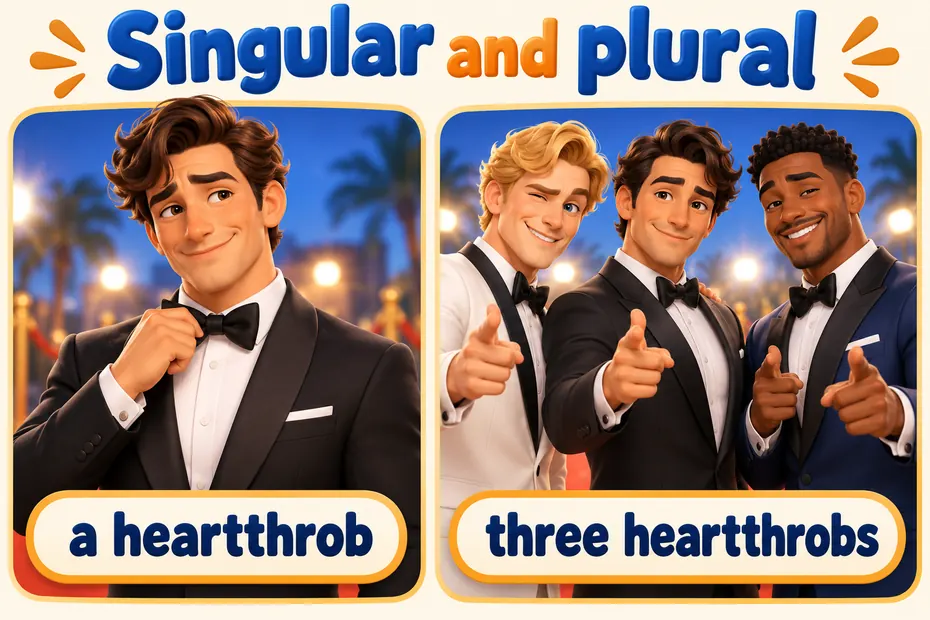
A heartthrob is someone admired for romantic appeal, often an actor or singer. Use it as a noun: “The fictional actor became a heartthrob after the film’s release.” Write a heartthrob for one person and heartthrobs for more than one. Being talented or widely liked does not automatically make someone a heartthrob.
What does heartthrob mean in everyday writing?
Merriam-Webster’s heartthrob entry records several senses, including a heartbeat and a sweetheart, as well as the familiar entertainer sense associated with romantic appeal. This guide focuses on the last meaning because that is how the original examples below use the word.
Heartthrob adds a particular kind of admiration. “The singer is popular” may refer to music, performances, or personality. “The singer is a heartthrob” points toward romantic attraction. If all you know is that fans enjoy someone’s work, popular singer, admired performer, or fan favorite may express the intended claim more accurately.
How does heartthrob fit into a sentence?
Heartthrob is a countable noun in the person sense. A singular use usually needs an article or another determiner. “He became a heartthrob” introduces the description. “The heartthrob signed autographs” refers to a particular person. “My favorite heartthrob appears in the sequel” identifies the person through the speaker’s preference.
| Pattern | Original example | What it shows |
|---|---|---|
| a heartthrob | The fictional singer became a heartthrob. | One person |
| the heartthrob | The heartthrob appeared on the magazine cover. | A known person |
| plural heartthrobs | The feature profiles three movie heartthrobs. | Several people |
| heartthrob of + group | In the story, he is the heartthrob of the theater club. | A specified audience |
| heartthrob among + group | The actor became a heartthrob among romance-film fans. | The admirers |
| heartthrob status | The role brought him heartthrob status. | A reputation or description |

The term is also found before nouns in combinations such as heartthrob status. However, “heartthrob actor” can sound compressed. “The actor became a heartthrob” often reads more smoothly because it makes the person and description explicit. Choose the structure that fits the surrounding sentence instead of placing the word at the beginning automatically.
Eight natural heartthrob sentence examples
- The magazine introduced the film’s lead as a rising heartthrob.
- Her favorite heartthrob plays a shy musician in the new drama.
- The fictional singer became a heartthrob after his first tour.
- The interview focused on the actor’s work rather than his heartthrob image.
- Several heartthrobs appeared in the magazine’s anniversary issue.
- The reviewer described the character as a reluctant heartthrob.
- Fans regarded the leading actor as the show’s heartthrob.
- He joked that his days as a movie heartthrob were behind him.
These are invented examples of English usage, not reports about actual performers. They vary the word’s role: subject description, noun after an article, plural noun, and noun used before another noun. When writing about a real person, attribute the description to a publication or fans if that is where it comes from.
Common meaning mistakes in heartthrob examples
Several original examples below link heartthrob status to helping people, winning a competition, or winning an election. Those actions might make a person respected, talented, or successful, but the word specifically adds romantic appeal. “My friend admires the superhero because he helps people” is clearer if no attraction is intended.
The original phrase “heartthrob of many people” is understandable but less natural than “a heartthrob among many fans.” Likewise, calling a whole group “a heartthrob group” can obscure who receives the admiration. Write “a group whose members are regarded as heartthrobs” if the description applies to several individuals, or simply “a favorite pop group” if you mean musical preference.
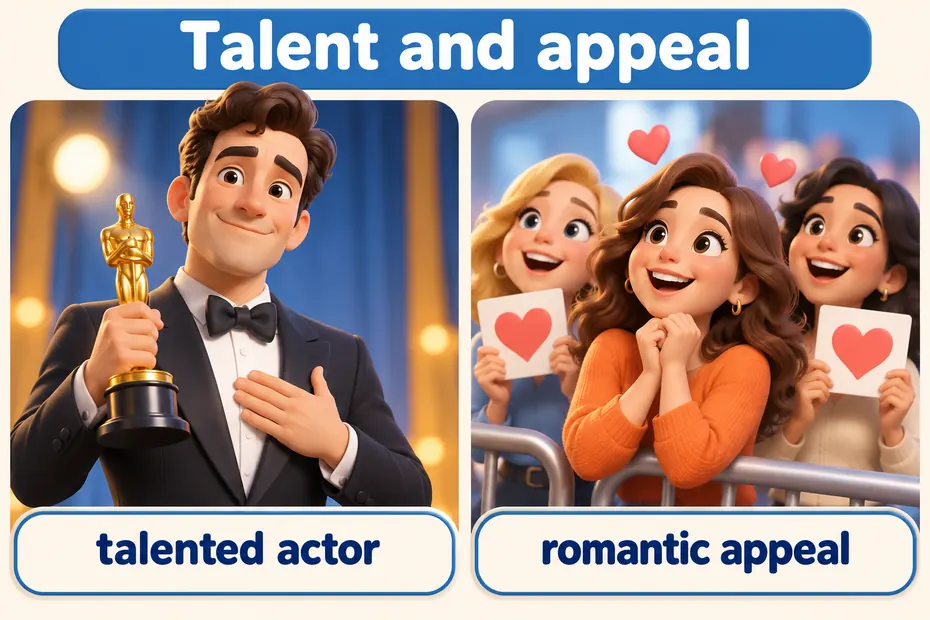
Heartthrob is an informal, evaluative description. It does not explain a person’s acting ability, singing technique, or character. A profile can mention the label while discussing skill separately: “Although often described as a heartthrob, the actor wanted the interview to focus on his stage performances.”
Frequently asked questions about heartthrob
Is heartthrob one word?
The dictionary spelling used here is heartthrob, one word. Preserve both adjacent t letters: the word combines heart and throb. If spelling is the goal of an exercise, check that you have not accidentally written “hearthrob” with one t.
What is the plural of heartthrob?
The plural is heartthrobs. Add s without an apostrophe: “The article compares two heartthrobs.” Use an apostrophe for possession instead: “The heartthrob’s interview” is one person’s interview, while “the heartthrobs’ interviews” refers to interviews belonging to several people.
Does heartthrob mean a good person?
Not by itself. In the celebrity sense, it describes romantic appeal. It does not guarantee kindness, honesty, or skill. If a sentence is about someone’s helpful behavior, words such as kind, generous, or admired may express your point more directly.
How can I use heartthrob in formal writing?
Use it when the subject requires discussion of celebrity image or fan culture, and attribute the description where appropriate. “The magazine presented the actor as a heartthrob” reports a portrayal. In a neutral biography focused on career facts, name the roles or achievements instead of adding an unsupported personal judgment.

Have you ever found yourself swooning over a celebrity or fictional character and referring to them as a “heartthrob”? The term “heartthrob” is commonly used to describe someone who is extremely attractive and captures the hearts of many admirers.
Derived from the idea of someone who makes hearts beat faster with their charm or charisma, a heartthrob can be a famous actor, musician, or even a character in a book or movie that elicits strong feelings of admiration and infatuation from fans. A heartthrob is typically seen as desirable and captivating, often becoming the center of fantasies and romantic daydreams.
7 Examples Of Heartthrob Used In a Sentence For Kids
- Heartthrob is someone who makes our heart feel happy.
- My favorite actor is a heartthrob because he is so handsome.
- When I see my favorite singer, my heart beats fast because he is a heartthrob.
- She is known as the heartthrob of the school because everyone likes her.
- The famous dancer is a heartthrob of many people.
- Heartthrob is a word used for someone who is loved by many.
- My friend thinks the superhero is a heartthrob because he helps people.
14 Sentences with Heartthrob Examples
- Heartthrob actor, Kartik Aaryan, visited our college for a promotional event.
- My friend’s new roommate turned out to be a total heartthrob and caught everyone’s attention.
- After the dance competition, the judges declared Rohan as the ultimate heartthrob of the night.
- The college canteen buzzed with excitement as the famous singer walked in, becoming an instant heartthrob.
- During the annual fest, the fashion show had a special guest appearance by a famous heartthrob model.
- A new student transferred to our college and immediately became the talk of the town, being labeled as the new heartthrob on campus.
- Students lined up for hours to get a glimpse of the Bollywood heartthrob who was invited as a guest lecturer.
- The sports field lit up with cheers when the captain of the cricket team scored a winning shot, solidifying his status as the ultimate heartthrob athlete.
- In the college elections, the charming candidate became the unexpected heartthrob and won by a landslide.
- Priya’s room was filled with posters of her favorite K-pop heartthrob group, showcasing her admiration for them.
- The annual college play featured a talented actor who stole the show and became the new heartthrob of the drama club.
- When the lead guitarist of a popular band performed at the college fest, he instantly became a heartthrob among music enthusiasts.
- The literature club was abuzz with excitement as the famous author, known as the literary heartthrob, agreed to a book reading session.
- The college magazine cover featured the rising star who had become a heartthrob among the student body for his poetry and writing.
How To Use Heartthrob in Sentences?
Heartthrob is a noun that refers to someone who is very attractive and causes others to have romantic feelings for them.
When using the word Heartthrob in a sentence, make sure to describe a person who is seen as highly desirable to others because of their looks, charm, or demeanor. For example, “The actor Brad Pitt was considered a heartthrob in the 1990s due to his good looks and charismatic personality.”
Remember to place the word Heartthrob in the appropriate context within your sentence. You can use it as a subject complement following a linking verb, like “is,” “was,” or “seems,” to describe someone’s appeal. For instance, “Henry Cavill has become the new heartthrob of Hollywood with his role as Superman.”
Additionally, you can also use Heartthrob in a sentence by describing how someone feels towards the person who is seen as attractive. For example, “She couldn’t help but swoon over the heartthrob lead singer of the band.”
In conclusion, using Heartthrob in a sentence is all about highlighting someone’s attractiveness and the impact they have on others. Keep in mind the definition of the word and use it to convey admiration or romantic feelings towards a charming individual.
Conclusion
In summary, the term “heartthrob” is commonly used to describe someone who is attractive and captures the hearts of many admirers. Examples of sentences with “heartthrob” include phrases like “He quickly became the heartthrob of the school” or “She found herself swooning over the Hollywood heartthrob.” This word is often employed in discussions about celebrities or individuals who have a strong influence on the emotions and affections of others.
Overall, “heartthrob” encapsulates the idea of someone who is not only physically appealing but also has a charismatic and captivating presence that makes them stand out. This term is frequently used in contexts where someone’s charm and attractiveness have a significant impact on those around them, highlighting the power of personal magnetism and allure in capturing the hearts of admirers.


