
Hectic is an adjective meaning very busy, fast-paced and full of rushed activity. To use hectic in a sentence, attach it to the overloaded period or place: “The week before the exams was hectic.” The word describes the schedule rather than the person’s mood, so even a calm worker can face a hectic afternoon.
Hectic at a glance
- Hectic is an adjective; the adverb is hectically.
- It describes schedules, days or places rather than a single person.
- Common patterns are a hectic day, a hectic schedule and things get hectic.
- Hectic is neutral in register and common in everyday speech and workplace email.
- The commonest error is confusing hectic with chaotic, which stresses disorder rather than speed.
What does hectic mean?
Hectic is an adjective meaning very busy, fast-moving and crowded with activity. The Cambridge entry for hectic gives that everyday sense, and medicine keeps a second one: a hectic fever rises and falls in a steady fluctuating pattern. The general sense dominates, and where the trouble is disorder rather than speed, chaotic is the sharper word. Hectic is not a synonym for difficult or stressful; a quiet week of hard thinking is demanding but not hectic, because nothing about it is rushed.
| Sense | Plain meaning | Example sentence |
|---|---|---|
| Ordinary | Very busy and fast-paced | The shop was hectic on the last Saturday before the holidays. |
| Technical | A fever that rises and falls | Historical notes describe a hectic fever that worsened each evening. |
How do you use hectic in a sentence?
Hectic is an adjective, so it either sits before a noun or follows a linking verb. The table lists the patterns that cover ordinary use.
| Pattern | Example | What it signals |
|---|---|---|
| hectic + noun | She survived a hectic schedule. | Labels the busy thing directly. |
| be + hectic | The office was hectic all morning. | Describes a place or period. |
| get + hectic | Things get hectic before a launch. | Marks the moment busyness begins. |
| a bit/really + hectic | It has been a pretty hectic term. | Softens or strengthens the judgement. |
| hectic + for + person | The first week was hectic for the new staff. | Names who felt the pressure. |
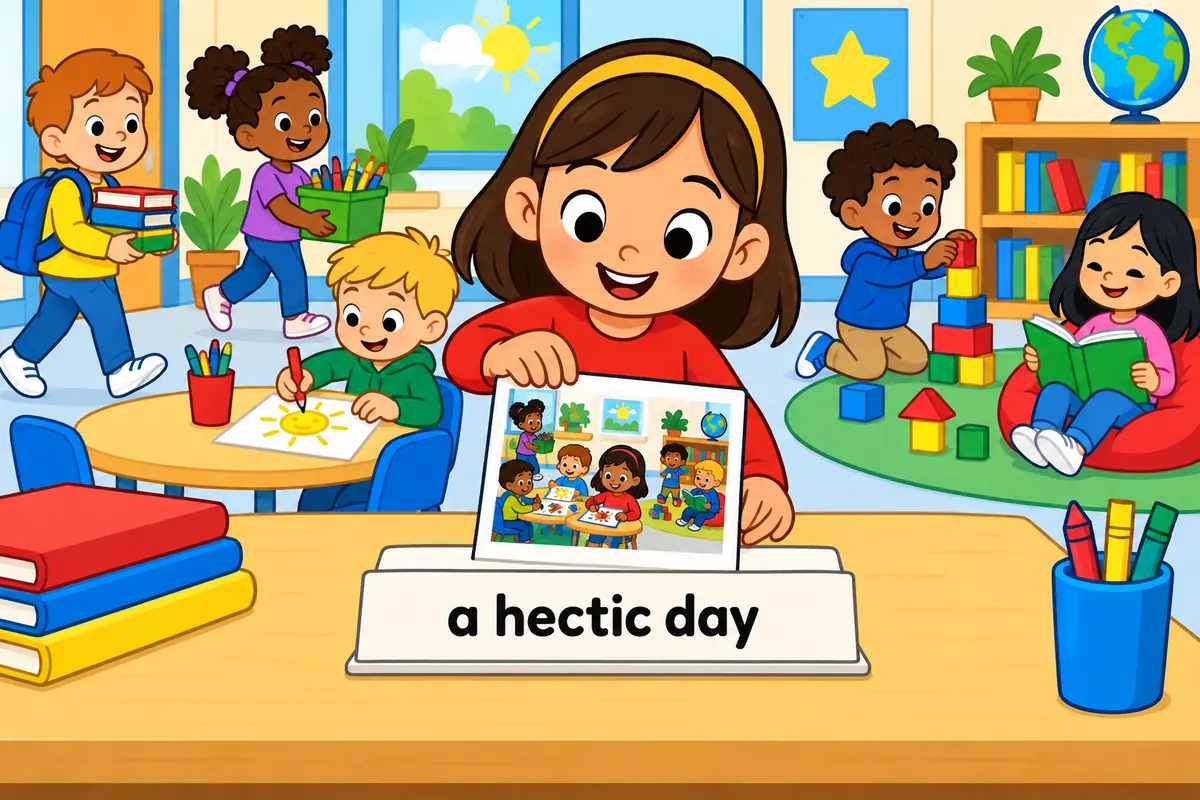
Hectic in a sentence: examples across contexts
| Context | Example sentence | Why this works |
|---|---|---|
| Classroom | The last lesson before the play was hectic, with costumes to fix everywhere. | Names a specific busy period rather than a mood. |
| Workplace email | Apologies for the slow reply; it has been a hectic week in accounts. | A polite way to explain delay without excuses. |
| News report | Paramedics described a hectic night after the storm. | Quotable and vivid for a busy emergency shift. |
| Conversation | How was your trip? Hectic, but we saw everything. | Short, natural and common in speech. |
| Retail | The tills never stopped on a hectic Saturday. | Paints a crowded, fast-moving shop floor. |
| Travel writing | Kolkata feels hectic the moment you leave the airport. | Captures a city’s busy energy in a phrase. |
| Academic writing | Surveyors worked a hectic schedule during the two-week window. | Stays factual while marking the intensity. |
| Sport | The final minutes were hectic as both teams chased a winner. | Fits fast, crowded end-of-match action. |
| Medical history | Old records mention a hectic fever that flared each night. | Shows the technical sense in its proper setting. |
Hectic vs chaotic
Hectic and chaotic are close, but hectic stresses speed and fullness while chaotic stresses how busy and disordered a scene has become. The table separates them.
| Attribute | hectic | chaotic |
|---|---|---|
| Core meaning | Very busy and fast-paced | Completely disordered |
| Main focus | Speed and volume of activity | Lack of order or control |
| Implied outcome | Things get done, quickly | Things may fall apart |
| Typical noun | A hectic day, schedule or week | A chaotic scene, meeting or traffic jam |
| Register | Neutral, very common in speech | Neutral to dramatic |
Choose hectic for a packed but functioning day, and chaotic when order itself has gone.
Word forms and grammar of hectic
| Form | Part of speech | Example |
|---|---|---|
| hectic | adjective | It was a hectic morning. |
| hectically | adverb | The team worked hectically until noon. |
| more hectic | comparative adjective | Friday is more hectic than Monday. |
| most hectic | superlative adjective | That was the most hectic sale of the year. |
| hecticness | noun, rare | The hecticness of the season wore everyone down. |
Avoid the invented forms hecticly and hectical, and never add -er to make hecticer. The rushed feel of the word comes from the activity, not from any ending.
Common mistakes with hectic
- Incorrect:
I am hectic today.Correct: My day is hectic today. The adjective describes the schedule or place, not the person as a state of being. - Incorrect:
We worked hectic to finish.Correct: We worked hectically to finish. An adverb needs -ly, not the bare adjective. - Incorrect:
The busy room was chaotic.used when nothing is disordered. Correct: The busy room was hectic. Keep chaotic for scenes where order has broken down. - Incorrect:
This week is more hecticker than last.Correct: This week is more hectic than last. Long adjectives form the comparative with more. - Incorrect:
It was a hectic, stressful problem.Correct: It was a hectic morning. Hectic describes activity, not the difficulty of a problem.
Practice using hectic
- Fill in the blank: The restaurant kitchen was ___ during the lunch rush.
- Choose the better word: The flooded hall was ___. (hectic / chaotic)
- Correct the error: She worked hectic all week.
- Build a sentence: use get hectic about the days before a school fair.
- Spot the register: which sentence suits a polite work email? (a) My week was hectic. (b) My week was a total disaster zone.
- Fill in the blank with the adverb: The nurses moved ___ between beds.
Answers
- hectic — the kitchen was busy and fast, which is exactly the adjective’s job.
- chaotic — a flooded hall has lost all order, so chaotic is stronger and more accurate.
- She worked hectically all week — the adverb needs the -ly ending.
- Things get hectic at school in the days before the fair — get hectic marks when the busyness starts.
- (a) My week was hectic — brief and neutral, unlike the exaggerated second option.
- hectically — an adverb describing how the nurses moved.
The bottom line
Hectic means very busy and fast-paced, and it fits schedules, days and places rather than people. Use hectic in a sentence for a packed but working stretch of time, and switch to chaotic when order itself has collapsed. Keep the adverb hectically, and reach for busy when speed is not the point.
Frequently asked questions about hectic
Is hectic a negative word?
Hectic is mildly negative or neutral depending on the tone. It signals pressure and speed, which can sound tiring in a complaint, yet it often carries a hint of energy and success in a busy workplace. Saying a week was hectic rarely means it was bad, only that it was full.
Can you describe a person as hectic?
Standard usage attaches hectic to a schedule, day or place, not to a person. Saying I am hectic sounds like a direct translation from another language. English prefers my week is hectic or I am rushed, which keeps the adjective on the time and the person in the right frame.
What is the adverb of hectic?
The adverb is hectically, as in the staff worked hectically before the opening. The bare adjective cannot do adverb work, so we worked hectic is non-standard. Longer adjectives like hectic also avoid -er comparatives, which is why we say more hectic rather than hecticer.
What is the difference between hectic and busy?
Busy simply means occupied with activity, while hectic adds speed and a sense of being overwhelmed by it. A busy shop is full of customers; a hectic shop is also rushed and loud. If you need the plainer word, busy works everywhere, but hectic captures the pace.
Do you ever feel overwhelmed by your hectic schedule? “Hectic” describes a situation that is extremely busy, fast-paced, and chaotic, leaving you feeling stressed and frazzled. It’s a common feeling in today’s fast-paced world where deadlines, responsibilities, and obligations can pile up quickly.
Navigating a hectic schedule can be challenging, but with some effective time management strategies and self-care practices, you can regain control and find balance amidst the chaos. Let’s explore ways to cope with a hectic lifestyle and create a more peaceful and manageable daily routine.
7 Examples Of Hectic Used In a Sentence For Kids
- Hectic days make us tired.
- We should take breaks during hectic study sessions.
- It’s important to stay calm during hectic situations.
- Sometimes, our schedule can be very hectic.
- When things get hectic, take a deep breath.
- Let’s try to stay organized when things get hectic.
- Remember to ask for help when things feel hectic.
14 Sentences with Hectic Examples
- Hectic academic schedules can often lead to burnout among college students.
- Many students find it hectic to juggle assignments, exams, and extracurricular activities.
- The week before exams is always the most hectic time for students.
- Balancing a part-time job with studies can make a student’s life even more hectic.
- Group projects can become especially hectic when working with classmates who have conflicting schedules.
- The hectic atmosphere in the library during exam season can be overwhelming for some students.
- Trying to secure internships during the hectic placement season can add to a student’s stress.
- Waking up early for classes after a hectic night of studying can be a struggle for many students.
- Navigating through campus during hectic lunch breaks can be challenging.
- Missing deadlines due to a hectic social life can negatively impact a student’s grades.
- The hectic traffic during peak hours can make commuting to college a nightmare for students.
- The pressure to maintain high grades in a hectic academic environment can take a toll on students’ mental health.
- Finding time to relax and de-stress amidst the hectic college life is crucial for students’ well-being.
- For international students, adjusting to a new culture can make college life even more hectic.
How To Use Hectic in Sentences?
Hectic is used to describe a situation or period of time that is very busy, fast-paced, and chaotic. When you want to convey that something is intense, dizzying, or frantic, you can use the word hectic.
Here are some examples of how to correctly use hectic in a sentence:
- “My schedule is so hectic this week with back-to-back meetings and deadlines.”
- “The office was hectic as everyone rushed to complete the project before the deadline.”
- “After a hectic day at work, all I wanted to do was relax and unwind.”
- “Her life has been especially hectic since starting a new job and moving to a new city.”
- “The hectic pace of the city was overwhelming for the small-town visitor.”
Remember that hectic is an adjective and should be used to describe the situation or period of time, not as an action verb. Also, it is important to use hectic appropriately in context to ensure clear communication and understanding. Experiment with using hectic in various sentences to become more comfortable incorporating it into your vocabulary.
Conclusion
In summary, sentences that include the word “hectic” often describe situations that are fast-paced, chaotic, or frenzied. These sentences convey a sense of busyness, stress, or disorder, highlighting the bustling nature of the scenario being depicted. Whether it’s a hectic work environment, a hectic schedule, or a hectic day, these sentences effectively communicate the overwhelming and intense nature of the situation at hand.
By using the word “hectic” in a sentence, writers can paint a vivid picture of a situation characterized by busy activity, confusion, or urgency. These sentences allow readers to quickly grasp the hectic nature of the context being described, providing a clear understanding of the chaos or frenetic pace of the situation.


