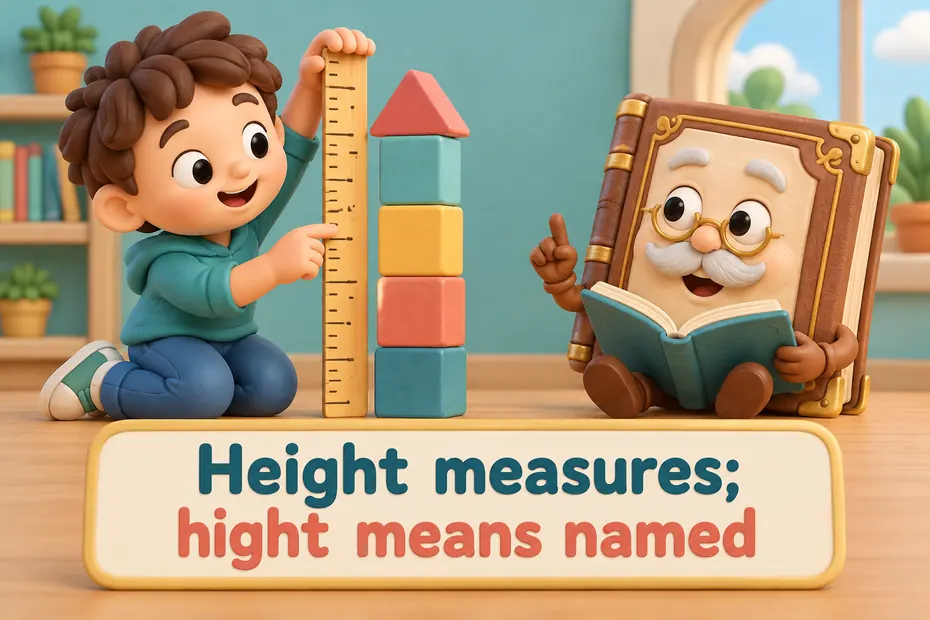
Usage correction: The older explanation below incorrectly calls hight a past-tense form of height. Height is the measurement noun. Hight is an archaic word meaning called or named, with a different history. Use the checked distinction in this guide.
Height vs hight: the direct answer
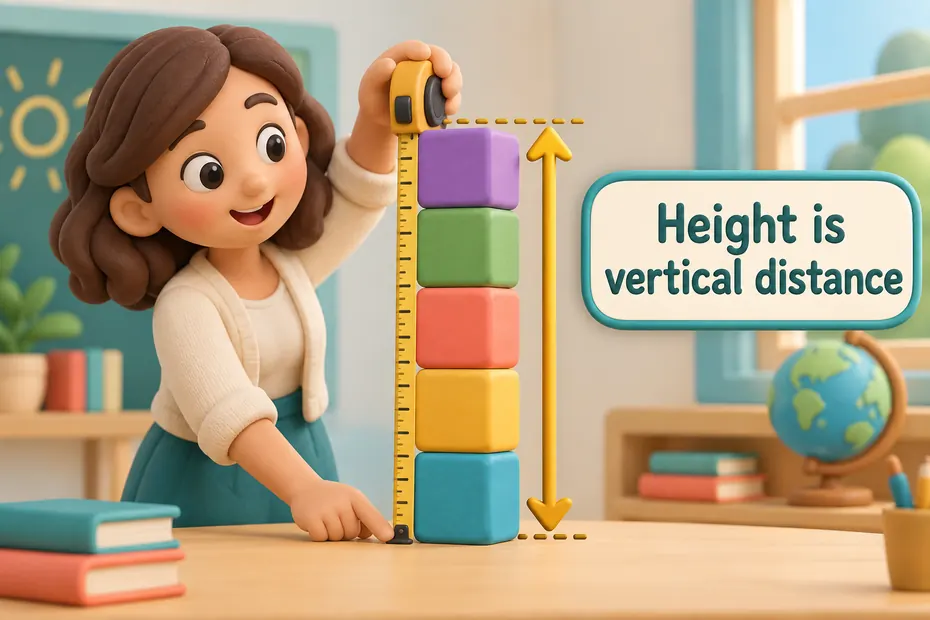
Height means vertical distance, how tall something is, or a highest point or level. Hight is an archaic adjective meaning called or named. Write “the height of the tower” for a measurement. In an intentionally old-fashioned story, “a knight hight Robin” means a knight named Robin. Hight is not the ordinary spelling for a measurement.
Both words have the pronunciation “hyt,” rhyming with light. Their shared sound does not make them alternative spellings with the same meaning. The most useful everyday rule is to keep the e in height when discussing how tall something is.
Key facts
- Height is an ordinary modern noun.
- Hight is a rare archaic adjective meaning named.
- Height can be literal or figurative.
- Height is not normally a verb needing a past tense.
- Use context to distinguish a spelling error from deliberate historical language.
Use height for vertical measurement
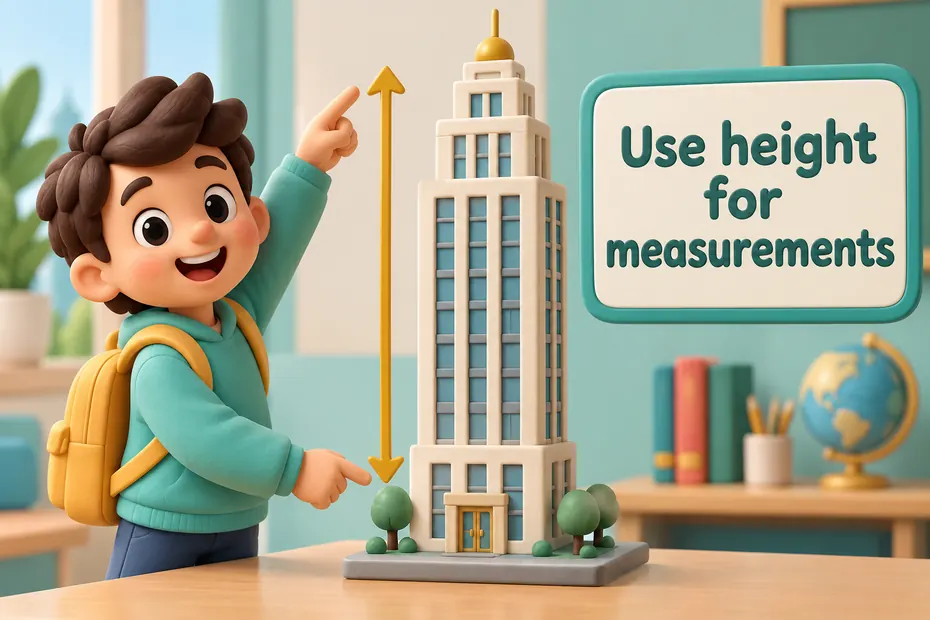
A person’s height describes their vertical extent. A building’s height similarly concerns the distance from its bottom to its top. When recording a measurement, include the unit: “The model’s height is 30 centimeters.” A number without a unit may leave the reader uncertain about scale.
Height can also refer to distance above a reference level. “The platform is at a height of two meters above the floor” states both the measurement and its reference. In practical descriptions, specify what you measured from and to if that could otherwise be ambiguous.
For a box, height, width, and depth describe different dimensions. Calling all three height makes the description harder to use. “The box is 20 centimeters high, 30 centimeters wide, and 10 centimeters deep” separates them. These invented dimensions demonstrate sentence structure rather than describe a real product.
The adjective high and noun height have related meanings but different grammatical roles. “The shelf is high” describes its position. “The shelf’s height is adjustable” names the dimension. Tall can likewise describe a person or object, while height names the measurement. Merriam-Webster: height.

Height in figurative expressions
Height does not always involve a ruler. “At the height of the festival” points to the event’s peak. “The project reached new heights” describes a level of achievement. In these expressions, the noun keeps its standard spelling even though its meaning is figurative.
Consider two original examples: “We measured the height of the display” is literal. “The display was the height of elegance” is an evaluation of style. The surrounding words indicate whether you are discussing distance or a peak quality.
The plural heights can refer to high places or levels: “She dislikes heights” and “The team reached new heights.” The s changes number, not the spelling of the base word. Neither example requires hights.
Hight in older or deliberately archaic writing
Hight means being called or named. A phrase such as “a traveler hight Rowan” can be understood as “a traveler named Rowan.” The example here is invented to demonstrate the meaning; it is not a quotation from a historical text.
In ordinary modern prose, named is usually clearer. You might use hight when discussing an older passage, explaining historical vocabulary, or deliberately imitating an old-fashioned narrative voice. Keep that choice intentional rather than letting it replace height in a measurement.
Merriam-Webster labels hight archaic and traces it to an older word concerned with calling or naming. That history explains why describing it as the past tense of the measurement noun height is misleading. Merriam-Webster: hight.
When reading an unfamiliar old word, first identify the sentence’s grammatical role. If it follows a character description and introduces a name, the naming sense may fit. If it follows a number or introduces a dimension, height is likely the intended measurement word in modern writing.
Compare the words
| Context | Choice | Original example |
|---|---|---|
| Vertical dimension | height | The tree’s height surprised us. |
| Distance above a reference | height | The shelf sits at a height of one meter. |
| Peak stage | height | We arrived at the height of the celebration. |
| Archaic naming | hight | A traveler hight Rowan entered the tale. |
A spelling check
- Ask whether you mean measurement, peak level, or naming.
- For measurements and peak levels, choose height.
- For an archaic naming expression, check hight.
- If modern readers may not recognize hight, use named.
- Check units and reference points in measurement sentences.
Spellcheck may not flag hight because it is a real dictionary word. A sentence such as “Record your hight” still needs height if it asks for a measurement. Valid words can be incorrect in a particular context.
Practice with answers
Fill the gaps: (1) Measure the ___ of the wall. (2) The hero was a knight ___ Robin. (3) The concert reached the ___ of excitement. (4) The two plants have different ___.
Answers: (1) height; (2) hight, in the deliberately archaic sentence; (3) height; (4) heights. In modern wording, the second sentence could simply say “a knight named Robin.”
Frequently asked questions
Is hight a misspelling every time?
No. It is a real archaic word. It is wrong when used as the ordinary measurement noun in modern writing.
Is hight the past tense of height?
No. The words have different meanings and histories.
Which spelling belongs on a measurement form?
Height, with an e.
Can height describe a peak rather than a distance?
Yes. Expressions such as the height of a celebration use the peak-level sense.
Have you ever found yourself confused about when to use “height” and when to use “hight”? As an expert writer, I’ve encountered this common dilemma many times. In this text, I’ll provide you with a clear understanding of the appropriate usage of these two words. Understanding the difference between “height” and “hight” is crucial for effective communication, whether you’re writing an essay, an email, or a social media post. So, let’s immerse and explore the nuances of these words, so you can confidently use them in your writing.
Key Takeaways
- “Height” is a widely accepted term in modern English, while “hight” is an obsolete form.
- “Height” refers to the measurement or vertical extent of an object, person, or thing.
- “Hight” is an archaic past tense form of “height” that is no longer commonly used.
- Using “height” accurately allows for clear and precise measurements and descriptions.
- Consistency and context are important when using “height” in writing.
- In most cases, it’s safer to opt for the widely accepted term “height” rather than using the outdated form “hight.”
What is “height” and “hight”?
To understand the appropriate usage of “height” and “hight,” it’s important to first define these words.
- “Height” is a noun that refers to the measurement from the base to the top or the vertical extent of an object, person, or thing. It’s commonly used to describe how tall something is.
- On the other hand, “Hight” is actually an obsolete or archaic form of the word “height.” It’s no longer commonly used in modern English.
Now that we have a clear understanding of these words, let’s investigate into the differences between “height” and “hight.”
The Difference between “Height” and “Hight”
The main difference between “height” and “hight” lies in their usage and relevance in contemporary English.
- “Height” is the correct and widely accepted term in modern usage. It appears regularly in written and spoken English across various contexts. Using “height” ensures clear and effective communication.
- Conversely, “hight” is an outdated form of the word that isn’t used today. It can be found in older texts or literature, but it has largely fallen out of common usage. Hence, it’s important to refrain from using “hight” in your writing if you want to ensure clarity and accuracy.
Understanding the difference between these two words is essential for effective communication. By using “height” correctly, you can convey precise measurements and descriptions, enabling your readers or listeners to comprehend your message with accuracy and clarity.
Now that we’ve established the definition and the distinction between “height” and “hight”, let’s explore some examples of how to use “height” correctly.
Common mix-ups between “height” and “hight”
As a writer, I understand that certain words can often be confused, leading to errors in our writing. “Height” and “hight” are such words that can frequently cause confusion. In this section, I will clarify the difference between these two words, providing you with a clear understanding of when to use each one.
First, let’s start with the definition of “height”. It is a noun that refers to the measurement from the base to the top or the vertical extent of an object, person, or thing. Essentially, it is the distance from the bottom to the highest point. It’s a crucial term when precise measurements or descriptions are needed.
Let me address the usage of “hight.” The word “hight” is an obsolete or archaic form of “height” that is no longer commonly used in modern English. It was used in earlier times, but its relevance has dwindled over the years. In contemporary English, “hight” is outdated, and “height” is the correct and widely accepted term.
So, what is the difference between “height” and “hight”? The primary distinction lies in their usage and relevance in modern language. “Height” is the appropriate and standard term used today, while “hight” is a relic from the past. Using “height” accurately enables precise measurements and descriptions, ensuring effective communication.
Understanding the difference between these two words is paramount for effective written communication. Here are a few key points to remember:
- “Height” is the correct and widely accepted term in modern English.
- “Hight” is an obsolete or archaic form of “height” that is no longer commonly used.
- Using “height” accurately allows for accurate measurements and descriptions.
By grasping the nuances between “height” and “hight,” you will not only improve your writing skills but also ensure that your communication is clear and accurate. So, remember to use “height” when referring to the vertical measurement or extent of something, and avoid using the outdated term “hight” in your writing.
Understanding the difference between “height” and “hight”
As an expert writer, I understand the confusion that can arise when deciding between “height” and “hight” in writing. Let’s jump into the difference between these two words and gain a clearer understanding of their appropriate usage.
First, let’s establish the definition of “height.” It is a noun that refers to the measurement from the base to the top or the vertical extent of an object, person, or thing. In other words, it is the vertical distance or elevation of something.
On the other hand, “hight” is an obsolete or archaic form of “height.” It is no longer commonly used in modern English. The main difference between the two lies in their usage and relevance in contemporary language.
In today’s English, “height” is the correct and widely accepted term. It is the word you would use when referring to the measurement of something’s vertical extent. “Hight,” although historically used, has fallen out of favor and should be avoided in current writing.
Understanding this difference is essential for effective communication. By using “height” correctly, we can provide precise measurements and descriptions. This ensures clarity and accuracy in expressing the vertical extent of an object, person, or thing.
To recap, here are the key points to remember:
- “Height” is the correct and widely accepted term in modern English.
- “Hight” is an obsolete or archaic form of “height” that is no longer commonly used.
- Using “height” accurately allows for accurate measurements and descriptions.
By understanding the nuances between these two words, we can improve our writing skills and ensure clear communication. So, remember to choose “height” when discussing vertical measurements, and let’s strive for effective and precise communication in our writing.
How to use “height” correctly
When it comes to using the word “height,” it’s important to ensure accuracy and clarity in communication. Here are some tips on how to use “height” correctly:
1. Understand the Definition of “Height”
To use “height” appropriately, it’s essential to understand its definition. In simple terms, “height” refers to the measurement from the base to the top or the vertical extent of an object, person, or thing.
2. Know the Difference between “Height” and “Hight”
One area of confusion lies in distinguishing between “height” and “hight.” While “height” is a commonly used noun in modern English, “hight” is an obsolete or archaic form of “height” that is no longer commonly used. The main difference between the two lies in their usage and relevance in contemporary English.
3. Use “Height” as the Correct Term
To ensure accurate measurements and descriptions, it’s crucial to use “height” as the correct and widely accepted term in modern English. Avoid using “hight”, as it can create confusion and may not be understood by your audience.
4. Be Consistent in Usage
Consistency is key when using “height” in writing. Choose one form and stick with it throughout your piece to maintain clarity and avoid any inconsistencies or confusion.
5. Consider Context
Finally, take into account the context in which you are using the word “height.” Is it in a scientific or technical context? Or perhaps in a descriptive passage? Adapting the usage of “height” to fit the specific context will help convey your intended meaning effectively.
By understanding the nuances between “height” and “hight,” you can become a more confident writer and ensure clarity in your communication. Remember, “height” is the correct and widely accepted term in contemporary English, while “hight” is an obsolete form that should be avoided. Using “height” accurately allows for precise measurements and descriptions, avoiding any confusion or misinterpretation.
With these guidelines in mind, you can confidently incorporate the word “height” into your writing, enhancing your ability to convey accurate information and engage your readers.
How to use “hight” correctly
When it comes to the use of the word “hight,” there is an important distinction to be made. While “hight” is an obsolete or archaic form of “height” that is no longer commonly used in modern English, there are still a few instances where it may be appropriate to consider its usage. Here are some guidelines on when and how to use “hight” correctly:
- Understanding the Definition: To use “hight” correctly, it’s crucial to first understand its definition. “Hight” is a past tense form of “height” and was primarily used in older English texts. It means the same as “height”, which refers to the measurement from the base to the top or the vertical extent of an object, person, or thing. While “height” is the widely accepted and modern form, “hight” is now considered outdated.
- Historical or Literary Context: One context where the use of “hight” may be appropriate is in historical or literary writing. When discussing literature or historical events that took place in a specific time period, using “hight” can add an authentic touch to the writing. But, it’s important to be mindful of the intended audience and the overall tone of the piece. Using “hight” in everyday, casual writing is not recommended.
- Quoting from Older Texts: Another instance where using “hight” can be appropriate is when quoting directly from older texts. If you’re referencing a quote or passage from a classic work of literature or an archaic document, it may be necessary to include the original language, including the use of “hight” instead of “height.” But, be sure to provide context and explanation for unfamiliar or uncommon terms to ensure clarity for your readers.
- Practicing Caution: Although there are exceptions to the rule, it’s important to exercise caution when using “hight” in your writing. It’s generally safer to opt for the more commonly used and accepted term, “height.” This helps to ensure your writing is easily understood by a wider audience and avoids confusion or misinterpretation.
Conclusion
To conclude, it is crucial to understand the distinction between “height” and “hight” in writing. While “height” is the correct and widely accepted term in contemporary English, “hight” is an outdated form that is no longer commonly used. By following a few simple tips, such as understanding the definition of “height,” recognizing the difference between “height” and “hight,” and considering the context, writers can ensure the appropriate usage of this word.
But, it is important to note that there may be a few instances where using “hight” is appropriate, such as in historical or literary writing or when directly quoting from older texts. Nonetheless, caution should be exercised when employing this archaic form to avoid confusion or misinterpretation.
To ensure clarity and effective communication, it is recommended to opt for the more commonly used term, “height.” By doing so, writers can convey their message accurately and avoid any potential confusion that may arise from using the obsolete form, “hight.”
Frequently Asked Questions
Q: What is the difference between “height” and “hight”?
A: “Height” is the correct and widely accepted term in contemporary English, while “hight” is an obsolete or archaic form of “height” that is no longer commonly used.
Q: How do I use “height” correctly?
A: To use “height” correctly, it is important to understand its definition, know the difference between “height” and “hight,” and consider the context.
Q: When should I use “hight” instead of “height”?
A: While “hight” is no longer commonly used, there are a few instances where it may be appropriate, such as in historical or literary writing or when quoting directly from older texts. However, caution should be exercised to ensure clarity and avoid confusion or misinterpretation.


