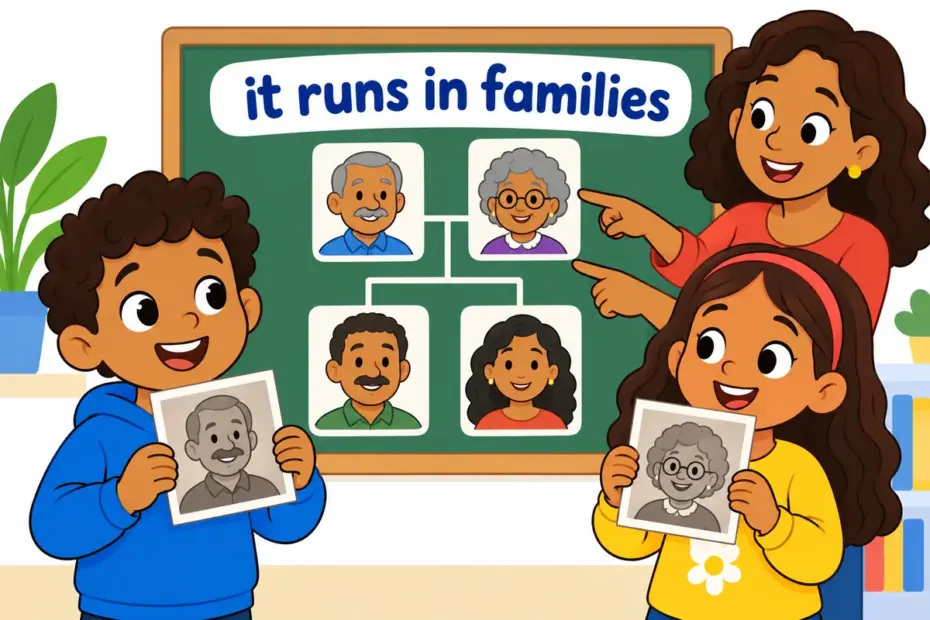
Hereditary is an adjective meaning passed down from parent to child through genes, or handed on by family succession, as in a hereditary title. To use hereditary in a sentence, place it before the noun it describes: a hereditary trait, a hereditary illness, a hereditary claim. The word always points to something received from an earlier generation.
Hereditary at a glance
- Hereditary is an adjective; its related forms are hereditarily and the noun heredity.
- It describes qualities, illnesses and titles received from an earlier generation.
- Hereditary stands before a noun or after a linking verb such as be, seem or run.
- The usual collocates are disease, condition, trait, title, peer and tendency.
- The commonest error is writing hereditary from; the verb inherited takes from.
What does hereditary mean?
Hereditary is an adjective meaning received from a parent or ancestor through genes, or passed on by an established right of succession. The Cambridge entry for hereditary records both the biological sense and the legal sense of a title or office. The biological sense answers a question about a body: why a condition or a resemblance appears in the same family line. The legal sense answers a question about a right: why a seat, a rank or a crown passes down a family rather than being elected.
A useful contrast is with inherited from a parent, which names the act of receiving and lets you say who the source was, while hereditary simply labels the quality of the thing itself. A trait can also be innate qualities present from birth without any family link at all, so the two words are not interchangeable.
| Sense | Plain meaning | Example sentence |
|---|---|---|
| Biological | Passed through genes from parent to child | The clinic screens for several hereditary conditions. |
| Succession | Passed down by right within a family | The estate followed a hereditary rule of inheritance. |
| Family resemblance | Appearing across several generations | A hereditary resemblance runs through the old photographs. |
One limitation is worth stating plainly. Hereditary does not mean inevitable or fixed. A hereditary condition may never appear in a particular person, and many family traits come from shared habits rather than from genes. When a doctor is unsure of the route, inherited is the more careful word, because it says only that something came from a relative and does not claim a mechanism.
How do you use hereditary in a sentence?
The adjective either sits in front of the noun it judges or follows a linking verb that states the nature of something. Five patterns cover almost every real sentence.
| Pattern | Example | What it signals |
|---|---|---|
| hereditary + noun | She carries a hereditary condition. | Labels the thing that is passed down. |
| linking verb + hereditary | The unusual palate is hereditary. | States the nature of the subject after be, seem or run. |
| hereditary + title, peer or claim | The duke held a hereditary seat. | Marks succession rather than biology. |
| not / non-hereditary | The tumour is not hereditary. | Denies the genetic route explicitly. |
| strongly / highly hereditary | Height is strongly hereditary. | Adds degree to the genetic claim. |
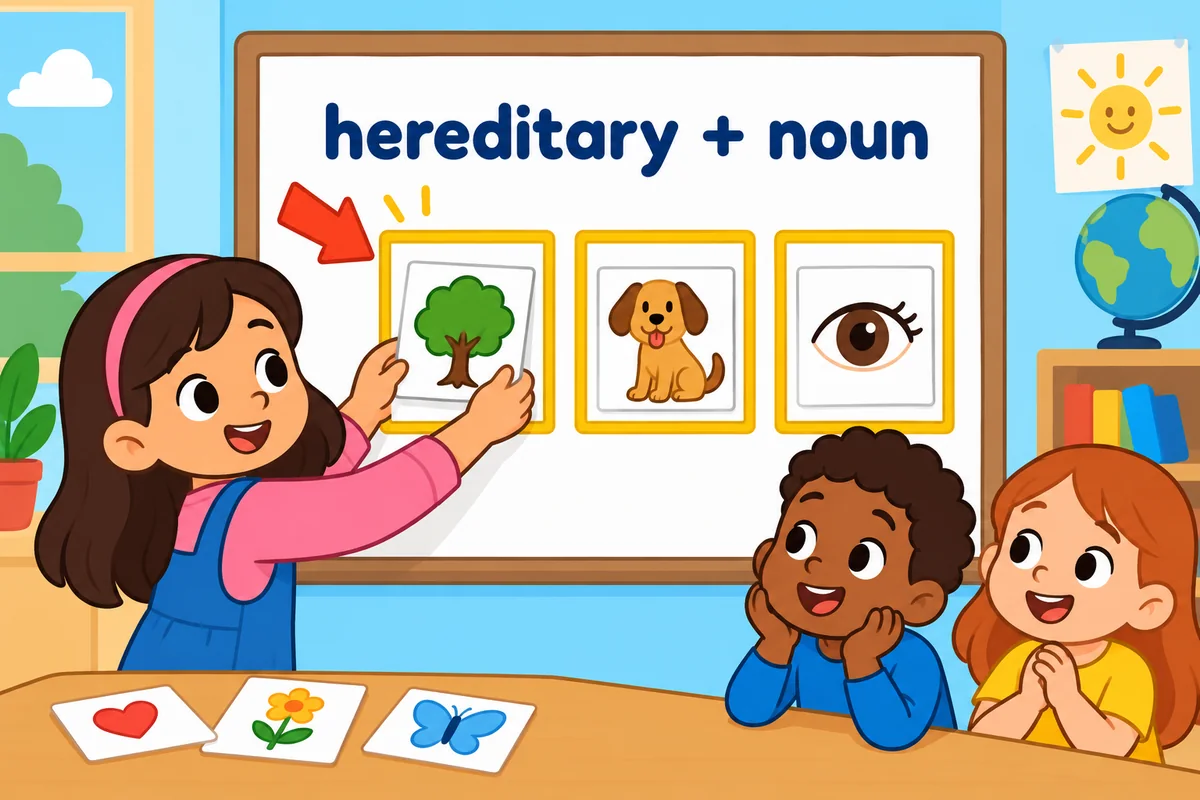
Hereditary in a sentence: examples across contexts
Hereditary moves between medicine, law and everyday talk, but it always claims a line of descent. Each example below names the thing that has been passed down.
| Context | Example sentence | Why this works |
|---|---|---|
| Classroom | The class learned that eye colour is a hereditary trait. | Names one concrete feature, not the whole person. |
| Medical writing | Doctors asked whether the clotting disorder was hereditary. | Puts the adjective after a linking verb to test the claim. |
| Workplace email | Our insurer covers testing for hereditary illnesses. | Uses it as a plain qualifier inside a practical sentence. |
| News report | The report traced the title to a hereditary line of earls. | Applies the word to succession rather than genes. |
| Legal writing | The charter replaced a hereditary seat with an elected one. | Contrasts hereditary with elected to define the change. |
| Academic writing | Researchers warned against treating poverty as hereditary. | Flags a disputed claim by putting it after the verb. |
| Conversation | Their musical talent looks hereditary. | Softens the claim with looks, which keeps it a guess. |
| Genealogy | A hereditary surname passed through six generations. | Shows the word attached to a name that travels down a line. |
Notice that every example points to something specific: a condition, a title, a surname, a talent. The word loses its force when it is aimed at a whole person rather than at a named trait.
Hereditary vs inherited
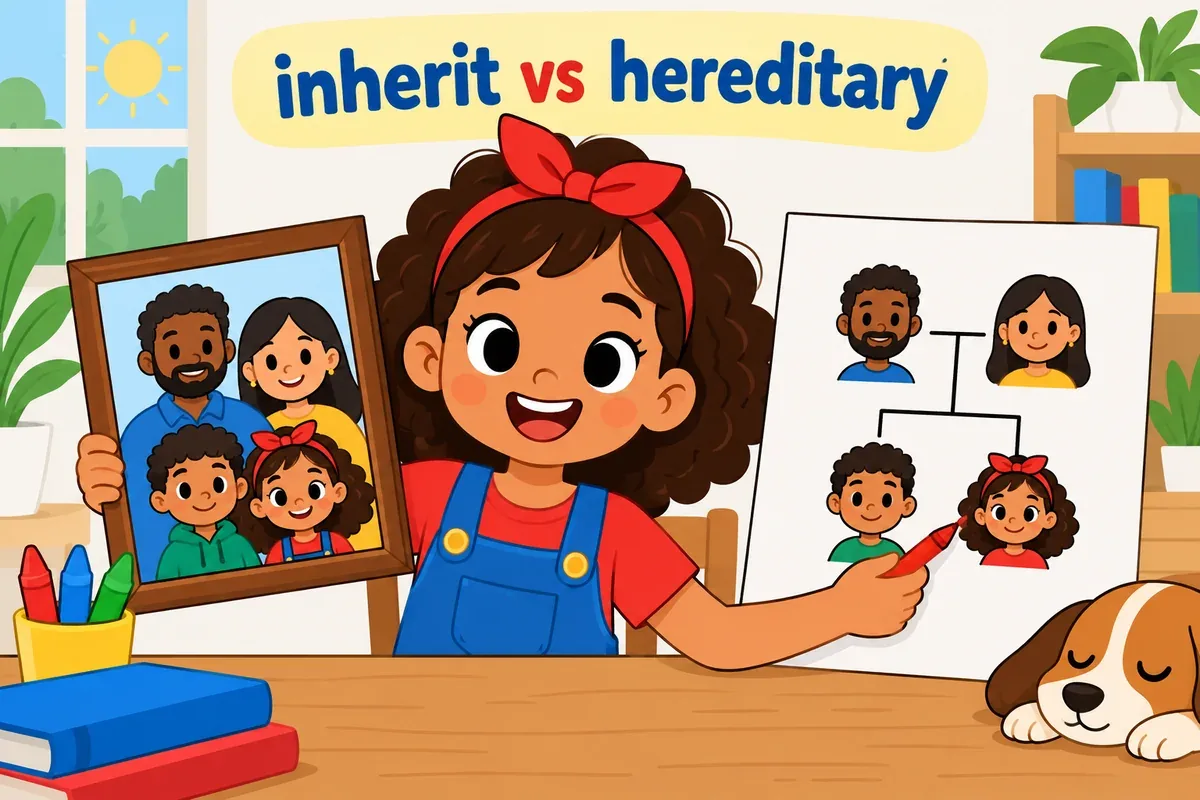
Hereditary and inherited both describe something received from an earlier generation, but they do different grammatical work. Hereditary is an adjective that describes the thing, while inherited is a verb form that names the act and usually keeps the source in view.
| Attribute | hereditary | inherited |
|---|---|---|
| Core meaning | Passed down through genes or family right | Received from a particular source |
| Part of speech | Adjective | Past participle and adjective |
| Focus | The quality of the thing | The act and its source |
| Typical subject | Condition, trait, title, seat | Money, a house, a habit, a watch |
| Register | Formal, scientific and legal | Neutral and everyday |
| Example | The condition is hereditary. | She inherited the condition from her mother. |
Verdict: choose hereditary when you want to describe the nature of a trait or right, and inherited when you want to name who it came from. What genes carry is transmitted through families from one generation to the next. A hereditary condition is inherited from someone, but a family recipe is inherited without ever being hereditary.
Word forms and grammar of hereditary
Hereditary belongs to a small family. The noun the noun heredity names the process, while the adjective describes the result. The adverb is rare and the adjective itself never takes a plural.
| Form | Part of speech | Example |
|---|---|---|
| hereditary | adjective | A hereditary condition runs in the family. |
| heredity | noun | Heredity explains much of the resemblance. |
| hereditarily | adverb, rare | The trait is hereditarily linked to one line. |
| hereditarian | noun and adjective, technical | Hereditarian theories once dominated the debate. |
| hereditarys | non-standard | Do not pluralise the adjective; write hereditary traits instead. |
Common mistakes with hereditary
- Incorrect:
The disease is hereditary from her father.Correct: The disease was inherited from her father. Rule: hereditary describes the condition; inherited from names the source. - Incorrect:
Hereditary is a noun.Correct: Heredity is the noun and hereditary is the adjective. Rule: Keep the -ary ending for the describing word. - Incorrect:
He has a hereditary.Correct: He has a hereditary condition. Rule: An adjective needs its noun, because hereditary cannot stand alone. - Incorrect:
The crown is inheriting.Correct: The crown is hereditary. Rule: Use the adjective for a right fixed by succession, not a progressive verb. - Incorrect:
Allergies are hereditary by the environment.Correct: Allergies are hereditary, though the environment also matters. Rule: hereditary marks the genetic route only, so it cannot take by as its agent.
Practice using hereditary
Work through the six items, then read the reasoning rather than only the answer.
- Fill the gap: The doctor explained that the condition was ______.
- Choose the better word: For a watch that came from a grandparent, (hereditary / inherited) is correct.
- Correct the error: The illness is hereditary from my uncle.
- Build a sentence: use hereditary title about a royal family.
- Spot the register: which belongs in a medical report — a hereditary disorder, or something that runs in the family?
- Rewrite with a noun: The genes she received shape her height. Use heredity.
Answers
- hereditary — the adjective follows the linking verb was and describes the condition.
- inherited — the watch came from a named relative, so the verb form fits.
- The illness was inherited from my uncle — inherited from names the source.
- Model answer: The young prince was born with a hereditary title.
- A hereditary disorder — a medical report prefers the precise adjective to a casual phrase.
- Heredity shapes her height — the noun names the process, not the trait.
The bottom line
Use hereditary in a sentence to say that a trait, condition or right has come down from an earlier generation, and place it before the noun it describes. Two nuances decide most sentences: the word covers both genes and succession, and it does not promise that the trait will appear. Where you want to name who something came from, the plainer inherited from is the safer choice.
Frequently asked questions about hereditary
Is hereditary the same as genetic?
Hereditary and genetic overlap but are not identical. Hereditary means passed down within a family, whether through genes or through a right of succession. Genetic means relating to genes specifically, so a genetic test looks at DNA. A hereditary condition is genetic, but a hereditary title has nothing to do with genes.
Can a hereditary condition skip a generation?
Yes, a hereditary condition can appear to skip a generation when a carrier does not develop it but still passes it on. The trait is present in the family line even though no symptom shows in one person. That is why doctors ask about grandparents as well as parents when they take a family history.
What is the noun form of hereditary?
The noun is heredity, which names the passing of qualities from parents to children. The adjective hereditary describes a particular trait or right, and the adverb hereditarily is rare. Adding an s to the adjective, as in hereditarys, is a common error because adjectives do not take plurals.
Is hereditary used for titles as well as genes?
Hereditary is used for both. In a medical sentence it describes a condition passed through genes, and in a legal or royal sentence it describes a title, seat or rank that passes down a family. The surrounding noun tells you which sense is meant, because the adjective itself carries both.
Have you ever wondered about the traits and characteristics passed down through generations in your family? These hereditary qualities are patterns of genetic information that are inherited from our parents and ancestors.
Hereditary traits can include physical features, such as eye color or hair texture, as well as predispositions to certain health conditions or even personality traits. Understanding the concept of heredity can provide insight into why individuals in the same family may share similar traits or tendencies.
7 Examples Of Hereditary Used In a Sentence For Kids
- Hereditary traits are passed down from parents to children.
- You may have hereditary features that look like your family members.
- Some animals have hereditary traits that help them survive in the wild.
- Hereditary diseases can sometimes run in families.
- It is important to understand your hereditary background.
- Plants can also have hereditary traits that make them unique.
- Learning about hereditary characteristics can be interesting and fun.
14 Sentences with Hereditary Examples
- Understanding the concept of hereditary traits is essential for biology students in college.
- Many students in India study the hereditary patterns of diseases in their genetics class.
- Hereditary factors play a significant role in determining a person’s susceptibility to certain health conditions.
- College students often explore the impact of hereditary characteristics on physical appearance.
- Learning about hereditary traits can help students comprehend genetic disorders better.
- Exploring the history of hereditary diseases in a family can be crucial for medical students.
- Genetics courses in college delve deep into the science behind hereditary transmission.
- Indian students often study the hereditary factors that contribute to mental health disorders.
- Understanding hereditary traits can aid students in predicting potential health issues.
- College laboratories conduct experiments to observe hereditary traits in different organisms.
- Hereditary studies are imperative for students aiming to pursue a career in genetic counseling.
- Analyzing hereditary markers can help students track similarities and differences between family members.
- Research projects on hereditary characteristics provide valuable insights for college students.
- College seminars on hereditary inheritance offer a platform for students to discuss and debate various genetic concepts.
How To Use Hereditary in Sentences?
Hereditary is an adjective that describes something that is passed down through generations in a family, such as traits, characteristics, or diseases. To use Hereditary in a sentence, start by identifying the noun that you want to describe as being inherited from one’s ancestors.
For example:
– Trait: “Hereditary traits like eye color and hair texture can be seen in multiple generations of the family.”
– Characteristic: “The royal family’s hereditary leadership style has been consistent for centuries.”
– Disease: “It is important to know if a certain health condition is hereditary in your family in order to take preventive measures.”
When using Hereditary in a sentence, it is essential to ensure that the context makes it clear that you are referring to something that is passed down genetically within a family lineage. By including this adjective in your sentence, you are highlighting the genetic aspect of the trait, characteristic, or disease being discussed.
In summary, remember that Hereditary is used to describe something that is inherited from one’s ancestors in a family. Incorporate it into your sentence to emphasize the genetic transmission of a particular attribute or condition from one generation to another.
Conclusion
In conclusion, hereditary characteristics are traits or conditions that are passed down from one generation to the next through genetic inheritance. These traits can include physical attributes, such as eye color or height, as well as predispositions to certain diseases or conditions. Understanding the role of heredity in determining these traits is essential in fields like genetics and medicine, as it can help predict and manage health risks based on familial history.
By studying sentences with the keyword “hereditary,” we can grasp the significance of genetic inheritance and its impact on human traits and conditions. Recognizing the influence of heredity in shaping individuals can provide valuable insights into various aspects of human health and development, offering opportunities for preventive healthcare and tailored treatment approaches based on an individual’s genetic makeup.