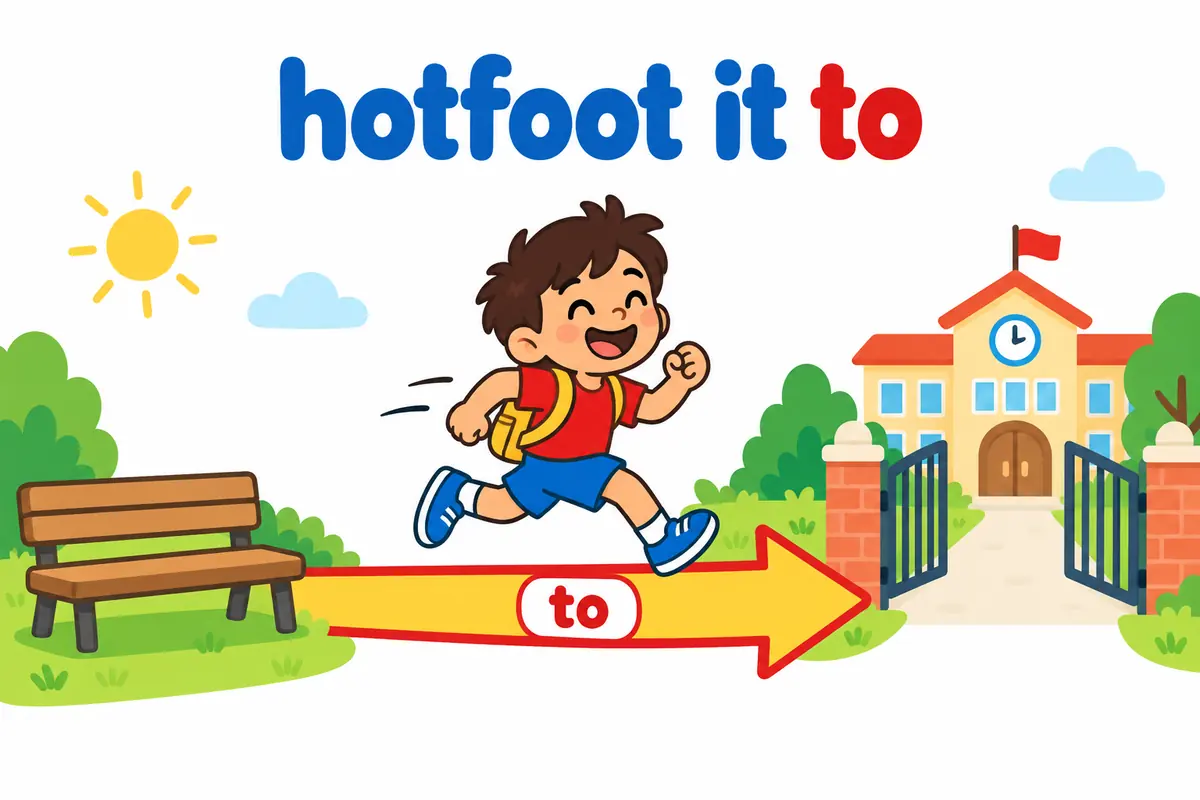
Hotfoot it means to go somewhere quickly, and the phrase is almost always completed by a destination. To use hotfoot it in a sentence, keep the two fixed words together and add to, over to or down to: “We hotfooted it to the station.” Removing it or the destination leaves a sentence that no longer sounds English.
Hotfoot it at a glance
- Hotfoot it is a fixed, informal phrase meaning to hurry somewhere on foot.
- It is completed by a destination, usually with to: hotfoot it to the door.
- The past tense is hotfooted it and the continuous form is hotfooting it.
- It suits speech, stories and light journalism rather than formal reports.
- The commonest error is dropping it or leaving out the destination.
What does hotfoot it mean?
Hotfoot it is an informal phrase meaning to hurry somewhere on foot. The Cambridge entry for hotfoot it treats the two words as one unit, and the Merriam-Webster entry defines it as to go in haste. The phrase names both speed and a destination, so it answers the question where did you rush to. Old stories often use it of a messenger or a servant who must move at once, and that spoken, slightly theatrical flavour survives in the phrase today.
| Sense | Plain meaning | Example sentence |
|---|---|---|
| Go quickly | Move fast towards a place | We hotfooted it to the bus stop. |
| Act promptly | Hurry to deal with something | She hotfooted it to the manager’s office. |
One limitation matters. Hotfoot it is playful and slightly old-fashioned, so it is the wrong phrase for a serious emergency. A fire notice would never tell people to hotfoot it outside; it would say leave quickly by the nearest exit. Keep the phrase for light, spoken and narrative writing. Where speed is competitive or dramatic, race is the livelier verb.
The phrase is deliberately vivid: it pictures feet growing hot from running. That image is why it suits storytelling and light journalism, and why it would sound odd in a legal document, where a neutral verb such as attend or proceed serves better.
How do you use hotfoot it in a sentence?
The phrase is fixed, so only the tense of hotfoot and the destination change. Five patterns cover almost every real use, and each one answers the question where someone went in a hurry.
| Pattern | Example | What it signals |
|---|---|---|
| hotfoot it + to + place | He hotfooted it to the office. | The standard pattern, naming the destination. |
| hotfoot it + over to + place | We hotfooted it over to the park. | Adds a short, casual distance. |
| hotfoot it + down or back + to + place | They hotfooted it back to the car. | Names direction as well as place. |
| hotfoot it + before or after + clause | Hotfoot it before the shop closes. | An imperative that adds urgency. |
| had better + hotfoot it | You had better hotfoot it. | Warns someone to move now. |
Because the phrase is intransitive, it never takes an object: you hotfoot it to a place, not hotfoot it a place. The destination can be a building, a person or an event, and the same pattern survives every tense.
Hotfoot it in a sentence: examples across contexts
The phrase keeps its playful speed in every register, and the twelve sentences below show how the destination changes while the fixed words stay put.
| Context | Example sentence | Why this works |
|---|---|---|
| Classroom | We hotfooted it to the library before the bell. | A clear destination and a reason. |
| Workplace email | I had to hotfoot it to the meeting after the call ran long. | The phrase lightens a work anecdote. |
| News report | Shoppers hotfooted it to the tills on the final day. | A light, lively verb for a feature story. |
| Storytelling | The children hotfooted it down the lane to the fair. | Direction and destination together. |
| Sports report | The winger hotfooted it back to defend. | Speed across the pitch. |
| Everyday speech | I am going to hotfoot it home before it rains. | A spoken, future use. |
| Travel writing | We hotfooted it to the harbour for the last boat. | Urgency tied to a timetable. |
| Humour column | He hotfooted it out of the room when the singing began. | The phrase suits comic timing. |
| Diary entry | Hotfoot it to the postbox, the letter must go today. | An imperative with a deadline. |
| Narrative prose | She hotfooted it up the stairs two at a time. | Adds pace to a description. |
| Historical fiction | The messenger hotfooted it to the castle. | The phrase’s slightly old-fashioned flavour. |
| Casual message | Hotfoot it over, the film is about to start. | A friendly, direct instruction. |
| Family note | We hotfooted it to the airport when the call came. | Shows the phrase on a real errand. |
| School newsletter | Hotfoot it to the hall for the science show. | A cheerful imperative that invites readers. |
| Community notice | Hotfoot it to the fete before the cakes run out. | A playful call to a local event. |
The imperative rows show the phrase’s spoken origin, since it is often a command to move now. When the movement is a sudden start, bolt is sharper and more physical than hotfoot it. A careful writer keeps one destination per sentence, because stacking places muddles the picture.
Hotfoot it vs hurry and rush
Hotfoot it, hurry and rush all mean to move fast, but they differ in formality and grammar. hurry and rush can be transitive or intransitive; hotfoot it is a fixed intransitive phrase that requires a destination and a light tone.
| Attribute | hotfoot it | hurry | rush |
|---|---|---|---|
| Register | Informal and playful | Neutral | Neutral to urgent |
| Grammar | Fixed phrase, intransitive | Verb, transitive or intransitive | Verb, transitive or intransitive |
| Destination needed | Usually yes, with to | No | No |
| Typical object | None | A person can be hurried | A person or task can be rushed |
| Tone | Lively, slightly old-fashioned | Practical | Pressing |
| Typical use | Speech and stories | Everyday writing | Work and warnings |
Verdict: choose hotfoot it for a lively, spoken description, hurry for plain everyday speed, and rush when the speed carries pressure or a deadline. The three also differ in what they imply about the reason: hotfoot it suggests eagerness, hurry suggests necessity, and rush suggests that time itself is short.
Word forms and grammar of hotfoot it
The phrase is fixed, so only the verb hotfoot changes shape. The pronoun it never varies, and no words may be inserted between hotfoot and it. That rigidity is the clearest sign that the two words work as a single unit rather than as a verb and its object.
| Form | Part of speech | Example |
|---|---|---|
| hotfoot it | base phrase | We should hotfoot it to the gate. |
| hotfooted it | past phrase | They hotfooted it to the bus. |
| hotfooting it | continuous phrase | She is hotfooting it down the road. |
| hotfoot (alone) | verb, rare without it | He hotfooted across the yard. |
| hotfoot (as noun) | noun, different meaning | A hotfoot is a practical joke. |
Verbs such as dash and fly also mean to move fast, but neither carries the phrase’s spoken, humorous edge. In speech the base form often follows going to or had better, which keeps the phrase in its natural spoken habitat.
Common mistakes with hotfoot it
- Incorrect:
We hotfooted to the station.Correct: We hotfooted it to the station. Rule: The pronoun it is part of the fixed phrase and cannot be dropped. - Incorrect:
She hotfooted it quickly.Correct: She hotfooted it to the office. Rule: Speed is already inside the phrase, so add a destination rather than an adverb. - Incorrect:
Hotfoot it the shop.Correct: Hotfoot it to the shop. Rule: A destination follows to; without it the sentence is incomplete. - Incorrect:
He will hotfoot it in a formal report.Correct: He will rush in a formal report. Rule: Hotfoot it is informal and sounds out of place in official writing.
Practice using hotfoot it
Work through the eight items, then read each answer for the reason, not only the key.
- Fill the gap: We had to ______ it to the platform before the doors shut.
- Choose the better word: In the emergency notice, staff must (hotfoot it / leave) by the nearest exit.
- Correct the error: They hotfooted to the market.
- Build a sentence: use hotfoot it to about getting to a birthday party on time.
- Spot the register: which fits a story for children – the fox hotfooted it to the den, or the fox proceeded rapidly?
- Rewrite in the past: We hotfoot it to the gate. Change the tense.
- Add a destination: The pupils hotfooted it. Complete the sentence.
- Replace the phrase: She hotfooted it to the office. Use hurry instead.
Answers
- hotfoot – the full fixed phrase is hotfoot it.
- leave – an emergency notice needs formal, neutral wording.
- They hotfooted it to the market – the pronoun it is required.
- Model answer: We hotfooted it to the party so we would not miss the cake.
- The fox hotfooted it to the den – a children’s story welcomes the playful phrase.
- We hotfooted it to the gate – the past phrase changes only hotfoot.
- Model answer: The pupils hotfooted it to the playground.
- She hurried to the office – hurry keeps the speed without the informal tone.
The bottom line
Use hotfoot it in a sentence for a lively, informal way of saying that someone hurried somewhere, and always name the destination with to. The two points that decide most uses are that the pronoun it is fixed and cannot be dropped, and that the phrase is too playful for formal or emergency writing. In a serious context, rush carries urgency without the joke.

Frequently asked questions about hotfoot it
Is hotfoot it formal or informal?
Hotfoot it is informal and slightly old-fashioned, so it belongs in speech, stories and light feature writing. A formal report would use hurry or rush instead. The phrase also carries a playful tone, which makes it a poor fit for emergency instructions or serious news.
Why does hotfoot it include the word it?
The pronoun it is a fixed part of the phrase, so hotfoot it works like a single verb. Dropping it produces the non-standard we hotfooted to the station. Think of it as permanently attached, the way certain other English phrases keep a fixed pronoun.
What is the past tense of hotfoot it?
The past tense is hotfooted it, as in we hotfooted it to the bus. The continuous form is hotfooting it, as in she is hotfooting it down the road. Only the verb hotfoot changes; the pronoun it stays exactly as it is.
Does hotfoot it need a destination?
In practice, yes. Hotfoot it normally takes a destination with to, such as hotfoot it to the door. Without one the sentence feels unfinished, because the phrase answers where someone hurried. You can add direction with over to, back to or down to for extra detail.