Indigent is an adjective meaning very poor and lacking the basic necessities of life. To use indigent in a sentence, place it before the person or group it describes: “The clinic offers free care to indigent patients.” The word belongs to formal, legal and official writing.
Indigent at a glance
- Indigent is an adjective meaning very poor; it also works as a collective noun for needy people.
- The usual pattern is indigent plus a person or group noun, as in indigent families.
- The register is formal, legal and official rather than conversational.
- The related noun is indigence, and care for the indigent is a common set phrase.
- The commonest error is confusing indigent with indignant, which means angry at unfair treatment.
What does indigent mean?
Indigent is an adjective meaning very poor and lacking basic necessities. The Cambridge entry for indigent records the sense of being in need. In everyday speech poor is the plain word, while indigent belongs to official writing about legal aid, hospitals and relief. A family that is destitute lacks even the basics, which is a harsher state than being short of money.
| Sense | Plain meaning | Example sentence |
|---|---|---|
| Very poor | Lacking the means for basic needs | The charity helps indigent families. |
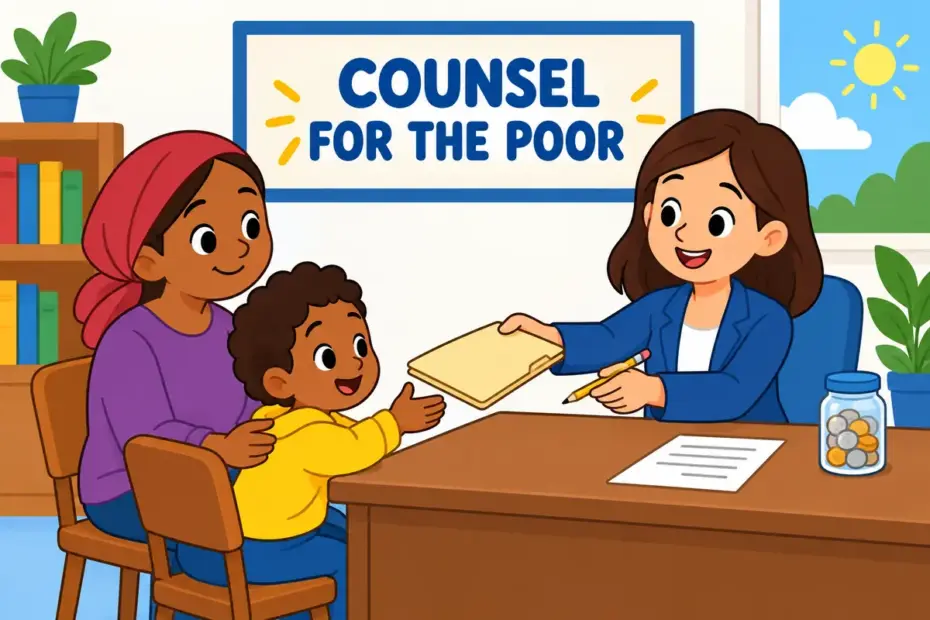
| Needy person | A person in poverty, used as a noun | The court appoints counsel for the indigent. |
Indigent is not a synonym for homeless or unemployed. A person can be indigent while housed, and can hold a job while still unable to afford essentials, so the word marks poverty of means rather than housing or work status.
How do you use indigent in a sentence?
Indigent almost always sits before a person noun, or stands alone as a collective noun after the.
| Pattern | Example | What it signals |
|---|---|---|
| adjective before plural noun | The fund supports indigent families. | A group defined by poverty |
| adjective before a person noun | An indigent patient asked for help. | One person in need |
| the plus indigent as a noun | Free care is offered to the indigent. | Needy people as a class |
| legal collocation | The judge reviewed the indigent defendant’s plea. | A standard legal phrase |
| predicative use | The household was indigent after the flood. | A state reached by an event |

Indigent in a sentence: examples across contexts
| Context | Example sentence | Why this works |
|---|---|---|
| Legal writing | The court appointed counsel for the indigent defendant. | The standard legal collocation. |
| Hospital policy | The clinic offers free care to indigent patients. | Adjective before the person noun. |
| News report | Rising rents have left many elderly residents indigent. | Predicative use after the verb. |
| Charity appeal | Donations will support indigent families through the winter. | Group noun in a direct appeal. |
| Historical essay | The parish once levied a rate to relieve its indigent poor. | Formal, older register. |
| Sociology paper | Indigent households spend a larger share of income on fuel. | Technical, neutral tone. |
| Court filing | Counsel was assigned because the appellant was indigent. | Legal register, predicative. |
| Government report | The scheme targets indigent applicants without savings. | Official and precise. |
| Memoir | My grandmother was never indigent, but she counted every coin. | Contrasts poverty of means with thrift. |
| Editorial | A society is judged by how it treats the indigent. | Collective noun in a general claim. |
A region that has been impoverished by war may be called indigent in a formal report, and a poverty-stricken district faces the same shortage of basics.
Indigent vs indignant
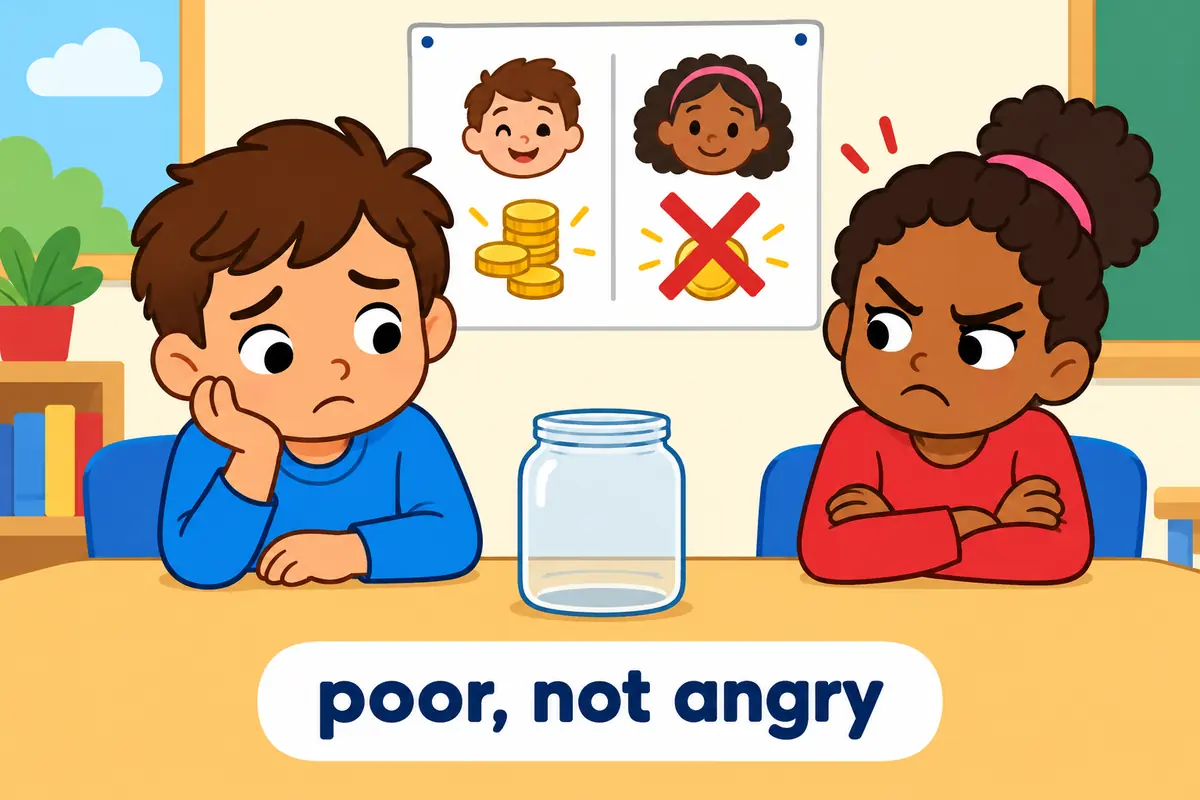
Indigent and indignant look alike but describe completely different states.
| Attribute | Indigent | Indignant |
|---|---|---|
| Meaning | Very poor | Angry at unfair treatment |
| Part of speech | Adjective, also a noun | Adjective only |
| What it describes | Money and means | Emotion and pride |
| Example | an indigent patient | an indignant customer |
| Register | Formal, legal, official | Everyday and formal both |
Travellers left penniless abroad often seek help from a consulate, and they may feel indignant about it, but only the lack of money makes them indigent. Choose indigent for poverty and indignant for anger, because the two words share four letters and nothing else.
Word forms and grammar of indigent
| Form | Part of speech | Example |
|---|---|---|
| indigent | adjective | An indigent family needs support. |
| the indigent | collective noun | The charity serves the indigent. |
| indigence | noun | Indigence is hard to escape. |
| indigency | noun, legal | The court assessed his indigency. |
| indigently | adverb, rare | He lived indigently for a year. |
| indigence family | non-standard | Write an indigent family needs support. |
The noun indigence names the state rather than the person, and legal writing uses indigency when a court decides who qualifies for free counsel.
Common mistakes with indigent
- Incorrect:
The customer was indigent about the delay.Correct: The customer was indignant about the delay. Rule: indignant means angry at unfair treatment, while indigent means poor. - Incorrect:
The sleepy student was indigent and missed the lecture.Correct: The sleepy student was indolent and missed the lecture. Rule: indolent means lazy; indigent means poor. - Incorrect:
She was indigent of money.Correct: She was indigent, or short of money. Rule: indigent is never followed by of. - Incorrect:
The charity helps indegent people.Correct: The charity helps indigent people. Rule: the word begins with indig, not indeg. - Incorrect:
An indigence family needs support.Correct: An indigent family needs support. Rule: indigent is the adjective and indigence is the noun.
Practice using indigent
- Fill in the blank: The court appointed counsel for the ______ defendant.
- Choose the better word: The refund delay left her (indigent / indignant).
- Correct the error: The charity helps indigence families.
- Build a sentence: use indigent about a family that has lost its savings.
- Spot the register: which line belongs in a legal filing? (A) The appellant is indigent and seeks assigned counsel. (B) The appellant is broke and wants a free lawyer.
- Fill in the blank: Free care is offered to the ______.
- Choose the better word: After the flood the household was (indigent / indolent) for months.
Answers
- indigent, because the adjective sits before the person noun defendant.
- indignant, because she is angry about unfair treatment, not poor.
- The charity helps indigent families, because indigent is the adjective.
- The family was indigent after losing its savings, using the adjective predicatively.
- A, because the formal legal register suits a court filing.
- indigent, because the plus adjective forms a collective noun here.
- indigent, because the household lacks money rather than motivation.
The bottom line
Indigent in a sentence works as a formal adjective before a person or group, as in an indigent defendant, and as a collective noun in the indigent. It names poverty of means rather than homelessness or idleness, which is why it lives in legal and official writing. Reach for poor in ordinary speech and keep indigent for the register that suits it.
Frequently asked questions about indigent
Is indigent a polite word to use?
Indigent is formal and neutral rather than insulting, and it appears in legal and medical writing about people who cannot pay. In conversation it can sound distant or bureaucratic, where poor or struggling sounds more natural. Use it when the register is official and the focus is on financial need.
What is the noun form of indigent?
The noun is indigence, which names the state of being very poor. Legal writing also uses indigency, especially when a court decides whether a defendant qualifies for free counsel. The adjective indigent can itself act as a noun, as in care for the indigent, where it refers to needy people as a group.
Can indigent describe an organization?
It usually describes people, families or households rather than organizations. A business in trouble is called struggling, failing or insolvent, not indigent, because the word implies personal poverty and unmet basic needs. Keep it for individuals and for groups of people.
What is a synonym for indigent that is less formal?
Poor, penniless, broke and hard up all express the same idea in plainer language. Poor is the general word, penniless stresses having no money at all, and broke is informal. Choose indigent when the writing is official and the other words would sound too casual.
Have you ever wondered what the term “indigent” means? In simple terms, an indigent person is someone who lacks the means to provide for themselves – often without even the basic necessities of life.
This word typically describes individuals who are extremely poor or destitute, often struggling to afford food, shelter, or healthcare. In many cases, indigent individuals rely on public assistance or charity to meet their most basic needs.
7 Examples Of Indigent Used In a Sentence For Kids
- Indigent means someone who needs help because they don’t have much money.
- Some people are indigent and may not have enough food to eat.
- We should help indigent people by giving them clothes and food.
- Let’s be kind to indigent people and share what we have with them.
- It’s important to show compassion and help indigent people in our community.
- We can donate toys and books to indigent children to make them happy.
- Remember to be caring and understanding towards indigent individuals who need our support.
14 Sentences with Indigent Examples
- Indigent students may qualify for scholarships and financial aid to help cover their educational expenses.
- Many college students in India struggle with being indigent due to the high cost of tuition and living expenses.
- It is important for universities to provide resources and support for indigent students to ensure they can succeed academically.
- Student organizations can organize fundraisers and donation drives to support indigent students in need.
- College campuses should have food pantries and resource centers to assist indigent students who are facing hunger and homelessness.
- Professors can offer extra tutoring and mentorship opportunities for indigent students who may need additional support.
- Campus employment programs can provide indigent students with part-time job opportunities to help them gain work experience and financial stability.
- It is crucial for colleges to create a welcoming and inclusive environment for indigent students to feel supported and valued.
- Online platforms and community forums can connect indigent students with valuable resources and networking opportunities to help them succeed in their academic journey.
- Student-led initiatives can raise awareness about the challenges faced by indigent students and advocate for policy changes to address these issues.
- Financial literacy workshops can empower indigent students to make informed decisions about budgeting and managing their finances during their college years.
- College counseling services can offer mental health support and resources for indigent students who may be facing additional stress and anxiety.
- Alumni networks can provide networking opportunities and mentorship for indigent students to help them navigate their academic and career goals.
- Campus housing programs can offer affordable housing options for indigent students to ensure they have a safe and stable living environment while pursuing their education.
How To Use Indigent in Sentences?
To use the word Indigent in a sentence, you can follow these simple steps:
-
Understand the Meaning: Before using Indigent, make sure you understand its meaning. Indigent refers to someone who is extremely poor and lacking basic necessities.
-
Choose the Right Context: Select a context where the word Indigent fits appropriately. For example, you can use it when talking about poverty, charity, or social issues.
-
Construct a Sentence: Once you have a context in mind, create a sentence that includes the word Indigent. For instance, “The local charity organization provides food and shelter for the indigent population in the city.”
-
Review Your Sentence: Before finalizing your sentence, ensure that Indigent is correctly used and the sentence conveys the intended meaning.
-
Practice Using the Word: To become more comfortable with using Indigent, try incorporating it into your everyday conversations or writing.
-
Expand Your Vocabulary: As you become more familiar with using Indigent, explore other synonyms and related words to enhance your language skills.
By following these steps, you can effectively incorporate Indigent into your vocabulary and communicate with clarity and precision.
Conclusion
In conclusion, the examples of sentences with the keyword “indigent” demonstrate its usage in describing individuals who are impoverished or in extreme financial need. These sentences illustrate the challenges and hardships faced by indigent populations, highlighting the importance of providing support and resources to those in need. By using the term “indigent” in discussions and writings, we can draw attention to social inequalities and call for action to address poverty and deprivation in our communities.
Overall, the sentences featuring the word “indigent” serve as a reminder of the struggles faced by the most vulnerable members of society. It is crucial to recognize and advocate for the needs of indigent individuals, ensuring that they have access to basic necessities and opportunities for a better quality of life. By acknowledging the existence of indigence and working towards solutions, we can strive for a more equitable and compassionate society.