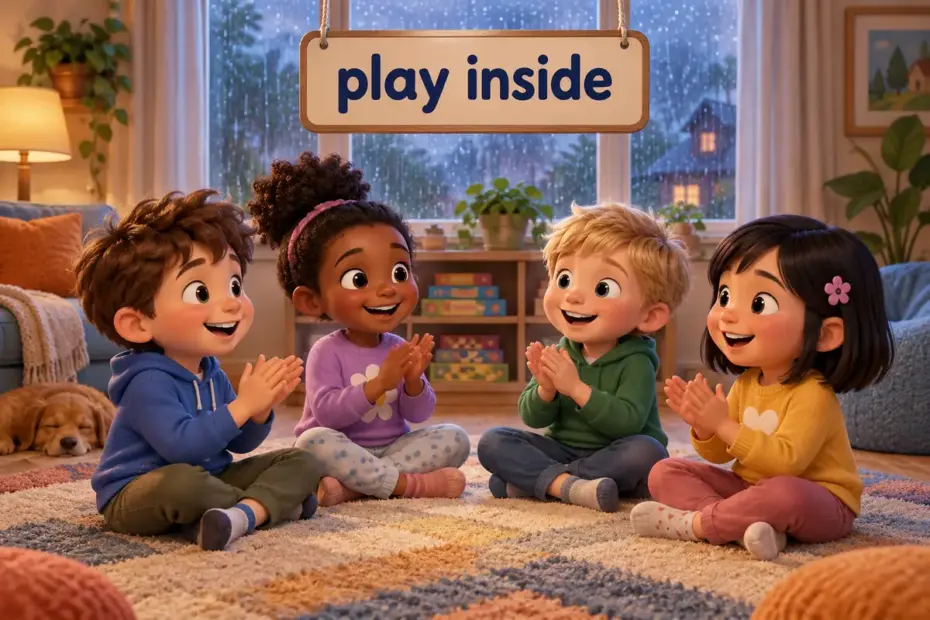
Indoor games for kids are the activities that keep young children playing, thinking and moving inside a room. They need few props, clear rules and a short turn, so the fun lasts until the game ends. “Let us play charades,” a child can suggest on a wet afternoon.
Indoor games for kids at a glance
- An indoor game is an activity with simple rules that children play inside a room.
- The usual starting pattern is let us play plus the name of the game.
- Charades, Simon says and musical chairs need almost no equipment.
- Short turns keep every child involved and reduce waiting and quarrels.
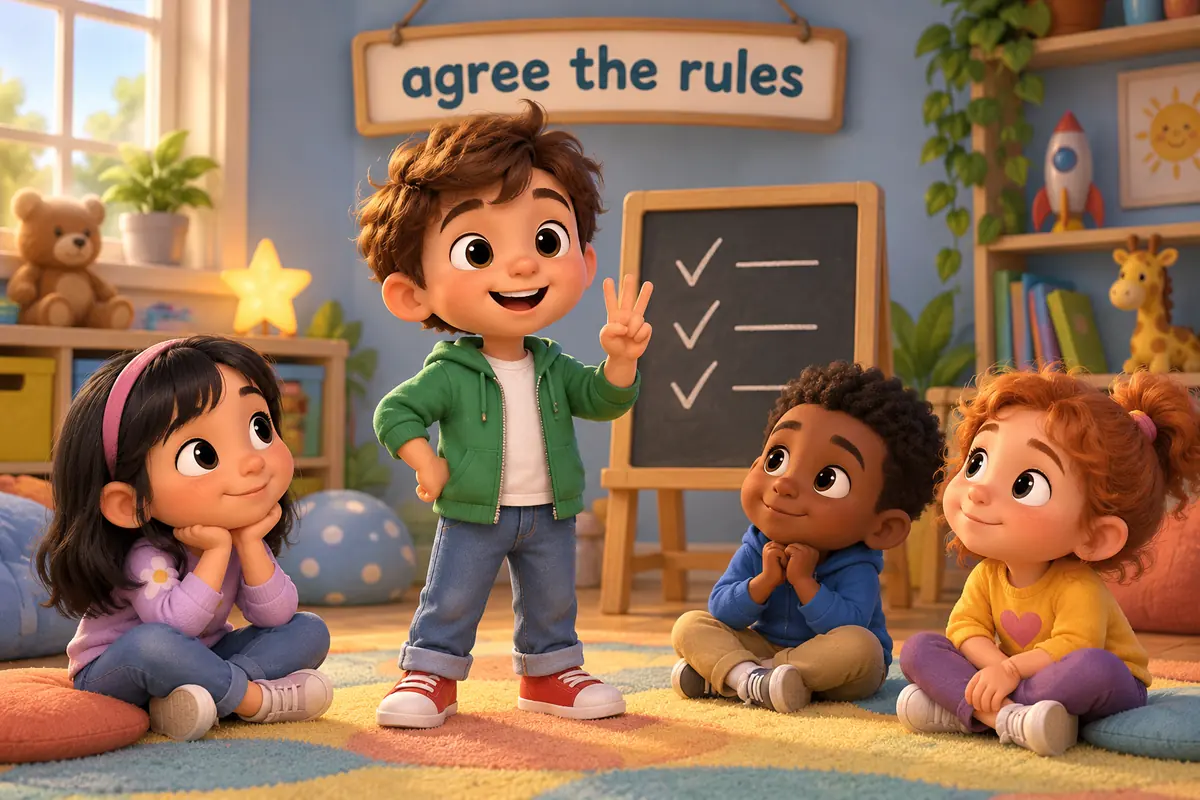
- The commonest mistake is starting a game before agreeing on the rules.
What are indoor games for kids?
Indoor games for kids are activities with clear rules that a child can play in a living room, a classroom or a hall. Most of them use movement, memory or guessing, and most need only a chair, a card or a voice. The games below are the ones children meet first, and each teaches a different small skill.
| Game | How it works | Example sentence |
|---|---|---|
| Charades | act a word without speaking | She acted a lion in charades. |
| Simon says | follow an order only after the right words | Simon says touch your nose. |
| Musical chairs | sit down when the music stops | He found the last chair in time. |
| Hide and seek | one child counts while the others hide | I hid behind the sofa. |
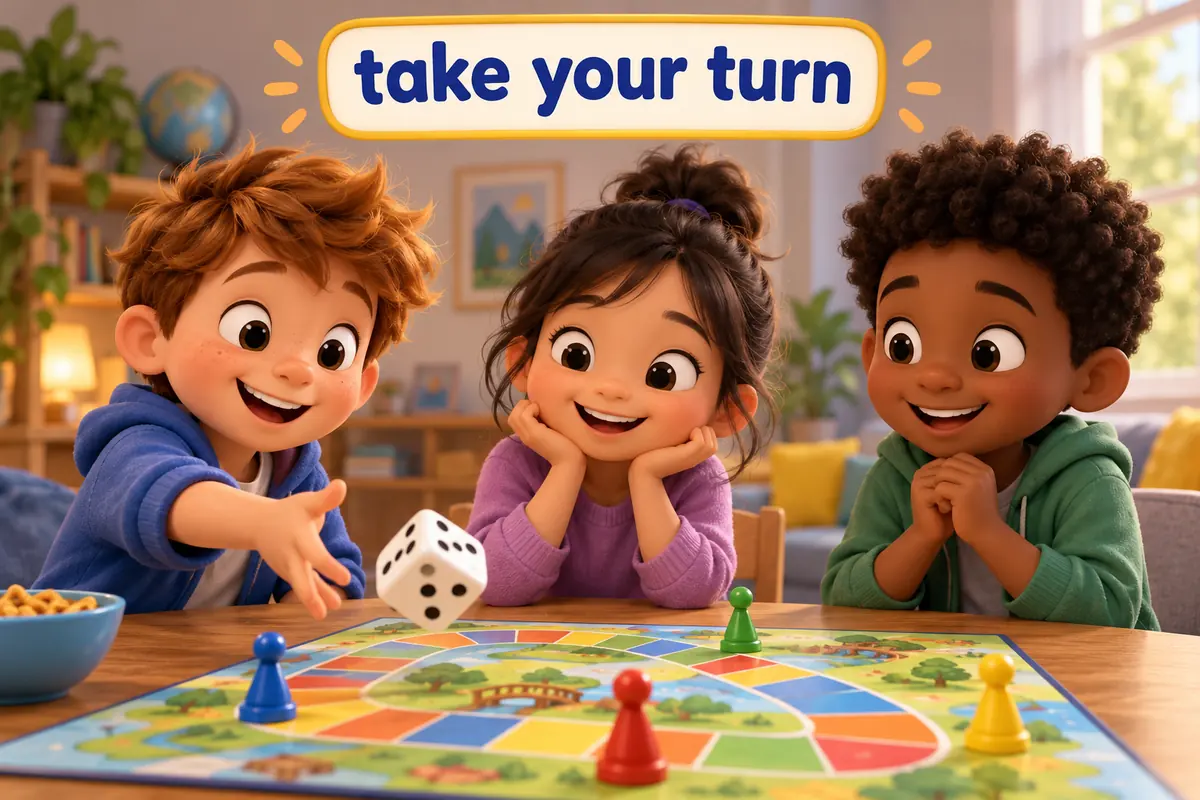
| Board games | move a piece and follow the rules | We played a board game after dinner. |
| Treasure hunt | follow clues to find a hidden prize | The treasure hunt led to the kitchen. |
One honest caution is worth stating: an indoor game is only as good as its rules, and a game with no agreed rules ends in tears. A short set of three or four rules is enough for young children, and the rules should be said out loud before the first turn. It also helps to keep the space clear, because indoor play in a small room needs a safe path.
How do you set up an indoor game?
Setting up a game follows a short pattern that tells everyone what to do and whose turn comes next. These frames keep a game fair and calm from the first minute.
| Pattern | Example | What it signals |
|---|---|---|
| Let us play + game | Let us play charades. | a shared suggestion |
| You are + role | You are the first one to guess. | assigns a turn |
| Take turns + verb | Take turns to roll the dice. | keeps the game fair |
| If you + verb, you + verb | If you speak, you lose a point. | states a rule |
| It is your + noun | It is your turn now. | names whose move is next |
Indoor games across contexts
The same few games work in many rooms, from a rainy-day home to a school hall. Children learn the words faster when they hear them in the middle of play, and pages such as adjectives for video games and a words for kids widen the language a child brings to a game.
| Context | Example sentence | Why this works |
|---|---|---|
| Rainy day at home | Let us build a den and hide inside. | uses the space creatively |
| Classroom break | Simon says stand on one foot. | a quick, quiet group game |
| Birthday party | Musical chairs came after the cake. | a party favourite for a crowd |
| Sleepover | We played charades in our pyjamas. | a calm game before bed |
| Grandparents visit | Grandpa won the board game. | a game for mixed ages |
| Waiting room | Let us play I spy while we wait. | a quiet, seated game |
| Car on a trip | We counted red cars as a game. | turns a long trip into fun |
| After-school club | The treasure hunt used five clues. | organises a group activity |
| Family evening | We took turns choosing the game. | teaches fair play |
| Wet lunch break | We played cards at the table. | a small space suits cards |
Which indoor game should you choose?
The right game depends on the space, the number of children and how much noise is welcome. A short comparison helps an adult choose fast.
| Situation | Better game | Weaker choice | Reason |
|---|---|---|---|
| Very small room | I spy | Hide and seek | a seated game needs no running |
| Lots of energy | Musical chairs | Board games | a moving game uses the energy |
| Quiet bedtime | Charades | Treasure hunt | charades can be calm and still |
| Mixed ages | Board games | Simon says | board games adjust to each player |
| One child alone | A puzzle or solitaire | A team game | a solo game needs no partner |
A game goes better when the adult plays too, because children copy the tone they see. Cheerful losing, taking turns and a short game length all teach fair play without a lecture. And a tidy-up song at the end turns the last chore into part of the fun, so the room is clear for the next activity.
Words and phrases linked to games
The word game sits inside a small family that helps a child talk about playing and winning. Young readers can pair playmate and scoreboard with compound words for kids, then describe the mood with b words for kids such as bright and busy.
| Word | Type | Example |
|---|---|---|
| play | verb and noun | We play indoors when it rains. |
| player | noun | Every player takes a turn. |
| rule | noun | The first rule is to take turns. |
| turn | noun | It is your turn to guess. |
| team | noun | Two teams played against each other. |
Common mistakes with game words
Mistake 1: starting without rules. Incorrect: Let us just play and see. Correct: Let us agree the rules first. Rule: a game needs clear rules before the first turn.
Mistake 2: confusing play and game. Incorrect: We played a play. Correct: We played a game. Rule: a game is the activity; play is the doing of it.
Mistake 3: using the wrong preposition. Incorrect: We played in charades. Correct: We played charades. Rule: play takes a direct object, with no preposition.
Mistake 4: saying it is my turn wrongly. Incorrect: It is me turn. Correct: It is my turn. Rule: the possessive my comes before the noun turn.
Mistake 5: writing all games as one word. Incorrect: hideandseek. Correct: hide and seek. Rule: this game name keeps three separate words.
Mistake 6: leaving out the third person s. Incorrect: She take a turn. Correct: She takes a turn. Rule: a singular subject takes a verb ending in s.
Practice using indoor game words
- Fill in the blank: Let us play ___ , and act the animals without speaking.
- Choose the better game: (I spy / Hide and seek) for a very small, quiet room.
- Correct the error: We played in a board game after dinner.
- Build a sentence: invite a friend to a game and say whose turn is first.
- Spot the register: which sentence suits a classroom, (a) Take turns, please, or (b) Give me the dice?
- Fill in the blank: Simon ___ touch your toes.
Answers
- charades, because it is acted without speaking.
- I spy, because it is a seated game that needs no space.
- We played a board game after dinner; play takes a direct object with no preposition.
- Let us play a game, and you can take the first turn.
- (a), because a classroom instruction uses please and a calm tone.
- says, because Simon says is the fixed opening of the game.
The bottom line
Indoor games for kids turn a small room into a place to play, as long as the rules are clear and the turns are short. Charades, Simon says, musical chairs and board games need almost no equipment, and the useful pattern is let us play plus the name. Agree the rules first and keep the mood cheerful, and the game stays fun for everyone.
Frequently asked questions about indoor games for kids
What indoor games need no equipment?
Charades, Simon says, I spy and hide and seek need no equipment at all beyond a room. They use movement, memory or guessing, so a child can start within seconds. A piece of paper and a pencil turn the same games into a scoresheet or a set of clues.
How do I stop children arguing during a game?
Agree three or four rules out loud before the first turn and write them down if the children can read. Short turns reduce waiting, which is the usual cause of quarrels. An adult who accepts losing calmly models the behaviour and takes the sting out of competition.
What indoor games suit a single child?
A puzzle, a solo card game, a building set or a drawing challenge all work well alone. A treasure hunt with clues is easy to set up for one child. Books of puzzles give a quiet child a satisfying task without needing a partner nearby.
Are video games indoor games for kids?
A video game is an indoor game, and it can build coordination and problem solving when the time is limited. It works best alongside active and social indoor games rather than replacing them. Agreeing a time limit before the game begins keeps the balance healthy and avoids arguments.