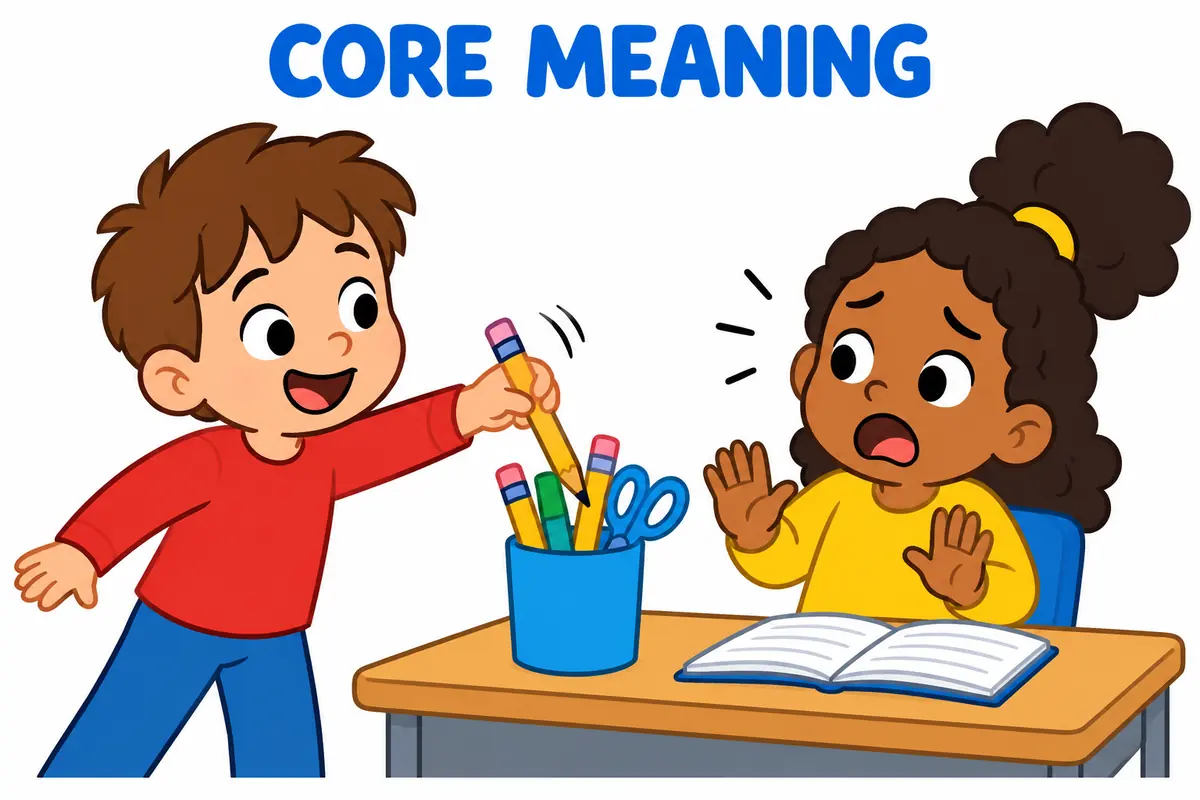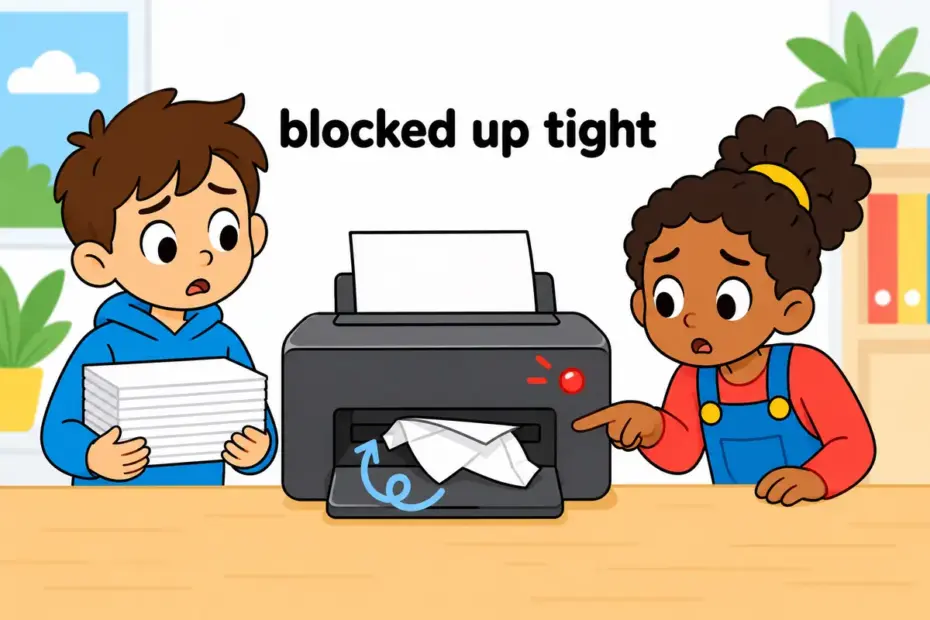
Jam up means to become blocked or to block something so it cannot move or work, and it can also mean to pack a space completely full. To use jam up in a sentence, name what is stuck or what is being stuffed: “Traffic jammed up at the bridge.” The verb works both with and without an object.
Jam up at a glance
- Jam up is a phrasal verb meaning to block, clog or become blocked.
- A second sense means to pack something tightly, as when a case is jammed up with clothes.
- The common forms are jams up, jammed up and jamming up.
- Both the transitive use, jam up the printer, and the intransitive use, the printer jammed up, are standard.
- The commonest error is treating jam up and clog up as exact synonyms, since jam up suggests a sudden block and clog up a slow build-up.
What does jam up mean?
Jam up is a phrasal verb meaning to block or become blocked so that normal movement stops. The Cambridge entry for jam up records the sense of something sticking and refusing to move, and the same verb extends to packing a container so tightly that nothing else fits. A photocopier jams up when a sheet folds, and a suitcase is jammed up when it is filled to the hinge.
| Sense | Plain meaning | Example sentence |
|---|---|---|
| Block a machine | Stop moving because something is stuck | The printer jammed up halfway through the batch. |
| Block a route | Fill a road or channel so traffic cannot pass | Lorries jammed up the narrow lane at dawn. |
| Pack tightly | Fill a space completely with things | She jammed up the drawer with old cables. |
One limitation is worth stating. Jam up describes a blockage and never a slow leak; if something drips or escapes, use clog only for the build-up that leads to a block, and leak for the escape itself. The verb also carries no sense of damage in itself, because the jam may clear without repair.
How do you use jam up in a sentence?
Jam up is flexible: it can be transitive, as in the child jammed up the box, or intransitive, as in the box jammed up. The particle can stay put even when an object follows, and the -ed form jammed up is by far the most common in real writing. Five patterns cover almost every sentence.
| Pattern | Example | What it signals |
|---|---|---|
| jam up + object (transitive) | Silt jammed up the outlet after the storm. | The blocker is the subject and the passage is the object. |
| subject + jam up (intransitive) | The bike chain jammed up on the hill. | The thing that sticks is the subject. |
| be jammed up | The tunnel was jammed up with rubble. | Passive, with with naming the cause. |
| jam up + place | Boxes jammed up the corridor. | A space is blocked rather than a device. |
| jam + object + up | He jammed the pipe up with cloth. | The object may sit between verb and particle. |
Because the object is optional, the same event has two valid sentences: traffic jammed up the bridge, and the bridge jammed up with traffic. The choice depends on whether the writer wants the cause or the victim of the block in focus, which is why free is the natural antonym when the passage opens again.

Jam up in a sentence: examples across contexts
Jam up moves easily between machines, roads and containers, and the ten sentences below show that range. Each one names what is blocked or what is stuffed, because the verb needs at least one of the two.
| Context | Example sentence | Why this works |
|---|---|---|
| Classroom | The pencil sharpener jammed up with broken lead. | A familiar object shows the everyday sense. |
| Workplace email | The main lift has jammed up again this morning. | A short report of a practical problem. |
| News report | Fallen trees jammed up the coast road for six hours. | Names a cause and a duration. |
| Technical writing | Debris can jam up the filter and raise the pressure. | A condition and a consequence. |
| Travel writing | Buses jammed up the square as the festival began. | Sets a busy scene in one clause. |
| Home advice | Never jam up the drain with cooking fat. | A warning with a clear object. |
| Sports report | Runners jammed up at the first bend. | Captures a sudden crowding. |
| Narrative writing | Words jammed up in his throat before he spoke. | A figurative block that the reader feels. |
| Academic prose | Narrow channels jam up when sediment settles. | A dated process stated impersonally. |
| Conversation | The trolley jammed up at the till again. | Everyday speech with a named place. |
The figurative example is the only one that cannot be fixed with a tool, which shows how far the verb reaches from its mechanical origin.
The noun and the verb pull in different directions in business writing. A jam-up on the motorway is something a driver reports, while to jam up a production line is something a supplier must explain. That difference in blame explains why the hyphenated noun stays informal and the verb appears in maintenance logs. A manager who writes the line jammed up again this week states a fact, but a manager who writes we jammed up the line accepts that the blockage came from inside.
Jam up vs clog up
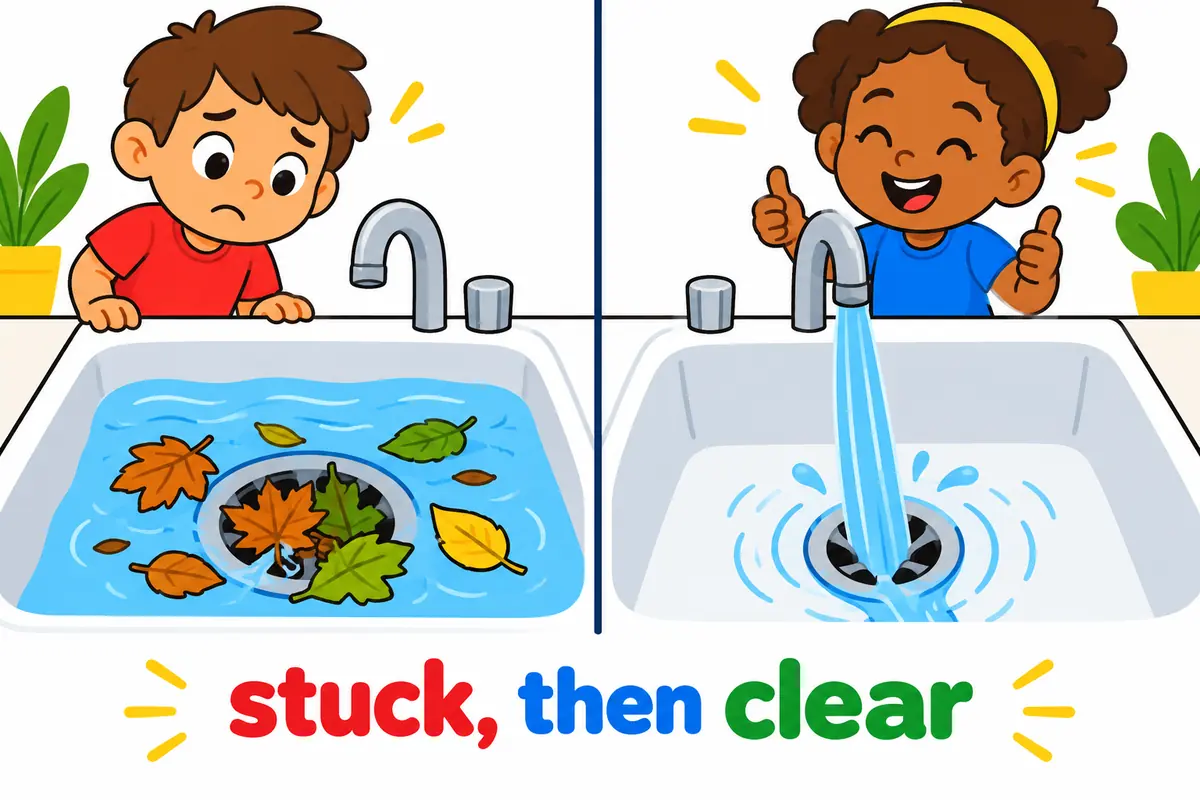
Jam up and clog up both name a blockage, and the difference is speed. Jam up suggests a sudden stoppage, often mechanical; clog up suggests a slow build-up of material over time. The table keeps the two apart.
| Attribute | jam up | clog up |
|---|---|---|
| Speed | Sudden, often in one moment | Gradual, over many uses |
| Typical subject | A machine, traffic, a container | A drain, an artery, a filter |
| Cause | A single object or surge | Accumulated material |
| Register | Neutral and everyday | Neutral, common in health and plumbing |
| Reversal | Often clears itself | Usually needs cleaning out |
Verdict: choose jam up when something stops at once and may free itself, and clog up when layers of material have gathered and must be removed.
Word forms and grammar of jam up
Jam up inflects through its base verb and can keep the particle after an object or before it. The related plug is the deliberate version of the same idea, in which a gap is sealed on purpose.
| Form | Part of speech | Example |
|---|---|---|
| jam up | phrasal verb, base form | Wet paper will jam up the machine. |
| jams up | phrasal verb, third person singular | The shredder jams up every Monday. |
| jammed up | phrasal verb, past and past participle | The gutters jammed up with leaves. |
| jamming up | phrasal verb, present participle | Shoppers were jamming up the aisles. |
| jam | verb, base form, no particle | Something has jammed the door shut. |
| jam-up | noun, informal and hyphenated | A jam-up on the ring road delayed the van. |
The noun jam-up is informal and means a traffic jam, so it belongs in casual writing only. The verb shifts the stress the same way in every tense, keeping the particle light.
Common mistakes with jam up
- Incorrect:
The printer jammed up of paper.Correct: The printer jammed up with paper. Rule: With names the material causing the block; of would imply a part rather than a cause. - Incorrect:
Traffic jammed the bridge up with.Correct: Traffic jammed up the bridge. Rule: A sentence cannot end on with; the object must be complete. - Incorrect:
The slow leak jammed up the pipe.Correct: The slow leak eventually clogged up the pipe. Rule: A gradual build-up takes clog up; jam up signals a sudden stop. - Incorrect:
The lift was jam up.Correct: The lift was jammed up. Rule: The description uses the past participle jammed, never the base form. - Incorrect:
She jammed up with the suitcase.Correct: She jammed the suitcase up with clothes. Rule: The container is the object, and with introduces what fills it.
Practice using jam up
Work through the six items, then check the reasoning rather than only the answer.
- Fill the gap: Wet leaves ______ the drains during the storm.
- Choose the better word: Years of grease slowly (jammed up / clogged up) the kitchen pipe.
- Correct the error: The photocopier was jam up with paper.
- Build a sentence: use jam up about a busy market blocking an alley.
- Spot the register: which belongs in a repair log – the feed tray jammed up at 09:40, or everything got totally stuck?
- Rewrite in the passive: Debris blocked the channel. Use be jammed up instead.
Answers
- jammed up – the leaves are the cause and the drains are the object.
- clogged up – grease builds up slowly, which is the work of clog up.
- The photocopier was jammed up with paper – the description needs the past participle.
- Model answer: Crates and stalls jammed up the narrow alley before the fair.
- The feed tray jammed up at 09:40 – a repair log keeps the time and avoids totally.
- The channel was jammed up by debris – the passive keeps with and by clear.
The bottom line
Use jam up in a sentence when something blocks a passage or becomes stuck, and decide whether the cause or the blocked thing should be the subject. Two details settle most cases: the verb works both transitively and intransitively, and the past participle jammed up is the form that describes the result. Reserve clog up for a slow build-up and clear for the moment the passage opens again.
Frequently asked questions about jam up
Is jam up one word or two?
Jam up is written as two words as a verb, as in the drain jammed up overnight. The informal noun jam-up takes a hyphen and means a traffic jam. Learners sometimes close the verb into one word, but no dictionary accepts jamup, so the two-word spelling is the safe choice.
Can jam up be used without an object?
Yes. Jam up works intransitively when the thing that sticks is the subject, as in the chain jammed up on the hill. It also works transitively when the blockage is the subject and the passage is the object, as in silt jammed up the outlet. Both are standard.
What is the difference between jam up and clog up?
Jam up suggests a sudden stoppage, often caused by one object or a surge, and it may clear itself. Clog up suggests a slow build-up of material that usually needs cleaning out. A folded sheet jams up a printer, while years of grease clog up a pipe.
Is jam up formal enough for work writing?
Jam up is neutral and acceptable in most workplace writing, especially in maintenance notes and reports. In highly formal documents, blocked or obstructed may read better. The noun jam-up stays informal and belongs in conversation rather than in a formal report.