Kneel down means to lower the body onto one or both knees, and the particle down is usually emphatic rather than essential. To use kneel down in a sentence, name the surface or person with a preposition: She knelt down on the mat. The verb is intransitive, so it takes no object and the particle cannot move.
Kneel down at a glance
- Kneel down is an intransitive phrasal verb meaning to lower the body onto one or both knees.
- It takes no object, so the particle down never separates from the verb.
- The particle is often emphatic rather than essential, because kneel alone already means the same action.
- The usual prepositions are on, before, beside and to, as in kneel down on the mat.
- The commonest confusion is with crouch, which keeps the feet flat and never touches the knees to the ground.
What does kneel down mean?
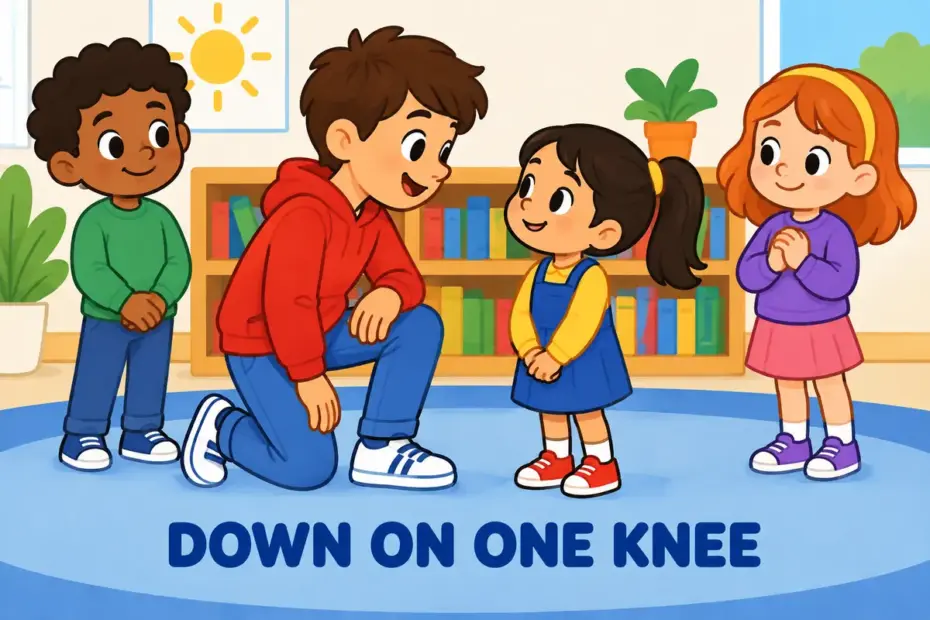
Kneel down is an intransitive phrasal verb meaning to lower the body so that the knees rest on the ground or another surface. The Cambridge entry for kneel down records the action and the posture of respect that often accompanies it. Where the point is simply going lower to work, bend down to reach something names a smaller movement of the upper body.
| Sense | Plain meaning | Example sentence |
|---|---|---|
| Lower onto the knees | Move the body down so the knees rest on a surface | The gardener knelt down on the grass. |
| Show respect or reverence | Take a kneeling posture before someone | The crowd knelt down before the queen. |
| Pray or reflect | Kneel as part of worship or thought | She knelt down beside the bed to pray. |
| Help at a low level | Kneel to reach a small child or object | He knelt down to tie his daughter shoelace. |
One limitation matters. Kneel down is not a synonym for every low posture, because the knees must touch the ground; crouching and squatting keep the feet flat. The verb also carries a solemn or gentle tone, so it fits prayer, ceremony and helping a small child better than a hurried everyday action.
How do you use kneel down in a sentence?
Kneel down is intransitive, so it has no object and the particle never separates. A surface, a person or a purpose follows through a preposition or a to-infinitive, as in kneel down on the mat or kneel down to help. Five patterns cover almost every natural sentence.
| Pattern | Example | What it signals |
|---|---|---|
| kneel down + on + surface | They knelt down on the cushions. | The knees meet a named surface. |
| kneel down + before + person | The visitors knelt down before the statue. | A formal posture of respect. |
| kneel down + beside / next to | The nurse knelt down beside the child. | Lowering to help at close range. |
| kneel down + to + verb | He knelt down to look under the bed. | The purpose of the movement. |
| kneel down + bare | Please kneel down and wait quietly. | An instruction, with down as emphasis. |
Because the verb takes no object, there is nothing for the particle to move around, which is why kneel it down is impossible and kneel down it is worse. A writer who wants the formal posture of respect can use bow the head, which lowers the upper body while the feet stay planted, and the ceremony ends when everyone will rise to your feet. A chair posture such as sit on a chair is the opposite of going down onto the knees.
Kneel down in a sentence: examples across contexts
The verb stays fixed while the setting moves from a garden to a ceremony, because the action is always the same one. In every sentence below the knees meet a surface, which is the detail that keeps the verb literal.
| Context | Example sentence | Why this works |
|---|---|---|
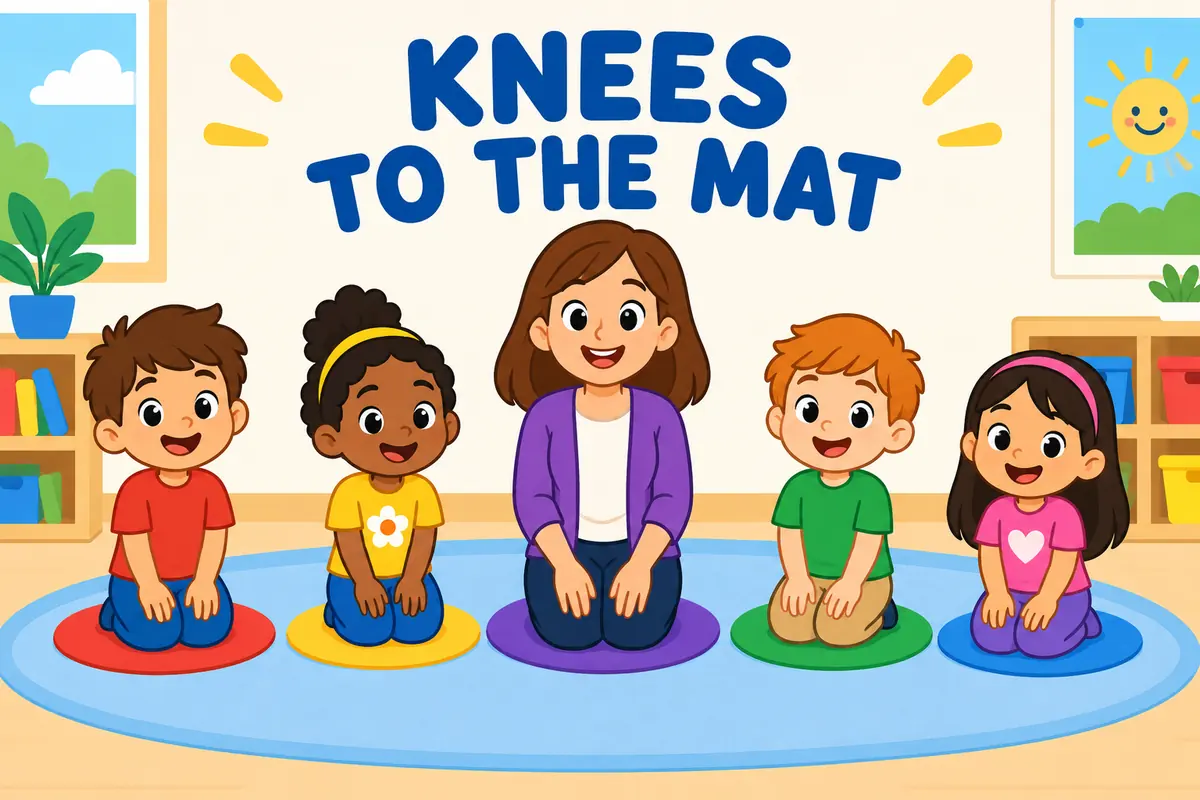
| Classroom | The pupils knelt down on the mat for the story. | The knees rest on a named surface. |
| Place of worship | The congregation knelt down to pray. | The reverence sense with a clear purpose. |
| Gardening | She knelt down on the path to plant the bulbs. | A practical, low action. |
| First aid | The paramedic knelt down beside the injured cyclist. | Lowering to help at close range. |
| Family | He knelt down to meet his son at eye level. | The helpful, gentle use with a purpose clause. |
| Ceremony | The squire knelt down before the king. | A formal posture of respect and loyalty. |
| Sports | The keeper knelt down slowly after the final whistle. | A posture that shows tiredness or relief. |
| News report | Supporters knelt down in silence outside the hall. | A public act reported in a formal register. |
| Storytelling | The knight knelt down and lowered his head. | The respect sense inside a familiar tale. |
| Photography | The photographer knelt down to catch the low angle. | A practical reason for the movement. |
| Nature study | The children knelt down to watch the beetles closely. | A gentle, curious use of the verb. |
| Proposal | He knelt down on one knee and asked her to marry him. | The fixed cultural image of the action. |
Kneel down vs crouch
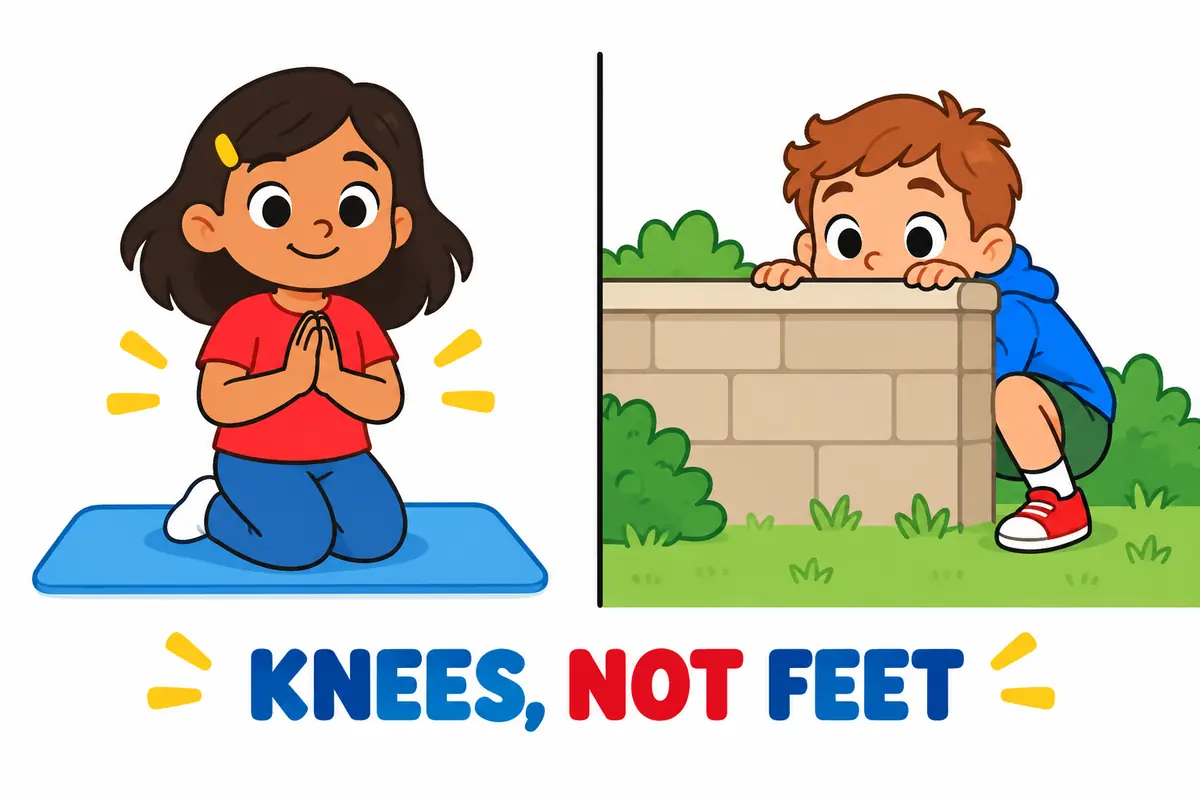
Kneel down and crouch to hide both lower the body, and the difference is where the weight rests. Kneeling puts the knees on the ground and can be held; crouching keeps the feet flat and the body ready to move. A writer who confuses them sends a praying figure onto the toes and a hiding figure onto the knees.
| Attribute | kneel down | crouch |
|---|---|---|
| Contact point | The knees rest on the ground | The feet stay flat on the ground |
| Height | Very low, with the body supported on the knees | Medium, with the body balanced on the feet |
| Typical purpose | Reverence, prayer or helping a small child | Hiding, springing or reaching low |
| Duration | Often held for a while | Usually brief and ready to move |
| Register | Neutral, warm and literal | Neutral, often alert or athletic |
Verdict: choose kneel down for reverence, prayer or speaking to a small child at eye level, and crouch when the feet stay planted and the body must be ready to spring.
Word forms and grammar of kneel down
Kneel down inflects through kneel, which has two accepted past forms. The table lists the standard forms and the plain verb without the particle, and it also names a near-homophone the prayer sense can invite, the noun knell, which means the slow sound of a bell and has nothing to do with the knees.
| Form | Part of speech | Example |
|---|---|---|
| kneel down | base phrasal verb | They will kneel down for the prayer. |
| kneels down | third person singular | She kneels down to speak to the toddler. |
| knelt down | past tense, common | He knelt down on the stone floor. |
| kneeled down | past tense, also accepted | The team kneeled down at the line. |
| kneeling down | present participle | The choir is kneeling down already. |
| kneel | verb without the particle | Please kneel for a moment. |
Knelt and kneeled are both correct, so a writer should pick one and keep it. The participle kneeling never takes the irregular form, and the particle down never changes its spelling or position, because there is no object to pull it away from the verb.
Common mistakes with kneel down
- Incorrect:
He knelt down the cushion.Correct: He knelt down on the cushion. Rule: Kneel down is intransitive, so it takes no object; a surface needs on. - Incorrect:
She knelt down it to tie her shoe.Correct: She knelt down to tie her shoe. Rule: The verb takes no direct object, so no pronoun can follow it. - Incorrect:
The children crouched down on their knees to pray.Correct: The children knelt down to pray. Rule: Crouch keeps the feet flat; prayer needs the knees on the ground, which is kneel. - Incorrect:
He kneeled down on the chair and sat.Correct: He knelt down beside the chair. Rule: Kneeling is a posture, not a way of sitting, so the action and the surface must match. - Incorrect:
The crowd kneel down before the statue yesterday.Correct: The crowd knelt down before the statue yesterday. Rule: A past time word needs the past form knelt or kneeled.
Practice using kneel down
Work through the seven items, then check the reasoning rather than only the answer.
- Fill the gap: The little boy ______ down to stroke the puppy.
- Choose the better word: To pray, the worshippers (kneel down / crouch down) on the mat.
- Correct the error: She knelt down the floor to look under the sofa.
- Build a sentence: use knelt down about a runner resting after a race.
- Spot the register: which fits a news report — Supporters knelt down in silence, or The fans got down on their knees?
- Rewrite without the particle: He knelt down on one knee. Use kneel.
- Choose the past form: Last week the child (knelt / kneels) down beside the pond.
Answers
- knelt down — the past-time action takes the irregular past form knelt.
- kneel down — prayer puts the knees on the ground, while crouch keeps the feet flat.
- She knelt down on the floor to look under the sofa — a surface takes the preposition on.
- Model answer: The tired runner knelt down on the track and caught her breath.
- Supporters knelt down in silence — a formal report keeps the neutral verb and avoids slang.
- He knelt on one knee — the particle can be dropped because kneel alone carries the action.
- knelt down — a past time word such as last week requires the past form knelt.
The bottom line
Use kneel down in a sentence when the body lowers onto the knees for prayer, respect or helping someone small, and remember that the verb is intransitive, so a surface follows a preposition and the particle never moves. The two facts that decide most sentences are that down is usually emphasis and that crouch keeps the feet flat. Either past form, knelt or kneeled, is correct.
Frequently asked questions about kneel down
Is kneel down redundant?
It is not wrong, but down is often emphasis rather than meaning, because kneel already describes lowering the body onto the knees. Writers keep the particle when the movement matters, as in kneel down and wait, and drop it for a settled posture, as in the crowd knelt in silence. Both forms are standard English.
Is the past tense knelt or kneeled?
Both are accepted. Knelt is the older, irregular form and is more common in British writing, while kneeled is a regular form that appears more often in American usage. Either reads correctly, so the safe choice is to keep one form throughout a single piece of writing rather than mixing them.
Is kneel down transitive?
No. Kneel down is intransitive, so it never takes a direct object and cannot be made passive in the ordinary way. A surface or person after it needs a preposition such as on, before or beside. This is also why a pronoun cannot follow the verb directly: you kneel beside it, not kneel it down.
What is the difference between kneel down and crouch?
Kneel down puts the knees on the ground, so the body rests low and stays there. Crouch keeps the feet flat and the body balanced on them, ready to move or spring. A person crouches to hide behind a desk and kneels to pray or to speak to a small child at eye level.