Skip to content

Latest English Guides

Understanding the Difference: Aisle vs Ill vs Isle – Using Appropriately

    Key Takeaways Aisle vs Ill vs Isle: Understanding the Difference When it comes to the English language, there are several words that can be confusing and easily misused. In this section, I want to shed some light on the difference between three commonly confused words: “aisle,” “ill,” and “isle.” Definition of Aisle: An aisle refers… Read More »Understanding the Difference: Aisle vs Ill vs Isle – Using Appropriately

    A theater group rehearses while a director points toward the stage.

    Roles vs Rolls: Parts, Actions, and Objects

      Have you ever found yourself in a situation where you weren’t sure whether to use “roles” or “rolls”? Don’t worry, you’re not alone. In this text, I’ll guide you on how to use these two words appropriately and avoid any confusion.
      When it comes to language, precision is key. Understanding the distinction between “roles” and “rolls” is essential for effective communication. We’ll explore the defini

      Choosing the Right Word: Understanding and Using “Tole” vs “Toll” Appropriately

        Have you ever found yourself confused between the words “tole” and “toll”? Don’t worry, you’re not alone. In this text, I’ll shed some light on the differences between these two commonly misused words and help you understand how to use them appropriately. Understanding the nuances of language can be challenging, but fear not, I’m here to guide you through it. By the end of this article, you’ll hav

        A reader reviews a short page beside a thick report.

        Summary vs Summery: Noun or Summer Description?

          Are you often confused between the words “summary” and “summery”? Don’t worry, you’re not alone. In this text, I’ll shed light on the differences between these two words and help you understand how to use them appropriately. By the end of this read, you’ll have a clear understanding of when to use “summary” and when to use “summery” in your writing.
          We often come across these words in various cont

          A dim lamp glows behind a curtain at dusk.

          Faint vs Feint: Weakness or a Deceptive Move?

            Have you ever found yourself confused between the words “faint” and “feint”? Trust me, you’re not alone. As an expert writer, I’ve seen these two words being misused time and time again. But fear not, because in this text, I’ll guide you through the subtle yet significant differences between “faint” and “feint” and help you use them appropriately.
            We’ll start by unraveling the true meaning of each

            Understanding the Difference: Light vs Lite and Using Them Appropriately

              Key Takeaways What is the difference between “light” and “lite”? When it comes to the words “light” and “lite,” the difference may seem subtle, but it’s important to use them appropriately. Let’s immerse and explore their definitions. The word “light” is a common English term that has multiple meanings. It can refer to something that… Read More »Understanding the Difference: Light vs Lite and Using Them Appropriately

              Understanding the Differences Between Faro, Farrow, and Pharaoh and How to Use Them Appropriately

                Key Takeaways What is the difference? When it comes to English language, there are many words that sound similar but have different meanings. These words can often be confusing, especially for language learners or those who are not native English speakers. In this section, I’ll explain the difference between three commonly confused words: “faro,” “farrow,”… Read More »Understanding the Differences Between Faro, Farrow, and Pharaoh and How to Use Them Appropriately

                Differentiating ‘Warn’ vs ‘WVSN’ and Using Them Appropriately for Effective Communication

                  Key Takeaways What is “warn” and “wvsn”? “Warn” and “wvsn” are two commonly confused words in the English language. While they may sound similar, they have distinct meanings and usage. Definition of “warn” “Warn” is a verb that means to inform or alert someone about a potential danger or problem. It is used to give… Read More »Differentiating ‘Warn’ vs ‘WVSN’ and Using Them Appropriately for Effective Communication

                  A film crew prepares a garden set with a camera.

                  Scene vs Seen: Setting or Past Participle?

                    Have you ever found yourself confused about when to use “scene” and when to use “seen”? Don’t worry, you’re not alone. As an expert blogger, I’ve received countless questions about the proper usage of these two words. In this text, I’ll provide you with a clear and concise guide on how to use “scene” and “seen” appropriately. Understanding the difference between these words is crucial for effectiv

                    A fictional noble in formal clothing stands in a manor hall.

                    Baron vs Barren: Title or Lack of Growth?

                      Are you tired of mixing up “baron” and “barren”? Don’t worry, you’re not alone. These two words may sound similar, but they have completely different meanings. In this text, I’ll guide you through the proper usage of “baron” and “barren” so you can confidently use them in your writing. Whether you’re a student, a professional, or just someone who wants to improve their vocabulary, understanding th

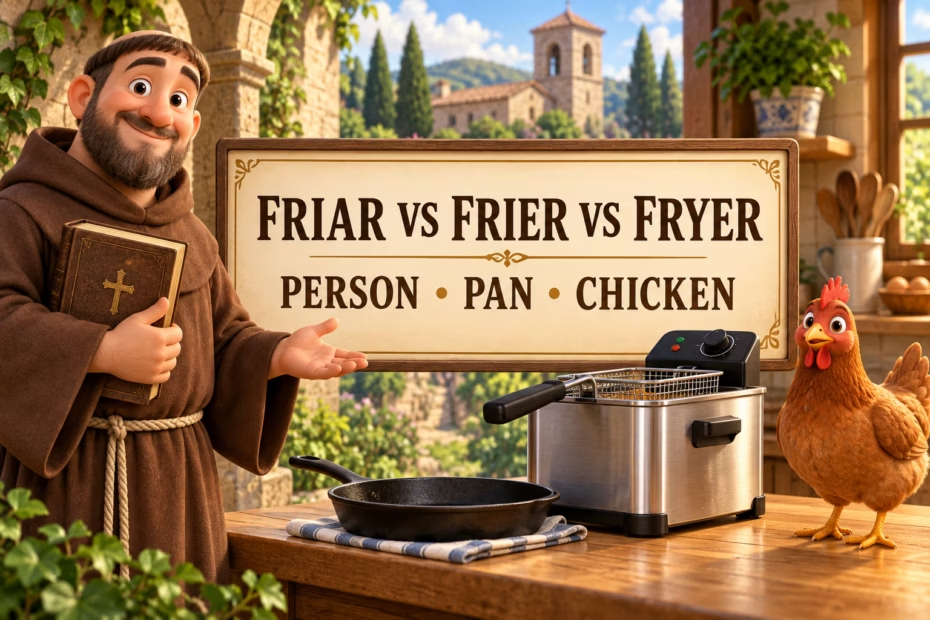
                      A friendly robed friar with a book, a clean deep fryer, and a live chicken beside a sign reading Friar vs Frier vs Fryer: Person, Pan, Chicken

                      Friar vs Frier vs Fryer: Meanings and Usage

                        Are you confused about the difference between “friar,” “frier,” and “fryer”? Well, you’re not alone. In this text, I’ll clarify the proper usage of these words and help you avoid any embarrassing mix-ups. As a language enthusiast and seasoned writer, I’ve encountered this common confusion countless times. So, let’s immerse and uncover the nuances of these terms.
                        Firstly, let’s address the word “fr

                        Old liturgical books rest on a library shelf.

                        Missals vs Missiles: Books or Projectiles?

                          Have you ever found yourself confused between missals and missiles? I’ll admit, it can be quite a mix-up! In this text, I’ll guide you through the proper usage of these two words, ensuring you never make that mistake again. Missals, with an “s,” are liturgical books used in religious ceremonies, while missiles, with an “i,” are projectiles designed for warfare. Understanding the difference between

                          Understanding the Difference Between “Band” and “Banned” and Using Them Appropriately

                            Have you ever found yourself confused between the words “band” and “banned”? It’s a common mistake that many people make, but fear not, because I’m here to shed some light on this linguistic dilemma. In this text, I’ll be delving into the differences between “band” and “banned” and how to use them appropriately in your writing.
                            We’ll start by exploring the meaning and usage of “band,” which refers