
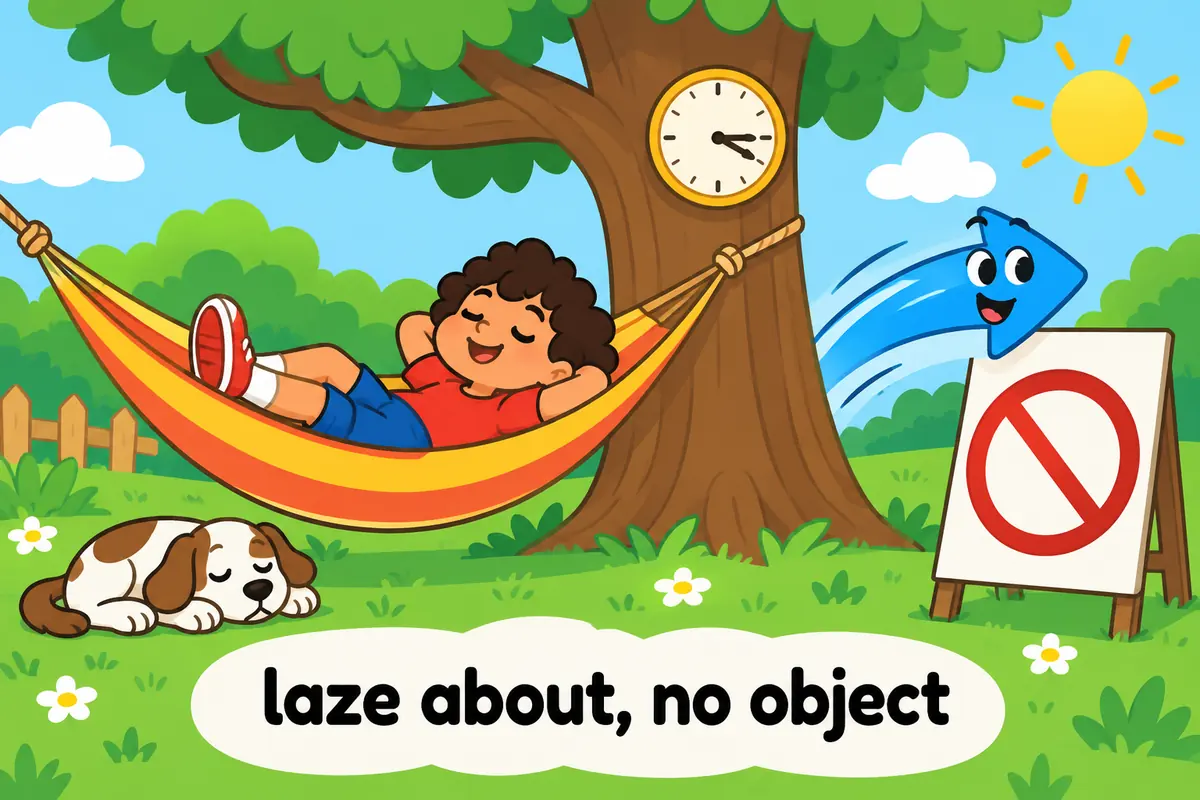
Laze about means to spend time in a relaxed, idle way with no particular purpose. To use laze about in a sentence, name who is resting and where: “The students lazed about on the grass between lectures.” The phrasal verb is intransitive, so it never takes an object, and the two words always stay together.
Laze about at a glance
- Laze about is an intransitive phrasal verb meaning to relax idly.
- Its forms are laze about, lazes about, lazed about and lazing about.
- The subject is a person or a group, never a thing.
- Laze about belongs to informal and descriptive writing.
- The commonest error is adding an object, as in laze about the chores.
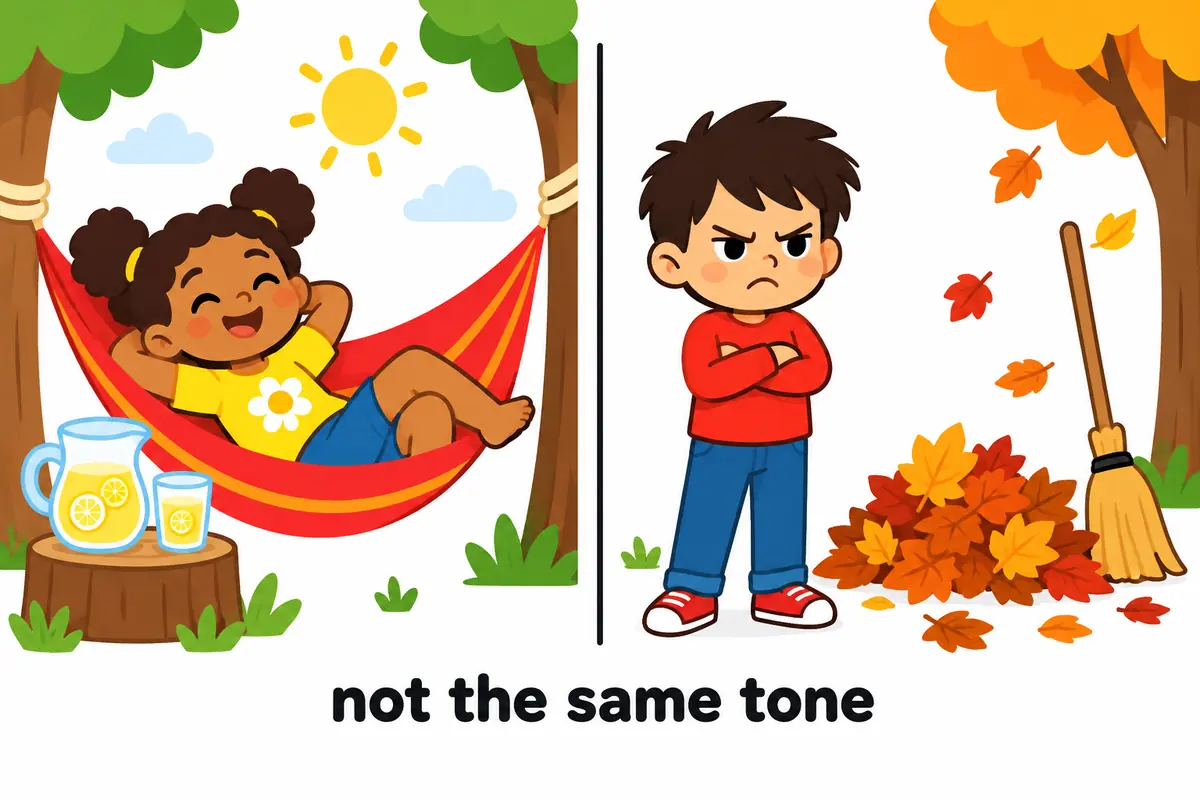
- The verb has a milder tone than the adjective lazy, which often criticises.
What does laze about mean?
Laze about is an intransitive phrasal verb meaning to pass time in a relaxed and lazy way, without working or hurrying. The Cambridge entry for laze about links it to doing very little, and that is the tone to keep. Where the rest is deserved and calm, relax after work is the warmer verb, because laze about adds a gentle note of idleness.
| Sense | Plain meaning | Example sentence |
|---|---|---|
| Rest idly | Spend time relaxing with no task | We lazed about on the porch all afternoon. |
| Pass time slowly | Let the hours drift by | He lazed about until the film started. |
| Recover lazily | Take an unhurried break | They lazed about for a week after the exams. |
One limitation is worth stating plainly. Laze about does not mean to be lazy in a harsh sense, and it never means to waste something valuable. It describes pleasant, chosen idleness, usually on a day off, so it would be odd in a report about missed deadlines, where the plainer verbs idle or shirk fit better. The verb is a choice rather than an accusation, and it rarely blames the person it describes.
How do you use laze about in a sentence?
The verb is intransitive and inseparable, so the two words never split. Four patterns cover almost every natural example, and the setting phrase does most of the descriptive work. Because the verb is inseparable, the particle never moves and no pronoun can sit between laze and about.
| Pattern | Example | What it signals |
|---|---|---|
| subject + laze about | They laze about on Sundays. | Idle rest, with no object needed. |
| laze about + place | We lazed about by the river. | Where the resting happened. |
| laze about + time phrase | She lazed about for an hour. | How long the idling lasted. |
| be + lazing about | He is lazing about again. | An unhurried action happening now. |
Laze about in a sentence: examples across contexts
Laze about shifts tone more than meaning, and each sentence below names the place where the idling happens. The setting decides whether the picture is one of holiday ease or mild laziness.
| Context | Example sentence | Why this works |
|---|---|---|
| Classroom | The pupils lazed about on the field until the bell rang. | A school setting keeps the idling innocent. |
| Workplace email | Nobody should be lazing about while the stockroom is full. | Mild criticism without a harsh verb. |
| News feature | Families lazed about the promenade as the heat settled in. | A scene-setting phrase suits descriptive reporting. |
| Travel writing | We lazed about the harbour for three unhurried days. | The time phrase captures holiday ease. |
| Family conversation | The children lazed about in the garden instead of tidying up. | The contrast with a chore adds gentle reproach. |
| Sports report | The squad lazed about before the final practice of the tour. | Pairs relaxation with an approaching event. |
| Diary entry | I lazed about all morning and read two chapters. | The first person is natural in a personal diary. |
| Retirement letter | She plans to laze about the coast for a whole month. | A future plan shows chosen idleness. |
| Novel narration | They were lazing about the veranda when the telegram arrived. | The progressive sets the scene before a change. |
| Holiday diary | We lazed about the beach club while the afternoons melted away. | A leisurely setting keeps the tone warm and unhurried. |
| Office note | Half the team lazed about the canteen during the audit. | Mild criticism of time that was not spent working. |
| Gardening column | There is no shame in lazing about the lawn on a warm afternoon. | The negated frame turns idling into gentle advice. |
| School report | Two pupils lazed about the corridor while the hall was being set up. | A mild note of reproach suits a school record. |
Where the resting is fully deserved and calm, writers choose lounge on the sofa, and where the day is spent in gentle comfort they choose loaf in the sun. Laze about sits between the two, idle but rarely critical.
Laze about vs lazy and lounge
The words share a relaxed mood but not a grammar. Laze about is a verb that stands alone; lazy is an adjective that describes a person or a mood; lounge is a verb that usually names a place.
| Attribute | laze about | lazy | lounge |
|---|---|---|---|
| Part of speech | Intransitive phrasal verb | Adjective | Intransitive verb |
| Core meaning | Spend time relaxing idly | Unwilling to work or move | Recline in comfort |
| Typical frame | laze about the garden | a lazy afternoon | lounge on the sofa |
| Tone | Mild, often pleasant | Critical | Comfortable and calm |
| Needs a place | Optional | No | Often |
| Likelihood of offence | Rarely | Often | Never |
Verdict: use laze about for pleasant, chosen idling, lazy when you mean unwillingness to work, and lounge on the sofa when the body is reclining in a particular spot. Only lazy is likely to give offence.
The three words also differ in how much blame they carry. Laze about is the gentlest and can sound almost affectionate, lazy is a judgement about character, and lounge is purely descriptive of posture. That difference in warmth matters more than the dictionary overlap between them.
Word forms and grammar of laze about
Laze about inflects on the base verb only, and the particle never changes. The table also shows the sister phrase laze around, which carries the same meaning.
| Form | Part of speech | Example |
|---|---|---|
| laze about | phrasal verb, base form | They laze about on holidays. |
| lazes about | third person singular | She lazes about whenever it rains. |
| lazed about | past and past participle | We lazed about all weekend. |
| lazing about | present participle | He is lazing about in the hammock. |
| laze around | variant phrasal verb | Writers outside Britain often say laze around. |
| lazy | adjective, different role | A lazy morning suited everyone. |
Keep laze about and laze around as one meaning with two spellings of the particle. Both are intransitive and inseparable, so laze it about is never correct. The adjective lazy is a different part of speech and cannot replace the verb.
Common mistakes with laze about
- Incorrect:
They lazed about the chores all morning.Correct: They lazed about all morning. Rule: the verb is intransitive, so it cannot take the chores as an object. - Incorrect:
She laze abouts in the garden.Correct: She lazes about in the garden. Rule: the third-person -s attaches to laze, not to the particle. - Incorrect:
We were laze abouting by the pool.Correct: We were lazing about by the pool. Rule: the -ing ending attaches to laze, and the particle stays after it. - Incorrect:
He lazed about that he was tired.Correct: He lazed about because he was tired. Rule: the verb takes no clause; use a conjunction to give a reason. Where the idling harms others, dawdle in the hallway and idle away a Sunday are the sharper verbs.
Practice using laze about
Work through the six items, then check the reasoning rather than only the answer.
- Fill the gap: The children ______ in the garden until lunchtime.
- Choose the better word: After the exam week, a (lazy / laze) afternoon felt wonderful.
- Correct the error: They lazed about the housework instead of helping.
- Build a sentence: use laze about about a family on a sunny Sunday.
- Spot the register: which belongs in a travel diary, we lazed about the harbour for days, or we lazed about the harbour for days, per operational requirements?
- Rewrite in the progressive: They laze about the veranda. Use were lazing.
- Choose the better word: The manager found the crew (lazing about / relaxing) during the busiest hour and was not pleased.
- Correct the error: She laze abouts the veranda every summer.
Answers
- lazed about. The verb stands alone and the time phrase follows.
- lazy. An afternoon is described by the adjective, not by the verb.
- They lazed about instead of helping. The verb cannot take housework as an object.
- Model answer: The family lazed about the garden all Sunday morning.
- We lazed about the harbour for days. A diary keeps the informal, leisurely tone.
- They were lazing about the veranda. The progressive sets the scene in the past.
- lazing about. The mild reproach of chosen idleness fits the manager’s displeasure better than relaxing.
- She lazes about the veranda every summer. The third-person -s attaches to laze, not to the particle.
The bottom line
Use laze about in a sentence when someone spends time relaxing idly with no task in hand, and keep the verb intransitive. The two facts that decide most sentences are that laze about never takes an object and that the two words stay together. When the tone should be critical rather than pleasant, hang about the square and the sharper verb shirk are better choices.
Frequently asked questions about laze about
Is it laze about or laze around?
Both are correct and mean the same thing. Laze about is the usual form in British writing, while laze around is more common in American English. The particle changes, but the verb stays intransitive and inseparable, so you laze about the garden or laze around the house, never laze the garden about.
Is laze about the same as lazy?
They are related but different parts of speech. Laze about is a verb meaning to spend time relaxing idly, and its tone is usually mild or pleasant. Lazy is an adjective meaning unwilling to work or move, and it is often critical. A laze about sentence can be warm; a lazy sentence rarely is.
Can laze about take an object?
No. Laze about is intransitive, so it never takes a direct object. You say the children lazed about the garden, where the garden is a place phrase introduced by the verb’s pattern, not an object of the verb. A sentence such as they lazed about the chores is wrong and needs a different verb.
How do you use laze about in the past tense?
The past tense is lazed about, with the ending on the base verb and the particle unchanged. The past participle is the same form, so you can write we lazed about all weekend or we had lazed about until noon. The progressive is was lazing about, as in she was lazing about the veranda.