Laze around in a sentence describes relaxing and doing very little, usually in a slow, unhurried way. The phrasal verb is intransitive, so the particle around stays with laze and no direct object follows: “We lazed around the pool all afternoon.” The close variant laze about means exactly the same thing.
Laze around at a glance
- Laze around is an intransitive phrasal verb; its forms are lazes around, lazed around and lazing around.
- The particle around never separates from the verb and never takes a direct object.
- It often sits before a place phrase, as in laze around the house.
- The phrase is informal and mildly critical whenever work is expected.
- The commonest error is treating around as a movable particle, as in laze the house around.
What does laze around mean?
Laze around is a phrasal verb meaning to relax and spend time doing nothing in particular. According to the Cambridge entry for laze around, the sense is enjoying yourself without expending energy, which is why the phrase suggests pleasant idleness rather than exhaustion. Its variant laze about carries no difference in meaning.
| Sense | Plain meaning | Example sentence |
|---|---|---|
| Relax idly | Spend time doing nothing energetic | We lazed around the garden all Sunday. |
| Relax in a place | Sit or lie somewhere without purpose | He lazed around the harbour watching the boats. |
| Variant: laze about | The same relaxed idleness, chiefly British | They lazed about the flat until noon. |
One limitation matters for learners. Laze around is informal, and it quietly suggests that the time could have been used better. Rest is neutral and recovery is positive, but laze around carries a hint of mild disapproval whenever there is work to do, which is why a manager would not describe a hard-working team this way.
The register is the second thing to check. Laze around belongs to diaries, postcards, travel writing and relaxed conversation, so it sits oddly in a report or a formal letter, where rest or downtime would appear instead.
How do you use laze around in a sentence?
Keep laze and around together and let the sentence stop there or add a place phrase after around. The five patterns below show the intransitive frame, the prepositional frame and the variant, and none of them allows the particle to jump over a noun.
| Pattern | Example | What it signals |
|---|---|---|
| subject + laze around | We lazed around all afternoon. | No object; the idleness is the whole point. |
| laze around + place | She lazed around the pool. | Around acts as a preposition before a noun. |
| laze around + gerund | They lazed around reading magazines. | A participle adds the small activity that fills the time. |
| laze about + place | He lazed about the house. | The British variant with identical meaning. |
| laze + object + away | They lazed the morning away. | A different, transitive pattern using away. |
Where the point is staying in one spot while waiting, hang around is the closer phrase, and where the idle time is social, people often say they look around a town instead. Laze around is the choice when relaxation itself, not waiting or exploring, is the subject.
The phrase also teams up with a small set of place words: laze around the house, the pool, the garden and the beach. Gerunds such as reading or chatting often follow, as in lazing around reading, which softens the idleness with a gentle activity.

Laze around in a sentence: examples across contexts
Laze around shifts from warm holiday writing to gentle criticism with only a change of setting. The ten sentences below keep the same relaxed phrase and show how context decides whether the idleness is pleasant or wasteful.
| Context | Example sentence | Why this works |
|---|---|---|
| Conversation | We lazed around the flat all Sunday. | A plain weekend report shows the intransitive frame. |
| Travel writing | They lazed around the pool until the sun went down. | The place phrase after around is the natural holiday pattern. |
| Personal diary | I lazed around in pyjamas until noon. | First person suits this informal phrase. |
| Workplace email | After the deadline we lazed around the office for an hour. | The setting quietly signals a break after effort. |
| Narrative fiction | The cat lazed around on the warm windowsill. | Animals make the idleness charming rather than lazy. |
| News feature | Holidaymakers lazed around the harbour while ferries queued. | Contrast between rest and activity keeps the scene alive. |
| Academic prose | The characters laze around, and the plot barely moves. | Here the phrase carries criticism of a slow story. |
| Family | The cousins lazed around the garden all afternoon. | A shared subject makes the idleness social. |
| Retirement | He lazes around the allotment most mornings. | The routine signals a peaceful habit, not laziness. |
| Sports report | The squad lazed around the hotel before the evening match. | Rest before effort makes the phrase neutral. |
| Playground | The younger children lazed around the sandpit while the race finished. | A calm subject in a busy scene shows the contrast. |
| Airport lounge | We lazed around the terminal for three hours. | A place phrase after around suits a long wait. |
Only the academic row uses the phrase to fault someone. In every other sentence the reader supplies a holiday, a weekend or a recovery, and the idleness reads as well earned.
Laze around vs hang around and fool around
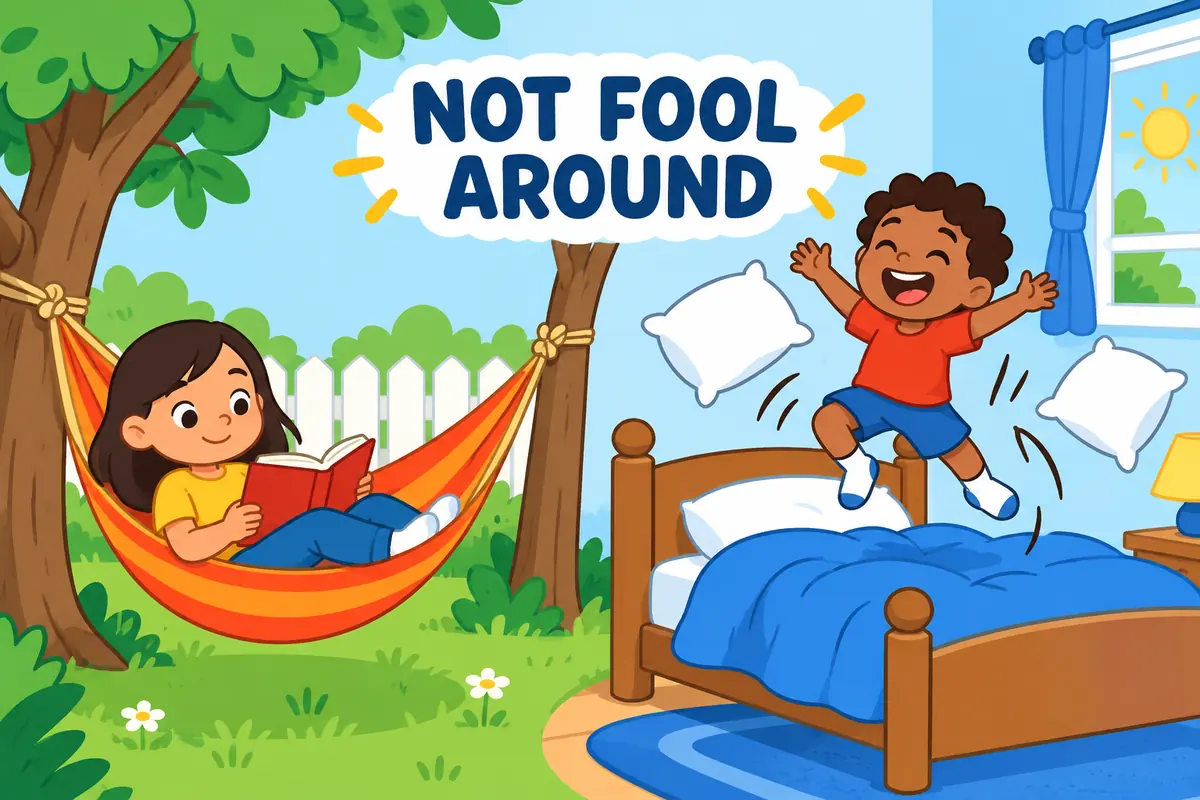
Laze around belongs to a large family of around phrasal verbs, and three of them overlap with it. fool around means to behave silly or waste time playfully, and mill around describes a crowd drifting without direction.
| Attribute | laze around | hang around | fool around |
|---|---|---|---|
| Core meaning | Relax and do nothing | Stay in a place, often waiting | Behave silly or waste time |
| Feeling | Contentment and rest | Waiting and mild boredom | Playfulness or mischief |
| Typical subject | People on holiday, pets | People with time to fill | Children and idle adults |
| Place phrase | Optional after around | Usually names the spot | Rarely needed |
| Register | Informal, mildly critical | Informal and neutral | Informal, often disapproving |
Verdict: choose laze around for relaxed idleness, hang around when somebody is waiting in a place, and fool around when the time is spent being silly rather than still.
Word forms and grammar of laze around
Laze around is built from the verb laze plus the particle around, and only the verb changes. The table also shows laze about and the transitive laze away, which learners sometimes mix into the around pattern by mistake.
| Form | Part of speech | Example |
|---|---|---|
| laze around | phrasal verb, base form | to laze around on a Sunday |
| lazes around | third person singular | She lazes around until ten. |
| lazed around | past and past participle | We lazed around the campsite. |
| lazing around | present participle | They are lazing around the deck. |
| laze about | variant phrasal verb | He lazed about the house. |
| laze | verb, base form | to laze in the sun |
| laze away | transitive pattern | They lazed the morning away. |
Common mistakes with laze around
- Incorrect:
They lazed the house around.Correct: They lazed around the house. Rule: Around is a fixed particle and stays directly after laze. - Incorrect:
The children lazed the afternoon around.Correct: The children lazed away the afternoon. Rule: Only the pattern with away takes a direct object. - Incorrect:
She lazed around to do her homework.Correct: She lazed around instead of doing her homework. Rule: Laze around is not a verb of planning; it takes no infinitive of purpose. - Incorrect:
The team lazed around and completed the report.Correct: The team lazed around after finishing the report. Rule: The phrase means doing nothing, so it cannot share the subject with a productive act. - Incorrect:
We lazed clown around by the lake.Correct: We lazed around by the lake. Rule: The verb is laze; clown around is a different phrase meaning to act the fool.
Practice using laze around
Work through the six items, then read the reason beside each answer.
- Fill the gap: On the first day of the holiday we just ______ the beach.
- Choose the better word: Stop (lazing around / hanging around) and help set the table.
- Correct the error: He lazed the garden around in a deckchair.
- Build a sentence: use laze around about a rainy weekend at home.
- Spot the register: which belongs in a holiday postcard — we lazed around the pool, or we utilized our leisure time?
- Rewrite with the variant: The cat lazed around the kitchen. Use laze about instead.
- Fill the gap: The puppy ______ the kitchen while we cooked.
Answers
- lazed around — the beach is a place phrase after around, with no direct object.
- lazing around — the speaker objects to idleness rather than to waiting; hanging around would suggest they were only staying there.
- He lazed around the garden in a deckchair — the particle around stays with the verb.
- Model answer: We lazed around the flat while the rain hammered the windows.
- We lazed around the pool — a postcard is informal, and the formal alternative sounds absurd.
- The cat lazed about the kitchen — laze about is the British variant with the same meaning.
- lazed around — the kitchen is a place phrase after around, and no direct object follows.
The bottom line
Use laze around in a sentence to describe idling in a relaxed way, and keep the particle attached to the verb. The two details that decide most sentences are transitivity, since the phrase never takes a direct object, and tone, since laze around sounds mildly critical whenever work is waiting. For resting after effort, relax and take it easy are safer when no disapproval is intended.
Frequently asked questions about laze around
Is laze around one word or two?
It is written as two words, laze around, because it is a verb plus a particle rather than a compound. The same is true of its variant laze about. Only the verb changes for tense, giving lazed around and lazing around, while around stays exactly where it is.
Can you separate laze and around?
No. Around is a fixed particle, so it always follows laze directly. You can say they lazed around the house, but not they lazed the house around. A different pattern with away is the one exception, and that lets a direct object sit between the verb and the particle.
What is the difference between laze around and hang around?
Laze around means relaxing and doing nothing, while hang around means staying in a place, often while waiting for something. A person can hang around a bus stop without relaxing, and can laze around a garden without waiting. The two overlap only when time is being filled idly.
Is laze around rude or negative?
It is informal rather than rude, but it carries a hint of criticism whenever work is expected. A manager would not praise a busy team by saying they lazed around. In holiday writing, by contrast, the phrase reads as warm and content, because the setting makes rest the whole point.