Leave out means to omit or exclude someone or something. To use leave out in a sentence, place the thing that is missing after the verb, and put a pronoun in the middle: “The coach left out the injured striker.” The verb is separable, so you write leave him out, never leave out him.
Leave out at a glance
- Leave out is a transitive phrasal verb meaning to omit or exclude.
- It is separable: leave out a name or leave a name out are both correct.
- A pronoun must sit between the verb and the particle: leave her out, never leave out her.
- The commonest patterns are leave out of, leave something out of a list, and leave it out.
- The usual errors are putting the pronoun last and confusing leave out with miss out.
What does leave out mean?
Leave out is a phrasal verb meaning to fail to include something, or to keep a person out of a group or activity. The Cambridge entry for leave out records the omit sense, and the table separates it from the rarer literal sense of leaving something outside, because that one behaves like the ordinary verb leave.
| Sense | Plain meaning | Example sentence |
|---|---|---|
| Omit | Fail to include something | They left out the final paragraph. |
| Exclude | Keep a person out of a group | The coach left out the injured striker. |
| Leave outside | Put something outdoors and leave it there | I left the bin out overnight. |
| Omit on purpose | Drop a detail deliberately | The summary left out the costs. |
Leave out is neutral about intention: you can leave something out by accident or on purpose, and the sentence does not say which. When the leaving-out is a deliberate snub, exclude makes the intent explicit; when it is a plain error, omit is the formal choice.
How do you use leave out in a sentence?
The verb is always transitive, and its separability is the key. A full noun can sit on either side of the particle, but a pronoun must sit between the verb and the particle, so the phrase never ends in leave out plus a pronoun.
| Pattern | Example | What it signals |
|---|---|---|
| leave out + noun | They left out the last chapter. | Omission of a whole item. |
| leave + noun + out | Leave the cost out of the report. | Separated form; out follows the object. |
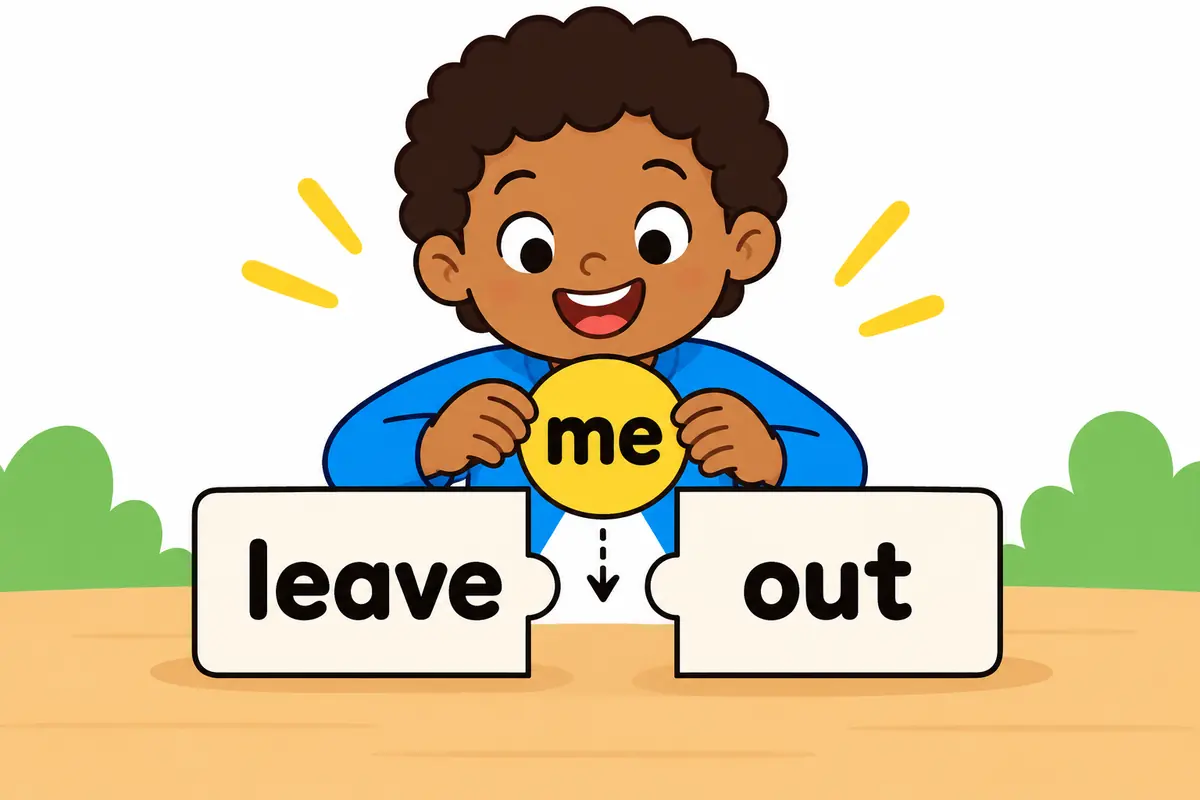
| leave + pronoun + out | Leave me out of this. | A pronoun must sit between verb and particle. |
| be left out of + noun | He was left out of the team. | Passive exclusion from a group. |
| leave out + of + noun | Leave the date out of the letter. | Names the whole the item belongs to. |
| leave + thing + out | I left the bike out in the rain. | The literal sense of leaving something outside. |
Two details reward attention. When the object is long, English usually keeps it after the particle, as in leave out the names of everyone who arrived late, because a heavy noun reads better at the end. When the object is short, either order sounds natural, so leave the cost out and leave out the cost are equally idiomatic.
Leave out in a sentence: examples across contexts
| Context | Example sentence | Why this works |
|---|---|---|
| Classroom | The teacher left out two questions by mistake. | A full noun object after leave out. |
| Workplace email | Please leave me out of the planning thread. | The pronoun sits between verb and particle. |
| News report | The report left out the cost of the scheme. | A deliberate omission, neutral in tone. |
| Conversation | You left the best part out of the story. | The separated form with a full noun. |
| Academic writing | The sample left out participants under eighteen. | A precise description of scope. |
| Family | She felt left out of the family group chat. | The passive form describes a state of exclusion. |
| Recipe | Leave out the salt if you prefer. | An instruction to omit an ingredient. |
| Legal drafting | Nothing in this clause may be left out. | A formal passive in a clause about completeness. |
| Team sport | The manager left out three regulars. | Exclusion from a squad, the person is the object. |
| Proofreading | I left out a comma on the first line. | An accidental omission, past tense. |
| Home | Do not leave the paint out in the cold. | The literal sense of leaving something outside. |
| Travel | We left out the museum to save time. | Omitting an item from an itinerary. |
Leave out vs miss out
Miss out usually means to lose an opportunity, and in British English it can also mean to be omitted, which is why the two are so often mixed up. The wider page on miss covers that separate verb and its many senses.
| Attribute | leave out | miss out |
|---|---|---|
| Core meaning | Fail to include, or exclude | Lose an opportunity |
| Typical object | A thing or a person | Usually on plus an experience |
| British extra sense | Not applicable | To be omitted, as in I was missed out |
| Separability | Separable: leave it out | Separable: miss it out, in British use |
| What it implies | Something is absent | Someone loses a chance |
| Example | They left out the tax. | Do not miss out on the trip. |
Use leave out when the focus is on the thing that is absent, and miss out on when the focus is on the chance someone loses. In British English, miss out can borrow the omit sense, but leave out is never wrong there.
Several verbs live beside leave out. To include is the direct opposite; to skip is the casual way to leave something out in speech; to overlook a detail is to leave it out without meaning to; and to back out is to withdraw from a promise, a different job for the same particle.
Word forms and grammar of leave out
| Form | Part of speech | Example |
|---|---|---|
| leave out | base phrasal verb | Leave out the final line. |
| leaves out | third person singular | The list leaves out two names. |
| left out | past tense | They left out the footer. |
| left out | past participle or adjective | She felt left out. |
| leaving out | present participle | Leaving out the tax changes the total. |
| be left out | passive | He was left out of the squad. |
The passive is worth practising because it is so common in complaints and apologies. Being left out is the feeling of exclusion, and the phrase is felt left out is a fixed description of that mood. In the active voice the same idea is they left her out, with the pronoun still in the middle.
Common mistakes with leave out
- Incorrect:
Leave out me of the game.Correct: Leave me out of the game. Rule: a pronoun object must sit between the verb and the particle. - Incorrect:
Leave out it of the essay.Correct: Leave it out of the essay. Rule: the same rule holds for it, which is always a pronoun. - Incorrect:
Do not leave out to mention the date.Correct: Do not leave out the date. Rule: leave out takes a noun object, never an infinitive. - Incorrect:
He was leave out of the squad.Correct: He was left out of the squad. Rule: the passive needs the past participle left. - Incorrect:
We left out the selected team.Correct: We left the selected team out. Rule: with a longer object, keep the noun before the particle for clarity.
The clearest single test is to replace the object with a pronoun. If the original sentence was leave out the sugar, the pronoun version must be leave it out, and any sentence that produces leave out it has the order wrong.
Practice using leave out
The exercises test object placement, the passive and the contrast with miss out.
- Fill the gap: The editor ______ my favourite paragraph.
- Choose the better word: Hurry, or you will (leave out / miss out) on the best seats.
- Correct the error: Please leave out it of the summary.
- Build a sentence: use be left out about a child not chosen for a team.
- Spot the register: which suits a legal clause, Nothing may be left out. or Leave nothing out.
- Rewrite with the separated form: They omitted the cost from the report. Use leave the cost out.
- Fill the gap with the pronoun: The group invited everyone but did not want to ______ .
- Correct the error: He was leave out of the final list.
Answers
- The editor left out my favourite paragraph. A full noun object may follow the whole verb.
- miss out fits because the point is losing an opportunity, not omitting a thing.
- Please leave it out of the summary. The pronoun it must sit between verb and particle.
- The youngest child was left out of the team. The passive uses left and the phrase of the team.
- Nothing may be left out. The formal passive suits a legal clause; the imperative sounds too casual for drafting.
- They left the cost out of the report. The separated form keeps the noun between leave and out.
- The group invited everyone but did not want to leave her out. The pronoun her sits between verb and particle.
- He was left out of the final list. The passive needs the past participle left, not leave.
The bottom line
Leave out in a sentence follows one firm rule: keep a pronoun in the middle and a full noun on either side. Use leave out when something or someone is missing, and reach for miss out on only when the point is a lost chance, and the phrase will sound like a native speaker.
Frequently asked questions about leave out
Why do you say leave me out and not leave out me?
English strongly prefers a pronoun between the verb and the particle in a separable phrasal verb, so we say leave me out, leave it out and leave them out. A full noun can come after the particle, as in leave out the details, but a pronoun almost never does.
Is leave out the same as miss out?
They overlap but are not identical. Leave out focuses on the thing that is absent, as in the list left out two names. Miss out usually focuses on a lost opportunity, as in do not miss out on the offer, and only British English uses miss out to mean omit a person.
Can leave out be passive?
Yes. The passive is common when the focus falls on the person or thing excluded, as in she was left out of the team. The passive uses the past participle left, and the group or list is introduced by of. This form often describes feelings of exclusion.
What is the difference between leave out and drop?
Both can describe an omission, but drop is more casual and often suggests a quick, deliberate cut, as in drop the last item. Leave out is the general word and fits written genres such as reports and lists, where it is the safer and clearer choice.