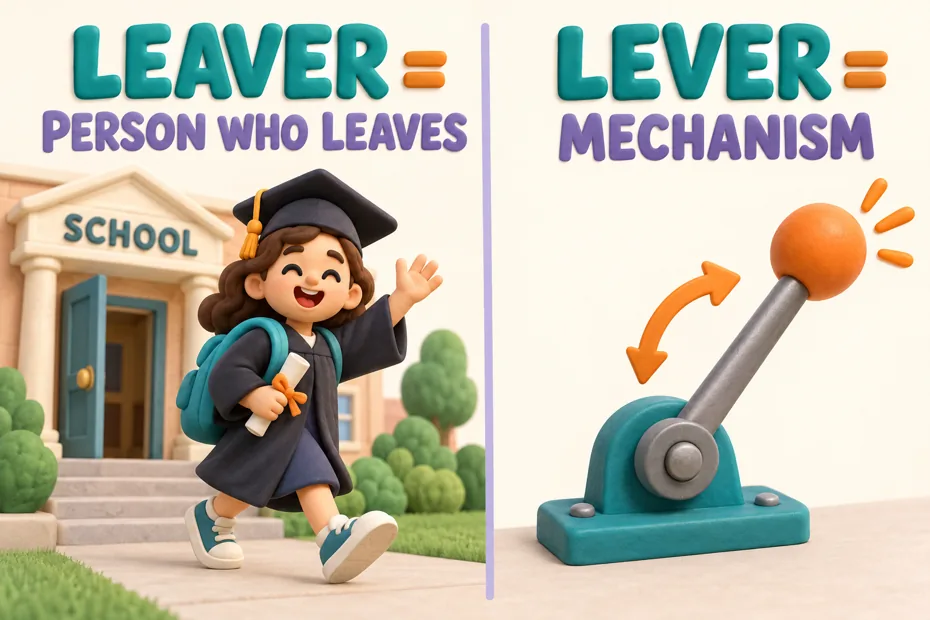
Leaver means someone who leaves, while lever means a bar or control that applies or transmits force, or a means of influence. Write “a school leaver” for a person leaving school and “pull the lever” for a mechanism. Lever also works as a verb meaning pry or raise.
Leaver vs. lever: key facts
- Leaver is formed from leave and names someone who leaves.
- Lever can name a physical bar, control, or figurative means of influence.
- Lever can also be a verb.
- Lever has more than one accepted pronunciation.
- The plurals are leavers and levers; their meanings remain distinct.
Correction to the older guide below: leaver is a noun, not the ordinary verb for departure. The older examples “Please leaver the room quietly” and “He accidentally leavered his hat” are incorrect. Write “Please leave the room quietly” and “He accidentally left his hat.” Lever, however, does have a verb use for prying or raising.

Which word names the person and which names the device?
Choose leaver for a person leaving and lever for the bar, control, or means of influence. Merriam-Webster defines leaver through leaving and describes several noun and verb senses of lever. Both are valid words, so neither should be corrected without context.
| Word | Meaning | Original example | Replacement test |
|---|---|---|---|
| Leaver | Someone who leaves | The course supports school leavers. | People leaving school |
| Lever | Mechanical bar or control | The operator moved the lever. | Control handle |
| Lever | Means of influence | The grant became a lever for change. | Means or tool |
| Lever | Pry or raise | They levered the panel away from the frame. | Pried |
The presence of a person does not settle the word. “The leaver returned a uniform” concerns a departing person; “the operator returned the lever to its starting position” concerns a control. Read the noun’s role in the sentence rather than choosing whichever spelling is most familiar.

How is leaver used in everyday writing?
Leaver labels someone by the action of leaving. School leaver is a familiar example: it identifies a person who has left or is leaving school. In a workplace document, leaver can refer to a departing employee, provided that the document makes that context clear.
For an unfamiliar audience, a fuller description may be easier to understand. “Departing employees must return their passes” states the workplace meaning explicitly. “The program helps students leaving school” avoids assuming that every reader recognizes school leavers. These alternatives change the phrasing, not the underlying distinction from a mechanical lever.
Leaver is not another spelling of leave as a verb. Write “They leave at noon” for an action and “The early leavers waited outside” for the people. The ending -er creates a noun, just as a writer is someone who writes. Keep the base verb’s meaning in mind when checking the spelling.
What does lever mean beyond a simple machine?
Lever can name a control used to operate a mechanism or a figurative means of achieving a result. Collins Dictionary’s lever entry covers these extensions and the related verb. A sentence about a policy lever therefore does not necessarily refer to a literal metal bar.
In a basic mechanical description, a lever turns around a fulcrum as force is applied. In an everyday instruction, “move the lever” may identify a handle connected to a device. In figurative writing, “education is a lever for change” compares its influence to a tool that enables movement. State the specific mechanism or influence when the reader needs practical detail.
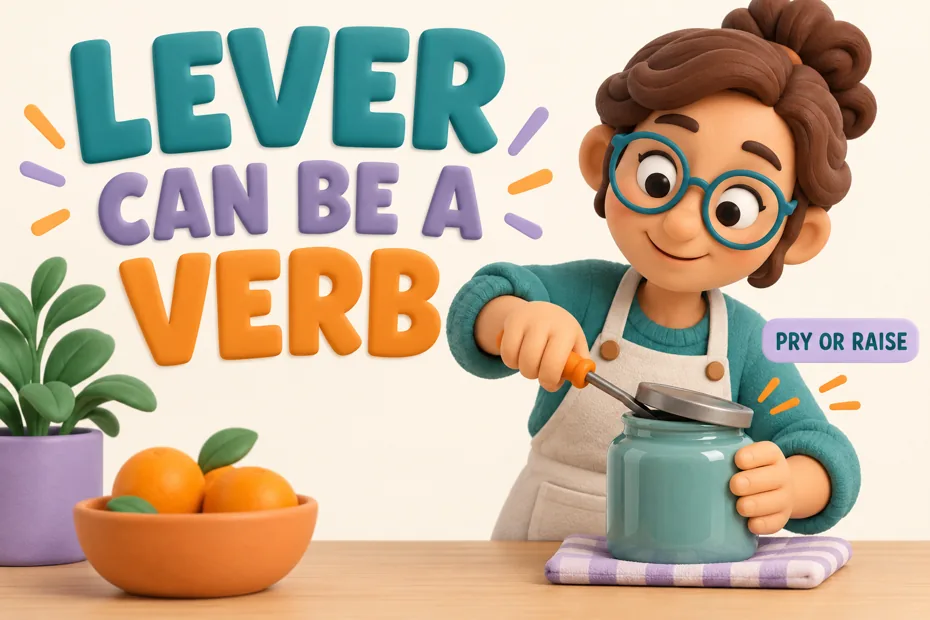
As a verb, lever describes prying, raising, or moving with a lever or something functioning like one. The past form is levered and the -ing form is levering. Compare “The worker used a lever” with “The worker levered the cover upward.” The first names the tool; the second names the action.
Do leaver and lever always sound different?
No. Merriam-Webster records both short-vowel and long-vowel pronunciations for lever. With the long-vowel pronunciation, lever can sound like leaver. With the short-vowel pronunciation, the sound provides a distinction. Do not use one pronunciation preference as proof that the other spelling is wrong.
For transcription, identify whether the speaker means a departing person or a device. If a recording says “the lever is missing,” ask whether the surrounding discussion concerns an operator’s control or someone leaving a group. A homophone can be correctly pronounced while a transcription chooses the wrong meaning.
A quick editing exercise
- Try someone who leaves for leaver.
- Try control, bar, or means of influence for the noun lever.
- Try pry or raise for the verb lever.
- Check plural and verb endings after choosing the meaning.
Complete “The school ___ attended the course,” “Pull the ___ gently,” and “They ___ the lid upward.” The answers are leaver, lever, and levered. For leaver vs. lever, the person’s role, the device, or the action determines the spelling more reliably than sound alone.
Frequently asked questions
Is leaver a real word?
Yes. Leaver is an established noun for someone who leaves, and school leaver is a familiar example. Use the term when its context is clear. For readers unfamiliar with a workplace or educational label, a phrase such as departing employee or person leaving school can make the meaning more explicit.
Can lever be pronounced like leaver?
Yes. Lever has accepted pronunciation variants, including a long-vowel form that can sound like leaver. The difference in meaning remains even when the sounds coincide. Choose lever for a bar, control, influence, or prying action, and leaver for someone who leaves.
Should I write levered or leavered?
Write levered for the action of prying, raising, or moving with a lever. Leaver is ordinarily a noun naming a departing person, so it does not supply that verb form. In a sentence about departure, use the verb leave and its appropriate form, such as left.
Is a policy lever a physical object?
Usually the phrase is figurative: a policy lever is a means of influencing a result. The writer compares that influence to a mechanical tool. Explain the actual policy or action when precision matters. The spelling remains lever because the meaning concerns a means of influence rather than a person leaving.
Have you ever found yourself confused between “leaver” and “lever”? Don’t worry, you’re not alone. In this text, I’ll guide you through the proper usage of these two words, helping you avoid common mistakes and ensuring clear communication. Whether you’re a native English speaker or learning English as a second language, understanding the difference between “leaver” and “lever” is essential for effective writing and speaking. So, let’s immerse and unravel the mystery behind these often misused words. By the end of this article, you’ll be equipped with the knowledge to confidently use “leaver” and “lever” in the appropriate context.
Key Takeaways
- “Leaver” can be both a noun and a verb, referring to a person or thing that leaves or causes something to leave a specific place, organization, or group.
- “Lever” is a noun that represents a simple machine consisting of a pivoted bar or board used to transmit or alter force or motion.
- “Leaver” and “lever” have distinct meanings and contexts, so it’s important to understand the difference to avoid confusion.
- Common mistakes include confusing the spellings, using “leaver” instead of “leaver’s” for possessive form, and misusing “lever” in the context of mechanics.
- To use “leaver” and “lever” appropriately, understand their respective meanings, pay attention to the context, be mindful of spelling, avoid incorrect possessive form, and use examples to reinforce understanding.
What is a leaver?
A leaver refers to an individual or object that leaves or causes something to leave a place or position. It can be used as both a noun and a verb, depending on the context. Understanding the correct usage of the word “leaver” is essential for effective communication in both written and spoken English.
Definition of Leaver: A person or thing that leaves or causes something to leave.
When used as a noun, a leaver refers to a person who has left a specific place, organization, or group. It can often be associated with actions such as resigning from a job, withdrawing from a team, or departing from a social gathering. For example:
- “Lisa is a recent leaver from our company.”
- “The leaver of the group left before we finished dinner.”
On the other hand, when used as a verb, “leaver” describes the action of leaving or causing something to leave a particular location. The verb form is commonly used in sentences like:
- “Please leaver the room quietly.”
- “He accidentally leavered his hat at the restaurant.”
Understanding the distinction between a noun and verb form is vital to ensure the correct usage of “leaver” in your writing or conversations. The proper context and understanding of the word will enhance your communication skills and avoid any potential confusion.
To summarize, a leaver can refer to both a noun and a verb, representing a person or thing that leaves or causes something to leave. It is crucial to comprehend the different meanings and contexts in which “leaver” can be used, allowing for effective communication and writing skills.
What is a lever?
A lever is a simple machine that consists of a rigid bar or a board that is pivoted on a fixed point called a fulcrum. It is one of the oldest and most basic tools used by humans and has been instrumental in various applications.
The lever operates on the principle of balancing forces. When a force is applied to one end of the lever, known as the effort, it causes the lever to rotate around the fulcrum. This rotation then produces an output force, known as the load, at the other end of the lever.
There are three main types of levers: first-class levers, second-class levers, and third-class levers. These classifications are based on the positions of the fulcrum, effort, and load.
- First-Class Levers: In a first-class lever, the fulcrum is positioned between the effort and the load. Examples of first-class levers include seesaws and scissors.
- Second-Class Levers: In a second-class lever, the load is positioned between the fulcrum and the effort. A classic example of a second-class lever is a wheelbarrow.
- Third-Class Levers: In a third-class lever, the effort is positioned between the fulcrum and the load. Some everyday examples of third-class levers are tweezers and fishing rods.
Understanding the concepts and principles behind levers is essential in various fields, including physics, engineering, and even everyday tasks. Knowing how levers work can help us design more efficient machinery, solve mechanical problems, and improve our understanding of the physical world around us.
To summarize, a lever is a simple machine consisting of a pivoted bar or board that operates on the principle of balancing forces. It has three main types – first-class, second-class, and third-class levers – each with its own unique configuration of the fulcrum, effort, and load. Being familiar with the basics of levers empowers us to better comprehend and use this fundamental tool in various fields of study and practical applications.
Understanding the difference between leaver and lever
When it comes to the English language, there can be a lot of confusion between words that sound similar but have different meanings. One such pair of words that often gets mixed up is “leaver” and “lever”. To effectively navigate the world of proper usage, it’s crucial to understand the distinction between these two words.
Let’s start with leaver. The word “leaver” can play two roles; it can function as both a noun and a verb. As a noun, leaver refers to a person who has left a specific place, organization, or group. It represents someone who has departed from a particular location. On the other hand, leaver as a verb describes the action of leaving or causing something to leave a particular place or position.
Let’s shift our focus to lever. A lever is a simple machine that operates on the principle of balancing forces. It consists of a pivoted bar or board that can be used to lift or move objects. Understanding the concept of levers is essential, especially in fields like physics and engineering.
There are three main types of levers – first-class, second-class, and third-class. Here’s a brief overview of each type:
- First-class lever: In a first-class lever, the fulcrum (the pivot point) is located between the effort and the load. This type of lever can be found in tools like seesaws and crowbars.
- Second-class lever: In a second-class lever, the load is positioned between the fulcrum and the effort. Examples of second-class levers include wheelbarrows and nutcrackers.
- Third-class lever: In a third-class lever, the effort is applied between the fulcrum and the load. Examples of third-class levers include fishing rods and tweezers.
Understanding the principles and applications of levers can have a significant impact on various industries and fields. From designing machinery to understanding how our bodies move, levers play a fundamental role.
Remember, gaining clarity on the difference between leaver and lever is crucial for precise communication. By using them appropriately, you can convey your thoughts and ideas with confidence.
Common mistakes when using leaver and lever
One of the most common mistakes people make when using “leaver” and “lever” is confusing the two words altogether. While they may sound similar, they have distinct meanings and are used in different contexts. Let’s investigate into some common misconceptions and errors when it comes to these often confused terms.
Difference Between “Leaver” and “Lever”
To understand the common mistakes made with “leaver” and “lever,” it’s crucial to grasp the difference between the two words.
- “Leaver”: Referring to both a noun and a verb, a “leaver” signifies a person or thing that leaves or causes something to leave a certain place, organization, or group. As a noun, it can describe someone who has departed from a specific location. As a verb, it denotes the action of leaving or causing something to leave a particular position or situation.
- “Lever”: On the other hand, a “lever” is a simple machine consisting of a pivoted bar or board that operates on the principle of balancing forces. It is used to transmit or alter force or motion, often used as a tool to gain mechanical advantage. Understanding the principles and applications of levers is essential in various fields, including physics and engineering.
- Confusing Spelling: One common mistake is mixing up the spelling of “leaver” and “lever.” Remember the difference: “leaver” refers to a person or thing that leaves, while “lever” is a mechanical device.
- Using “Leaver” Instead of “Leaver’s”: Another error is using “leaver” as a possessive form. When expressing possession, always use “leaver’s,” not “leaver.” For example, “The leaver’s belongings were left behind.”
- Incorrect Context: Using “lever” when referring to a person who has left a specific place is another common mistake. Remember, the correct term is “leaver,” not “lever.”
- Misusing “Lever” in Mechanics: Using “lever” inappropriately in the context of mechanics and physics is also an error. Make sure to use “lever” when discussing mechanical principles and applications.
Tips for using leaver and lever appropriately
In this section, I’ll provide some helpful tips for using the words “leaver” and “lever” appropriately, so you can confidently incorporate them into your writing and speech. Let’s immerse!
- Understand the Difference: First and foremost, it’s crucial to grasp the distinction between “leaver” and “lever.” Here’s a quick recap:
- “Leaver” can be used as both a noun and a verb. As a noun, it refers to a person or thing that has left a specific place, organization, or group. On the other hand, as a verb, it describes the action of leaving or causing something to leave a particular location.
- “Lever” is a noun that refers to a simple machine consisting of a pivoted bar or board that operates on the principle of balancing forces. It is commonly used in physics and engineering.
- Context is Key: To ensure accurate usage, pay attention to the context in which you’re using these words. Consider the following:
- Is it a person or thing that has left? Use “leaver” as a noun.
- Are you describing an action of leaving or causing something to leave? Use “leaver” as a verb.
- Are you talking about a mechanical device? Use “lever” as a noun.
- Pay Attention to Spelling: Mixing up the spelling of “leaver” and “lever” is a common mistake that can lead to confusion. Be mindful of the double “e” in “leaver” and the absence of it in “lever.”
- Avoid Possessive Form: Remember, “leaver” is not used as a possessive form. If you want to indicate possession, use “leaver’s” or “leavers’.”
- Use Examples: To strengthen your understanding, consider these examples:
- Leaver as a Noun: “John, as a leaver, will be missed by his colleagues.”
- Leaver as a Verb: “She decided to leaver her job and pursue a new career.”
- Lever as a Noun: “The mechanic used a lever to lift the heavy engine.”
- Lever Analogies: “A seesaw is a classic example of a first-class lever.”
Conclusion
Understanding the correct usage of “leaver” and “lever” is essential for effective communication. Throughout this article, we have explored the differences between these two words and provided valuable insights on how to use them appropriately.
By now, you should have a clear understanding that “leaver” can be both a noun and a verb, referring to someone or something that has left a specific place or organization. On the other hand, “lever” is a noun that represents a simple machine used in physics and engineering.
To ensure proper usage, it is crucial to pay attention to the context in which these words are used. Familiarize yourself with the examples provided in this text to avoid any confusion.
Finally, always remember to spell these words correctly and avoid using the possessive form of “leaver.” By following these tips, you will enhance your writing and avoid any potential misunderstandings.
So, next time you encounter these words, feel confident in your ability to use them appropriately and communicate effectively.
Frequently Asked Questions
Q: What is the difference between “leaver” and “lever”?
A: “Leaver” can be used as both a noun and a verb, referring to a person or thing that has left a specific place, organization, or group, or describing the action of leaving or causing something to leave. “Lever” is a noun that refers to a simple machine used in physics and engineering.
Q: Can “leaver” be used as a verb?
A: Yes, “leaver” can be used as a verb to describe the action of leaving or causing something to leave.
Q: Can “leaver” be used as a noun?
A: Yes, “leaver” can be used as a noun to refer to a person or thing that has left a specific place, organization, or group.
Q: What is a “lever”?
A: A “lever” is a noun that refers to a simple machine used in physics and engineering.
Q: What should I pay attention to when using these words?
A: Pay attention to the context in which these words are used. Make sure to use “leaver” or “lever” appropriately based on its intended meaning.
Q: Are there any examples to clarify the usage?
A: Yes, for example: “She was a leaver and left the company last month.” (noun) and “He levered the door open with ease.” (verb).
Q: Should I be mindful of any spelling issues or common mistakes?
A: Yes, make sure to spell these words correctly and avoid using the possessive form of “leaver.”


